




We may not have the course you’re looking for. If you enquire or give us a call on 01344203999 and speak to our training experts, we may still be able to help with your training requirements.
Is UI/UX Design a Good Career: A Complete Career Guide
ByNilotpal SarmahLast updated on: 17 September 2026
Discover what a career in UI/UX design has to offer, from creative problem-solving and user-focused work to opportunities across different industries. Explore the skills required, career paths and benefits of getting into this field.

What makes you delete an app after five minutes but keep another for years? The answer is not always the features. Sometimes, it is simply how easy, intuitive, and enjoyable the experience feels. That is the difference thoughtful UI/UX design can make.
Behind these experiences are UI/UX Designers who study what users need, where they struggle, and how digital interactions can work better. It is a career that brings together creativity, technology, research, and problem-solving.
But does that make UI/UX design a good career for you? This blog explores the opportunities, skills, career paths, and earning potential to help you decide.
What is UI/UX Design?
User Interface (UI) and User Experience (UX) design are closely related areas of digital product design, but they focus on different aspects of the user's interaction with a product.
UI design focuses on the visual and interactive elements users encounter, including layouts, typography, colours, buttons, menus, and other interface components.
UX design takes a broader view of the user's overall experience. It involves understanding user needs, researching behaviour, organising information, creating user journeys, developing prototypes, and testing whether a product is easy and effective to use.
UI + UX in One ExampleImagine a food delivery app.UI Asks: Are the buttons, menus, colours, and screens clear and visually consistent?UX Asks: Can users easily find a restaurant, choose their food, place an order, and track its delivery?UI shapes what users interact with. UX considers how the whole experience works.

Is UI/UX Design a Good Career?
UI/UX design can be a good career for people who enjoy combining creative thinking with practical problem-solving. The work involves understanding how people interact with digital products and finding ways to make those interactions clearer, easier, and more useful.
Another advantage is its application across different sectors. Organisations in technology, finance, healthcare, education, retail, entertainment, and other industries develop digital products and services that require thoughtful user experiences.
However, whether it is a good career for you depends on your interests. The field involves research, collaboration, feedback, problem-solving, and continuous learning alongside visual creativity.
The Career QuestionDon't only ask:“Do I like designing?”Also ask:“Do I enjoy understanding why people struggle with something and finding a better way for it to work?”That question gets much closer to what a UI/UX career involves.
Benefits of Choosing a Career in UI/UX Design
UI/UX design offers several advantages for professionals who enjoy combining creativity, technology, and user-centred problem-solving. Here are some key benefits of pursuing this career:
1) Opportunities Across Industries: UI/UX Designers are not restricted to technology companies. Their skills can be applied wherever organisations create websites, applications, software, or other digital services.
2) Blend of Creativity and Problem-solving: UI/UX design allows you to be creative while solving practical user problems. Designers consider not only how a digital product looks, but also how easily and effectively people can use it.
3) Multiple Career Directions: UI/UX design is not a single career path. Professionals can specialise in areas such as UI design, UX design, research, interaction design, or information architecture.
4) Transferable Skills: A UI/UX career develops skills such as research, communication, collaboration, problem-solving, and design thinking.
5) Visible Impact: Design decisions directly influence how people interact with digital products. Professionals can see how their research, prototypes, and design decisions translate into experiences used by real people.
6) Continuous Learning: Digital products, technologies, tools, and user expectations continue to change. This creates opportunities to keep developing new skills throughout your career.
Design Through Their EyesA user might be:In a hurry | Distracted | New to the product | On a small screen | Trying not to make a mistakeGood UI/UX design considers these situations rather than assuming every user will interact with a product in the same way.
Popular Career Paths in UI/UX Design
UI/UX design offers several career paths based on your interests and strengths. While some roles focus more on research and user behaviour, others concentrate on visual design, interaction, or information structure.
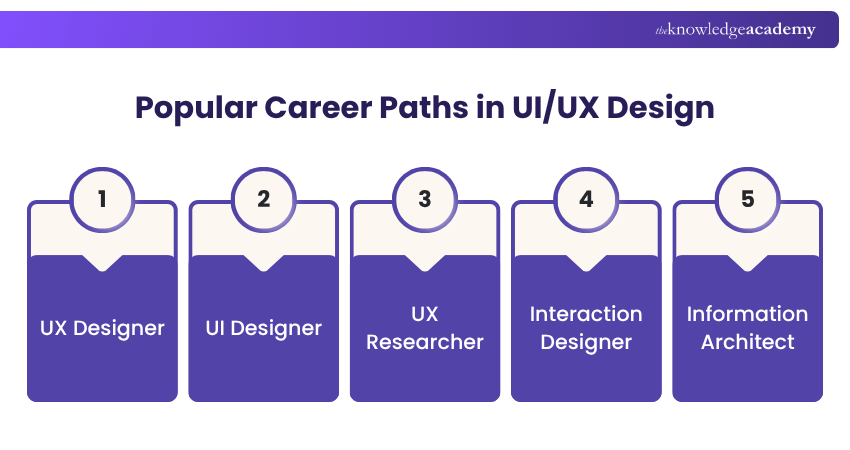
1) UX Designer: UX Designers research user needs and create experiences that make digital products easier to use. Their work can include user journeys, wireframes, prototypes, and usability testing.
2) UI Designer: UI Designers focus on the visual and interactive elements of digital products. They work with layouts, typography, colour, interface components, and visual consistency to create clear and engaging interfaces.
Trainer Insight: Strong UI/UX Designers do not rely on personal preference alone. They use research, user feedback and testing to understand whether a design actually solves the intended problem.
3) UX Researcher: Studies user behaviour and needs through methods such as interviews, surveys, observation, and usability testing to inform design decisions.
4) Interaction Designer: Focuses on how users interact with a digital product, including workflows, responses, navigation, and other interactive behaviours.
5) Information Architect: Organises information and content into logical structures that help users understand and navigate digital products.
Learn the fundamentals of web design and bring your creative ideas to life by signing up for the Website Design Course now!
Essential Skills for a UI/UX Design Career
Building a career in UI/UX design requires a combination of creative, analytical, technical, and interpersonal skills. Some of the most valuable skills include:
1) Creative Thinking
UI/UX Designers need creativity to explore different ideas and develop engaging ways to solve user problems. This involves looking beyond obvious solutions while keeping usability at the centre of the design.
2) Problem-solving Skills
Designers regularly encounter issues such as confusing navigation, complicated user journeys, or unclear interfaces. Strong problem-solving skills help them identify the cause of these problems and develop practical solutions.
Beginner Tip:
Do not wait for a professional project to start building experience. Choose an everyday digital experience, identify a genuine usability problem and document how you would research, test and improve it.
3) Empathy
Understanding a product from the user's perspective is fundamental to UI/UX design. Empathy helps designers consider different needs, expectations, frustrations, and behaviours rather than designing around their own assumptions.
4) Communication Skills
UI/UX Designers need to explain ideas, present design decisions, ask effective questions, and communicate research findings clearly to different stakeholders.
5) Collaboration Skills
Design rarely happens in isolation. UI/UX Designers work alongside developers, Product Managers, researchers, marketers, and stakeholders, making effective teamwork an important part of the role.
6) Analytical Thinking
Designers need to interpret research findings, recognise patterns in user behaviour, evaluate feedback, and use evidence to support design decisions.
7) Attention to Detail
Small details can influence how easily people use an interface. Designers need to notice inconsistencies in spacing, typography, alignment, interactions, navigation, and visual hierarchy.
8) Adaptability
Design requirements, user expectations, technologies, and feedback can change throughout a project. Adaptability helps designers respond to these changes and refine their work when needed.
Learn the various strategies for user experience by signing up for the UX Design Course now!
How to Start a Career in UI/UX Design?
Starting a career in UI/UX design involves more than learning design software. You need to understand the fundamentals, practise solving user problems, build evidence of your work, and continuously improve your skills.
1) Learn the UI/UX Fundamentals
Build a foundation in user-centred design, user research, visual hierarchy, information architecture, wireframing, prototyping, and usability testing. Understanding these concepts helps you see how the complete design process works.
2) Get Comfortable with Design Tools
Learn tools used for wireframing, interface design, prototyping, and collaboration. Focus on understanding what each tool helps you achieve rather than learning software features without applying them to design problems.
3) Work on Practical Projects
Put your knowledge into practice through personal projects, design challenges, volunteer opportunities, or realistic case studies.
Instead of simply redesigning screens, start with a user problem and demonstrate how your design attempts to solve it.
4) Build a Strong Portfolio
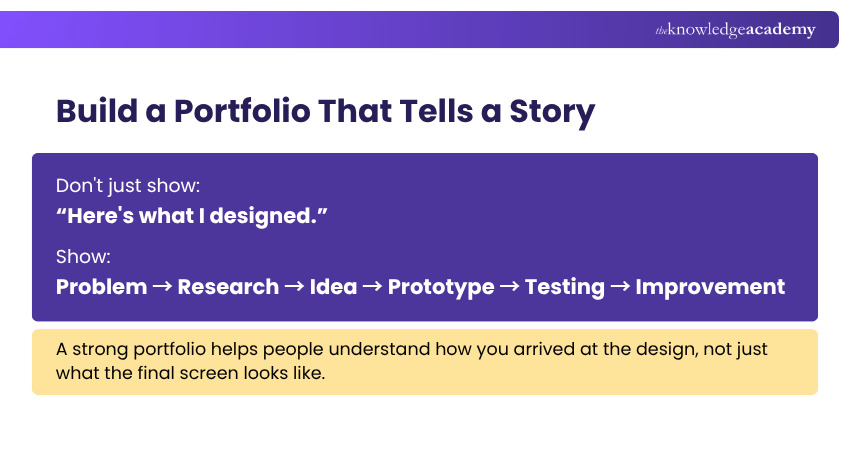
Create a portfolio that demonstrates both your final designs and the thinking behind them.
For each project, explain the problem, research, design decisions, prototypes, testing, iterations, and final outcome. This helps employers understand how you approach UI/UX challenges.
5) Seek Feedback and Improve
Share your work with experienced designers, mentors, peers, or design communities. Constructive feedback can help you find areas for improvement and see your designs from different perspectives.
6) Keep Developing Your Skills
UI/UX design continues to change alongside technology, accessibility expectations, design practices, tools, and user behaviour. Continue practising, exploring new approaches, and refining your skills as you gain experience.
Is UI/UX Design the Right Career for You?
UI/UX design can offer an interesting career path, but the right fit depends on what you enjoy, how you approach problems, and the kind of work you want to do. This career could be a good fit if you:
1) Enjoy Solving Problems: You are interested in finding out why something is difficult to use and exploring ways to improve it.
2) Are Curious About People: You like understanding how people think, behave, and interact with digital products.
3) Welcome Feedback: You are comfortable testing your ideas, receiving feedback, and revising your designs.
4) Balance Creativity with Evidence: You enjoy creative work but are also willing to use research and user insights to guide decisions.
5) Enjoy Collaboration: You are comfortable working with developers, Product Managers, researchers, and other professionals.
6) Like Continuous Learning: You are willing to keep developing your knowledge as technologies, tools, and user expectations evolve.
Turn your innovative ideas into functional apps and websites with the App and Web Development Training - Join now!

Nilotpal Sarmah is a Senior Content Writer with 11+ years of overall experience spanning engineering, operations and content development. His technical knowledge and extensive writing experience enable him to simplify specialised topics across IT and Tech, Business Skills, Project Management, Health and Safety, and ISO and Compliance.
View Detail

 If you wish to make any changes to your course, please


