


We may not have the course you’re looking for. If you enquire or give us a call on 01344203999 and speak to our training experts, we may still be able to help with your training requirements.
Home
 Resources
IT Security & Data Protection
GDPR Roles and Their Responsibilities: A Complete Guide
Resources
IT Security & Data Protection
GDPR Roles and Their Responsibilities: A Complete Guide
GDPR Roles and Their Responsibilities: A Complete Guide
ByThe Knowledge AcademyLast updated on: 16 November 2026
Explore the key GDPR roles and responsibilities, including Data Controllers, Data Processors and Data Protection Officers, and understand how they support compliance and protect personal data.

What You'll Learn
1. Understand how Data Controllers and Data Processors differ in their responsibilities for handling personal data.2. Learn when organisations act as Joint Controllers and how they share GDPR responsibilities.3. Explore when a Data Protection Officer must be appointed and what their duties involve.4. Understand the functions of supervisory authorities and the requirements for appointing GDPR representatives.5. Identify the key factors that help determine an organisation's role and obligations under GDPR.
Every time you shop online, book a flight or sign up for a service, you share personal information with an organisation. But who decides how that information is used, who handles it and who makes sure that it remains protected? This is where the General Data Protection Regulation (GDPR) becomes important, defining roles and establishing responsibilities for organisations involved in processing personal data.
From deciding how information is collected to overseeing compliance and protecting individual rights, GDPR roles help organisations handle personal data responsibly. In this blog, we'll explore the key GDPR roles, their responsibilities and how they differ from one another.
Key GDPR Roles
The GDPR defines specific roles to establish accountability for how personal data is collected, processed and protected. Each role carries distinct responsibilities and legal obligations to support compliance with data protection requirements. Here are the key GDPR roles and their responsibilities:
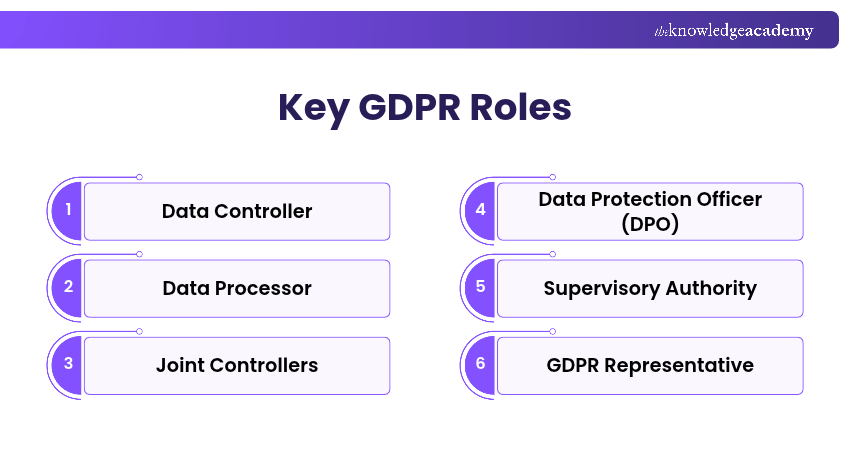
1) Data Controller
A Data Controller is an individual, organisation or public body that determines the purposes and means of processing personal data. In simple terms, the controller decides why personal data is collected and how it should be used. Their responsibilities include:
a) Identifying an appropriate lawful basis for processing personal data.
b) Providing individuals with information about how their data is used.
c) Ensuring personal data is processed securely and transparently.
d) Facilitating the exercise of data subject rights.
e) Maintaining records of processing activities where required.
f) Notifying the relevant supervisory authority of personal data breaches when legally required.
g) Selecting processors that provide sufficient guarantees and establishing compliant processing agreements where required.
Controllers must report personal data breaches to the relevant supervisory authority without undue delay and, where feasible, within 72 hours, unless the risk to individuals is unlikely. If notification is made after 72 hours, reasons for the delay must be provided. Affected individuals must also be informed without undue delay if the breach poses a high risk, subject to applicable exceptions.
Example: An online retailer collecting customers' names, addresses and payment information to fulfil orders generally acts as a Data Controller because it determines why that information is collected and how it is processed.

2) Data Processor
A Data Processor is an individual, organisation or other body that processes personal data on behalf of a Data Controller. Unlike controllers, processors do not determine the purposes or essential means of processing. They carry out processing activities according to the controller's documented instructions, unless otherwise required by applicable law.
Data Processors have specific responsibilities under GDPR, including:
a) Processing personal data according to documented instructions.
b) Implementing appropriate technical and organisational security measures.
c) Ensuring authorised personnel maintain confidentiality.
d) Assisting controllers with data subject requests and applicable compliance obligations.
e) Informing controllers without undue delay after becoming aware of a personal data breach.
f) Engaging sub-processors only with the required prior written authorisation from the controller.
g) Deleting or returning personal data at the controller's choice when the processing services end, unless applicable law requires continued storage.
h) Making necessary compliance information available to the controller and allowing or contributing to audits and inspections as required under Article 28.
The relationship between a processor and controller must be governed by a contract or any other binding legal act that meets GDPR Article 28 requirements. Although processors follow the controller's instructions, they may make certain non-essential technical and organisational decisions about how processing activities are carried out.
Example: A company that hires an external payroll provider to calculate employee salaries generally acts as the Data Controller, while the payroll provider acts as the Data Processor for those activities.
3) Joint Controllers
Joint Controllers are two or more organisations or other parties that jointly determine the purposes and means of processing personal data. Under GDPR Article 26, they must establish an arrangement that transparently defines their respective responsibilities for compliance.
Their key responsibilities include:
a) Jointly determining the purposes and essential means of the relevant processing activities.
b) Establishing a transparent arrangement outlining their respective GDPR responsibilities.
c) Clarifying responsibility for providing privacy information and facilitating data subject rights.
d) Making the essence of their joint controller arrangement available to individuals.
e) Ensuring individuals can exercise their GDPR rights against either controller, regardless of the arrangement.
Example: Two organisations jointly operate a customer research programme and together decide what personal data to collect and how it will be used. They may act as Joint Controllers for that processing activity.
4) Data Protection Officer (DPO)
A Data Protection Officer (DPO) is a designated professional responsible for advising an organisation on data protection obligations and monitoring its compliance with applicable requirements. Appointing a DPO is mandatory in specific circumstances, including when:
a) A public authority or body processes personal data, excluding courts performing judicial functions.
b) The organisation's core activities involve regular and systematic monitoring of individuals on a large scale.
c) Its core activities involve large-scale processing of special categories of personal data under Article 9 or personal data relating to criminal convictions and offences under Article 10.
A DPO's key responsibilities include:
a) Advising management and employees on GDPR obligations.
b) Monitoring organisational compliance with data protection requirements.
c) Supporting staff awareness and training activities.
d) Providing advice, where requested, on Data Protection Impact Assessments (DPIAs) and monitoring their performance.
e) Cooperating with supervisory authorities.
f) Working as a point of contact for data protection enquiries.
The DPO must perform their duties independently, without receiving instructions about how to carry out those duties. They must also report directly to the highest management level of the organisation.
Example: A large hospital processing patients' health information on a large scale may be required to appoint a DPO to advise on and monitor its data protection practices.
Trainer's Insight
Appointing a Data Protection Officer does not transfer legal responsibility for GDPR compliance to that individual. The DPO provides independent advice and monitors compliance, while the Data Controller or Data Processor remains responsible for meeting its legal obligations.
Lead data privacy initiatives with confidence by signing up for the Certified Data Protection Officer (CDPO) Training now!
5) Supervisory Authority
This is an independent public authority responsible for monitoring and enforcing data protection requirements under the GDPR. Each EU Member State must provide for one or more independent supervisory authorities. These authorities help protect individuals' rights and ensure organisations comply with applicable data protection laws.
Their primary responsibilities include:
a) Monitoring and enforcing GDPR compliance.
b) Handling complaints relating to personal data processing.
c) Conducting investigations and data protection audits.
d) Providing guidance on data protection requirements.
e) Ordering corrective actions where organisations violate GDPR provisions.
f) Imposing administrative fines where appropriate and legally permitted.
Example: France's data protection authority is the Commission Nationale de l'Informatique et des Libertés (CNIL). It monitors compliance, investigates complaints and exercises regulatory powers under the applicable legal framework.
6) GDPR Representative
A GDPR representative is an individual or organisation designated in writing by certain controllers or processors established outside the EU to act as their contact point within the EU. Under GDPR Article 27, organisations without an EU establishment that fall within the territorial scope of Article 3(2) must generally appoint a representative in the EU, unless an exception applies.
This requirement may apply when an organisation processes the personal data of individuals in the EU in connection with:
a) Providing goods or services to people located in the EU, whether payment is required or not.
b) Monitoring their behaviour within the EU.
Article 27 provides exceptions for public authorities or bodies and for processing that is occasional, does not include large-scale processing of Article 9 special-category data or Article 10 criminal-conviction and offence data, and is unlikely to result in any risks.
The GDPR representative's responsibilities include:
a) Acting as a contact point for supervisory authorities and data subjects.
b) Facilitating communication concerning GDPR-related matters.
c) Being available to address enquiries relating to the organisation's processing activities.
d) Supporting communication between relevant parties regarding data protection obligations.
Example: A business established outside the EU that regularly offers online services to individuals in the EU may need to appoint an EU representative if Article 3(2) applies and no Article 27 exception is available.
Which GDPR Role Applies to Your Organisation?
Understanding which GDPR role applies to your organisation is essential for identifying its legal obligations and responsibilities. The appropriate role depends on how your organisation handles personal data, makes processing decisions and works with other parties. Here are the key factors to consider when determining your organisation's role under GDPR:
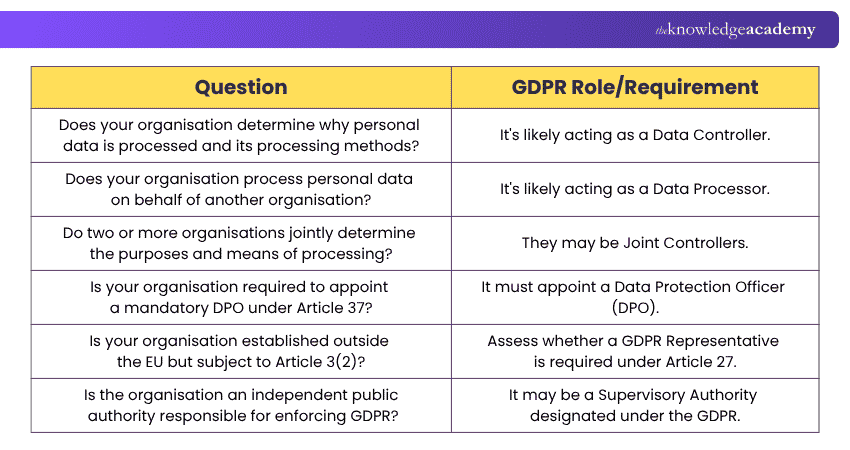
So, understanding GDPR roles is essential for handling personal data responsibly and meeting regulatory requirements. Clearly identifying these responsibilities helps organisations strengthen accountability, protect individuals' rights and maintain effective data protection practices.
Support compliance and safeguard sensitive information with GDPR Awareness Training – Join now!

The Knowledge Academy develops accessible learning content across Project Management, IT, Cybersecurity, Data Science, Business Analysis, HR, Accounting and Finance, Leadership and Health and Safety. Its resources combine subject research with clear explanations to help professionals build practical knowledge across a wide range of disciplines.
View Detail

 If you wish to make any changes to your course, please


