


We may not have the course you’re looking for. If you enquire or give us a call on 01344203999 and speak to our training experts, we may still be able to help with your training requirements.
Career in Java: Top 15 Job Roles and Required Skills
ByThe Knowledge AcademyLast updated on: 16 November 2026
A career in Java offers opportunities across backend development, enterprise applications, cloud computing and software architecture. Explore 15 Java career paths, their responsibilities and the technical skills needed for each role. Discover how Java expertise can support career progression in software development.

At a Glance
1. Career Opportunities: Discover roles across application development, cloud engineering, automation and software architecture.2. Essential Skills: Understand the importance of core Java, Spring Boot, SQL, APIs, and development tools.3. Getting Started: Learn how practical projects, technical training and a strong portfolio can support a career in Java.4. Career Growth: Explore pathways from entry-level Java development to senior technical and leadership roles.
Think Java is only for Software Developers?
Think again.
Java Developer | Java Automation Test Engineer | Cloud Application Developer | Software Architect
Java opens up opportunities across different technical specialisations, each requiring its own combination of skills and expertise. Understanding these career options and how to prepare for them is the first step towards finding your path in Java.
Top 15 Career Opportunities in Java
Java's extensive ecosystem supports different areas of software development, from application programming to system architecture. Its object-oriented features, established frameworks and cross-platform capabilities make it suitable for developing and maintaining a wide range of applications.
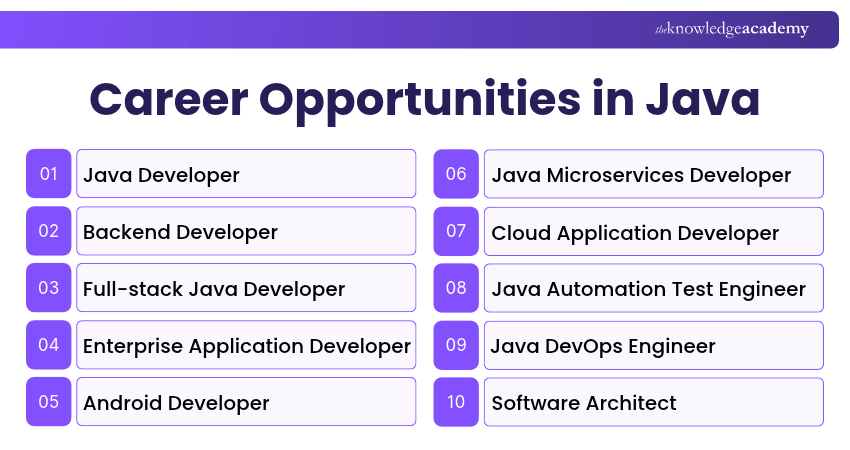
Here are 15 career paths worth exploring.
1) Java Developer
Java Developers design, build and maintain software applications using the Java programming language. They write application logic, resolve programming errors, and improve existing systems to meet business and technical requirements.
This role provides a foundation for specialising in backend development, enterprise applications, or other areas of Java engineering.
Key Skills: Advanced Java, software architecture, code reviews, Agile development, technical mentoring and problem-solving.

2) Backend Developer
Backend Developers build the server-side components that enable applications to process information, manage data and respond to user requests. They use Java frameworks to develop business logic, integrate databases, and create Application Programming Interfaces (APIs).
Unlike general Java Developers, backend specialists concentrate on server-side functionality rather than broader application development.
Key Skills: Java, Spring Boot, REST APIs, SQL, database integration, and authentication.
3) Full-stack Java Developer
Full-stack Java Developers work across both the frontend and backend of web applications. They use Java for server-side development and technologies such as HTML, CSS, JavaScript, and frontend frameworks to create user interfaces.
This role is suitable for professionals who want to understand how different application components interact and deliver complete web solutions.
Key Skills: Java, Spring Boot, JavaScript, React or Angular, SQL, and API integration.
4) Enterprise Application Developer
Enterprise Application Developers build and maintain software that supports organisational operations, such as financial management, customer relationship management, and internal business processes.
Their work often involves integrating multiple systems, implementing complex business rules and maintaining applications that support large numbers of users.
Key Skills: Java, Jakarta EE, Spring, relational databases, transaction management, and enterprise integration.
5) Android Developer
Android Developers create and maintain applications for Android devices. Java remains relevant for working with existing applications, integrating supported libraries, and maintaining established codebases.
However, Android development has evolved. Google recommends Kotlin for new projects, making knowledge of both languages valuable for professionals pursuing this career.
Key Skills: Java, Kotlin, Android Studio, Android SDK, mobile application architecture, and debugging.
Code your way into Android app development with Android App Development Course - Register now!
6) Java Microservices Developer
Java Microservices Developers build applications as smaller, independently deployable services rather than relying entirely on a single application structure.
They use Java frameworks to develop services that communicate through APIs or messaging systems. Their responsibilities include maintaining service reliability, managing communication, and supporting independent deployments.
Key Skills: Java, Spring Boot, REST APIs, Docker, service communication, and distributed systems.
7) Cloud Application Developer
Cloud Application Developers working with Java build applications designed to run on cloud infrastructure. They focus on creating services that can be deployed, monitored, and scaled according to application requirements.
This career combines programming knowledge with cloud computing concepts, making it suitable for developers interested in modern application deployment.
Key Skills: Java, Spring Boot, AWS or Azure, Docker, cloud storage and application monitoring.
8) Java Automation Test Engineer
Java Automation Test Engineers develop automated tests that verify whether software behaves as expected. They write test scripts, identify defects, and support consistent software quality throughout the development lifecycle.
Java is commonly used with testing frameworks and automation tools to validate application functionality, APIs, and integration between systems.
Key Skills: Java, JUnit, Selenium, REST Assured, test automation frameworks and continuous integration.
Pro Tip
Build a small automated testing project using Java and JUnit. Demonstrating how you identify defects and verify application behaviour can strengthen your portfolio.
9) Java DevOps Engineer
Java DevOps Engineers support the building, testing, deployment and operation of Java applications. They automate development workflows, manage deployment pipelines, and help teams release software more consistently.
Although DevOps is not exclusive to Java, knowledge of the language helps engineers troubleshoot Java applications, understand build processes and optimise deployment environments.
Key Skills: Java, Maven or Gradle, Jenkins or GitHub Actions, Docker, Kubernetes and CI/CD pipelines.
10) Software Architect
Software Architects define the technical structure of applications and establish guidelines for their development. Professionals with Java expertise can design architectures that support maintainability, reliability, and future system changes.
Their responsibilities include selecting appropriate technologies, defining application components, and evaluating technical trade-offs.
Key Skills: Java, software design patterns, system design, scalability, architecture documentation, and technical decision-making.
11) Java Integration Developer
Java Integration Developers connect applications, databases and external services so that information can move between systems.
They build integrations using APIs, messaging technologies, and data transformation techniques. Their work is particularly relevant in organisations that depend on multiple business applications operating together.
Key Skills: Java, REST APIs, message brokers, JSON, XML, Apache Kafka, and integration patterns.
12) Java Performance Engineer
Java Performance Engineers analyse and improve how Java applications use computing resources. They investigate slow response times, memory consumption, and process bottlenecks.
Their work involves examining application behaviour, identifying performance limitations, and applying improvements to increase efficiency and reliability.
Key Skills: Java Virtual Machine (JVM) internals, Java profiling, garbage collection, multithreading, performance testing and monitoring.
Build the skills behind scalable software solutions with Java Engineer Training – Join now!
13) Java Security Developer
Java Security Developers focus on protecting applications against vulnerabilities and unauthorised access. They implement secure authentication, manage permissions, and apply secure coding practices during software development.
Their work helps organisations reduce application security risks while maintaining reliable access to digital services.
Key Skills: Java, Spring Security, OAuth 2.0, OpenID Connect, encryption, secure coding and vulnerability management.
14) Big Data Engineer
Big Data Engineers develop systems that process and transform large volumes of information. Java knowledge can be useful when working with technologies built on the JVM, distributed data processing tools and data pipelines.
This role often requires additional expertise in databases, distributed computing, and data engineering technologies beyond Java itself.
Key Skills: Java, SQL, Apache Kafka, Apache Spark, distributed computing and data pipelines.
15) Java Technical Lead
Java Technical Leads guide development teams in designing and delivering Java-based applications. They review code, support technical decisions, establish development standards, and help resolve complex engineering challenges.
This role generally requires substantial experience in Java development alongside communication, mentoring, and technical leadership skills.
Key Skills: Java, software architecture, code reviews, system design, technical decision-making, mentoring and team leadership.
Career Selection Checklist
Use this checklist to identify the Java career paths that best match your interests and strengths.
1) I enjoy building application features and solving coding challenges.
2) I prefer working with databases, APIs, or backend systems.
3) I am interested in cloud infrastructure and application deployment.
4) I enjoy identifying software defects and improving quality.
5) I want to explore security, performance, and system architecture.
6) I have considered whether I prefer a specialist technical role or leadership responsibilities.
How to Start a Career in Java?
Building a Java career becomes easier when learning is connected to practical development experience. The following steps provide a structured starting point.
1) Learn Java Fundamentals: Develop an understanding of Java syntax, object-oriented concepts, collections, and exception handling. Practise writing simple programs that apply these concepts.
2) Build Practical Applications: Create projects such as a task management application, inventory system or REST API, and practise testing the code you write. Use these projects to demonstrate coding, problem-solving, and application design skills.
3) Explore Development Frameworks: Learn Spring Boot and database integration to understand how Java applications handle business logic and communicate with other systems.
4) Develop a Project Portfolio: Maintain code repositories, document application features, and demonstrate how your projects work. Include meaningful examples of testing and debugging.
5) Apply for Relevant Opportunities: Explore junior Java Developer, graduate software engineering and entry-level backend development roles. Match your applications to the technologies and responsibilities listed in each job description.
Trainer's Insight
Prioritise understanding how Java applications work before learning multiple frameworks. A strong foundation in core Java, database interaction and debugging makes it easier to adopt new development tools.
Master Java for building robust, scalable applications with our Java Courses – Sign up now!

The Knowledge Academy develops accessible learning content across Project Management, IT, Cybersecurity, Data Science, Business Analysis, HR, Accounting and Finance, Leadership and Health and Safety. Its resources combine subject research with clear explanations to help professionals build practical knowledge across a wide range of disciplines.
View Detail

 If you wish to make any changes to your course, please


