


 Top Rated Course

We may not have the course you’re looking for. If you enquire or give us a call on 01344203999 and speak to our training experts, we may still be able to help with your training requirements.
8 Workforce Planning Tools Every Business Needs
James Smith 15 July 2026Workforce Planning Tools help organisations forecast hiring needs, analyse skills, and align talent with business goals to improve productivity and performance. They enable data-driven decisions, optimise resource allocation, and support long-term workforce strategy for sustainable growth and operational efficiency.

Training Outcomes Within Your Budget!
We ensure quality, budget-alignment, and timely delivery by our expert instructors.
Table of Contents

Every successful organisation depends on its people. Ensuring the right individuals are in the right roles at the right time can be challenging. Too few employees can impact performance, while excess staffing can increase costs. This is where Workforce Planning Tools play a vital role, helping organisations forecast needs, address skill gaps, and remain adaptable.
In this blog, we will explore what Workforce Planning Tools are, highlight the top 8 options, outline their benefits, examine key features, and share practical steps to improve workforce planning.
Table of contents
1) Top 8 Workforce Planning Tools
2) Benefits of Workforce Planning Tools
3) How do you choose the right workforce planning tools?
4) Key Features to Look for in Workforce Planning Tools
5) What are the 5 R's of Workforce Planning?
6) What are the 5 Pillars of Workforce Planning?
7) Conclusion
Top 8 Workforce Planning Tools
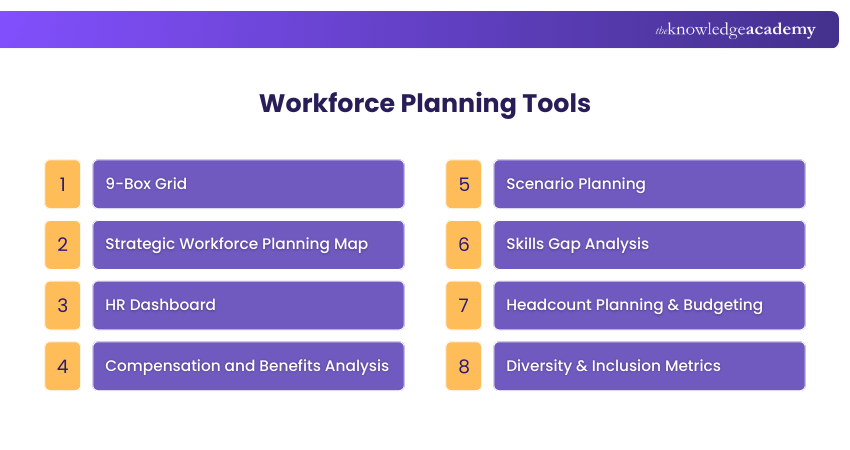
When you look for Workforce Planning Tools, you will find many choices. Here, we share the top eight tools with a short explanation of what they do and why they are useful:
1) 9-Box Grid
This tool helps you check how employees are performing now and their future growth potential. It shows who is ready for leadership roles and who needs more support. It looks at:
a) Past and current performance
b) Future growth and leadership potential
Value: Helps find employees with high potential and plan for future leaders

2) Strategic Workforce Planning Map
This tool helps plan your workforce based on business goals and future needs. It focuses on:
a) Checking current workforce skills and performance
b) Predicting future staffing needs
c) Finding skill gaps
d) Making an action plan
Value: Keeps your workforce aligned with business plans and prepares for future changes.
3) HR Dashboard
This tool shows important workforce data in a visual format. It helps Human Resources (HR) and leaders understand employee performance quickly. It looks at:
a) Absenteeism
b) Employee engagement
c) Performance and productivity
d) Recruitment and turnover
e) Workforce overview
Value: Gives leaders a clear and quick view of HR data to make better decisions.
4) Compensation and Benefits Analysis
This tool studies everything about employee salaries and benefits. It checks if pay and benefits are fair, competitive, and cost-effective. It looks at:
a) Salary structures
b) Bonuses and incentives
c) Benefits and perks
d) Pay fairness
e) Total compensation
Value: Helps set fair salaries to attract, keep, and motivate top talent.
5) Scenario Planning
This tool prepares for different future situations by creating plans for each one. It helps manage unexpected changes better. It looks at:
a) Best-case situations
b) Worst-case situations
c) Expected or normal situations
Value: Helps businesses stay ready, flexible, and confident in times of change.
6) Skills Gap Analysis
This tool compares the skills employees have now with the skills needed in the future. It helps plan training and hiring better. It looks at:
a) Current skills
b) Required skills
c) Missing skills that need training or hiring
Value: Ensures employees get the right training and helps plan smarter hiring.
7) Headcount Planning & Budgeting
This tool helps manage the number of employees a company needs now and in the future. It also plans the hiring budget. It looks at:
a) Current workforce size
b) Future hiring needs
c) Budget planning
d) Resource use
Value: Ensures the company has the right people in the right jobs without overspending.
8) Diversity & Inclusion Metrics
This tool tracks data to make the workplace fair and inclusive. It measures:
a) Diverse hiring
b) Pay fairness
c) Leadership promotions
d) Employee satisfaction
e) Retention of diverse employees
Value: Builds an inclusive workplace that attracts, supports, and keeps top talent.
Equipped with the modern tools and techniques for effective hiring. Join our Talent Acquisition Training now!
Benefits of Workforce Planning Tools
Amid the intricate dance of managing a workforce, technology becomes indispensable. Workforce Planning Tools orchestrate data-driven insights, predictive analytics, and strategic foresight, providing organisations with benefits that elevate their staffing strategies. Here are the benefits of Workforce Planning Tools:
1) Data-informed Decision Making
Workforce Planning Tools are a treasure trove of Data, enabling organisations to make informed decisions based on concrete insights rather than intuition. From historical performance metrics to future projections, these tools allow HR professionals and management to identify trends, anticipate needs, and make precise decisions.
2) Anticipating Skill Requirements
The evolving business landscape demands agility in skill acquisition. Workforce Planning Tools analyse market trends and technological advancements to identify the skills in demand. This foresight empowers organisations to proactively train their existing workforce or attract new talent, ensuring a continuous alignment with industry needs.
3) Resource Optimisation
Practical Workforce Planning Tools help organisations optimise their resource allocation. Companies can streamline staffing levels by understanding peak periods, identifying surplus capacities, and addressing skill gaps. This enhances operational efficiency and curtails unnecessary expenses associated with overstaffing.
4) Talent Retention and Engagement
Employee turnover can be a costly affair. Workforce Planning Tools analyse factors contributing to turnover, enabling organisations to design targeted retention strategies. By identifying engagement trends, organisations can create a work environment that caters to employee satisfaction and loyalty.
5) Cost Savings
Financial implications are never far behind in the intricate web of staffing decisions. Workforce Planning Tools assist in calculating the cost of staffing decisions, aiding organisations in making choices that align with their Budget constraints. This strategic financial approach prevents overspending and promotes a lean staffing strategy.
6) Scenario Modelling
Workforce Planning Tools empower organisations to simulate different scenarios, such as expansion, downsizing, or changes in project volume. This capability allows for strategic evaluation of the outcomes of various decisions before they are implemented, reducing the risk of missteps.
7) Aligning HR with Business Strategy
Gone are the days when Human Resources (HR) was confined to administrative tasks. Workforce Planning Tools elevate HR to a strategic partner, aligning its efforts with overarching business goals. HR becomes an integral driver of success by contributing to organisational growth strategies.
Learn fair methods to conduct accurate performance reviews. Join our Performance Appraisal Training now!
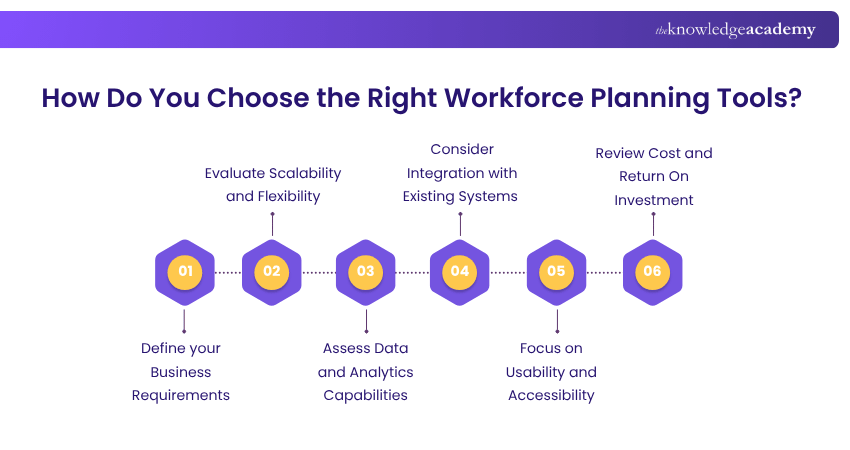
How Do You Choose the Right Workforce Planning Tools?
Choosing the right Strategic Workforce Planning Tools is essential for aligning workforce strategies with business goals and ensuring efficient resource management. The right tool should support accurate forecasting, improve decision-making, and adapt to organisational needs.
1) Define your business requirements
Start by identifying your workforce goals, challenges, and planning needs. Whether it is demand forecasting, skill gap analysis, or resource allocation, clarity helps in selecting suitable Workforce Planning Tools.
2) Evaluate scalability and flexibility
Choose tools that can grow with your organisation and adapt to changing workforce demands. Flexible Workforce Planning Tools support both short-term adjustments and long-term strategy.
3) Assess data and analytics capabilities
Effective workforce planning relies on accurate data insights. Look for tools that offer real-time analytics, reporting, and forecasting features to support informed decision-making.
4) Consider integration with existing systems
Ensure the tool integrates seamlessly with HR systems, payroll, and other business platforms. This improves efficiency and avoids data silos.
5) Focus on usability and accessibility
Select Strategic Workforce Planning Tools that are easy to use and accessible to key stakeholders. A user-friendly interface ensures better adoption and consistent usage across teams.
6) Review cost and return on investment
Evaluate pricing in relation to features and long-term value. The Best Workforce Planning Tools should deliver measurable benefits such as improved productivity and reduced operational costs.
By carefully evaluating these factors, organisations can choose Workforce Planning Tools that enhance planning accuracy, optimise resources, and support sustainable growth.
Key Features to Look for in Workforce Planning Tools
The right features in Workforce Planning Tools can greatly improve staffing strategies. These tools bring together Data Analysis, predictive modelling, and strategic insights. Here are the key features organisations should consider when choosing tools used in Workforce Planning:
1) Forecasting Capabilities
Accurate predictions lie at the heart of effective Workforce Planning. Advanced tools harness historical data and trends to forecast future staffing needs. These forecasts act as a compass, guiding organisations toward staffing decisions aligned with projected demand.
2) Data Visualisation
Numbers alone may not convey the complete picture. Workforce Planning Tools with robust data visualisation capabilities transform complex data sets into understandable visuals. This empowers decision-makers to quickly grasp trends, patterns, and anomalies, enabling faster and more informed choices.
3) Scenario Modelling and Simulations
The ability to simulate various scenarios is invaluable. Tools that allow users to model different staffing scenarios, such as expansion, market shifts, or seasonal fluctuations, help organisations assess potential outcomes before making decisions. This minimises risks associated with uninformed choices.
4) Skill Gap Analysis
Identifying skill gaps is crucial for targeted training and recruitment. Workforce Planning Tools that analyse existing skills within the workforce and compare them against anticipated skill requirements can guide Professional Development initiatives and hiring strategies.
5) Integration with HR and Management Systems
Seamless integration with existing HR and management systems is a game-changer. This feature enables a unified view of workforce data, ensuring that staffing decisions are informed by real-time information from various organisational departments.
6) Predictive Analytics
Predictive analytics take Workforce Planning to the next level. These tools leverage historical data and algorithms to anticipate future trends, enabling organisations to make proactive decisions rather than reactive adjustments.
7) Scalability and Flexibility
As organisations grow, their staffing needs change. Workforce Planning Tools should be scalable and capable of accommodating the expanding demands of an evolving organisation. Flexibility to adapt to changing industry dynamics and strategies is also essential.
8) Collaboration and Reporting
Efficient collaboration and reporting functionalities ensure that relevant stakeholders are on the same page. Workforce Planning Tools that facilitate easy sharing of insights, reports, and recommendations enhance communication and decision-making.
Learn how to support employee growth and career development effectively. Join our Talent Management Training now!
What are the 5 R's of Workforce Planning?
The 5 R's of workforce planning provide a structured approach to managing talent and aligning workforce strategies with organisational goals. These principles help organisations use Workforce Planning Tools effectively to ensure the right people are in the right roles at the right time.
1) Right Size
Ensuring the organisation has the correct number of employees to meet current and future demands without overstaffing or understaffing.
2) Right Skills
Identifying and developing the skills required to support business objectives, ensuring employees are equipped to perform effectively.
3) Right Shape
Structuring teams and roles efficiently to improve productivity, collaboration, and operational performance.
4) Right Site
Placing employees in the most appropriate locations, including remote or on-site roles, to optimise performance and cost efficiency.
5) Right Spend
Managing workforce costs effectively by aligning budgets with strategic priorities and ensuring maximum return on investment.
Using Workforce Planning Tools helps organisations analyse these factors, forecast workforce needs, and make informed decisions to maintain a balanced and capable workforce.
What are the 5 Pillars of Workforce Planning?
The 5 pillars of workforce planning provide a strategic framework for building, managing, and sustaining an effective workforce. These pillars support long-term organisational success and are often implemented alongside Workforce Planning Tools to improve planning accuracy and execution.
1) Attract
Drawing in the right talent through effective recruitment strategies, employer branding, and competitive offerings.
2) Train
Developing employee skills through continuous learning and professional development to meet evolving business needs.
3) Employ
Ensuring employees are placed in roles that match their skills and capabilities, enabling optimal performance.
4) Retain
Keeping valuable employees engaged and motivated through career development opportunities, recognition, and supportive work environments.
5) Nurture
Supporting long-term growth by fostering a positive culture, encouraging leadership development, and maintaining employee well-being.
By combining these pillars with effective Workforce Planning Tools, organisations can build a resilient workforce, improve productivity, and adapt to changing market demands.
Conclusion
Strong collaboration and reporting features help ensure all stakeholders stay aligned. Workforce Planning Tools that enable easy sharing of insights, reports, and recommendations improve communication and support more effective decision-making.
Learn effective leadership skills to manage and motivate diverse teams. Join our People Management Courses now!
Frequently Asked Questions
What are the 7 R's of Workforce Planning?

These are the 7 R’s:
1) Right People: Hire those who fit the company
2) Right Skills: Ensure they have the abilities needed
3) Right Shape: Keep the right mix of roles
4) Right Size: Maintain the correct workforce
5) Right Time: Have staff when required
6) Right Place: Position employees strategically
7) Right Cost: Budget-friendly pay
What are the two Types of Workforce Planning?
The two main types are:
1) Strategic Workforce Planning: Plans for the future, focusing on long-term goals, skills, and talent growth.
2) Operational Workforce Planning: Handles current needs, like filling vacancies and meeting short-term staffing demands.

James Smith


Digital Marketing Manager and Trainer
James Smith is a digital marketing professional with over a decade of experience in SEO, content strategy, paid media and analytics. He has supported both SMEs and global brands in transforming their digital presence. James’s writing and training are rooted in results-driven tactics and the latest marketing trends.
View Detail

 If you wish to make any changes to your course, please


