


We may not have the course you’re looking for. If you enquire or give us a call on 01344203999 and speak to our training experts, we may still be able to help with your training requirements.
Home
 Resources
IT Infrastructure & Networking
What is Scripting Language: Types, Applications, and Examples
Resources
IT Infrastructure & Networking
What is Scripting Language: Types, Applications, and Examples
What is Scripting Language: Types, Applications, and Examples
ByNilotpal SarmahLast updated on: 13 October 2026
A scripting language is defined as a programming language that is utilised to automate tasks, control software, or create dynamic content. It uses Python, JavaScript, and PHP. These languages are often interpreted rather than compiled, allowing for quicker development and testing cycles.

Quick Overview
1. Scripting connects simple instructions with practical digital actions.2. Scripts can respond to events, inputs and changing conditions.3. Different environments influence how scripts are written and executed.4. Reusable scripts can support more consistent workflows.5. Choosing the right scripting approach depends on the task and execution environment.
Ever wondered how websites come to life or how your computer knows to run tasks automatically? This is where knowing what is scripting language becomes important. This is because it is a programming language that is utilised to automate tasks, control software, or create dynamic content. In short, you can think of them as the behind-the-scenes directors in the tech world.
Thus, this blog will let you know properly what is a scripting language. You will explore what it is and when it is used. You will also get into exploring the different types of it. The main advantages, limitations and how they compare to traditional programming languages will also be touched upon. So, get started by reading this blog thoroughly and get to know it in complete detail.
What are Scripting Languages?
Scripting languages are now a part of everyday computing. Even while scrolling through a website, chances are that a script is doing the heavy lifting behind the scenes. These languages are built to make life easier.
This is because scripting languages are typically executed through an interpreter or runtime environment, allowing developers to test, modify, and rerun code quickly. Depending on the language and implementation, techniques such as bytecode or JIT compilation may also be used.
So, in simple terms, a scripting language is a kind of programming language that helps automate tasks. It helps manage other software or create dynamic features in apps and websites too. They are present in your browser and server, on your desktop and even in video games. Languages like Python, JavaScript, and PHP have made scripting not only powerful but also incredibly accessible to just about anyone who wants to build something useful.
Did You Know?
A language does not have to be exclusively interpreted to be considered a scripting language. Modern runtimes may use interpretation, bytecode compilation, JIT compilation or a combination of these techniques.

Scripting Languages Applications
Scripting languages are a big part of modern computing. They are used in everything from web development to system maintenance. They're often approachable for beginners and great for automating repetitive tasks. Since scripting languages commonly support execution through an interpreter or runtime environment, they can often be tested and modified quickly. Their flexibility makes them useful for tasks ranging from small automation scripts to larger applications, depending on the language and environment.
a) Web Development: JavaScript improves the user experience through interactive elements and dynamic content.
b) Server-side Programming: PHP and Python handle user inputs, manage sessions, and generate custom web pages.
c) System Administration: Shell scripts and Python make tasks like file organisation, system monitoring, and updates easier to automate.
d) Software Testing: Scripting is used to automate test cases. It also helps in simulating user behaviour and identifying bugs quickly.
e) Data Processing: Python scripts help in parsing, analysing, and visualising large datasets efficiently.
Real-world Scenario
Imagine a team receives hundreds of files every day that need to be renamed, sorted and moved into specific folders. Instead of completing these steps manually, a script can automate the workflow and perform the same sequence consistently whenever required.
Types of Scripting Languages
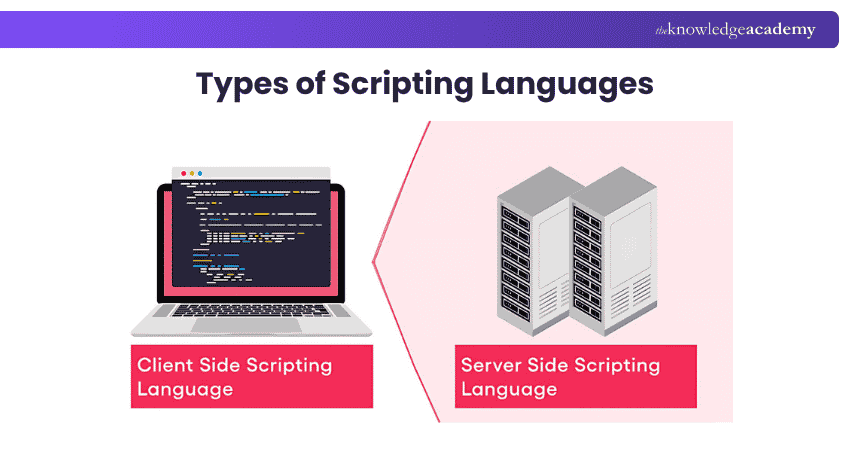
Scripting languages come in different forms. This means that each of them is used in different environments and for different tasks. Some run directly in your browser. This makes websites interactive, while others work behind the scenes on servers to handle data. They can also help deliver dynamic content. This is why knowing the types helps you understand where and how these languages are used. Let’s learn about them below:
1) Server-side Scripting Language
Server-side scripting works behind the scenes on the web server, handling the dynamic elements of a website, such as retrieving data from databases. Languages like PHP and Python are commonly used here. It can also mean something simple like handling form submissions. Other languages, such as Ruby and JavaScript, can also be used for server-side development, depending on the application's requirements, framework and technology stack.
This kind of scripting helps websites respond to each user based on their input. It is also a big part of what makes today’s websites feel smooth, smart, and personal.
2) Client-side Scripting Language
Client-side scripts run inside the user’s browser and make websites feel quick and responsive. Since they don’t have to go back to the server for every little task, users get feedback very fast. The primary scripting language used for this purpose is JavaScript.
JavaScript is supported by all major modern browsers and can be used for tasks such as form validation, animations, DOM manipulation and interactive content. These scripts help bring a site to life in real time.
Trainer’s Pro Tip
Start with the environment where your script will run. For browser-based interactivity, JavaScript is the standard choice. For server-side tasks or automation, consider the available runtime, libraries and project requirements before selecting a language.
Scripting Language Advantages
Scripting languages are very popular for a reason. This is because they are known to make coding faster, easier, and more efficient. This is especially true for tasks that do not need a full-blown application. So, whether you are just getting started or are a seasoned developer, scripting languages offer plenty of practical advantages. Let’s look at them below:
a) Beginner-friendly: Many scripting languages have readable syntax and accessible learning resources. This can make them easier to learn and write, particularly for beginners.
b) Fast Development: Scripting languages often support rapid development because code can typically be executed and tested through a runtime environment without a separate traditional ahead-of-time compilation step.
c) Automation Power: Scripting languages are great for handling repetitive tasks like backups, updates, or data processing. The best part is that all of this can be done with less manual effort once the script has been developed and tested.
d) Flexibility and Portability: Scripts can run on many platforms. Plus, they may require little modification when the necessary runtime, libraries and system dependencies are available.
e) Community and Libraries: Strong online communities and a wide range of pre-built libraries make problem-solving and development much faster.
Learn to write clean, efficient code across web, app, and software projects with the Coding Training - Register now!
Scripting Language Disadvantages
Scripting languages are super handy, especially for quick tasks and automation. However, depending on the language, runtime and application requirements, they may have limitations related to performance, system-level control or maintainability. In the right context, they work great. Still, you must know their limits:
a) Performance Considerations: Some scripting languages may execute more slowly than lower-level compiled languages for certain compute-intensive workloads. However, performance depends on the language, runtime, implementation and use case.
b) Security Risks: Poorly written or insecure scripts can introduce vulnerabilities such as Cross-site Scripting (XSS) or injection flaws. However, these risks generally result from insecure coding and application design rather than scripting languages themselves.
c) Maintainability at Scale: Large scripting-based applications can become difficult to maintain without clear architecture, coding standards, testing and appropriate tooling. However, scripting languages can still be used successfully for large and complex applications.
d) Limited System Access: Some scripting environments restrict access to hardware or operating system features for security reasons. However, languages such as Python can interact with files, processes and system resources through suitable libraries and APIs, depending on the permissions available.
e) Debugging Challenges at Scale: In some dynamically typed scripting languages, certain errors may only become apparent at runtime. As applications grow, strong testing, type-checking tools and debugging practices become increasingly important.
Scripting Language Examples
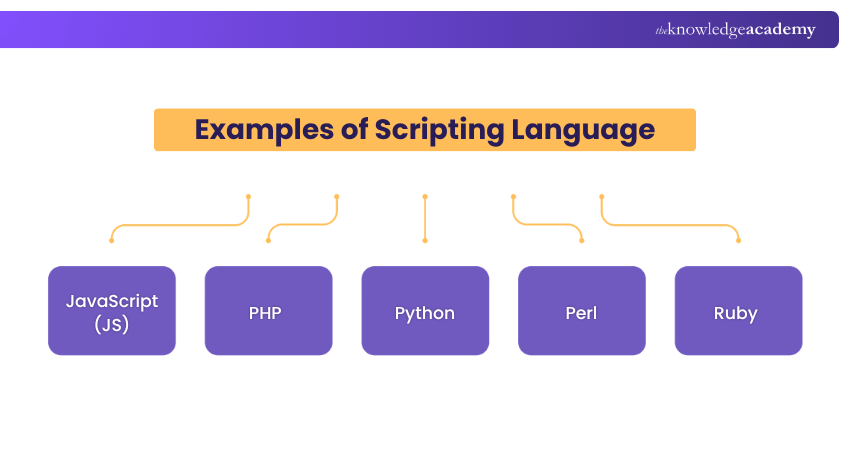
Scripting languages are used across many areas of tech, from web development to automation and system tasks. They’re known for being easy to use and quick to implement, making them a favourite for both beginners and pros. Whether you’re building websites, managing servers, or handling data, there’s a scripting language that fits the job. Here are some widely used ones you’ve probably come across:
1) JavaScript (JS)
JavaScript is the go-to language for adding interactivity to websites. It runs directly in the browser and powers everything from animations to form validations. Over the years, it's grown beyond the front end thanks to environments like Node.js, which allow it to run on servers too. JavaScript is essential for modern web development and is supported by every major browser. If you’ve used a dynamic website, chances are JavaScript was behind it.
2) PHP
PHP is a server-side scripting language that’s been around for decades and is still widely used. It’s especially common in building dynamic web pages and powering platforms like WordPress and Drupal. Many websites rely on PHP to process forms, manage sessions, and connect to databases. It integrates easily with HTML and is supported by many web hosting providers. Despite the availability of other server-side technologies, PHP remains an important part of many web development stacks.
3) Python
Python is one of the most versatile and beginner-friendly scripting languages out there. It's used in web development, data analysis, machine learning, automation, and more. Its clear and readable syntax makes it an excellent first language for newcomers, while still being powerful enough for professionals. Python has a rich ecosystem of libraries that extend its capabilities in nearly every field. From small scripts to large applications, Python can support a wide range of development needs.
Master scripting for automation, testing, data extraction, and reporting with the Python Scripting Training – Join now!
4) Perl
Perl has long been valued for its strength in text processing and system administration. It was a popular choice for early web development and scripting on Unix systems. Although it's less prominent today, Perl is still used in bioinformatics, legacy systems, and network scripting. It shines in tasks that involve regular expressions and file manipulation. With its motto “There’s more than one way to do it,” Perl gives coders plenty of flexibility.
5) Ruby
Ruby is known for its elegant syntax and focus on developer happiness. It became especially popular with the Ruby on Rails framework, which made web development faster and more enjoyable. Ruby emphasises readability and simplicity, making it easy to pick up and productive to use. While it’s mostly used for web applications, it’s also handy for scripting and automation tasks. Many developers love it for the clean, expressive code it encourages.
Scripting vs Programming Languages
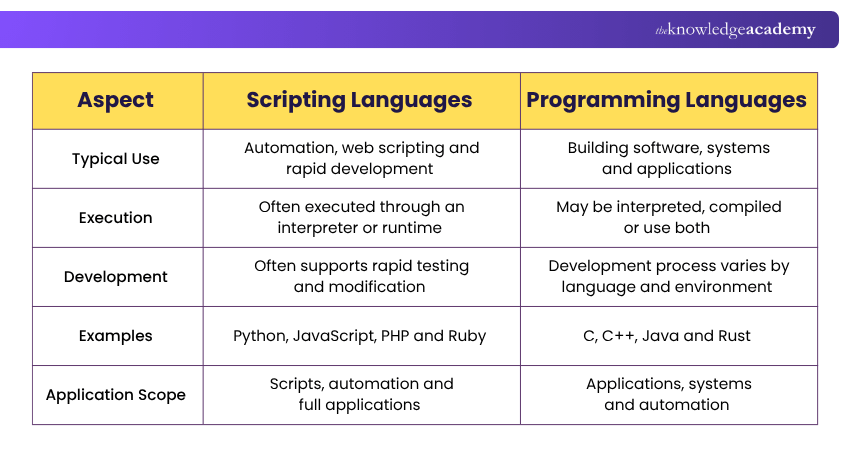
Scripting languages are programming languages, so the two terms are not completely separate categories. Traditionally, “scripting language” refers to languages commonly used to automate tasks, control other software or execute code within a host or runtime environment.
The distinction has become less rigid because languages such as Python and JavaScript are now used to build complete applications as well as scripts. Therefore, the difference is better understood in terms of typical usage and execution environment rather than treating scripting and programming languages as entirely separate categories. Let’s look at the differences in the table below:
Keep This in Mind
The label “scripting language” describes how a language is commonly used more than a strict technical category. Focus on the task, execution environment, ecosystem and project requirements when choosing a language.

Nilotpal Sarmah is a Senior Content Writer with 11+ years of overall experience spanning engineering, operations and content development. His technical knowledge and extensive writing experience enable him to simplify specialised topics across IT and Tech, Business Skills, Project Management, Health and Safety, and ISO and Compliance.
View Detail

 If you wish to make any changes to your course, please


