




We may not have the course you’re looking for. If you enquire or give us a call on 01344203999 and speak to our training experts, we may still be able to help with your training requirements.
What is Risk Management: Steps, Techniques and Benefits
ByThe Knowledge AcademyLast updated on: 03 September 2026
Risk Management helps organisations identify, assess and control potential risks. Explore its importance, process, techniques, applications, frameworks, technology and benefits to understand how organisations manage uncertainty effectively.
Key Takeaways
1. Risk Management provides a structured way to identify, assess, address and monitor uncertainty.2. Risks can arise from financial, operational, strategic, technological, regulatory and other sources.3. Risk assessment considers both the likelihood of an event and its potential impact.4. Common responses include avoiding, reducing, transferring and accepting risk.5. Continuous monitoring is important because risks and business conditions can change over time.
One business. Four possible risks.
Financial loss → Can the business absorb it?
Cyberattack → Is there a response plan?
Supplier failure → Is there an alternative?
Regulatory change → Who is monitoring it?
Every organisation faces uncertainty, but not every uncertainty needs to become a crisis. Understanding What is Risk Management helps businesses identify threats, assess their possible effects and prepare suitable responses before problems escalate.
From everyday operational risks to strategic and cybersecurity threats, effective Risk Management gives organisations a structured way to make more informed decisions.
What is Risk Management?
Risk Management is a structured process of identifying, assessing and responding to risks that could affect an organisation’s objectives. It helps organisations understand potential uncertainties, evaluate their likelihood and impact and determine the most appropriate way to address them.
Depending on the nature of the risk, organisations may choose to avoid, reduce, transfer or accept it. Since risks can change over time, effective Risk Management also involves continuously monitoring existing risks, reviewing controls and identifying new or emerging threats.
Why is Risk Management Important?
Risk Management is important because every organisation faces uncertainties that can affect its objectives, operations and performance. Identifying risks early helps organisations prepare for potential challenges rather than simply reacting when problems occur.
It also supports better decision-making by helping organisations understand possible outcomes and choose suitable responses. As business conditions change, effective Risk Management enables organisations to adapt and respond with greater confidence.
What Happens With vs Without Risk Management?
| Without Risk Management | With Risk Management |
| Risks discovered too late | Risks identified earlier |
| Reactive decisions | Planned responses |
| Unclear ownership | Defined responsibility |
| Greater disruption | Better preparedness |
| Limited visibility | Ongoing monitoring |
Steps of Risk Management
The Risk Management process provides a systematic approach to identifying, assessing and addressing risks that could affect organisational objectives. It follows a series of connected steps that help organisations understand uncertainty, select suitable responses and monitor risks over time. The key steps include:
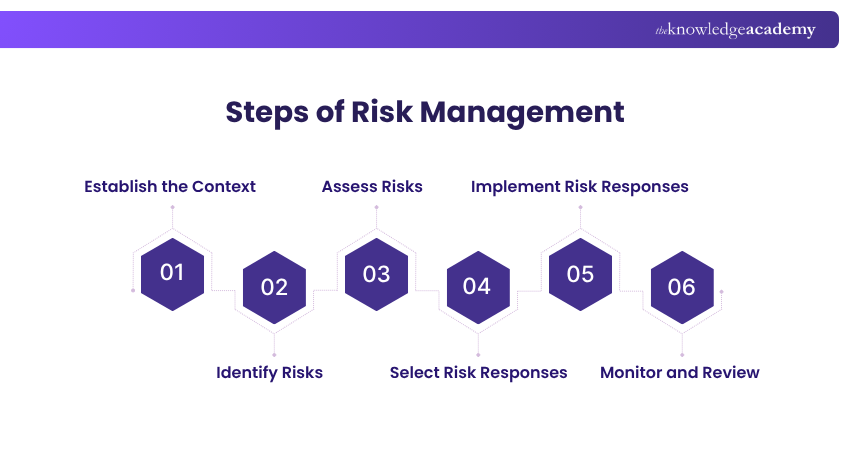
1) Establish the Context
Define the objectives, scope and risk criteria for the Risk Management process. Consider internal and external factors that could affect organisational objectives before identifying individual risks.
2) Identify Risks
Identify events, conditions or uncertainties that could affect organisational objectives. Methods such as brainstorming, data analysis, expert opinion and historical information can help uncover risks from different perspectives. These may include financial, operational, strategic, technological, regulatory and ESG-related risks.
3) Assess Risks
Examine the likelihood and potential impact of each identified risk. A Risk Matrix can help determine which risks require higher priority and which may need monitoring. However, the matrix should support professional judgement rather than replace it.
4) Select Risk Responses
Choose an appropriate response based on the nature and significance of the risk. Organisations may avoid the risk, reduce its likelihood or impact, transfer or share certain consequences with another party or accept it when it falls within established risk criteria or tolerance.
5) Implement Risk Responses
Assign a risk owner, establish clear responsibilities and define the actions, resources and timelines required. Risk responses become meaningful when they are properly implemented and someone is accountable for overseeing them.
6) Monitor and Review
Monitor existing risks, evaluate whether responses and controls remain effective and identify new or emerging risks. Findings should feed back into the Risk Management process so responses can be adjusted as circumstances change.
Risk Review Checklist
Before completing a risk review, ask:
Is the risk description still accurate? Has its likelihood or impact changed? Is a clear risk owner assigned? Have the agreed risk responses been implemented? Are the controls working as intended? Have any new or related risks emerged? Is the next review date clearly defined?
Risk Management in Different Sectors
Risk Management applies across industries, but the risks organisations face and the methods used to manage them can vary considerably between sectors. Here is how Risk Management can be applied across five major industries:
1) Construction
The construction industry faces risks ranging from cost overruns and project delays to safety hazards and environmental concerns. Risk Management in this sector can include:
a) Detailed project planning
b) Contract Management
c) Rigorous safety protocols
d) Insurance coverage
Technologies like Building Information Modelling (BIM) can also support planning, coordination and the early identification of potential design or construction issues.
2) Logistics
Risk Management in the logistics industry focuses on disruptions that could affect supply chains and the movement of goods. Common risks include:
a) Inventory management issues
b) Transportation delays
c) Supplier failures
d) Compliance issues
Forecasting, real-time tracking, supplier diversification and data analytics can help organisations anticipate and respond to potential disruptions.
3) Manufacturing
In the manufacturing sector, risks include supply chain disruptions, equipment failures, quality control issues and safety incidents. Common Risk Management measures include:
a) Diversified supplier networks to reduce dependence on individual suppliers
b) Preventive maintenance programmes to minimise equipment downtime
c) Robust quality control measures
d) Regular safety training and workplace controls
4) Oil and Energy
The oil and energy sector faces a range of operational, financial, environmental and regulatory risks, including:
a) Regulatory and compliance risks
b) Environmental risks
c) Market and price volatility
d) Safety hazards
Organisations can manage these risks through market and scenario analysis, environmental management systems, regular compliance audits, safety controls and contingency planning. Diversifying energy sources and investing in lower-emission technologies can also help organisations manage some transition and market risks, although these changes can introduce new risks that must also be assessed.
5) Food Production
Food production risks range from food safety and quality concerns to regulatory compliance and supply chain disruptions. Common Risk Management measures include:
a) Traceability systems to track food through the supply chain
b) Food safety and quality assurance programmes
c) Compliance with applicable food safety laws and regulations
For example, organisations operating in or supplying the United States may need to comply with applicable requirements under the FDA Food Safety Modernization Act (FSMA).
Pro Tip
A risk should not be considered resolved simply because controls are in place. Confirm that those controls are working and that the remaining risk is acceptable.
Learn what Risk Management is through the Risk Management Black Belt Training – Join now!
Practical Risk Management Techniques
Organisations can use different techniques to understand uncertainty, anticipate potential risks and make informed decisions. The right approach depends on the nature and context of the risk and organisational objectives. Here are some practical techniques:
1) Business Experiments: Small-scale experiments can help organisations test assumptions and understand possible outcomes before committing significant resources.
2) Assumption Validation: Surveys, interviews, questionnaires and stakeholder feedback can help test important assumptions before decisions are made.
3) Scenario Analysis: Exploring different possible scenarios helps organisations understand how changing conditions could affect objectives and prepare suitable responses.
4) Risk Containment: Isolating or containing certain risks can help limit their potential impact on wider operations.
5) Building Buffers: Time, financial and resource buffers can provide additional flexibility when delays, costs or other unexpected events occur.
6) Data Analysis: Historical and current data can help organisations identify trends, patterns, anomalies and areas of potential risk exposure.
7) Risk-reward Analysis: Comparing potential benefits with associated risks can support more balanced decision-making when evaluating opportunities.
8) Lessons Learned: Reviewing previous successes, failures and incidents can help organisations identify recurring risks and improve future responses.
9) Contingency Planning: Developing alternative plans helps organisations prepare for situations in which the preferred approach or normal operations are disrupted.
10) Risk Indicators and Monitoring: Tracking relevant indicators can help organisations recognise changes in risk exposure and respond before problems become more significant.
Trainer Insight
A Risk Matrix should support judgement rather than replace it. Two risks with similar scores can require very different responses depending on their context.
Risk Management Standards and Frameworks
Risk Management standards and frameworks provide structured guidance for identifying, assessing and managing risks. To address different risk environments, organisations can draw on several established frameworks, including the following:
1) ISO 31000:2018
ISO 31000:2018 provides principles, a framework and a process for managing risk across an organisation. It helps organisations integrate Risk Management into governance, planning and decision-making while supporting the achievement of objectives and the creation and protection of value.
2) COSO ERM Framework
The COSO Enterprise Risk Management (ERM) Framework focuses on managing risk alongside strategy and performance. It helps organisations consider uncertainty when setting objectives, making strategic decisions and evaluating performance across different areas of the business.
3) PMI's PMBOK Guide
The PMBOK® Guide – Eighth Edition addresses risk within the context of project management, with risk included as one of its seven performance domains. It helps project teams identify and address uncertainty while tailoring Risk Management practices to the needs and circumstances of individual projects.
4) NIST Cybersecurity Framework
The NIST Cybersecurity Framework (CSF) 2.0 helps organisations manage cybersecurity risks through six core functions: Govern, Identify, Protect, Detect, Respond and Recover. These functions provide a structured approach to understanding, prioritising and managing cybersecurity risks across an organisation.
5) IEC 31010 Risk Assessment Techniques
IEC 31010:2019 provides guidance on selecting and applying techniques for assessing risk in a wide range of situations. These techniques can support decision-making under uncertainty, provide information about particular risks and contribute to the wider Risk Management process.
Build stronger Risk Management foundations and make confident decisions with the Management Of Risk (MoR®) Foundation V3 Course Training – Register now!
Role of Technology in Risk Management
Technology enables organisations to collect, analyse and track risk information efficiently, supporting quicker and better-informed decisions.
It can support:
1) Data-driven Risk Assessments: Analyse large volumes of data to identify patterns, trends and risk factors.
2) Real-time Risk Monitoring: Track risk indicators and alert teams when thresholds are exceeded or unusual activity occurs.
3) Compliance Monitoring and Reporting: Support compliance activities by tracking controls, maintaining records and automating reporting processes.
4) Cyber Security and Data Protection: Help detect security threats, monitor vulnerabilities and support the protection of sensitive information.
5) Communication and Collaboration: Provide shared platforms and dashboards that help teams communicate risk information and coordinate responses.
6) Process Automation: Automate repetitive activities such as data collection, alerts, reporting and certain control checks.
Analytics and automated monitoring can help organisations identify patterns and emerging risks more quickly. However, technology should support human judgement rather than replace accountability for Risk Management decisions.
Benefits of Risk Management
Risk Management helps organisations manage uncertainty, protect resources and make informed decisions. Key benefits include:
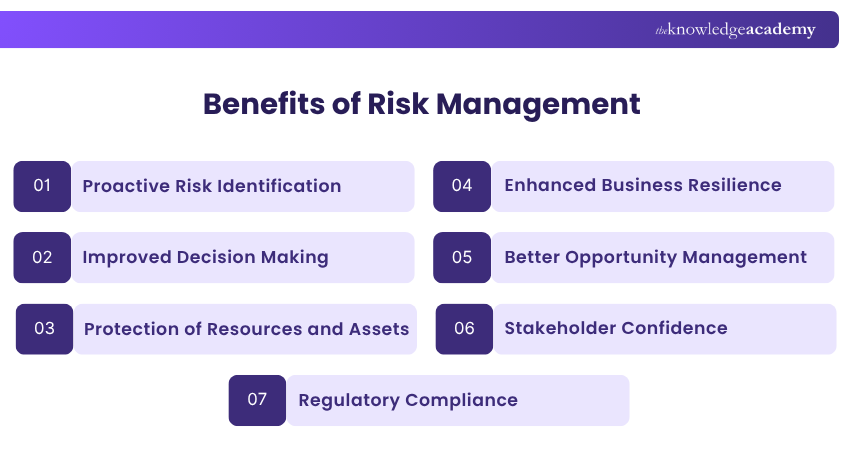
1) Proactive Risk Identification:
Potential threats can be identified early, giving organisations more time to assess them and take appropriate preventive or mitigating action.
2) Improved Decision Making:
Decision-makers can consider potential risks, opportunities and consequences when evaluating different courses of action.
3) Protection of Resources and Assets:
Risk controls can help protect financial resources, physical assets, information, people and organisational reputation from potential harm.
4) Enhanced Business Resilience:
Contingency planning and response measures can help organisations prepare for disruptions, respond effectively and support recovery.
5) Better Opportunity Management:
Understanding uncertainty can help organisations evaluate opportunities more confidently by considering both potential benefits and associated risks.
6) Stakeholder Confidence:
Clear and consistent Risk Management practices can strengthen stakeholder confidence by demonstrating that uncertainty is being identified, assessed and managed systematically.
7) Regulatory Compliance:
Effective Risk Management can support compliance with applicable legal and regulatory requirements while helping reduce exposure to penalties, legal disputes and reputational damage.
Conclusion
Risk is unavoidable, but being unprepared for it is not. Understanding What is Risk Management gives organisations a clearer way to anticipate uncertainty, make informed choices and respond when challenges arise. With the right processes, frameworks and technology in place, Risk Management can turn uncertainty from a potential obstacle into something organisations are better prepared to navigate.
Learn about governance principles to shape good governance expectations with the MoR® 4 Practitioner Risk Management Certification Training – Join now!

The Knowledge Academy develops accessible learning content across Project Management, IT, Cybersecurity, Data Science, Business Analysis, HR, Accounting and Finance, Leadership and Health and Safety. Its resources combine subject research with clear explanations to help professionals build practical knowledge across a wide range of disciplines.
View Detail

 If you wish to make any changes to your course, please


