




We may not have the course you’re looking for. If you enquire or give us a call on 01344203999 and speak to our training experts, we may still be able to help with your training requirements.
Home
 Resources
Data, Analytics & AI
What is Reinforcement Learning: Types, Benefits and Applications
Resources
Data, Analytics & AI
What is Reinforcement Learning: Types, Benefits and Applications
Resources
Data, Analytics & AI
What is Reinforcement Learning: Types, Benefits and Applications
What is Reinforcement Learning: Types, Benefits and Applications
ByRichard HarrisLast updated on: 07 October 2026
Reinforcement learning is a type of machine learning where an agent learns to make decisions by interacting with its environment. It receives feedback through rewards and penalties, allowing the agent to improve its actions over time. Understand how this powerful method is transforming decision-making in modern AI systems.
Overview
1. Reinforcement Learning (RL) enables agents to learn through interaction, feedback, and reward signals.2. Its core elements include the agent, environment, state, action, reward and policy.3. RL algorithms can be classified as value-based, policy-based, actor-critic, model-based, model-free and on-policy.4. Common applications include robotics, optimisation, marketing personalisation, financial decision-making and autonomous systems.5. Its future development is focused on safer, more efficient and more adaptable learning for complex real-world environments.
What if machines could learn from their mistakes, just like we do? This is reinforcement learning. Instead of just following orders, Artificial Intelligence (AI) experiments make mistakes and improve over time. It earns rewards for right choices and learns from failures, evolving with every decision. What is reinforcement learning? It is the key that lets machines learn and grow on their own.
Self-driving cars, learning robots, and game-winning AI show the power of reinforcement learning. Machines now learn, adapt, and grow. In this blog, we explore its types, applications, benefits, challenges, real-world use, and future prospects. Let's dive in!
What is Reinforcement Learning?
Reinforcement Learning (RL) is a type of machine learning where an agent (like a robot or computer program) learns how to make decisions by interacting with its environment. It works by trying different actions and getting feedback based on those actions. The agent receives rewards when it makes the right decision and penalties when it makes a wrong one. Over time, the agent learns which actions lead to the best results.
Think of it like teaching a pet. When the pet does something right, like sitting when told, it gets a treat (reward). If it does something wrong, like jumping on the couch, it might be told "no" or ignored (penalty). The pet keeps trying to figure out what gets the most treats. Similarly, reinforcement learning helps machines learn from their mistakes and successes.

How Does Reinforcement Learning Work?
Basically, RL involves an agent, an environment and rewards or punishments. Let’s break down the key components:
1) Agent: The decision-maker or learner. The agent interacts with the environment and makes choices based on the current state.
2) Environment: The world the agent operates in. This could be anything from a chessboard to a robot navigating a maze.
3) State: A snapshot of the environment at a given moment. For example, the position of a robot in a room or the current layout of a game board.
4) Action: The choices the agent can make. For example, moving left or right or selecting a particular move in a game.
5) Reward: The feedback the agent receives after taking an action. This is usually a number indicating how good or bad the action was. Positive rewards encourage repetition of the action; negative rewards discourage it.
6) Policy: A policy defines the agent's strategy for choosing actions based on the current state. As learning progresses, the policy is updated to favour actions that produce higher long-term rewards.
The agent aims to learn the best actions to maximise long-term rewards. It does this by exploration (trying new actions) and exploitation (relying on known actions that yield high rewards).
The Learning Process
The learning process in reinforcement learning happens through repeated interaction between the agent and the environment. Each interaction gives the agent new information that helps it improve its future actions. Let's check how it works:
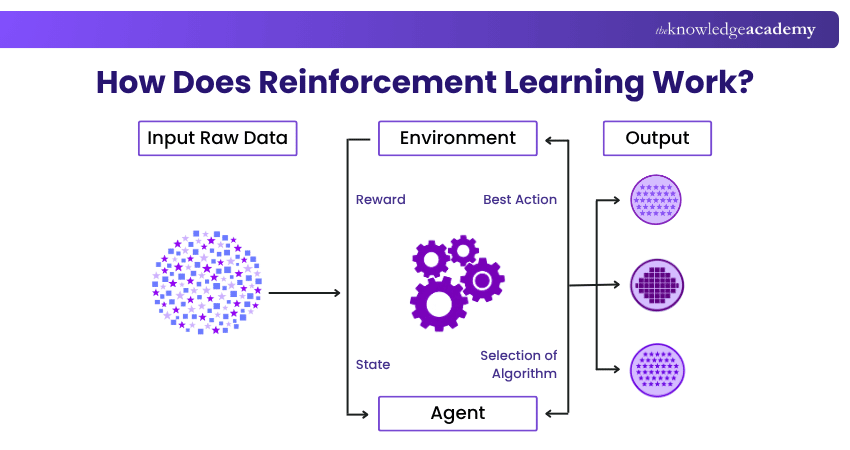
1) Observation: The agent observes the current state of the environment and gathers the information needed to understand the situation.
2) Action Selection: Based on the current state and what it has learned so far, the agent selects an action. It may choose a familiar action that has worked well before or explore a different action to discover potentially better outcomes.
3) Environment Response: After the agent takes an action, the environment changes and moves to a new state.
4) Reward: The agent receives a numerical reward that indicates how favourable the outcome of the action was. Positive or higher rewards generally indicate desirable outcomes, while lower or negative rewards indicate less desirable outcomes.
5) Learning and Update: The agent uses the reward and the resulting state to update its knowledge, such as its policy or value estimates. This helps it make better decisions during future interactions.
6) Repeat: The process continues over many interactions. By repeatedly observing, acting, receiving rewards and updating its knowledge, the agent gradually learns a strategy that aims to maximise cumulative rewards over time.
Start your AI journey with interactive learning with our AI Course for Beginners – Join today!
Types of Reinforcement Learning Algorithms
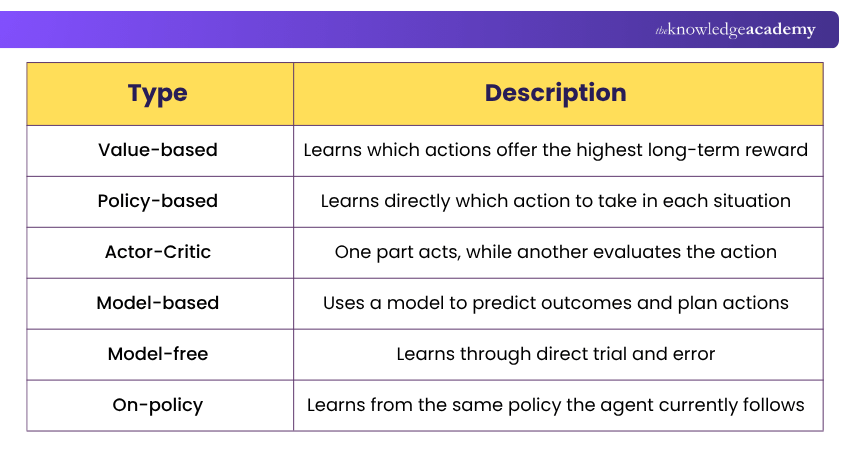
Reinforcement Learning algorithms can be grouped based on how an agent learns from the environment and how it estimates the value of actions or states. Some methods learn directly from experience, while others use a model of the environment to plan future actions. Here are its most common types based on learning approach, environment modelling and policy used for learning:
1) Value-based Algorithms
Value-based algorithms learn how valuable a particular state or action is by estimating the expected long-term reward. The agent then chooses actions that are likely to produce the highest cumulative reward.
A common example is Q-learning, where the agent learns a Q-value, which is a score showing how useful a particular action is in a particular situation. A higher Q-value means the action is expected to produce a better long-term reward. Deep Q-Networks (DQN) use neural networks to estimate these values when there are too many possible situations and actions to store individually.
2) Policy-based Algorithms
Policy-based algorithms learn a policy directly rather than estimating action values first. The policy determines which action the agent should take in a given state.
These algorithms are useful when the action space is continuous or when the best behaviour cannot be represented easily through value estimates. REINFORCE is a common policy-gradient algorithm that improves the policy based on rewards received during interaction.
3) Actor-Critic Algorithms
Actor-Critic algorithms combine ideas from value-based and policy-based methods. They use two main parts that work together: the actor and the critic. The actor decides which action to take based on the current policy, while the critic evaluates the result of that action and estimates how useful it was in terms of future rewards.
This combination can make learning more stable and efficient. Examples include Advantage Actor-Critic (A2C) and Proximal Policy Optimisation (PPO).
a) Advantage Actor-Critic (A2C) improves learning by comparing how good an action is against the average expected outcome.
b) Proximal Policy Optimisation (PPO) updates the policy more carefully, limiting large changes so that learning remains more stable.
4) Model-based Reinforcement Learning
a) The agent uses or learns a model of the environment.
b) This model predicts how the environment may change after a particular action and may also estimate the resulting reward.
c) The agent uses these predictions to plan actions that are likely to maximise long-term rewards.
d) For example, a robot can predict how moving left or right will change its position and use that information to plan a route through a room.
5) Model-free Reinforcement Learning
a) The agent doesn’t create a model of the environment.
b) Instead, it learns a policy or value estimates through direct interaction with the environment.
c) The agent receives rewards and uses them to update its policy or value estimates, helping it choose better actions over time.
d) For example, in a video game, an AI learns the best moves by trial and error, improving its strategy based on the feedback it gets.
6) On-policy Algorithms
On-policy algorithms learn from actions generated by the same policy that the agent is currently using. As the policy changes, the agent continues learning from its latest behaviour.
SARSA is a well-known on-policy algorithm. It updates its estimates based on the action actually selected by the current policy.
Gain the practical skills needed to build cutting-edge AI models with Neural Networks with Deep Learning Training – Register today!
Applications of Reinforcement Learning
Reinforcement learning has found its way into a wide range of industries and real-world applications. Some of the most common applications include the following:
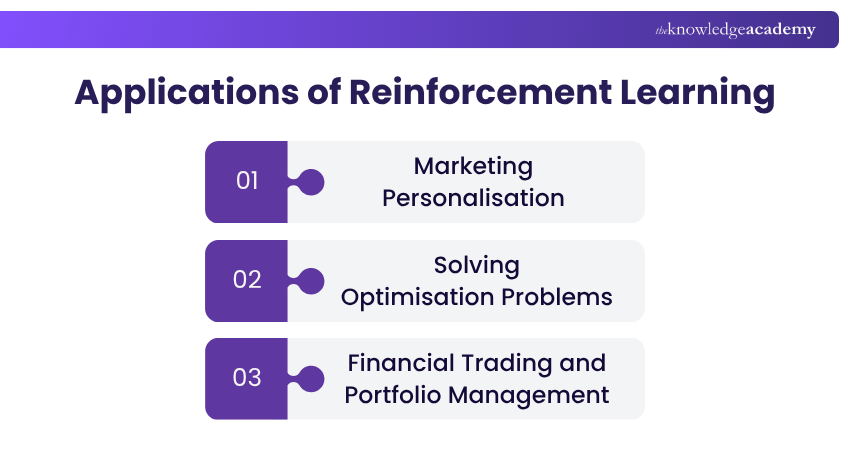
1) Marketing Personalisation
a) Reinforcement learning personalises ads and content recommendations.
b) It learns from user interactions to improve suggestions.
c) RL systems can adapt recommendations, content or advertising strategies based on user responses.
d) It optimises marketing strategies based on individual user behaviour.
e) This makes it a powerful tool for targeted marketing.
2) Solving Optimisation Problems
a) RL is used for resource allocation, scheduling, and planning.
b) It helps businesses optimise their operations and supply chain.
c) RL algorithms find the most efficient ways to use available resources.
d) It assists in reducing costs and improving operational efficiency.
e) This is crucial for industries like logistics, manufacturing, and more.
3) Financial Trading and Portfolio Management
a) RL can be used to develop trading or portfolio strategies that optimise specified objectives under changing market conditions.
b) Traders use RL to develop strategies that maximise profits.
c) It can incorporate risk considerations when adjusting strategies to changing market conditions.
d) RL simulates market conditions to refine trading tactics.
e) This makes it a valuable tool for long-term financial planning and decision-making.
Real-world Examples of Reinforcement Learning
Reinforcement learning is being used in many real-world scenarios. Let’s look at some famous examples where RL has made an impact:
1) AlphaGo
a) AlphaGo, developed by Google DeepMind, was the first AI to defeat a human world champion in Go.
b) It first learned from expert human games and then improved its strategy through reinforcement learning and self-play.
c) The AI learned optimal strategies over time, refining its moves.
d) AlphaGo's victory demonstrated the power of RL in solving complex, strategic problems.
2) Robotics
a) Reinforcement learning helps robots learn complex tasks like navigation and manipulation.
b) Robots improve their skills through trial and error, adjusting their movements based on feedback.
c) RL allows robots to adapt to new and unpredictable environments.
d) It plays a key role in the development of autonomous systems and automation.
3) Data Centre Cooling
a) Reinforcement Learning has been used to optimise cooling systems in large data centres.
b) RL agents can analyse operating conditions and adjust cooling controls to improve energy efficiency.
c) Google DeepMind demonstrated this approach by using AI-based control to reduce the energy required for data centre cooling.
d) This shows how RL can support real-world energy optimisation and operational efficiency.
Benefits of Reinforcement Learning
Reinforcement learning offers many benefits that make it ideal for solving complex problems. Let’s explore some of the key benefits:
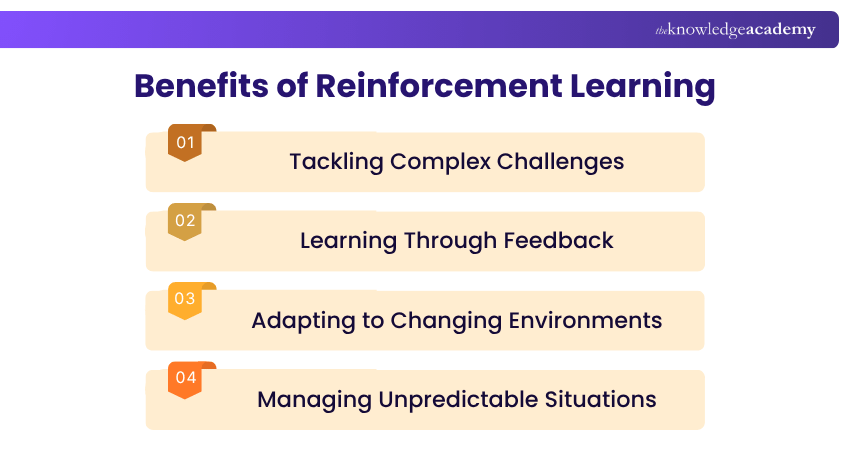
1) Tackling Complex Challenges
a) RL is ideal for solving complex problems with multiple variables.
b) It can handle situations with uncertain or incomplete information.
c) It is widely used in applications like game-playing, robotics, and optimisation.
d) RL can be particularly useful for sequential decision-making problems where fixed rules or traditional approaches may be difficult to design.
2) Learning Through Feedback
a) RL enables agents to improve their behaviour based on rewards and feedback from previous actions.
b) Agents learn which actions are more likely to produce favourable long-term outcomes.
c) The process helps agents improve performance over time.
d) It allows for continuous learning and refinement of actions.
3) Adapting to Changing Environments
a) RL agents can adjust their behaviour as environmental conditions change.
b) They learn from new interactions and update their strategies based on the feedback received.
c) RL enables agents to adapt to different situations.
d) This makes it useful in dynamic environments where conditions may not remain constant.
4) Managing Unpredictable Situations
a) RL is useful in unpredictable environments with unclear outcomes.
b) Agents adjust strategies based on the rewards or penalties they receive.
c) They can modify their decisions as new information and experiences become available.
d) This adaptability can help agents operate more effectively in complex and changing scenarios.
Design, train and optimise deep learning models for real-world business with our Deep Learning Course – Join now!
Challenges Faced in Reinforcement Learning
Despite its benefits, reinforcement learning also faces some challenges that make it difficult to implement in certain cases. Here are some common challenges:
1) Managing Delayed Rewards
a) In many cases, rewards are delayed and not immediately visible after an action.
b) It becomes difficult to link actions to rewards in such scenarios.
c) Handling delayed rewards requires advanced techniques to track the connection between actions and outcomes.
d) Proper credit must be assigned to actions, even if the reward comes after a long delay.
2) Limited Interpretability of Models
a) Reinforcement learning models can be complex and hard to understand.
b) It can be challenging to determine why an agent made a certain decision.
c) The agent’s behaviour may be influenced by many factors, making transparency difficult.
d) This absence of clarity can be a barrier in sensitive fields like healthcare or finance.
3) High Experience Requirements for RL Agents
a) RL agents often need significant experience to learn effectively.
b) Gaining this experience can be time-consuming and require a lot of resources.
c) The need for extensive experience can slow down the learning process.
d) For example, a robot may have to perform thousands of tasks before mastering a specific skill.
The Future Prospects of Reinforcement Learning
Reinforcement learning holds immense potential in transforming industries by enabling machines to learn from interaction and make optimal decisions. As computing power and data availability grow, RL is expected to play a critical role in shaping intelligent systems across various domains.
Key prospects of reinforcement learning include:
1) Autonomous Systems: Improved decision-making and adaptability in robotics, drones and self-driving vehicles.
2) Healthcare: Continued research into personalised treatment strategies, treatment optimisation and clinical decision support, subject to rigorous safety and clinical validation.
3) Finance: Smarter trading algorithms and risk management tools.
4) Gaming and Simulation: Creating more realistic and adaptive game AI.
5) Energy Management: Efficient grid systems and smart resource allocation.
6) Industrial Automation: Better control in manufacturing and supply chains.
7) Personalised Recommendations: Adaptive systems in e-commerce and content delivery.
8) Education: Customised learning paths through intelligent tutoring systems.
Build intelligent agents that deliver measurable results with the AI Agents Foundation and Practitioner (The Builders) Course – Join now!

Richard Harris creates technically detailed yet accessible content on full-stack development, software architecture and modern development frameworks. His knowledge of frontend and backend technologies helps developers understand how scalable, efficient and high-performing applications are designed and built.
View Detail

 If you wish to make any changes to your course, please


