




We may not have the course you’re looking for. If you enquire or give us a call on +44 1344 203 999 and speak to our training experts, we may still be able to help with your training requirements.
What is PI Planning in Agile: A Complete Guide
ByThe Knowledge AcademyLast updated on: 18 August 2026
Learn What is PI Planning in Agile, why it matters, how it works, its key goals and benefits, and how Agile teams align, manage risks and plan effectively.

Key Takeaways:
1. PI Planning aligns Agile teams around shared business goals.2. Teams use it to plan work for the upcoming Program Increment.3. It helps identify dependencies, risks and capacity constraints early.4. Successful PI Planning requires preparation and active collaboration.5. Clear PI Objectives give teams a shared direction for execution.
Imagine several Agile teams working on the same product. Priorities are shifting, dependencies are unclear, and teams are losing sight of the bigger picture.
What would you do?
1) Let each team plan independently
2) Resolve conflicts as they emerge
3) Bring everyone together to align priorities and goals
Still unsure which approach would work best? Keep the choice you picked in mind, and let’s explore What is PI Planning in Agile to understand how teams can resolve these challenges and plan together more effectively.
What is PI Planning in Agile?
PI Planning in Agile is a cadence-based event in the Scaled Agile Framework (SAFe) that brings Agile teams, stakeholders and leaders together to align on a shared mission, vision and plan for the upcoming Planning Interval (PI). It is typically a two-day event held every 8 to 12 weeks.
During PI Planning, teams collaboratively plan upcoming work, identify dependencies and risks, assess capacity, and create PI Objectives. The resulting plan gives teams a shared direction for delivering value during the upcoming PI.
In Simple Words:
PI Planning is a SAFe event where Agile teams come together to plan upcoming work, set shared goals and identify risks and dependencies.

Importance of PI Planning
PI Planning is crucial for successful Agile delivery at scale. It provides a structured opportunity for teams to align priorities, collaborate on planning, and commit to shared goals. Here's why it's important:
1) Alignment Across Teams
PI Planning ensures all teams in the Agile Release Train (ART) are working toward the same vision and business objectives.
1) Everyone learns about the company’s goals and customer needs
2) Teams align with the bigger picture through product vision discussions
3) Helps improve how work flows across teams and departments
4) Teams can make better choices with clear priorities
5) Aligns technology efforts with business strategy
6) Reduces duplicate efforts by clarifying who is doing what
2) Improved Collaboration
In business, PI Planning encourages face-to-face or virtual interaction, which thereby enhances communication and trust across teams and stakeholders.
1) Teams build stronger working relationships through regular interaction
2) Open discussions lead to better ideas and solutions
3) Helps avoid resource clashes by spotting team dependencies
4) Creates a supportive environment where everyone feels heard
5) Encourages feedback and continuous improvement
6) Enables shared problem-solving across different functions
3) Early Risk Identification
It surfaces dependencies and potential blockers before development starts, allowing for proactive mitigation.
1) Teams can make plans to reduce risks before they cause trouble
2) Regular reviews help update risk plans as work continues
3) Teams discuss possible problems openly early on
4) A shared “risk board” is used to track and manage risks
5) Teams learn from past risks and apply those lessons
6) Improves response time to unexpected issues during execution
4) Measurable Business Outcomes
PI Planning brings structure to planning and execution, enabling consistent and reliable value delivery.
1) Increased predictability in delivering features and capabilities
2) Reduced waste by eliminating duplicated or misaligned work
3) Faster time to market for new features and innovations
4) Improved customer satisfaction through on-time, value-driven releases
5) Supports better use of resources and budgeting
6) Helps align features with customer and market demand
5) Transparency and Visibility
In PI Planning, everyone from developers to executives gains visibility into priorities, capacity, and progress. It promotes transparency in the work.
1) All teams have the same understanding of what needs to be done
2) Dashboards and boards show progress in real time
3) Teams can track if they’re on track or need to adjust
4) Stakeholders feel more confident with clear, shared information
5) Promotes accountability through visible commitments
6) Keeps leadership informed and involved throughout the PI
Trainer Insight:
PI Planning is not about predicting every detail of the upcoming increment. Its real value comes from creating shared understanding, exposing dependencies and helping teams make realistic commitments together.
Transform team Agility with AI-empowered SAFe® by registering for the AI-Empowered SAFe® For Teams Course now!
How to Prepare for PI Planning in Agile
PI Planning typically follows a structured agenda to help Agile teams plan, align, and commit to a shared set of goals for the upcoming Program Increment.
Are You Ready for PI Planning?
Before the event begins, check whether:
a) The business context and priorities are clearb) The product vision has been communicatedc) The programme backlog is prioritisedd) Key stakeholders are availablee) Team capacity is understoodf) Known dependencies have been identifiedg) Planning tools and facilities are ready
Here are the key steps involved in the process of PI Planning:
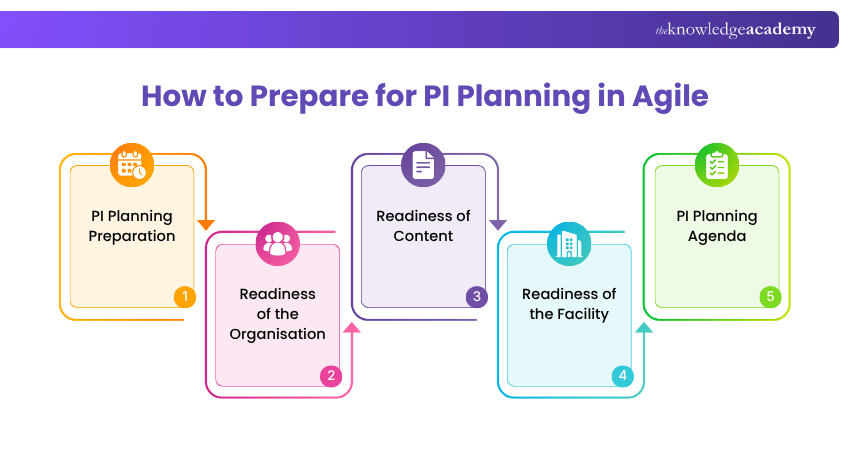
Step 1: PI Planning Preparation
The PI Planning process involves pre- and post-event activities. These preparatory steps, including defined roles and responsibilities, help bring team members, leadership and stakeholders together and create the foundation for planning the upcoming increment.
Step 2: Readiness of the Organisation
Strategic alignment among participants, stakeholders, and business/application owners is paramount. Achieving this alignment involves understanding the scope and context of planning, gaining agreement on business priorities, and ensuring that Agile teams are in place with dedicated team members, Scrum Masters, and Product Owners for each team.
Step 3: Readiness of Content
This stage is a crucial requirement for a clear vision and context. Essential components encompass executive briefings, product vision briefings, and architecture vision briefings, all designed to provide a comprehensive understanding of the landscape.
Step 4: Readiness of the Facility
A collaborative environment is needed for both distributed and co-located teams. This includes suitable locations, technology, planning tools, communication channels and presentation facilities.
Step 5: PI Planning Agenda
It follows a structured two-day schedule where activities are carefully planned and spread across both days. This is to ensure that the event stays focused and achieves its intended outcomes.
Steps of PI Planning in Agile
Once the organisation, people and planning content are ready, the PI Planning event brings teams and stakeholders together to turn that preparation into a coordinated plan for the upcoming Program Increment.
1) Share Business Context and Vision
Leaders and key stakeholders provide the business context, product vision and priorities. This gives teams a common understanding of what the organisation is trying to achieve.
2) Team Breakout Planning
Agile teams work on their plans for the upcoming PI. They consider priorities and capacity while identifying the work needed to achieve their objectives.
3) Identify Dependencies and Risks
Teams compare their plans to uncover cross-team dependencies, risks and potential blockers. These issues can then be discussed and addressed before execution begins.
4) Create PI Objectives
Teams define clear objectives describing what they intend to achieve during the PI. These objectives provide a shared view of the value and outcomes teams are working towards.
5) Review and Refine the Plan
Teams and stakeholders review the emerging plans, address concerns and make adjustments where priorities, capacity, dependencies or risks require changes.
6) Align on the Final Plan
The final planning discussions create a shared understanding of the PI objectives, planned work, dependencies and risks, giving teams a coordinated direction for execution.
What is Capacity in PI Planning?
Capacity in PI Planning represents the ability of Agile teams to complete planned work during a Program Increment (PI). It accounts for factors such as team size, availability, holidays, and historical velocity. During PI Planning, teams assess their capacity to estimate how much work they can commit to within the PI timeline.
Quick Example:
Suppose an Agile team normally has capacity for 100 units of work during a planning period. However, holidays, training and planned leave reduce its available capacity to 80 units.Planning for 100 units could lead to overcommitment. Using the realistic capacity of 80 helps the team create a more achievable plan.
This example shows how considering actual availability can help teams plan work more realistically, avoid overcommitment, and maintain a sustainable pace throughout the increment. Proper capacity management is vital for successful execution and meeting organisational objectives.
Understand and apply DevOps principles within the Scaled Agile Framework with the SAFe® DevOps Certification Training – Join now!
Common PI Planning Challenges and How to Overcome Them
PI Planning can face challenges that affect alignment, realistic planning and smooth execution. Here are some common issues and ways to overcome them:
1) Poor Preparation
Challenge: Teams may arrive with unclear priorities, unrefined backlogs or limited understanding of the business vision.
Solution: Refine backlogs early and conduct pre-PI alignment sessions to ensure teams are prepared.
2) Unmanaged Cross-team Dependencies
Challenge: Teams planning in isolation may overlook dependencies that later cause delays or blockers.
Solution: Use a shared programme board to identify, visualise and manage dependencies during planning.
3) Overloading Team Capacity
Challenge: Teams may commit to more work than they can realistically deliver.
Solution: Estimate capacity based on availability, use realistic sizing and leave room for unexpected work.
4) Analysis Paralysis
Challenge: Spending too much time creating precise estimates can slow planning and create false certainty.
Solution: Use practical estimates and focus on priorities, value and achievable outcomes.
Spot the Mistake:
Three Agile teams complete their PI Planning independently. Each team creates its own objectives and commits to its work. However, nobody discusses cross-team dependencies.What could go wrong?
Team A may need something from Team B before it can continue. If that dependency was never identified, both teams could face delays during execution.Lesson: PI Planning should make dependencies visible before teams commit to their plans.
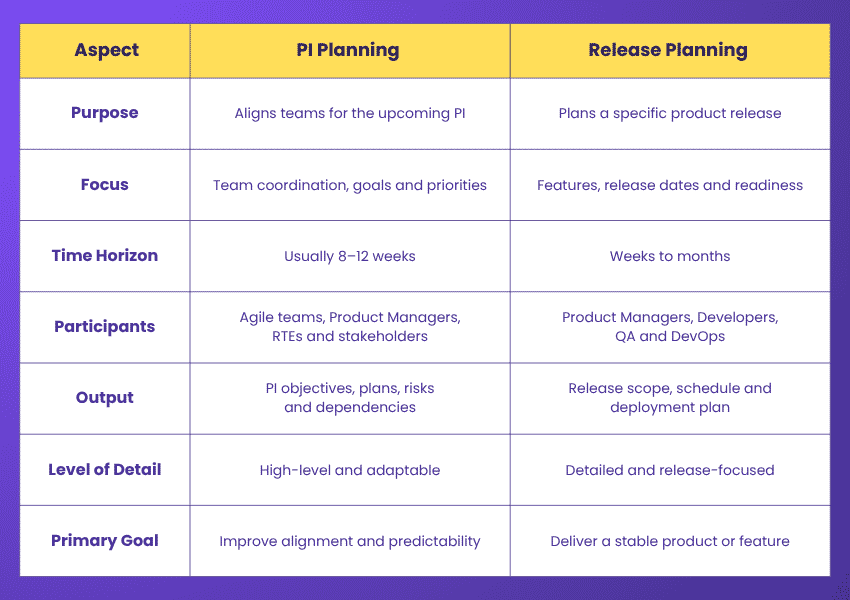
What is the Difference Between PI Planning and Release Planning?
PI Planning is a structured event where all Agile teams come together to plan their work for the next Program Increment, usually covering eight to 12 weeks. The goal is to align teams on priorities, identify dependencies, set objectives, and ensure everyone is moving in the same direction.
On the other hand, Release Planning focuses on deciding when and what features will be delivered to customers. It involves coordinating the release of finished work, often considering factors like market readiness, testing, deployment, and customer value.
Conclusion
Understanding What is PI Planning in Agile helps teams see how structured planning can improve alignment, manage dependencies and create clear objectives for the upcoming Program Increment. PI Planning brings teams and stakeholders together to build a shared direction while keeping plans realistic and adaptable.
Architect your Agile Success with the SAFe® for Architects Training and become a certified SAFe Architect- Register now!

The Knowledge Academy develops accessible learning content across Project Management, IT, Cybersecurity, Data Science, Business Analysis, HR, Accounting and Finance, Leadership and Health and Safety. Its resources combine subject research with clear explanations to help professionals build practical knowledge across a wide range of disciplines.
View Detail

 If you wish to make any changes to your course, please


