


 Top Rated Course

We may not have the course you’re looking for. If you enquire or give us a call on 01344203999 and speak to our training experts, we may still be able to help with your training requirements.
What is Photography: A Beginner’s Complete Guide
The Knowledge Academy 14 July 2026Photography is the Art and practice of capturing images with light, digitally or on film, used in Art, Science, and communication to preserve moments. It blends creativity and technology, allowing Photographers to express ideas and evoke emotions. From portraits to landscapes, Photography captures perspectives and tells powerful stories.

Training Outcomes Within Your Budget!
We ensure quality, budget-alignment, and timely delivery by our expert instructors.
Table of Contents
Related Courses
Have you ever looked at an old photo and instantly smiled, remembering a special moment? That’s the magic of Photography, it freezes time, captures emotions, and turns everyday scenes into lasting memories. From a child’s first steps to a breathtaking sunset, Photography lets us see, feel, and relive moments we never want to forget. It’s more than just clicking a button; it’s storytelling through images.
In this blog, we’ll explore What is Photography, its history, techniques, benefits, and uses. We’ll also look at the different types of Photography that help you capture moments in unique ways and share stories through images like never before.
Table of Contents
1) What is Photography?
2) How Does Photography Work?
3) A Brief History of Photography
4) What is the Purpose of Photography?
5) Technical Basics of Photographic Technology
6) Photography Composition Techniques
7) Benefits of Learning Photography
8) How Photography Changed Art?9) Why is Photography Important?
10) What are the Different Types of Photography?
11) Conclusion
What is Photography?
Photography is the art, science, and practice of creating images by capturing light, either electronically using a digital sensor or chemically using film. It’s a powerful medium for storytelling, documentation, and artistic expression.
Key Elements of Photography:
1) Camera: This is the device used to capture images.
2) Lens: This part focuses light onto the sensor or film.
3) Light: This is the most crucial element; it shapes the clarity and depth of a photo.
4) Composition: This shows how elements are arranged in the frame.
5) Exposure: This involves the amount of light that reaches the sensor, controlled by the aperture, shutter speed and sensor sensitivity (ISO).
1) A Modern Canvas
Before cameras, Artists captured reality through paintings, drawings, and sculptures, which required time and skill. Cameras introduced a new way to create art, instantly capturing reality with precision, like macro shots, and focusing more on how we see rather than how we paint.

2) Evolving Genres
As cameras improved, different Photography styles developed. Portrait Photography captures faces and emotions, landscape Photography shows nature’s beauty, abstract Photography uses patterns and colours for artistic images, Macro Photography reveals tiny details, and Candid Photography captures natural, unplanned moments.
How Does Photography Work?
From early film cameras to today’s digital systems, photography has always relied on one fundamental concept: the exposure triangle. This refers to the three key settings that control how light is captured in an image.
1) Aperture: Aperture refers to the adjustable opening inside the lens that allows light to enter the camera. When the shutter button is pressed, the aperture opens to a selected size. This controls how much light passes through the lens and reaches the sensor.
2) ISO: After light enters through the aperture, it hits either a digital sensor or light-sensitive film. ISO indicates how sensitive this sensor is to light. Higher ISO settings increase the sensitivity, which is helpful in low-light settings, but can introduce noise or grain.
3) Shutter Speed: Shutter speed determines for how long the camera’s shutter remains open. It controls the duration of light exposure and is measured from fractions of a second to several minutes. Faster shutter speeds freeze motion, while slower speeds allow more light and create motion blur.
When aperture, ISO, and shutter speed work together, they determine how much light is captured and how the final image looks. In film cameras, this light is recorded chemically. In digital cameras, the sensor converts it into electronic data to create the image.
A Brief History of Photography
Now that we’ve explored What is Photography, here's a brief overview of the evolution of Photography:
1) Origins of Photography & Black-and-White Beginnings
Photography emerged as a revolutionary medium in the 19th century. The monochrome daguerreotype was a prominent early form. These black-and-white images dominated the field for decades. This was true particularly after silver gelatin prints became the industry standard by the 1890s.
2) Early Experiments in Colour
The foundation of Colour Photography was laid with James Clerk Maxwell’s 1855 three-colour theory, first demonstrated in 1861 via three black-and-white exposures shown in red, green, and blue. Later, Louis Ducos du Hauron expanded on this by inventing subtractive colour printing techniques in the late 1860s.
3) Autochrome & the Dawn of Commercial Colour
The Lumière brothers introduced the Autochrome Lumière process around 1907. It’s an additive, mosaic-based colour plate that uses dyed potato starch grains. It became the first commercially successful colour method and remained widely used until the 1930s.
4) Emergence of Kodachrome & Mass Colour Photography
Eastman Kodak revolutionised the industry by launching Kodachrome film in 1935. This multilayer emulsion film made Colour Photography more practical and accessible. It quickly became the preferred format for both amateur and professional Photographers.
5) Digital Revolution & Contemporary Trends
The late 20th century brought digital sensors into the fold. Innovations like the CCD sensor and Bayer filter enabled cameras to capture full-colour images electronically. This marked the era of digital Colour Photography as we know it.
What is the Purpose of Photography?
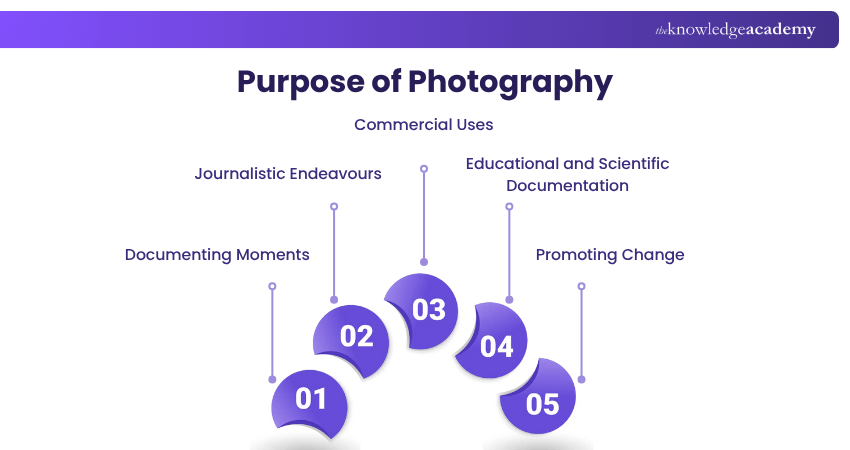
Photography has been used for many purposes throughout history. It helps us capture memories, tell stories, share emotions, and show the world from different perspectives. From personal milestones to global events, Photography plays an important role in our lives and highlights its versatility through different types and uses.
1) Documenting Moments
Photography helps us capture and save special memories. It turns personal milestones into lasting treasures we can revisit anytime. For example:
a) Baby’s first steps captured forever
b) Wedding photos to relive joyful moments
c) Family pictures act as visual diaries
Incorporating techniques like the Rule of Thirds can make these images balanced, beautiful, and unforgettable.
2) Journalistic Endeavours
Photography plays a big role in telling real-life stories and sharing important events with the world. Through photojournalism, we get an honest look at what’s happening globally. For example:
a) War Photography captures the struggles and sacrifices of people
b) Disaster Photography shows the impact of floods, earthquakes, and fires
c) Historic event coverage preserves moments that shape society
These photos offer a clear and powerful view of reality.
3) Commercial Uses
In the business world, Photography is used to sell products and build brands. High-quality photos make products look attractive and appealing. For example:
a) Fashion Photography highlights style and elegance
b) Food Photography makes dishes look delicious and tempting
c) Product and Real Estate Photography help customers visualise and decide better
Adding creative captions can make these images even more engaging and effective.
4) Educational and Scientific Documentation
Photography supports learning and research by making complex ideas easier to understand. It is used in many ways to record and explain discoveries. For example:
a) Experimental Photography documents results in labs
b) Wildlife Photography captures rare species in their natural habitat
c) Space and Microscopic Photography reveal what we can’t see with our eyes
These images also act as evidence for scientific studies.
5) Promoting Change
Photography can inspire people and create awareness about important issues. Strong images often move people to take action and bring positive change. For example:
a) Environmental Photography highlights the effects of climate change
b) Human Rights Photography shows struggles and injustice
c) Activism Photography spreads awareness and drives support
These photos are a powerful tool for social impact and change.
Understand the fundamentals of effective storytelling and strong screenwriting. Join our Filmmaking Course now!
Technical Basics of Photographic Technology
Besides understanding What is Photography, the technical basics of this field means understanding how a camera works and how to use it to take good photos. A camera captures pictures by using light, and learning a few simple settings helps you make your photos clear and beautiful. These basics help you take better, brighter, and sharper photos.
Key Points:
1) Camera: A tool that takes pictures by letting in light
2) Aperture: The hole in the lens that controls how much light goes in
3) Shutter Speed: How fast or slow the camera takes a photo
4) ISO: Controls how bright or dark the photo looks
5) Focus & Composition: Makes the subject clear and the photo look nice
Photography Composition Techniques
Good composition makes photos look better and more interesting. Here are some techniques explained in a little more detail:
1) Rule of Thirds: Balanced Framing
Divide your photo into a 3x3 grid. Place your subject on the lines or corners instead of the centre. This makes the photo look balanced and more natural.
2) Leading Lines: Guiding the Viewer
Use things like roads, rivers, fences, or paths to guide the viewer’s eyes. These lines naturally pull attention towards the main subject and add depth to the photo.
3) Framing: Highlighting the Subject
Use objects like windows, doors, trees, or arches to create a natural frame around the subject. This makes the subject stand out and gives the photo more focus.
4) Symmetry: Creating Harmony
Keep both sides of the photo equal for a neat and balanced look. Things like building reflections, butterfly wings, or patterns can make the photo pleasing to the eye.
5) Depth: Layered Storytelling
Add objects in the foreground, middle, and background to create a 3D effect. This makes the photo look richer and tells a better story.
6) Negative Space: Simplifying the Scene
Leave empty space around your subject to make it stand out more. This technique makes the photo simple, clean, and powerful.
7) Patterns and Textures: Adding Intrigue
Capture repeated shapes or surface details like tiles, fabrics, or ripples in water. Patterns are soothing, and textures make the photo feel real.
8) Fill the Frame: Emphasising Details
Go close to your subject or zoom in to remove distractions. This lets you show small details and makes the photo more focused and clearer.
9) Juxtaposition: Telling Contrast Stories
Place opposite things together in one photo, like old and new, big and small, or light and dark. This creates contrast and tells a strong visual story.
Benefits of Learning Photography
Learning Photography offers a wide range of benefits, from personal enrichment to professional advancement.
1) Personal Growth and Development:
a) Creativity: Enhance your creativity and explore new forms of expression through Photography.
b) Perspective: Gain a new perspective on the world, appreciating the beauty and intricacy of daily life.
c) Connections: Forge meaningful connections with others by sharing your visual stories.
2) Professional Development:
a) Career Skills: Strong Photography skills are valuable in fields like marketing, advertising, and any profession that relies on visual communication, core topics frequently addressed in Photography Interview Questions and Answers.
b) Effective Messaging: Photographs are crucial for effectively communicating messages and generating Photography Ideas, helping businesses engage with their audience.
3) Additional Benefits:
a) Stress Relief: Photography can be a relaxing and therapeutic activity, providing a break from daily stress.
b) Memory Preservation: Capture and preserve important moments and memories.
c) Technical Skills: Learn and master technical skills related to camera operation, lighting, and editing.
d) Portfolio Building: Create a portfolio that showcases your work, which can be useful for personal satisfaction or professional opportunities.
Enhances creativity and artistic skills to craft unique styles and trends. Join our Fashion Designing Training now!
How Photography Changed Art?
As Photography grew in popularity, it emerged as a powerful art form and transformed the purpose of traditional artistic practices, especially drawing and painting. Photographs offered a level of accuracy and realism that was difficult to achieve through manual illustration. Here's how Photography changed Art:
1) Replacement of Drawings in Visual Media: Photography replaced drawings in newspapers, advertisements, textbooks, portraits and many commercial art forms.
2) Increased Accessibility and Affordability: It made art more portable and affordable. It removed the exclusivity previously associated with hand-painted artworks.
3) Shift in Social Perception of Art: Portraits became available to all which led to some resistance from upper-class critics who felt Photography cheapened traditional art.
4) Rise of Abstraction in Other Art Forms: With Photography handling realism, Painters and Sculptors explored abstraction and emotional expression.
5) Reduced Need for Realistic Manual Artwork: Artists no longer needed to spend extensive time creating detailed, realistic depictions. Photographers could document scenes quickly.
6) Departure from Realism in the 20th Century: Many painters moved away from realism during the early 20th century, influenced by Photography’s transformative role.
7) Evolution into New Artistic Movements: From Impressionism to Pop Art, Artists shifted from realism, eventually blending Photography with painting in movements like Pop Art and hyperrealism.
Why is Photography Important?
Photography is important because it helps us keep memories and share them with others. A photo can save a moment forever and show feelings without using words.
Some reasons why Photography is important:
1) Keeps Memories: Saves special times like birthdays, weddings, and trips
2) Tells Stories: Shows what happened in just one picture
3) Shows Creativity: Lets you share your ideas in photos
4) Gives Information: Helps people learn through news, school, or social media
5) Helps Change Things: Strong photos can make people think and act
What are the Different Types of Photography?
Photography has many types, and each is used for a different purpose. Here are some common Types of Photography:
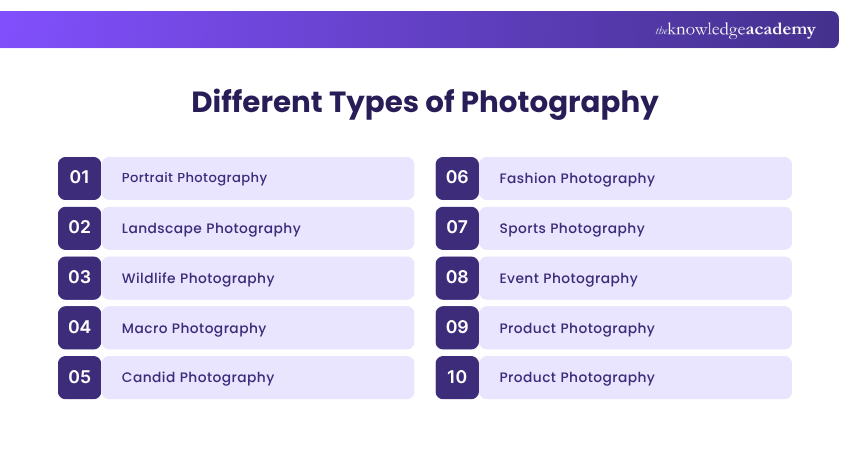
1) Portrait Photography: Takes pictures of people’s faces and expressions. It shows their feelings, moods, and personality.
2) Landscape Photography: Captures nature like mountains, rivers, and skies. It shows the beauty of the world around us.
3) Wildlife Photography: Takes photos of animals and birds in their natural homes. It helps us see and understand wildlife better.
4) Macro Photography: Shows tiny objects up close, like insects or flowers. It helps us notice small details we often miss.
5) Candid Photography: Captures natural, unplanned moments full of real feelings. It makes photos look real and lively.
6) Fashion Photography: Takes pictures of clothes, style, and trends. It makes fashion look creative and attractive.
7) Sports Photography: Freezes fast movements during games or sports events. It helps us relive exciting action moments.
8) Event Photography: Covers weddings, parties, and celebrations. It keeps special memories safe forever.
9) Product Photography: Makes products look attractive for ads, shops, and websites. It helps people decide what to buy.
10) Architectural Photography: Captures buildings and designs in a beautiful way. It shows the shape, style, and details of structures.
Conclusion
When we ask What is Photography, the answer goes beyond just taking pictures. It is about capturing memories, telling stories, and expressing creativity. From portraits to landscapes and candid shots, Photography helps us see the world in new ways. By learning the basics, beginners can explore their style and skills, making Photography the art of freezing moments to keep forever.
Engage in hobbies to positively impact your career and life with our Hobbies & Interests Courses - Join now!
Frequently Asked Questions
What are the 5 C's of Photography?

The five C's of Photography are:
a) Camera: The tool for capturing images
b) Condition: The environment and lighting conditions
c) Composition: The arrangement of elements within a frame
d) Creativity: The ability to think outside the box.
e) Concept: The idea or theme behind the image
What Equipment Do I Need as a Beginner Photographer?
The main equipment that is needed as a beginner is as follows:
a) Camera
b) Lens
c) Processing Software
d) Tripod Stand
e) Cleaning Kit
f) Batteries
These are the main basic equipment that are needed as a beginner to start and enhance your Photography skills.

The Knowledge Academy


Global Training Provider
The Knowledge Academy is a world-leading provider of professional training courses, offering globally recognised qualifications across a wide range of subjects. With expert trainers, up-to-date course material, and flexible learning options, we aim to empower professionals and organisations to achieve their goals through continuous learning.


 If you wish to make any changes to your course, please


