


 Top Rated Course

We may not have the course you’re looking for. If you enquire or give us a call on 01344203999 and speak to our training experts, we may still be able to help with your training requirements.
What is MERN Stack? A Compherhensive Guide
Richard Harris 16 July 2026MERN Stack is a JavaScript framework combining MongoDB, Express, React, and Node.js to create fast, scalable, and dynamic web applications. It enables developers to use a single language across front-end and back-end, creating scalable, dynamic, and efficient apps while streamlining development and enhancing user experiences.

Training Outcomes Within Your Budget!
We ensure quality, budget-alignment, and timely delivery by our expert instructors.
Table of Contents
In today’s fast-paced digital world, building web applications that are both powerful and efficient is no longer optional, it’s essential. The MERN Stack has emerged as a game-changer, enabling developers to create dynamic, high-performance apps quickly using a single language across the entire development process.
By combining MongoDB, Express, React, and Node.js, MERN streamlines development while ensuring scalability and responsiveness. In this blog, you will explore What is MERN Stack, how the MERN Stack works, its core advantages, and why it’s become a preferred choice for modern web development.
Table of Contents
1) What is the MERN Stack?
2) How Does the MERN Stack Work?
3) MERN Stacks vs Other JavaScript Stacks
4) Advantages of Using the MERN Stack
5) Challenges of Working with the MERN Stack
6) What Does a MERN Stack Developer Do?
7) Conclusion
What is the MERN Stack?
The MERN Stack is a set of technologies that is developed on the JavaScript platform to create scalable and robust web-based applications. MERN is also an acronym that means MongoDB, Express, React, and Node.js, but each of them has a distinct role in the development process.
These technologies form a complete, streamlined, holistic development approach. The combination contributes to making MERN a favourable solution for developers who want to create efficient, dynamic, and high-performance web apps.

How Does the MERN Stack Work?
Image Suggestion:
The MERN Stack operates as a connected unit to deliver data-driven web applications.
Here's how each component of the stack comes into play:
1) The stack starts with MongoDB, where all your application data is stored.
2) On the server side, Express.js acts as the framework that simplifies routing and managing HTTP requests.
3) For the front end, React.js provides the tools needed to create rich, dynamic user interfaces.
4) The server-side JavaScript engine, Node.js allows for non-blocking, event-driven communication
Build a strong foundation in functional programming with our Haskell Programming Training - Join now!
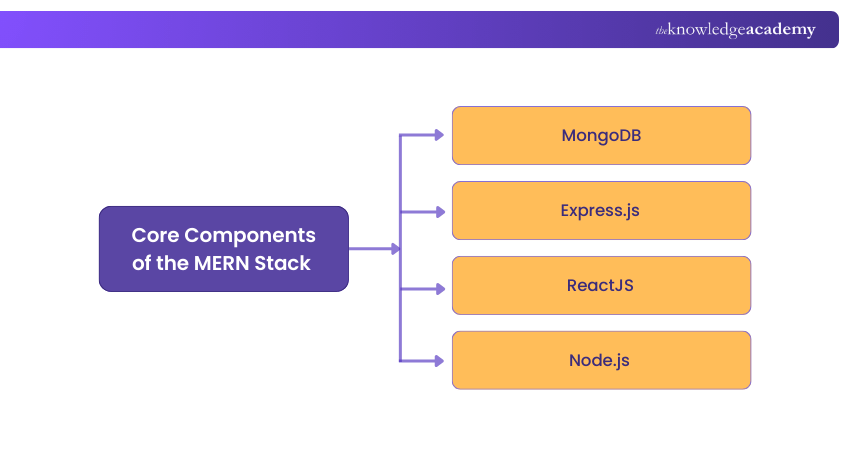
Core Components of the MERN Stack
The MERN Stack is an impressive full-stack model that permits developers to develop dynamic and execution-intensive web applications in one language, JavaScript. The core components of MERN Stack are:
1) MongoDB
MongoDB is a NoSQL database in which information is represented on the basis of JSON-like documents featuring key-value pairings. It enables the developers to produce databases, shape schemas, and maintain collections with efficiency. The Mongo shell allows people to query, update, and manipulate records using JavaScript commands. It is scalable and can be used in modern applications due to its flexible structure.
2) Express.js
Express.js is a Node.js backend that makes server-side development simpler. It offers a powerful collection of features and middleware to process requests, routing, and APIs. Express makes it possible to create maintainable and efficient backend systems by minimising the number of lines of redundant code. It provides the ease of communication between the front-end and the database layers.
3) ReactJS
ReactJS is a JavaScript front-end user interface builder to create/build single-page web apps. It enables developers to design reusable user interfaces and dynamically operate content. React provides a fast render and smooth user interaction with the use of a virtual DOM. It is also compatible with other MERN components to develop it as a full stack.
4) Node.js
Node.js is an open-source server-side JavaScript engine. It is released along with npm (Node Package Manager), which has access to thousands of packages and modules. Node.js is based on V8 of Chrome, which is a fast engine with the scalability of network programmes. It consists of the core of the server-side processes of the MERN Stack.
Enhance your application development skills with our Visual Basic Course - Sign up today!
MERN Stacks vs Other JavaScript Stacks
The MERN Stack is a widely used full-stack JavaScript framework, but other stacks offer different front-end, back-end, and database combinations. Each stack has unique advantages depending on the project type, scalability needs, and developer preference.
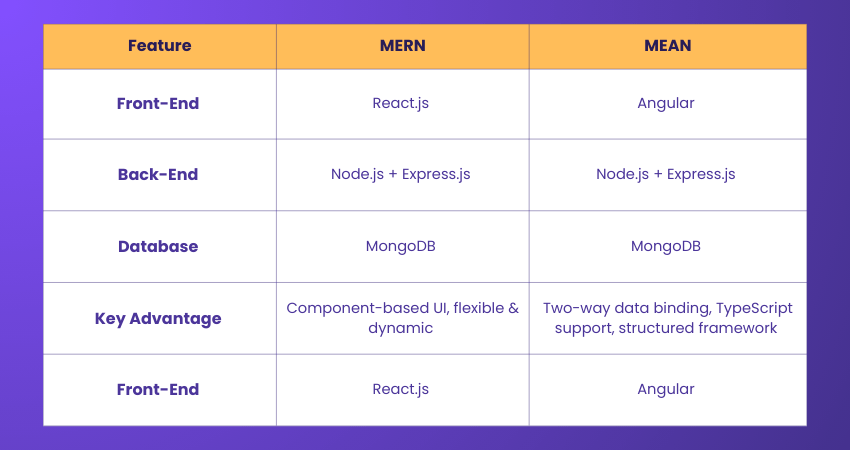
1) MERN Stack vs. MEAN Stack
MERN and MEAN share the same back-end (Node.js + Express.js) and database (MongoDB), but differ in front-end frameworks. MERN uses React for dynamic UIs, while MEAN uses Angular for a structured, feature-rich front-end. The key difference that distinguishes between what is MERN Stack and MEAN Stack are as follows:
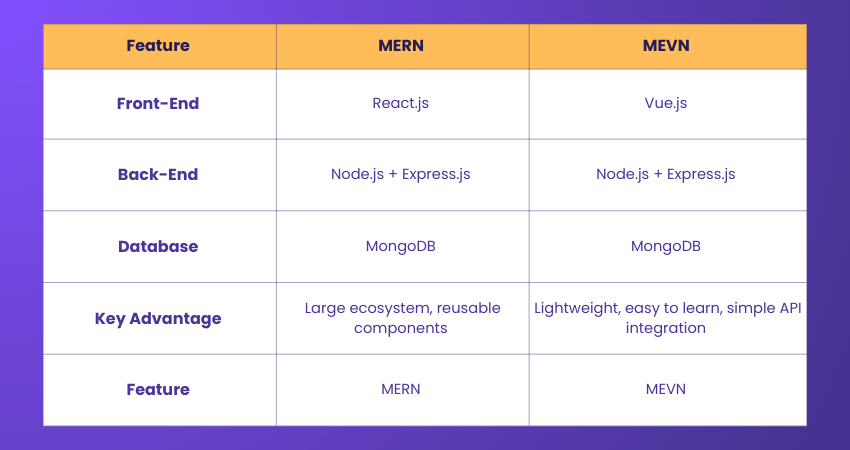
2) MERN Stack vs. MEVN Stack
MEVN replaces React with Vue.js, offering a lightweight and flexible front-end. MERN’s React ecosystem is larger, making it better for complex, interactive applications. The key difference that distinguishes between what is MERN Stack and MEVN Stack are as follows:
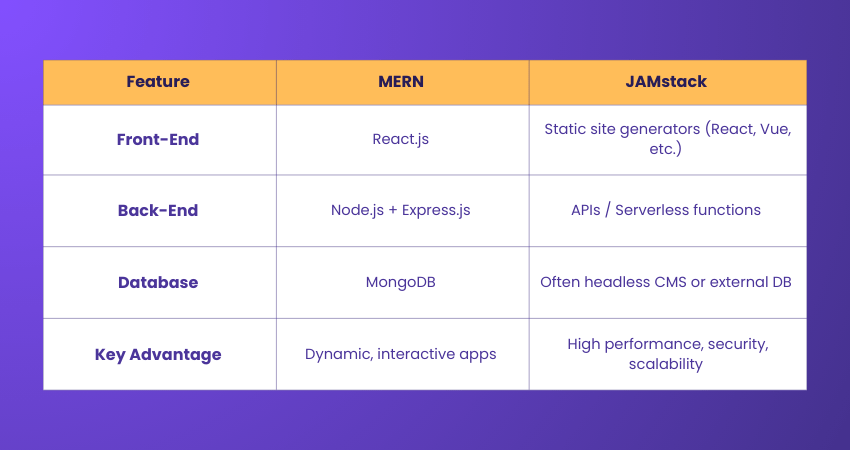
3) MERN Stack vs. JAMstack
JAMstack focuses on pre-rendered static sites with APIs and serverless functions, while MERN builds fully dynamic, database-driven apps. JAMstack is faster and more secure for content-heavy websites. The key difference between MERN Stack and JAMstack are as follows:
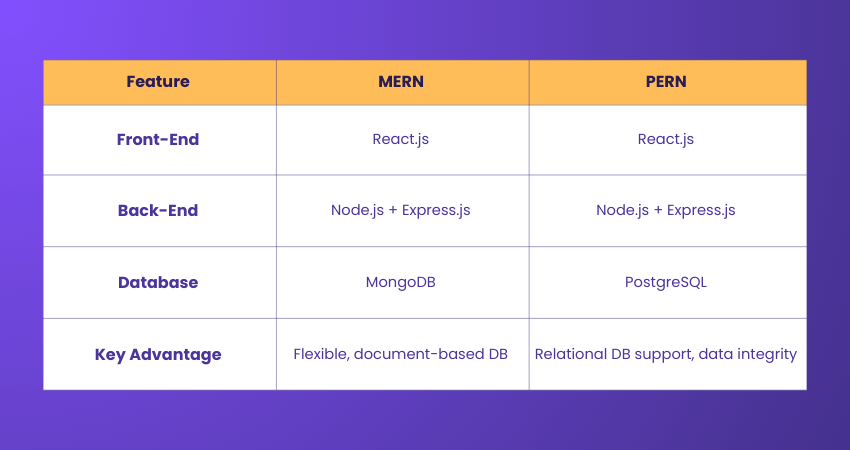
4) MERN Stack vs. PERN Stack
PERN is similar to MERN but uses PostgreSQL instead of MongoDB. It is better for relational data and applications requiring strong consistency. The key difference between MERN Stack and PERN Stack are as follows:
Advantages of Using the MERN Stack
Now you know What is MERN Stack, a solution providing a powerful, full-stack JavaScript environment, which is easy to develop with and offers high-performing web-based applications. The combination of technologies it provides guarantees its efficiency, scalability, and ease of use. The main benefits are:
1) Unified Language Stack
MERN applies JavaScript on both the back and front-end, so that one does not need to learn multiple languages. This single method accelerates the growth of the project, minimises the complexity, and assists in ensuring uniformity of the project.
2) Scalability
Combining the flexible NoSQL design of MongoDB and the non-blocking architecture of Node.js, MERN applications can be scaled horizontally to meet the needs of increasing data and traffic. This renders it suitable for huge and dynamic applications that require a fast adjustment.
3) Flexibility
MongoDB gives the developer an easy time working with complex and unstructured data, and the component-based design of React enables building dynamic user interfaces. The adaptable architecture of MERN allows adding new features quickly and developing an app in an efficient way.
4) Cost-effective
MERN Stack has taken advantage of a huge open-source library, tools, and modules ecosystem to minimise the cost of development. Having the same language that is used in the entire stack also reduces the resources required, hence making it cost-effective for businesses.
5) Great for Building Single-page Applications (SPAs)
The component-based nature of React allows easy interactive SPAs, which are capable of updating rendering without performing full page reloads. This guarantees the user a smooth experience and increases the interest in web applications today.
Develop dynamic, modern user interfaces with our ReactJS Course - Sign up now!
Challenges of Working with the MERN Stack
The MERN Stack is a powerful and full-stack environment based on JavaScript, but developers might experience some problems in relation to the size of their project and their level of expertise. Be aware of these challenges when working with MERN Stack:
1) Learning Curve
Even though MERN is built using a single language throughout the stack, it may be confusing to the novice to learn all four languages (MongoDB, Express.js, React, and Node.js) at the same time. The nature of front-end and backend technologies means that it takes time and experience to be skilled in them.
2) Potential SEO Challenges
Single-page applications (SPAs) based on React have potential risks of being limited in SEO since they are dynamically rendered on the client. Some solutions (server-side rendering, SSG) are possible, but they introduce complexity, which may be a challenge to implement for developers who are new.
3) Complex State Management in React
React state management. The state management in React may pose a challenge when the project starts to increase in size and complexity. Libraries such as Redux or Context API are also commonly required by developers to manage state effectively, which further increases the learning needs and code handling.
4) Database Performance with MongoDB
The seamless pattern of MongoDB is flexible enough, yet it may hinder processing complicated relational data. It may be challenging to maintain data consistency and establish relationships with entities, particularly in large applications with vast amounts of data.
What Does a MERN Stack Developer Do?
The task of a MERN Stack developer is to create full-stack web applications with the help of a JavaScript-based technology stack. They deal with the front-end and the backend, which makes them easy to integrate and functional.
Key Responsibilities:
1) Create and develop reactive user interfaces with React.js
2) Implement server-side handicraft and APIs utilising Node.js and Express.js
3) Manage and integrate databases with MongoDB
4) Transform business needs into technical solutions
5) Coordinate with designers, developers, and other stakeholders so that the project becomes successful
6) Be abreast with the current tools, frameworks, and good practices within the MERN ecosystem
Conclusion
The MERN Stack is a powerful full-stack framework that enables developers to build modern, scalable web applications using JavaScript. Its unified architecture supports efficient development, high performance, and dynamic user experiences. While it offers flexibility and cost efficiency, understanding its challenges is important. Overall, MERN remains a strong choice for developers aiming to build robust, future-ready applications.
Elevate your tech career with industry-leading programming with our Object Oriented Programming (OOPs) Course - Register Today!
Frequently Asked Questions
Is MERN Stack better than full-stack Java?

The MERN Stack is often preferred for modern, JavaScript-driven web applications due to its flexibility and faster development cycle. However, full-stack Java is better suited for large-scale, enterprise applications requiring strong type safety and complex business logic. The better choice depends on project requirements, scalability needs, and team expertise.
Is MERN a Backend or Frontend?
MERN is a full-stack JavaScript framework that covers both front-end and back-end development.
React.js handles the front-end, creating dynamic user interfaces, while Node.js and Express.js power the back end. It helps in managing server-side logic and APIs. MongoDB serves as the database, completing the stack.

Richard Harris


Senior Full Stack Developer and Technology Educator
Richard Harris is a highly experienced full-stack developer with deep expertise in both frontend and backend technologies. Over his 12-year career, he has built scalable web applications for startups, enterprises and government organisations. Richard’s writing combines technical depth with clear explanations, ideal for developers looking to grow in modern frameworks and tools.


 If you wish to make any changes to your course, please


