




We may not have the course you’re looking for. If you enquire or give us a call on 01344203999 and speak to our training experts, we may still be able to help with your training requirements.
What is Globalisation and How Does it Impact Us?
ByThe Knowledge AcademyLast updated on: 02 October 2026
Globalisation links economies, cultures, and trade across the world, powered by technology, communication, and international business exchange. It widens access to markets and encourages innovation. It also connects people more closely through shared ideas, global collaboration, and stronger cross-border relationships.
What You Should Know
1. Globalisation connects countries through trade, technology, investment, and cultural exchange.2. It can create opportunities for businesses while also introducing economic and social challenges.3. Different forms of globalisation affect economies, societies, and digital connections in distinct ways.4. Globalisation can influence jobs, living standards, cultural exchange, and international cooperation.5. Understanding its benefits and challenges helps explain how the global economy continues to evolve.
In a highly connected world, goods, services, information, and ideas increasingly move across borders. Ideas and digital services can move across borders almost instantly, while physical products move through international supply chains. Businesses and people interact globally every single day.
Many readers still ask, “What is globalisation?” and search for the meaning of globalisation in simple terms. From online shopping to international job opportunities, its influence is everywhere. Now, let’s break down how it actually works.
What is Globalisation?
Globalisation is the process through which countries, businesses, and people become increasingly interconnected through trade, investment, technology, communication, and cultural exchange. It can facilitate innovation and the spread of ideas and cultural elements.
It helps businesses expand beyond domestic markets, and it enables diversity by allowing the rapid flow of goods, services, and information. This encourages cultural exchange, economic integration, and international cooperation.

Reasons for Globalisation
Globalisation has grown quickly because of several important reasons that make it easier for countries and businesses to work together:
1) Better Transport: Bigger ships and faster travel have made it cheaper and quicker to move goods and people between countries.
2) Lower Costs with Bigger Scale: Companies can produce more items at once, which reduces the cost per item. This makes it easier to sell products in many countries.
3) Easier Trade Between Countries: Organisations such as the World Trade Organization (WTO) provide rules and a forum for negotiating lower trade barriers and improving market access between members.
4) Improved Communication: The internet and mobile phones allow people and businesses in different parts of the world to connect instantly.
5) Access to Global Labour Markets: Businesses can access workers with different skills and labour costs across countries. This has encouraged the international distribution of activities such as manufacturing, customer service, IT services and professional work.
All these reasons help bring the world closer together and make it easier for businesses and people to connect globally.
Impact of Globalisation on Society
Globalisation has influenced societies in many ways, shaping cultures by creating both diversity and similarity. It brings a mix of positive and negative effects. Let us see the impacts of globalisation for a better understanding:
1) Heterogeneous Society
Globalisation has brought people from different backgrounds together. In many countries, there’s now a mix of cultures, languages, and beliefs. This diversity creates richer experiences in food, music, fashion, and festivals. It also encourages new ideas and helps people understand different ways of life.
2) Homogeneous Society
Local cultural differences can become less distinct as global brands, media, and products spread across markets. For example, high streets in many countries now look similar, with the same chain stores and fast-food outlets. This can lead to a loss of local identity.
3) Positive Impacts
1) More Trade and Jobs: Businesses can sell their products worldwide. It creates jobs and boosts economies.
2) Better Communication: The internet and phones help people stay connected, irrespective of their location.
3) Cultural Exchange: People learn from each other, share traditions and become more open-minded.
4) Access to New Products: Globalisation imports a wider range of goods to different countries.
5) Faster Spread of Ideas: International collaboration can accelerate the exchange of ideas in areas such as science, health research and education.
Understand how your organisation can have a positive impact globally with Corporate Social Responsibility CSR Training - Join now!
What are the Different Types of Globalisation?
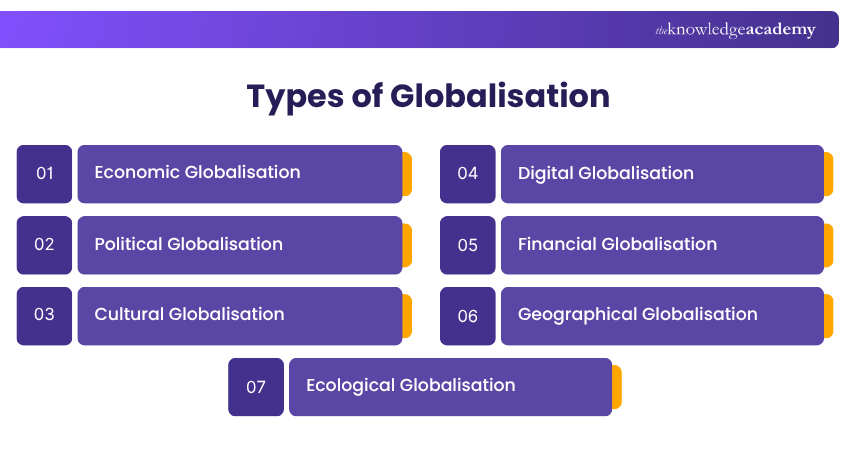
Globalisation can be understood through several interconnected dimensions, including the following:
1) Economic Globalisation
Economic globalisation integrates national economies with global markets through freer trade and capital movement. It is often associated with lower trade and investment barriers and greater economic interdependence.
2) Political Globalisation
Political globalisation strengthens cooperation between nations through shared rules, treaties, and global institutions. It can increase international coordination and common standards for governance and trade.
3) Cultural Globalisation
Cultural globalisation spreads ideas, values, and lifestyles across borders through communication and media. It increases cultural exchange and shapes shared global experiences.
Quick Check: Spot the Type of Globalisation
Identify which type of globalisation best fits each situation:
1. A business begins selling products in several international markets → Economic Globalisation2. Countries cooperate through treaties and international organisations → Political Globalisation3. Food, music, fashion, and entertainment spread across different countries → Cultural Globalisation
4) Digital Globalisation
Digital globalisation refers to the cross-border exchange of information, services, data and communication enabled by digital technologies and the internet. It connects people worldwide, enabling innovation and collaboration. However, it also presents challenges such as digital divides, data privacy concerns and cybersecurity risks.
5) Financial Globalisation
Financial globalisation refers to the increasing integration of financial markets across countries, enabling cross-border flows of capital, investment and financial services. It supports economic growth, connects investors globally, and widens access to funding. However, it can also expose weaker economies to economic instability, market volatility, and currency fluctuations.
6) Geographical Globalisation
Geographical globalisation emphasises the interconnectedness of regions and countries through physical, economic, and social networks. It promotes global trade routes, international collaborations, and mobility. While it strengthens global ties and resource sharing, it can also contribute to pressures related to urbanisation, resource demand, and unequal access to opportunities.
7) Ecological Globalisation
Over recent decades, countries and international organisations have worked together to address global environmental challenges such as climate change, deforestation, and biodiversity loss. While it promotes international cooperation to address these issues, it also highlights the disparities between nations in terms of responsibility and resources, making global environmental solutions complex yet an essential element for sustainable development.
Make effective supply chain decisions with our Introduction to Supplier Management Course – Register today!
What are the Advantages and Disadvantages of Globalisation?
Globalisation has changed how countries, businesses, and people connect and operate. While it brings many benefits, it also comes with challenges. Let’s look at its key advantages and disadvantages.
Advantages of Globalisation
a) Employment Growth: Special Economic Zones (SEZs) and export-oriented industries create large numbers of new jobs. Multinational companies also hire workers from different regions due to lower labour costs.
b) Increase in Compensation: Foreign investment can create higher-skilled roles and, in some markets, offer competitive wages and training opportunities. However, the effects vary by industry, country and type of employment.
c) Higher Standard of Living: Greater access to global goods, services, and income opportunities improves living conditions. People working in international sectors experience improved purchasing power and lifestyle.
d) Cultural Understanding: Globalisation promotes travel, communication, and interaction between societies. Exposure to diverse cultures encourages cooperation and mutual awareness worldwide.
e) Economic Growth: Developing countries gain foreign investment, capital, and advanced technology. This strengthens industries and helps raise national income levels.
Did You Know?
In 2025, the five largest services exporters among developing economies were all in Asia and accounted for 57% of developing economies’ services exports.Source: UN Trade & Development
Disadvantages of Globalisation
a) Market Instability: Greater exposure to international competition can put pressure on domestic industries that struggle to compete with lower-cost or more efficient producers. Outsourcing and changes in production locations can also affect employment in particular sectors.
b) Environmental Damage: Global transportation and large-scale production increase greenhouse gas emissions. Resource-based industries may shift locations, leading to deforestation, overfishing, and ecological harm.
c) Global Economic Recessions: Highly connected economies spread financial crises quickly across countries. Events like the 2007–2009 global financial crisis and recession showed how problems in one region can affect the entire world.
The Evolving Future of Globalisation
Globalisation continues to evolve as technology, trade policy and geopolitical relationships change. Advances in technology, such as Artificial Intelligence (AI), the Internet of Things (IoT), and digital connectivity, are driving deeper global integration.
You may notice a shift towards regional partnerships and local empowerment as nations balance global cooperation with protecting their own interests. The focus is increasingly on creating a fairer, more inclusive form of globalisation that prioritises equality, sustainability, and resilience. Understanding this evolution helps you prepare for the opportunities and challenges that lie ahead.
What is an Example of Globalisation?
A strong example of globalisation in action is Apple Inc., a company that reflects how modern businesses operate across borders to design, manufacture, and distribute their products worldwide. Here's how:
1) Global Supply Chain: Apple operates a global supply chain involving thousands of supplier facilities across more than 60 countries, covering components, manufacturing, logistics and services.
2) International Manufacturing: Apple continues to assemble products through manufacturing partners in China and other countries, while its supply chain has also expanded in markets such as India.
3) Design and Innovation in the US: While manufacturing happens abroad, Apple’s product design, software development, and key business decisions are handled at its California headquarters, showing how Research and Development (R&D) and creativity remain centralised.
4) Global Distribution and Sales: Apple distributes products and services across markets worldwide through retail, online and partner channels. Whether you're in London, Tokyo, or Mumbai, you’ll find the same Apple devices, often with local support and language compatibility.
5) Cultural Impact: Apple's brand influences consumer habits worldwide. The popularity of iPhones and other Apple products reflects how globalisation spreads not just goods, but culture, technology standards, and consumer trends.
Key Insight
Globalisation creates deeper connections between economies, businesses, cultures, and people. While it can support trade, innovation, and international cooperation, it also brings economic, social, and environmental challenges that require careful management.

The Knowledge Academy develops accessible learning content across Project Management, IT, Cybersecurity, Data Science, Business Analysis, HR, Accounting and Finance, Leadership and Health and Safety. Its resources combine subject research with clear explanations to help professionals build practical knowledge across a wide range of disciplines.
View Detail

 If you wish to make any changes to your course, please


