




We may not have the course you’re looking for. If you enquire or give us a call on +44 1344 203 999 and speak to our training experts, we may still be able to help with your training requirements.
What is Design Thinking: Key Stages, Principles and Importance
ByBenjamin WalkerLast updated on: 19 August 2026
Discover how Design Thinking combines user needs, creative ideas and practical testing to develop better solutions to real-world problems.
Key Takeaways
1. Design Thinking focuses on understanding users before developing solutions.2. The five key stages are Empathise, Define, Ideate, Prototype and Test.3. Design Thinking balances three important considerations: desirability, feasibility and viability.4. Its iterative nature allows teams to test assumptions, learn from feedback and continuously improve solutions.5. Design Thinking can be applied across industries to address both simple and complex challenges.
Think about the last problem you tried to solve.
Did you understand the people affected by it?
Did you question your first assumption?
Did you test the solution before deciding if it was right?
If not, you may have solved the problem based on what you thought people needed rather than what they actually needed.
Design Thinking offers a different approach. It puts users at the centre of problem-solving and encourages learning, experimentation and improvement along the way. But how does Design Thinking work in practice? Let’s explore it in detail!
What is Design Thinking?
Design Thinking is a human-centred approach to problem-solving that focuses on understanding people's needs before developing solutions. Rather than starting with assumptions about what might work, it involves observing users, listening to their experiences and identifying the challenges they actually face.
These insights help teams define the right problem and explore ideas that are relevant, practical and centred on the user. This makes problem-solving an ongoing process of learning and improvement, where solutions are shaped by user feedback.

Importance of Design Thinking
The value of Design Thinking goes beyond generating creative ideas. Here are some reasons why it is important:
1) Helps Identify the Right Problem
Design Thinking encourages teams to ask questions, observe what is happening and gather insights before taking action. This helps them focus their efforts on the actual problem instead of fixing the wrong one.
Pro Tip: What appears to be the problem may only be a symptom of something deeper.
2) Encourages Innovation
It is easy to rely on solutions that have worked before, but they may not always be the best choice. Design Thinking encourages teams to think beyond the usual solutions and explore different ways of solving a problem, creating more opportunities for innovation.
3) Reduces the Risk of Failure
Instead of spending months developing a complete solution and discovering problems later, teams can test simple versions of their ideas early. This helps them spot what is not working, make changes sooner and avoid wasting time and resources.
4) Improves Collaboration
People from different roles and backgrounds often see the same problem differently. Design Thinking encourages them to work together and share their perspectives. This can bring new insights into the discussion and lead to better ideas and decisions.
One Problem, Different Perspectives:
Think about a long queue at a supermarket. Here's what people in the queue might be thinking:
1. Customer: “I’m wasting too much time waiting.”2. Employee: “They don’t have enough staff at the checkout.”3. Manager: “The checkout process may not be organised efficiently.”One situation can reveal different problems depending on who you ask.
5) Supports Better Decision-Making
Teams do not have to rely only on guesses or personal opinions when deciding what to do next. They can use what they learn from research, observations, testing and feedback to understand which ideas are working and which need to change.
6) Helps Teams Adapt to Change
The first idea is not always the best one, and circumstances can change along the way. Design Thinking allows teams to go back, rethink and improve their ideas whenever they learn something new, rather than being locked into one solution.
7) Leads to More Useful Solutions
A technically successful solution is not necessarily a useful one. By continuously evaluating ideas against the problem being addressed, Design Thinking helps teams develop solutions that are practical, relevant and more likely to create meaningful value.
Five Stages of Design Thinking
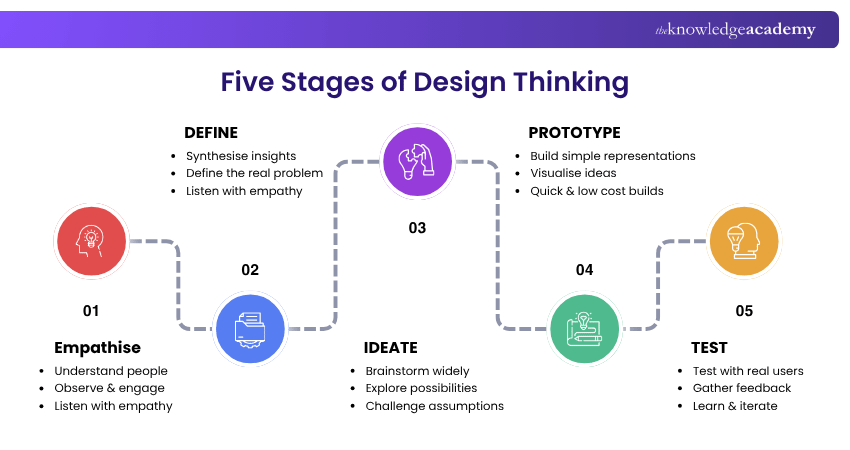
Design Thinking is commonly explained through five stages that take a problem from understanding to testing a possible solution. Let's explore them below:
Stage 1: Empathise
The first stage is about learning from the people who experience the problem. Teams observe users, speak with them and ask questions to understand their needs, experiences and difficulties. The aim is to see the situation from the user's perspective rather than making assumptions about what they want.
Watch Out:
Listen to users, but observe them too.Pay attention to what they do, struggle with and avoid, as their behaviour may reveal problems they do not mention directly.
Stage 2: Define
Once information has been collected, teams bring their findings together to identify the main problem. They look for repeated patterns, frustrations and needs and turn them into a clear problem statement that guides the next stage.
Stage 3: Ideate
At this stage, teams generate as many possible solutions as they can. The aim is not to immediately find the perfect answer but to explore different possibilities before deciding which ideas are worth developing further.
Try This: Set a timer for five minutes and generate as many ideas as possible without judging them. Evaluate them only after the time is up.
Stage 4: Prototype
A promising idea is turned into something users can see, experience or interact with. It could be a sketch, paper model, mock-up or basic digital version. The goal is to learn whether the idea could work without investing heavily in a finished solution.
Stage 5: Test
Users interact with the prototype while the team observes their experience and gathers feedback. What works can be retained, while confusing or ineffective elements can be changed and tested again.
Think in Loops, Not Lines!
Design Thinking does not always move neatly from Empathise to Test. Teams may return to earlier stages, rethink ideas and test again as they learn more about users and the problem.That is not a failure. Going back, learning and improving is part of Design Thinking.
Elevate your problem-solving prowess with our Creative and Analytical Thinking Training – Join today!
Core Principles of Design Thinking
The Design Thinking process focuses on three critical principles:
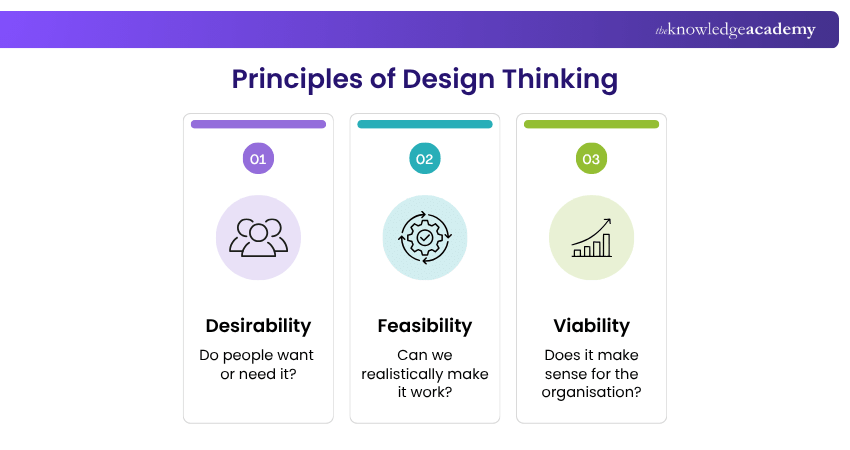
Design Thinking generally starts with desirability, as understanding people's needs comes before deciding whether a solution can be built or sustained. Let's check these principles in detail below:
1) Desirability
Desirability focuses on the people who will ultimately use or experience the solution. Teams explore their needs, behaviours, expectations and challenges to understand what would genuinely be useful to them.
Your Question to Answer: Would this solution solve something that genuinely matters to the user?
2) Feasibility
Once a promising solution has been identified, teams need to determine whether it can actually be created and delivered by your organisation. Feasibility considers factors such as technology, skills, people, time, equipment and other available resources.
Ask Yourself: Do we have what it takes to make this solution work?
3) Viability
A solution may be useful to users and possible to build, but it must also make sense for the organisation over time. Viability looks at factors such as cost, potential value, revenue, sustainability and alignment with organisational goals.
Your Value Test: Is It Worth It? Will the solution provide enough value to make it worth the cost and effort?
Industries that Benefit from Design Thinking Skills
Design Thinking is a versatile approach applied across various roles and industries, including business, government, education, and non-profit sectors. It helps in developing innovative solutions tailored to the needs of customers.
By fostering innovation, inspiring creativity, and driving solution development, Design Thinking skills are widely adopted in diverse fields such as:
1) Education
2) Business
3) Healthcare
4) Technology
This methodology supports the creation of highly effective and user-centred products and services.
Is Design Thinking Useful in Your Industry?
Use this quick checklist:
• Are you trying to understand your users better?• Are you facing problems without obvious solutions?• Do you need new or improved ideas?• Would early testing help reduce mistakes?• Could user feedback improve the outcome?If you answered “yes” to most of these, Design Thinking could be useful in your industry.
Learn how to transform raw data into actionable insights with Data to Insights Training – Register now!
Building a Design-driven Company Culture
Making Design Thinking a part of how an organisation works requires people to think differently about problems, ideas and feedback. A Design Thinking culture encourages teams to stay curious, understand users and continuously learn from what they create. Here's how you can create that culture:
1) Stay Close to Your Users
Make understanding customers and employees an ongoing activity rather than something done only at the beginning of a project. Talk to them and listen to their feedback at frequent intervals to stay updated on their evolving needs.
2) Make Design Part of Decision-making
User needs should be considered when important business decisions are made. Encourage leaders and teams to ask how a decision will affect the people using a product, service or process before moving forward.
3) Encourage Teams to Experiment
Give teams the freedom to explore different ideas instead of expecting the first solution to be perfect. Small experiments and simple prototypes can help them learn what works before investing significant time and resources.
4) Learn, Improve and Repeat
Not every idea will work as expected, and that is part of the process. Encourage teams to collect feedback, learn from mistakes and improve their ideas as new information becomes available.
Signs of a Design Thinking Culture
You may already be building a Design Thinking culture if:
• Teams ask “What do users need?” before deciding what to build.• Ideas are tested before major investments are made.• Feedback is used to improve rather than simply judge ideas.• People from different teams solve problems together.• Teams are comfortable changing direction when they learn something new.These behaviours gradually make Design Thinking a natural part of how teams solve problems and improve solutions.
Conclusion
Understanding what is Design Thinking shows us that solving problems is not just about finding quick answers, but about finding the right ones. By listening to users, questioning assumptions, and exploring different ideas, teams can approach problems with greater clarity and confidence. When this mindset becomes part of everyday problem-solving, organisations can create solutions that are not only innovative but genuinely useful to the people they are designed for.
Transform your team’s drive and enthusiasm with Staff Motivation Training – Achieve extraordinary results now!

Benjamin Walker develops practical content that helps managers guide teams, make informed decisions and respond to organisational change. His writing supports leaders in improving individual performance while contributing to sustainable organisational progress.
View Detail

 If you wish to make any changes to your course, please


