




We may not have the course you’re looking for. If you enquire or give us a call on +44 1344 203 999 and speak to our training experts, we may still be able to help with your training requirements.
What is Deep Learning Algorithm: A Comprehensive Overview
ByVishnu SankarLast updated on: 22 September 2026
A Deep Learning Algorithm uses neural networks to analyse data, recognise patterns, and make predictions, supporting applications in AI, vision, and automation. By learning from large datasets, it continuously improves its accuracy over time. This helps systems solve complex problems and make faster, more reliable decisions.

Deep Learning is a unique subset of Machine Learning that employs artificial neural networks, profound neural networks, to interpret and process data. So, if you are interested in learning in detail about Deep Learning, you need to understand What is Deep Learning Algorithm. The foundations of the Deep Learning Algorithm trace back to the structure of the human brain, which consists of interconnected layers of nodes or neurons.
According to Statista, the global AI market will grow by over £1.20 trillion by 2030. The convergence of expansive datasets, advanced algorithms, and robust computing capabilities will make Deep Learning Algorithms hugely crucial in Artificial Intelligence (AI) and Machine Learning. In this blog, you will learn about What is Deep Learning Algorithm, the types of this Algorithm, and more. Read further to know more!
What is Deep Learning Algorithm?
Deep Learning, a unique subset of Machine Learning, has revolutionised numerous fields, from computer vision to natural language processing. It utilises artificial neural networks inspired by the human brain's interconnected neurons, a key element of Brain Inspired Artificial Intelligence. These networks consist of several layers of neurons, allowing for the "depth" in Deep Learning. The depth enables these algorithms to process data in complex ways, extracting features and patterns that simpler algorithms might overlook.
A defining characteristic of Deep Learning is its ability to automatically learn such features from data, removing the need for manual feature extraction, which is often required in traditional Machine Learning. The algorithm refines its understanding as data progresses through a Deep Learning model's layer, gradually forming intricate and nuanced patterns. These algorithms don't operate in isolation. Their efficiency often hinges on vast datasets and powerful computational resources. Recent advances in Graphics Processing Unit (GPU) technology have significantly accelerated deep learning processes.

How do Deep Learning Algorithms Work?
Deep Learning Algorithms process data using multi-layered Artificial Neural Networks (ANNs), motivated by the human brain. These networks automatically learn patterns from raw data to solve complex tasks with minimal human intervention. The process involves three main stages:
1) Input Data: The algorithm receives raw data, such as images, text, or audio, and feeds it into an Artificial Neural Network (ANN).
2) Feature Learning: Multiple hidden layers automatically identify patterns and extract increasingly complex features without requiring manual feature selection.
3) Prediction: The output layer combines the learned information to produce a prediction, classification, or decision. Through repeated training, the model continuously refines its internal parameters, improving its accuracy over time.
Types of Deep Learning Algorithms
Deep Learning Algorithms come in various types, each with unique architectures and use cases. The most common types are mentioned below:
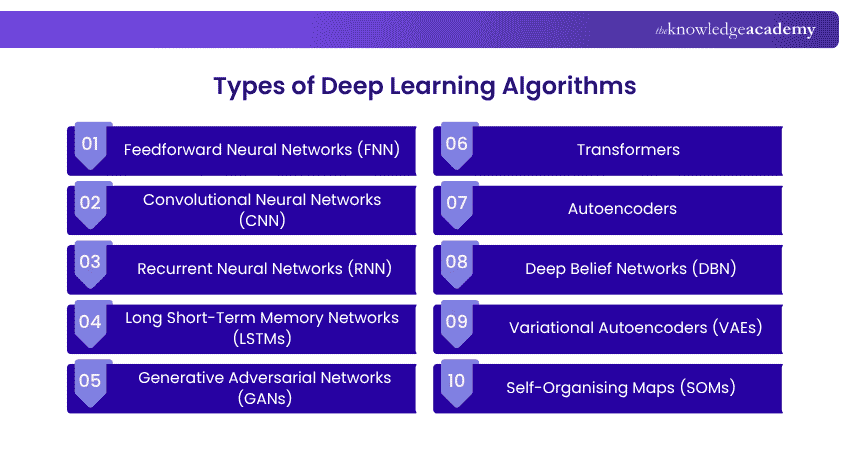
1) Feedforward Neural Networks (FNN)
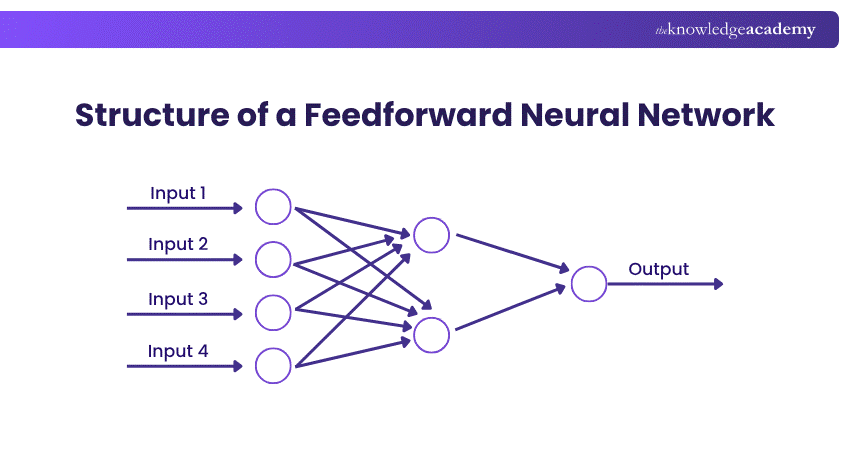
Feedforward Neural Networks (FNNs) are the simplest type of neural network, where data flows in one direction from the input layer to the output layer without feedback loops. They serve as the foundation for many Deep Learning models.
Architecture:
An FNN is a combination of an input layer, one or more hidden layers, and an output layer. Each layer processes information and passes it forward to the next layer until the final output is produced.
Example use case: Image classification, simple data regression, and customer churn prediction.
Key Points:
a) Simple Architecture: Easy to understand and implement.
b) Non-recurrent: Data flows only in one direction with no feedback loops.
Examples:
a) Linear Regression: A simple FNN with no hidden layers.
b) Multi-Layer Perceptrons (MLPs): FNNs with one or more hidden layers.
Advanced Features:
a) Activation Functions: Functions such as ReLU, Sigmoid, and Tanh help neurons learn patterns.
b) Loss Functions: Metrics like Mean Squared Error (MSE) and Cross-entropy Loss measure the difference between predicted and actual outputs.
Advanced Use-case: Credit scoring and risk assessment using historical financial data.
Empower your tech journey with our Machine Learning Training. Sign up now!
2) Convolutional Neural Networks (CNN)
Convolutional Neural Networks (CNNs) are specifically designed to process image and visual data. They automatically learn and extract visual features, making them highly effective for image recognition, object detection, and other computer vision tasks.
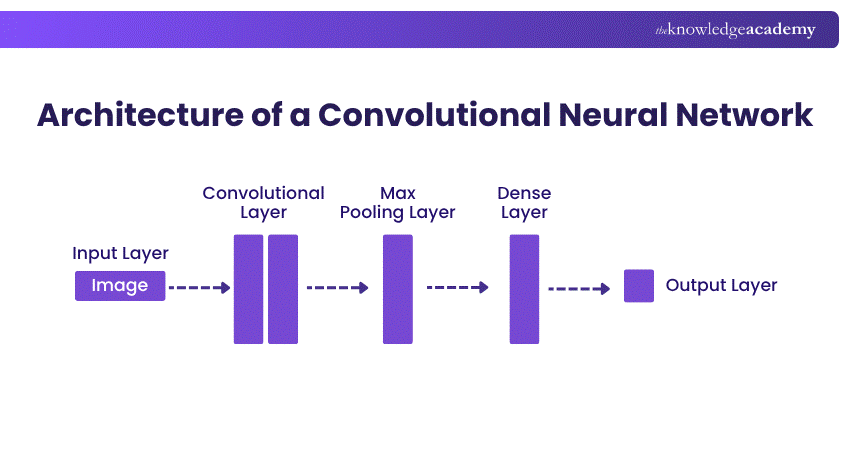
Architecture: Consists of convolutional, pooling, and fully connected layers that work together to identify and classify visual patterns.
Example Use-case: Image classification, object detection, and facial recognition.
Key Points:
a) Feature Learning: Automatically extracts meaningful features from images without manual feature engineering.
b) Translation Invariance: Recognises objects accurately regardless of their position within an image.
Examples:
a) LeNet: One of the earliest CNNs used for handwritten digit recognition.
b) VGGNet: A widely used CNN architecture known for image classification.
Advanced Features:
a) Pooling Layers: Reduce image size of feature maps, improve processing efficiency, and minimise overfitting.
b) Dropout: Helps prevent overfitting by randomly disabling neurons during training.
Advanced Use-case: Medical image analysis for detecting diseases and abnormalities from X-rays, CT scans, and MRI images.
3) Recurrent Neural Networks (RNN)
Recurrent Neural Networks (RNNs): process sequential data by retaining information from previous inputs. They are commonly used for tasks involving time-based, speech, and language data where context is important.
Architecture: Uses recurrent connections that allow information to persist across sequences, helping the network learn temporal patterns.
Example Use-case: Natural language processing and time-series forecasting.
Key Points:
a) Sequential Processing: Handles ordered data effectively by considering previous inputs.
b) Long-term Dependencies: Standard RNNs may struggle with learning from very long sequences.
Examples:
a) Elman Networks: Used for sequence prediction tasks.
b) Jordan Networks: A variation of RNNs with feedback connections.
Advanced Features:
a) Vanishing Gradient: Makes training difficult for long sequences.
b) Gradient Clipping: Helps prevent exploding gradients during training, improving model stability.
c) Advanced Use-case: Sentiment analysis of customer reviews, social media posts, and other sequential text data.
4) Long Short-Term Memory Networks (LSTMs)
Long Short-Term Memory Networks (LSTMs) are a specialised type of RNN that capture long-term dependencies in sequential data. Their memory cells enable them to retain important information over extended periods.
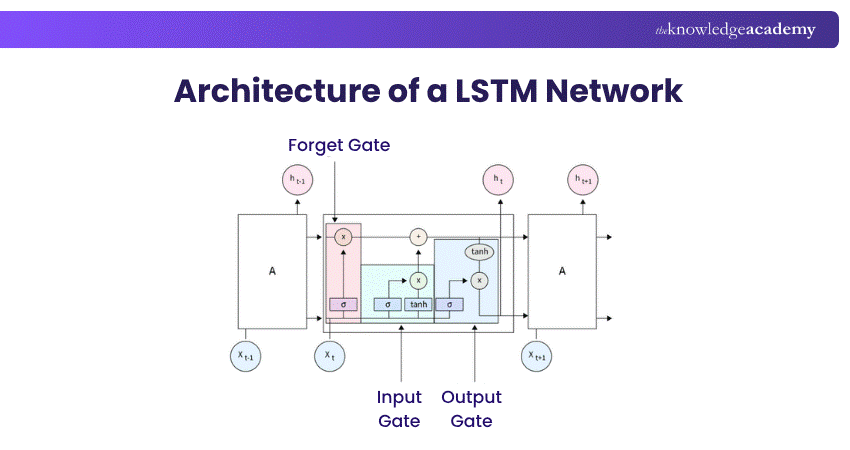
Architecture: Similar to RNNs but uses memory cells with forget, input, and output gates to manage information flow.
Example Use-case: Speech recognition and machine translation.
Key Points:
a) Long-term Memory: Learns patterns from long sequences effectively.
b) Versatile: Widely used for sequential prediction and language-processing tasks.
Examples:
a) Seq2Seq Models: Used in language translation.
b) Music Generation: Creates melodies based on learned musical sequences.
Advanced Features:
a) Forget Gate: Removes unnecessary information.
b) Input and Output Gates: Control how information is stored and passed forward.
Advanced Use-case: Predictive text, virtual assistants, and speech recognition systems.
Are you interested in learning Machine Learning and Artificial Intelligence? Register for our Artificial Intelligence Courses now!
5) Generative Adversarial Networks (GANs)
Generative Adversarial Networks (GANs) generate realistic new data using two competing neural networks: a generator and a discriminator. They are widely used for creative and image-generation tasks, data augmentation, and other creative AI applications.
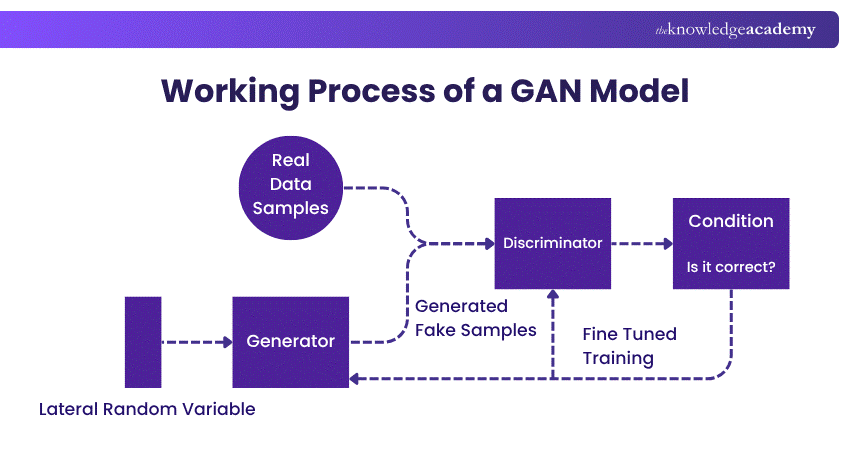
Architecture: Combines a generative model that creates data with a discriminative model that evaluates its authenticity.
Example Use-case: Image generation and data augmentation.
Key Points:
a) Adversarial Training: Improves output quality through competition.
b) Creative Generation: Produces realistic synthetic data.
Examples:
a) StyleGAN: Generates realistic human faces.
b) CycleGAN: Transfers styles between different image domains.
Advanced Features:
a) Latent Space: Generates new samples from learned representations.
b) Mode Collapse: A challenge where the generator produces limited output variations.
Advanced Use-case: Super-resolution image enhancement and realistic image synthesis.
6) Transformers
Transformers are Deep Learning models developed to understand relationships between words, sentences, or data elements in a sequence. They use an attention mechanism to process all input simultaneously, making them highly effective for language and AI tasks.
Architecture: Consists of encoder, decoder, or encoder-decoder architectures with self-attention mechanisms that identify the most relevant parts of the input.
Example Use-case: Language translation, text summarisation, chatbots, and AI assistants.
Key Points:
a) Attention Mechanism: Focuses on the most important parts of the input for better understanding.
b) Parallel Processing: Processes entire sequences simultaneously, improving speed and efficiency.
Examples:
a) Bidirectional Encoder Representations from Transformers (BERT): Used for language understanding, text classification, and question answering.
b) Generative Pre-trained Transformer (GPT): Generates human-like text for conversational AI, content creation, and code generation.
Advanced Features:
a) Self-attention: Captures relationships between words regardless of their position in a sequence.
b) Transfer Learning: Uses pre-trained models that can be fine-tuned for specific tasks.
Advanced Use-case: Powering intelligent chatbots, virtual assistants, machine translation, and content generation systems.
7) Autoencoders
Autoencoders are unsupervised neural networks that compress input data into a compact representation and reconstruct it. They are widely used for feature learning, dimensionality reduction, and data reconstruction.
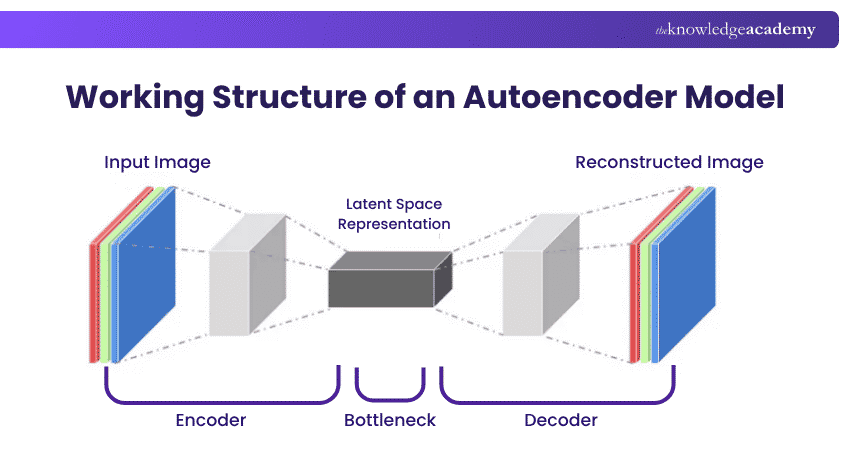
Architecture: Consists of an encoder that compresses data and a decoder that reconstructs it.
Example Use-case: Anomaly detection and feature extraction.
Key Points:
a) Data-specific Learning: Learns efficient representations for specific datasets.
b) Dimensionality Reduction: Compresses high-dimensional data while preserving important features.
Examples:
a) Sparse Autoencoder: Learns useful feature representations.
b) Denoising Autoencoder: Removes noise from images.
Advanced Features:
a) Latent Space: Encodes meaningful patterns into a compressed representation.
b) Reconstruction Loss: Guides the model to minimise differences between the original and reconstructed data.
a) Variational Autoencoders (VAEs): Generate new data samples.
b) Contractive Autoencoder: Learns robust feature representations.
Advanced Use-case: Image colourisation and anomaly detection in large datasets.
Improve your Artificial Intelligence skills – Register for our Artificial Intelligence (AI) for Project Managers Course today!
8) Deep Belief Networks (DBN)
Deep Belief Networks (DBNs) are multi-layer neural networks built from stacked Restricted Boltzmann Machines (RBMs). They learn hierarchical feature representations from complex datasets.
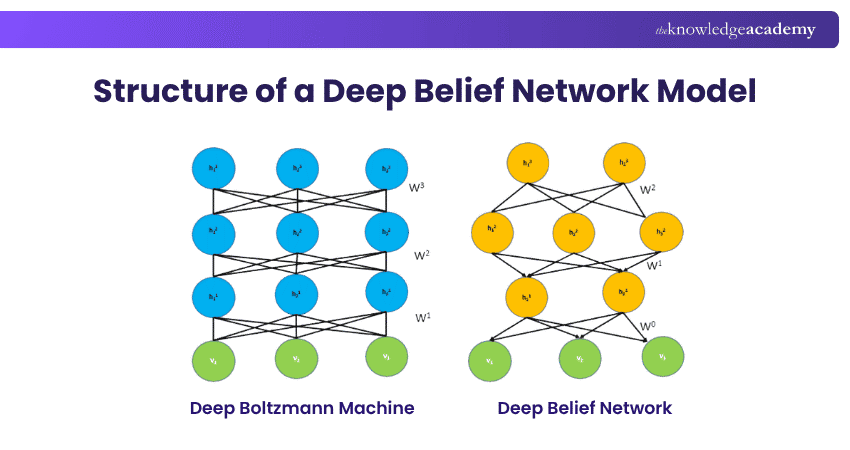
Architecture: Consists of multiple layers of stochastic latent variables that learn increasingly abstract features.
Example Use-case: Classification and dimensionality reduction.
Key Points:
a) Layer-wise Pre-training: Trains one layer at a time before fine-tuning.
b) Fine-Tuning: Uses backpropagation to improve prediction accuracy.
Examples:
a) Image Recognition: Identifies visual patterns and objects.
b) Document Retrieval: Improves search and document classification.
Advanced Features:
a) Energy-Based Models: Learn data distributions efficiently.
b) Contrastive Divergence: Optimises the training of Restricted Boltzmann Machines.
Advanced Use-case: Audio recognition, speech processing, and feature extraction.
9) Variational Autoencoders (VAEs)
Variational Autoencoders (VAEs): are a specialised type of autoencoder that generate new data by learning the probability distribution of the input. They are widely used for generative modelling and synthetic data creation.
Architecture: Consists of an encoder that maps data into a latent probability distribution and a decoder that reconstructs or generates new data samples.
Example Use-case: Image generation, image denoising, and anomaly detection.
Key Points:
a) Probabilistic Learning: Learns data distributions instead of fixed representations.
b) Generative Capability: Produces diverse and realistic data samples.
Examples:
a) Image Generation: Creates new images from learned patterns.
b) Synthetic Data Generation: Produces artificial datasets for training AI models.
Advanced Features:
a) Latent Space Sampling: Generates new data by sampling from the learned latent distribution.
b) Regularisation: Ensures smooth and meaningful latent representations.
Advanced Use-case: Generating synthetic data for AI model training and data augmentation.
10) Self-Organising Maps (SOMs)
Self-Organising Maps (SOMs) are unsupervised neural networks that organise high-dimensional data into a lower-dimensional map while preserving relationships between similar data points.
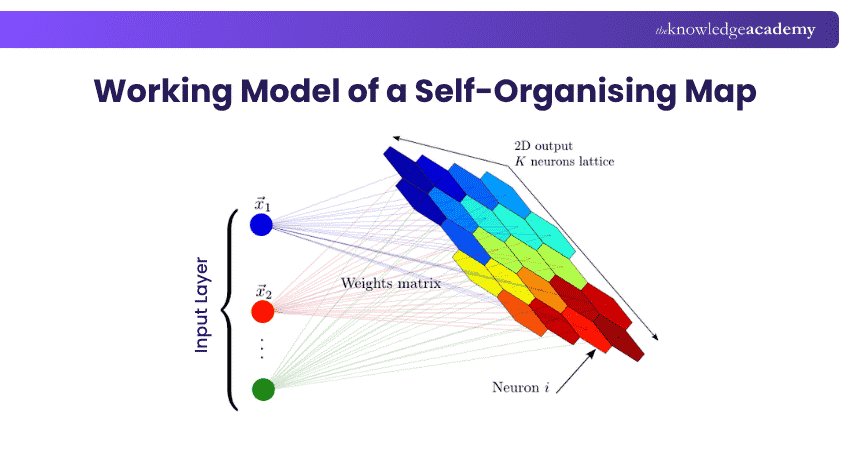
Architecture: Has an input layer connected to a two-dimensional grid of neurons that self-organise as the model learns.
Example Use-case: Data visualisation, clustering, and anomaly detection.
Key Points:
a) Unsupervised Learning: Identifies patterns without labelled data.
b) Topology Preservation: Maintains relationships between similar data points.
Examples:
a) Customer Segmentation: Groups customers with similar characteristics.
b) Data Clustering: Organises similar data into meaningful clusters.
Advanced Features:
a) Neighbourhood Learning: Updates neighbouring neurons to preserve data structure.
b) Dimensionality Reduction: Simplifies complex datasets for easier analysis and visualisation.
Advanced Use-case: Market segmentation, pattern discovery, and customer behaviour analysis in large datasets. Deepen your AI expertise with our Deep Learning with TensorFlow Training. Join now!
Applications of Deep Learning Algorithms Across Industries
Deep Learning Algorithms help organisations solve complex problems and make smarter, data-driven decisions. By learning from large datasets, they deliver accurate and scalable solutions across many industries. Some of the most common applications include:
1) Healthcare and Pharmaceuticals: Detects diseases from medical images, supports early diagnosis, and accelerates drug discovery by analysing medical and molecular data.
2) Banking and Finance: Identifies fraudulent transactions, improves credit scoring, and supports algorithmic trading through real-time Data Analysis.
3) Automotive and Transportation: Powers autonomous vehicles by recognising objects, reading traffic signs, and optimising traffic management systems.
4) Manufacturing and Supply Chain: Predicts equipment failures, automates quality inspections, and improves logistics through demand forecasting and route optimisation.
5) Retail and E-commerce: Delivers personalised product recommendations, enables visual product searches, and analyses customer behaviour to enhance shopping experiences.
6) Technology, Media, and Entertainment: Supports Natural Language Processing (NLP), powers virtual assistants and chatbots, and generates text, images, and other creative content.
7) Cyber Security: Detects malware, identifies network intrusions, and recognises anomalies and unusual activity to strengthen security and respond to cyber threats in real time.
8) Agriculture: Monitors crop health, detects plant diseases, predicts crop yields, and supports precision farming using image analysis and sensor data.
Do you want to learn the importance of neural networks? Sign up for our Neural Networks with Deep Learning Training.

Vishnu Sankar is a Senior Content Writer with 5+ years of experience across content development, software development, web development and system administration. His technical background and professional training support his expertise in IT and Tech, while his extensive research and writing experience covers Project Management and Health and Safety.
View Detail

 If you wish to make any changes to your course, please


