




We may not have the course you’re looking for. If you enquire or give us a call on +44 1344 203 999 and speak to our training experts, we may still be able to help with your training requirements.
What is Data Processing? Steps, Types & Applications
ByNilotpal SarmahLast updated on: 10 October 2026
Data processing means working with data in a planned way to make it more useful and organised through collecting, sorting, arranging, and understanding the data. This process is important across numerous fields, such as business and science, because it helps the people in charge of operations make better and more informed decisions.

At a Glanc
1. Data processing converts raw data into organised and useful information for decision-making.2. The process typically includes collection, preparation, input, processing, output, and storage.3. Common methods include batch, real-time, online, distributed, automatic, and electronic processing.4. Technologies such as databases, data warehouses, AI, machine learning, and cloud platforms support modern data processing.5. Data processing is widely used in digital marketing, finance, navigation, supply chains, and weather forecasting.
One of the common phrases that echoes through the digital world is 'Data is the new gold'. While that's the undeniable truth, raw data alone is nothing more than noise. This is where data processing comes in, which is the art of transforming scattered bits into meaningful insights. Data processing plays a vital role in every industry today, from calculating sales figures to powering AI systems. But how does it exactly work?
This blog takes a crack at it and explores what is data processing. It breaks down the steps, types, real-world uses, and more. So read on and learn how data processing helps businesses grow, how it makes decisions smarter, and how information becomes more than just numbers!
What is Data Processing?
Data processing means collecting and working with data to turn it into useful information. It includes steps like collecting, entering, checking, sorting, and processing data and then sharing the results. These steps can be done manually or, more often, by computers and software. The aim is to change raw, messy data into a clear format that’s easy to understand and use for making decisions.
Today, data processing is important in many areas like business, science, healthcare, and education. It helps organisations study trends, create reports, and make smart choices using accurate and up-to-date information.

Importance of Data Processing
Data processing is crucial for companies that rely on accurate and timely information to make good decisions. When done correctly, it offers several key benefits:
1) Better Decisions: Raw data may have limited value until it is organised. By processing it into clear information, businesses can make smarter choices. A strong data management strategy also helps maintain data quality.
2) Saves Time and Money: Setting up data systems may cost money, but they save time and improve efficiency. This allows companies to spend more time on growth than manually handling data.
3) Improved Customer Experience: By understanding customer habits and preferences through data, companies can tailor their products and services to meet customer needs, leading to higher satisfaction and loyalty.
4) Stronger Market Position: Effective data processing can help organisations identify trends, respond to customer needs and make faster evidence-based decisions, which may support competitive performance.
6 Steps of Data Processing
Data processing involves several key stages in converting raw data into useful information. Here's a breakdown of these stages:
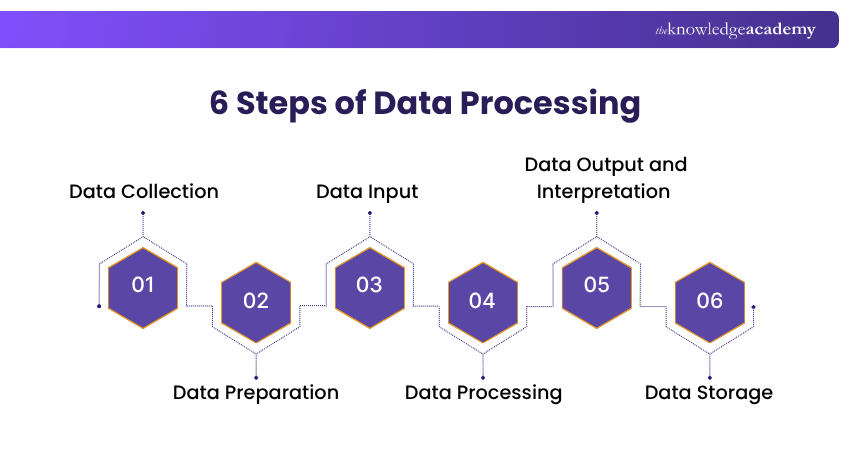
Step 1: Data Collection
Data collection is the first step. Data is gathered from sources such as databases, applications, sensors, APIs, surveys, transaction systems and files. Depending on the architecture, it may then be stored in repositories such as data lakes or data warehouses.
Step 2: Data Preparation
Once collected, data enters the preparation stage, often called "pre-processing." Here, raw data is cleaned and organised. Errors are checked, and bad data (redundant, incomplete, or incorrect) is eliminated to create high-quality data for business intelligence.
Data Quality Check
Before processing data, ask:
1. Is it accurate?2. Is it complete?3. Is it current?4. Is it consistent?
Step 3: Data Input
Prepared data is loaded or entered into the system where it will be processed, such as a database, application, analytics platform or data warehouse. During this stage, data may also be encoded or structured into formats the destination system can interpret
Step 4: Data Processing
During this stage, the data entered in the previous step is processed using methods such as calculations, sorting, filtering, aggregation, or algorithms, depending on the data source and intended use. Machine Learning (ML) may also be used for more advanced analysis.
Step 5: Data Output and Interpretation
This stage makes data usable for non-data scientists. Data is translated into readable formats like graphs, videos, images, or text. This helps users understand key findings, patterns, and insights more easily.
Step 6: Data Storage
The final stage is storing the processed data for future use. Properly stored data can be easily accessed when needed and is crucial for compliance with data protection laws like GDPR. While some data is used immediately, much of it serves future purposes.
Data Journey Map
Raw Data → Clean Data → Processed Data → Insights → Decisions
Different Types and Techniques of Data Processing
Data processing involves various methods to convert raw data into useful information. Each type suits different scenarios and needs.
1) Batch Processing
This method collects data over a period and processes it together in batches. It is well suited to high-volume tasks that do not require immediate results
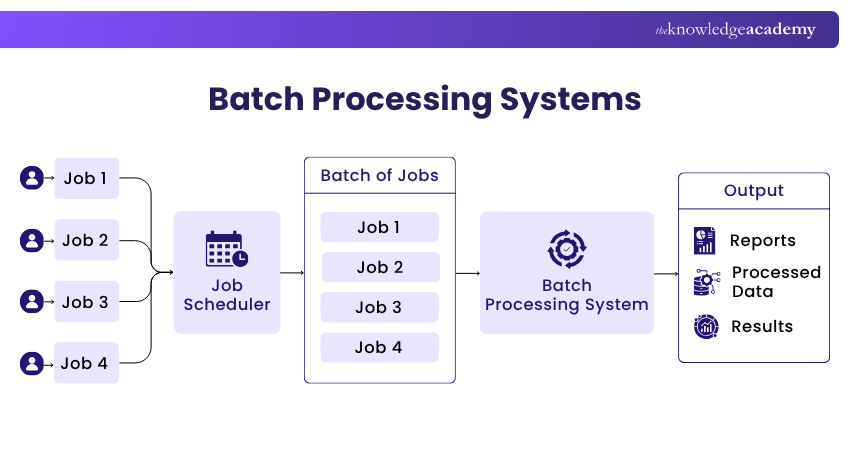
Example: Financial institutions process checks and transactions overnight, updating account balances in one go.
2) Real-time Processing
Processes data immediately upon receipt, providing instant feedback. Crucial for tasks where delays are unacceptable, ensuring timely decisions and responses.
Example: GPS navigation systems offer real-time, turn-by-turn directions based on live traffic and road conditions.
3) Multiprocessing
Uses multiple CPUs to handle tasks simultaneously, improving efficiency, especially for complex computations that can be split into smaller tasks.
Example: Movie production uses multiprocessing for rendering 3D animations, speeding up project completion and improving visual quality.
4) Online Processing
Online processing handles transactions or requests interactively as users submit them through connected systems. Responses are generally returned quickly, although the processing does not necessarily have the strict timing requirements associated with real-time systems.
Example: Online banking systems process financial transactions in real-time, allowing instant fund transfers and account updates.
5) Manual Data Processing
Requires human intervention for data input, processing, and output, typically without electronic devices. Prone to errors but was common before computers.
Example: Libraries used to catalogue books manually, recording details by hand for inventory purposes.
6) Cloud Computing
Provides computing resources like servers and storage over the internet, offering flexibility and scalability without physical infrastructure.
Example: Small businesses use cloud computing for data storage and software services, allowing easy scaling as the business grows.
7) Mechanical Data Processing
Uses machines or equipment for data tasks, a prevalent method before the digital era, involving tangible devices to input, process, and output data.
Example: Early 20th-century voting machines tallied votes by pulling levers, simplifying counting and reducing errors.
8) Distributed Processing
Spreads computational tasks across multiple devices to improve speed and reliability, handling large-scale tasks more efficiently than a single computer.
Example: Large-scale data analytics systems divide processing tasks across multiple computers or servers so that different parts of a dataset can be processed simultaneously.
9) Automatic Data Processing
It uses software to automate routine tasks, reduce manual input, and increase efficiency by streamlining processes and minimising errors.
Example: Automated billing systems in telecommunications calculate and send monthly charges to customers, streamlining operations and reducing errors.
10) Electronic Data Processing
Uses computers and digital technology for efficient data handling, allowing rapid processing, vast storage, and easy retrieval.
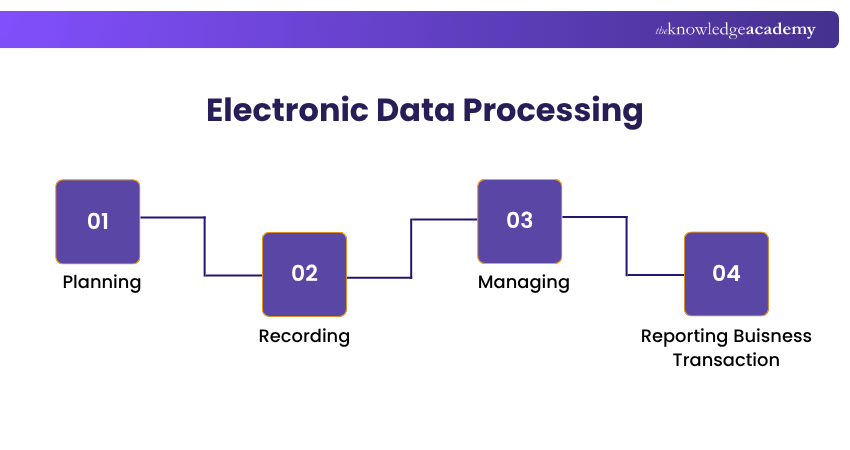
Example: Retail checkouts use barcode scans to update inventory and process sales quickly.
One Problem, Different Processing Methods
The same dataset may be processed differently depending on speed, scale, complexity, and the purpose of the analysis.
Data Processing Technologies and Tools
Data warehouses, artificial intelligence & machine learning, and cloud technology are among the technologies and tools that play vital roles in extracting valuable insights from raw data. Let's explore them in detail:
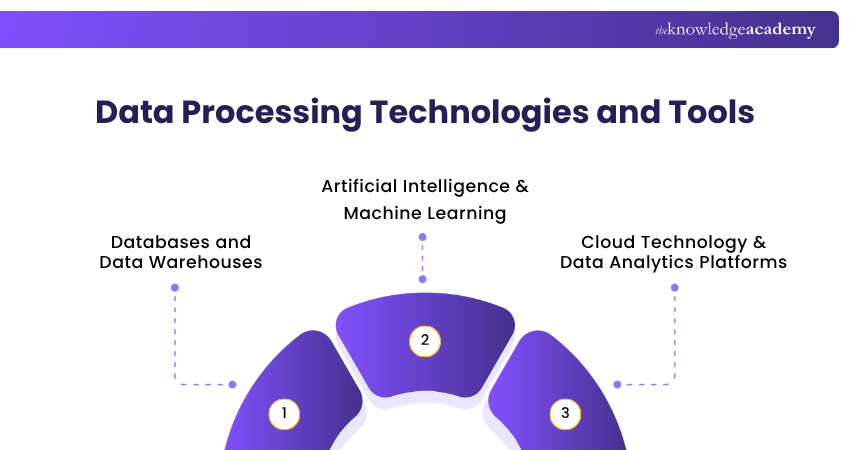
1) Databases and Data Warehouses
a) Databases store structured data and are essential for data processing tasks.
b) They allow quick querying, updating, and retrieving of information.
c) Common examples include MySQL, PostgreSQL, and Microsoft SQL Server.
d) Data warehouses collect data from multiple sources in one place.
e) They are built to analyse large datasets and support business decisions.
f) Data warehouses consolidate structured data from multiple sources for querying, reporting and analytics, while data lakes can store large volumes of structured, semi-structured and unstructured data.
2) Artificial Intelligence & Machine Learning
a) Artificial Intelligence (AI) and machine learning are key in modern data processing.
b) They help organisations find patterns and make predictions using data.
c) Python, R, and SAS are popular languages used in ML for data processing.
d) Supervised learning uses labelled data to train models for making predictions.
e) Unsupervised learning finds patterns in unlabelled data, like clustering and dimensionality reduction.
f) Reinforcement learning improves decisions through continuous feedback from the environment.
g) These ML methods have led to significant advances in speech recognition and medical diagnosis.
Elevate your career with our Advanced Data Science Certification Course - Build advanced data skills today!
3) Cloud Technology & Data Analytics Platforms
a) Cloud technology has changed how businesses manage data processing by offering scalable and cost-effective solutions.
b) It allows access to data processing tools from anywhere, removing the need for on-premises hardware.
c) Amazon Web Services (AWS), Microsoft Azure and Google Cloud Platform are top Cloud providers.
d) These platforms help organisations set up data analytics systems quickly and efficiently.
e) Cloud platforms support data storage in systems like data lakes.
f) They enable large-scale data processing tasks such as Extract, Transform, and Load (ETL) workflows and analytics.
g) Data orchestration tools manage and coordinate processing tasks across various systems.
h) Visualisation tools present processed data clearly for better decision-making.
Examples of Data Processing
Data processing is crucial in many industries and applications, showcasing its versatility and essential role in digital operations. Here are some examples highlighting its importance:
1) Digital Marketing
Digital marketing companies use demographic data to create targeted marketing campaigns. By processing this data effectively, they identify target audiences, understand their preferences, and optimise marketing efforts for better engagement and conversion rates.
2) Financial Transactions
Data processing is essential for financial transactions like bank transfers, online payments, and stock trades.
3) Navigation Systems
Navigation systems process positioning signals, map data and traffic information to calculate routes and provide timely turn-by-turn guidance.
4) Supply Chain Optimisation
Data from various supply chain points is processed to identify bottlenecks, predict demand, and optimise production logistics.
5) Weather Forecasting
Weather forecasting relies on multiprocessing (parallel processing), where data from satellites and weather stations is processed simultaneously. This enables rapid analysis of complex meteorological data to accurately predict weather conditions.
Challenges of Data Processing
Data processing is vital for businesses aiming to harness their data effectively. However, several challenges can hinder this process:
1) Data Silos: When teams work separately and don’t share data, it creates isolated data sets. This makes it hard to get a complete picture of the business and can slow down analysis and decision-making.
2) Poor Data Quality: Mistakes like duplicate, outdated, or incorrect data can happen when there’s no standard way to collect or clean data. This leads to wrong insights and poor decisions.
3) Integration Problems: Data often comes from different places and in different formats. If these can’t be connected easily, getting useful insights from all of them becomes difficult.
4) Scalability Issues: As the amount of data grows, older systems may be unable to keep up. Businesses need flexible tools, like cloud-based systems, that can grow with their data needs.
5) Security and Privacy Risks: Keeping data safe and following rules like GDPR is very important. Weak security may result in data breaches, regulatory action and financial penalties.
6) Lack of Data Governance: Without clear rules on managing data, companies can struggle with keeping data accurate, secure, and within legal boundaries.
The Future of Data Processing
Here are some important trends shaping the future of data processing:
1) AI-powered Automation: AI and machine learning are helping to speed up and simplify data processing. These tools can quickly find patterns and insights in large amounts of data with less need for manual work.
2) Growth of Edge Computing: Edge computing handles data closer to where it’s created, like on devices or sensors. This reduces delays and saves bandwidth, which is great for real-time apps and smart devices.
3) Data Mesh Approach: Data mesh allows different teams in a company to handle and use data independently, instead of relying on a central team. This makes it easier to scale and manage data as companies grow.
4) Real-time Data Use: Businesses want to make decisions faster, so real-time analytics is becoming more common. It lets companies process and act on data instantly, helping them stay ahead in a fast-changing market.
5) ML and AI Integration: ML and AI are increasingly integrated with data processing technologies. This integration automates data analysis, predictive modelling, and decision-making processes.
6) Privacy-preserving Data Processing: With increasing worries over data privacy and stricter regulations, technologies that support privacy-preserving data processing are becoming more important.
Data processing plays a central role in turning large amounts of raw data into information that people and organisations can actually use. Whether it involves batch processing, real-time analysis, cloud platforms, or AI-based tools, the goal remains the same: to make data accurate, accessible, and useful.
Tame the messy jungle of data with Pandas! Sign up for our Pandas for Data Analysis Training and unlock powerful data insights!

Nilotpal Sarmah is a Senior Content Writer with 11+ years of overall experience spanning engineering, operations and content development. His technical knowledge and extensive writing experience enable him to simplify specialised topics across IT and Tech, Business Skills, Project Management, Health and Safety, and ISO and Compliance.
View Detail

 If you wish to make any changes to your course, please


