




We may not have the course you’re looking for. If you enquire or give us a call on +44 1344 203999 and speak to our training experts, we may still be able to help with your training requirements.
What is Black Box AI: How it Works, Characteristics and Examples
ByThe Knowledge AcademyLast updated on: 15 October 2026
Black-box AI refers to artificial intelligence systems whose internal processes are difficult to interpret. This blog explores how these systems work, their characteristics, applications, advantages, limitations and real-world examples.
Quick Overview
1. AI opacity may result from technical complexity, restricted access to model details or both.2. Understanding a model's overall behaviour differs from explaining an individual prediction.3. These systems can support complex tasks such as image recognition and fraud detection.4. Limited explainability can create challenges involving trust, fairness and accountability.5. Explainable AI techniques can help users understand and evaluate model behaviour.
Your GPS says there's a faster route. But why that route? Is there traffic ahead? Road construction? A shortcut you've never noticed?
Most of the time, you follow the recommendation without questioning it. But what if the decision were more important than choosing a road?
This brings us to an interesting question: What is black box AI? It refers to Artificial Intelligence (AI) models whose internal processes are difficult to understand or interpret. These models can analyse complex patterns and generate predictions, but explaining exactly how they reach a particular result isn't always straightforward.
Let's explore how black box AI works, where it's used and why transparency matters in real-world decisions.
What is Black Box AI?
Black-box AI refers to artificial intelligence systems whose internal decision-making processes are difficult to interpret. Users can observe the inputs and outputs but may struggle to understand how the results are generated. These systems often involve complex machine learning models, such as deep neural networks, that learn patterns from large datasets.
For example, an AI system may analyse medical images and identify signs of disease without clearly revealing which patterns influenced its prediction. However, limited interpretability does not necessarily mean that an AI system is inaccurate or unreliable.

How Does Black Box AI Work?
Black-box AI processes information through trained algorithms to generate predictions, classifications or other outputs. While its general architecture may be known, the complex relationships learned during training can make individual results difficult to explain.
Developing and using a black-box AI model generally involves the following stages:
1) Data Input
The system receives information relevant to its task. This may include images, text, financial records, audio files or sensor readings.
2) Model Training
A Machine Learning (ML) algorithm learns patterns from training data. During this process, it adjusts internal parameters to improve its performance on a specific task.
3) Data Processing
Once trained, the model applies its learned patterns to new information. In deep neural networks, multiple interconnected layers perform mathematical operations to transform the input.
4) Output Generation
The system produces a result based on the information it has processed. This could be a prediction, classification, recommendation or generated response.
5) Performance Evaluation and Refinement
Developers assess the model's accuracy and reliability using testing and validation data. They may refine the model by adjusting parameters, updating training data, or applying additional evaluation techniques to improve performance.
Example: Detecting Fraudulent Transactions
Imagine an AI system evaluating an online payment. It examines the transaction amount, location, timing and spending patterns before predicting whether the payment is suspicious.The system may flag the transaction as potentially fraudulent, but its internal calculations might not provide a simple explanation of why that particular payment was selected.
Key Characteristics of Black Box AI
Black-box AI systems have several characteristics that make their internal behaviour difficult to understand or examine.
Limited Interpretability
Limited interpretability refers to the difficulty of understanding how a model's internal components contribute to its overall behaviour. For example, interpreting the learned representations within a deep neural network used for image recognition can be challenging.
Complex or Inaccessible Model Processes
Some black-box AI systems contain numerous interconnected parameters, making their operations difficult to explain through simple rules. In other cases, access to model details may be restricted to protect proprietary algorithms and intellectual property.
Difficulty Tracing Individual Decisions
Explaining a specific AI prediction can be challenging, even when the model performs well overall. For example, a recommendation system may suggest products based on user behaviour, but identifying the exact influence of each factor can be difficult.
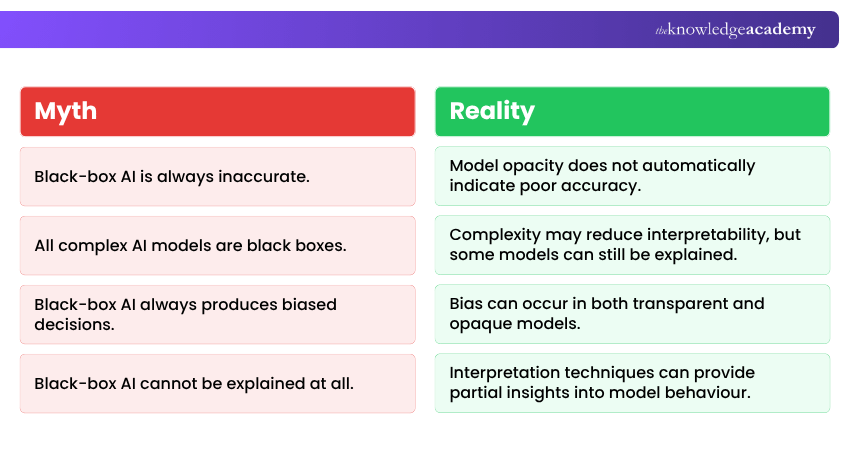
When Should Black Box AI be Used?
Black-box AI may be suitable when complex data needs to be analysed, and advanced models offer meaningful benefits over simpler alternatives. However, the choice depends on performance, potential risks and the need for explainability.
Some applications where these models may be useful include:
1) Image and Speech Recognition
Deep learning models can identify visual and audio patterns for applications such as object recognition, speech transcription and image classification.
2) Natural Language Processing
Complex language models can support translation, summarisation, text generation and other language-related tasks.
3) Fraud Detection
Financial institutions may use advanced predictive models to identify suspicious transaction patterns that traditional rule-based systems might miss.
4) Predictive Maintenance
Manufacturing organisations can analyse equipment and sensor data to predict possible failures and plan maintenance activities.
5) Scientific Research
Researchers may use complex AI models to explore relationships within large biological, chemical and environmental datasets.
Pro Tip
A more complex AI model is not automatically a better choice. Its performance should justify the additional difficulty involved in understanding, maintaining and evaluating it.
Pros and Cons of Black Box AI
Black-box AI can offer advanced analytical capabilities, but limited interpretability can create technical, ethical and operational challenges. The table below outlines its main advantages and disadvantages.
Pros of Black Box AI:
1) Can identify complex patterns and relationships within large datasets.
2) Can process complex data, including images, audio and text.
3) May deliver strong predictive performance on some complex tasks, depending on the model and task.
4) Can support automated processing of large volumes of information.
5) Can be applied across industries and tasks when supported by suitable data and evaluation.
Cons of Black Box AI:
1) Individual predictions can be difficult to explain.
2) Unexpected results can be challenging to investigate.
3) Limited transparency can make potential bias harder to detect.
4) Decisions may be difficult to justify to users or regulators.
5) Some models require substantial computing resources and expertise.
Understand the importance of deep learning and how it works with our Deep Learning Course – Sign up now!
Real-world Examples of Black Box AI
Black-box AI can create transparency and accountability challenges when automated systems influence important decisions. The following examples show how these concerns arise in different industries:
The COMPAS Recidivism Risk Assessment Tool
The COMPAS (Correctional Offender Management Profiling for Alternative Sanctions) risk assessment tool has been used in parts of the United States criminal justice system to assess the risk of reoffending. Its proprietary scoring methodology limits access to information about how factors are weighted and how risk scores are calculated.
This lack of transparency became an important issue in the 2016 State v. Loomis case. That same year, a ProPublica investigation raised concerns about racial differences in the tool's prediction errors. However, its developer, Northpointe, disputed the investigation's methodology and findings.
This example illustrates how restricted access to scoring processes can complicate the evaluation of fairness, accuracy and accountability.
Credit Scoring and Loan Decisions
Some financial institutions use complex machine learning models to assess creditworthiness and repayment risk. Certain models operate as black boxes because their internal calculations make it difficult to identify the factors behind a decision.
For example, an applicant may find it difficult to understand how a complex model influenced a loan rejection, making a meaningful explanation particularly important.
In 2022, the US Consumer Financial Protection Bureau (CFPB) clarified that creditors must provide specific and accurate reasons for adverse credit decisions under applicable federal requirements. The use of complex or opaque algorithms does not exempt creditors from these obligations.
IBM Watson for Oncology
IBM Watson for Oncology was developed to support healthcare professionals by providing cancer treatment recommendations based on patient information, medical literature and expert-curated knowledge.
A peer-reviewed study published in 2018 examined the system as a black-box decision-support tool. Researchers evaluated its recommendations using synthetic patient cases and compared them with established clinical guidelines.
This example highlights the importance of independent evaluation and clinical validation when using opaque AI systems in healthcare.
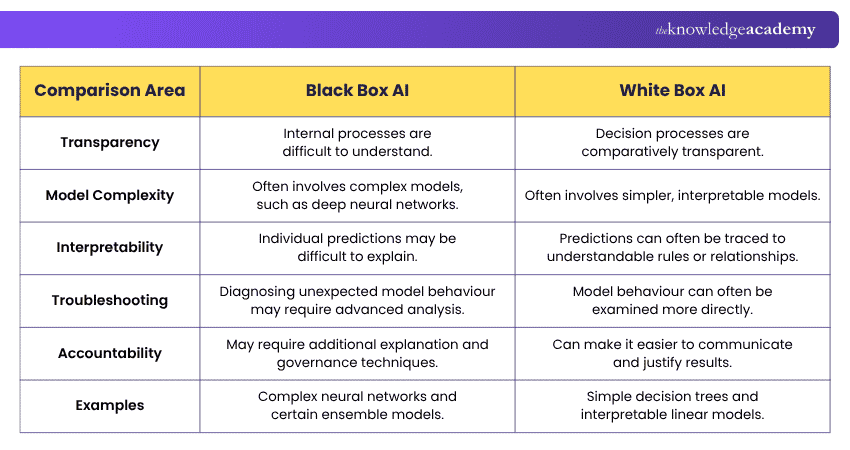
Black Box AI vs White Box AI: Key Differences
Black-box AI and white-box AI differ mainly in how easily their decision-making processes can be understood. The following table highlights their key differences.
Future of Black Box AI
Although several techniques already exist to manage the challenges of black-box AI, ongoing research may lead to more effective ways of understanding and controlling complex models. Some potential future developments include:
1) More Precise Model Interpretability
Future research may improve how accurately researchers identify the internal mechanisms responsible for AI predictions, particularly in large neural networks.
2) More Reliable AI Explanations
Advancements in Explainable AI (XAI) could produce explanations that better reflect how models actually make decisions, rather than relying heavily on approximations.
3) More Automated Risk Detection
Future monitoring systems may become better at identifying subtle model failures, unexpected behaviour and emerging risks with less manual investigation.
4) Stronger Oversight of Autonomous AI
As AI systems become increasingly autonomous, oversight methods may evolve to provide clearer records of decisions, more effective intervention mechanisms and greater accountability.
Keep This in Mind
An AI model producing accurate predictions does not necessarily mean its decisions are fair or appropriate. Organisations should assess potential risks, evaluate model performance across different situations and maintain appropriate human oversight when using black-box AI for important decisions.
Gain practical experience with AI tools and automation technologies with our Artificial Intelligence Courses – Register now!

The Knowledge Academy develops accessible learning content across Project Management, IT, Cybersecurity, Data Science, Business Analysis, HR, Accounting and Finance, Leadership and Health and Safety. Its resources combine subject research with clear explanations to help professionals build practical knowledge across a wide range of disciplines.
View Detail

 If you wish to make any changes to your course, please


