




We may not have the course you’re looking for. If you enquire or give us a call on 01344203999 and speak to our training experts, we may still be able to help with your training requirements.
What is Accounting Cycle: A Complete Overview
ByOlivia TaylorLast updated on: 03 October 2026
What is the accounting cycle? Discover the fundamental process that every business follows to record, analyse, and report financial transactions. From capturing data to generating financial statements, our blog breaks down the accounting cycle concept, making it easy to understand for both beginners and experienced professionals.

The Main Idea
1. The accounting cycle turns day-to-day financial activity into structured financial records.2. Each stage builds on the previous one, making sequence and consistency important.3. Trial balances help verify debit and credit equality but cannot identify every type of accounting error.4. Adjustments capture items that may not have been fully recorded during routine transaction processing.5. Closing the cycle separates one accounting period from the next and prepares the records for continued reporting.
Financial information becomes useful only when businesses can organise and interpret it effectively. Without a consistent accounting process, tracking financial activity across a reporting period can become difficult and increase the risk of incomplete or inaccurate records.
The accounting cycle provides an organised approach to managing this process from the initial transaction through to period-end reporting. In this blog, we will explore what the accounting cycle is, who performs it, when it occurs, its key steps and why it matters to businesses.
What is the Accounting Cycle?
The accounting cycle is a systematic process used by businesses to record, process, and report their financial transactions. It's a series of steps that helps support the accuracy and consistency of financial information. By meticulously recording each transaction, companies create a robust foundation for their financial records, enabling them to track the flow of money and resources accurately.

Who Does the Accounting Cycle?
The accounting cycle is typically managed by Accountants, Bookkeepers, or finance teams, often with support from accounting software and automated systems. These individuals possess strong accounting skills, which enable them to effectively manage financial record-keeping, transaction analysis, and reporting. They record all financial activities, ensuring accuracy and adherence to relevant regulations.
Timing of the Accounting Cycle
The timing of the accounting cycle is a crucial aspect for any business. It operates on a recurring and well-defined schedule. This cycle typically consists of a series of steps, including recording transactions, posting entries, preparing trial balances, making adjusting entries, preparing financial statements and completing closing procedures.
The accounting cycle is completed for a defined accounting period, which may be monthly, quarterly or annually, depending on the organisation's reporting requirements.
Steps Involved in the Accounting Cycle
The accounting cycle typically consists of several essential steps, each playing a crucial role in maintaining the financial health of a business. Here's an expanded look at these steps:
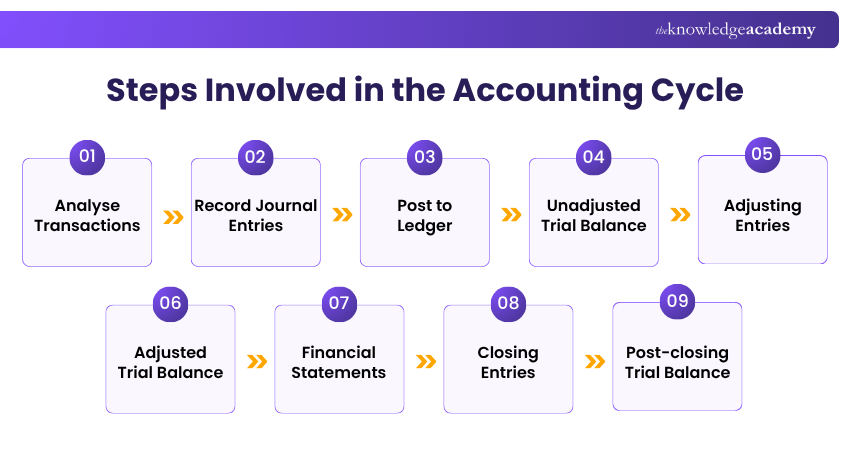
1) Identify and Analyse Transactions
The first step in the accounting cycle is identifying and analysing financial transactions. This involves reviewing business activities and determining how each transaction affects the relevant accounts.
These transactions include a wide range of activities, from sales and purchases to expenses and payments. Each transaction is like a piece of a financial puzzle, and accurately capturing these pieces is essential to building a comprehensive and reliable picture of the company's financial health.
Once identified, transactions are analysed to determine which accounts are affected and how they should be recorded. This sets the stage for accurate financial reporting and analysis.
2) Record Transactions in the Journal
Journal entries are used to record the transactions identified and analysed in the previous step. Each transaction is recorded according to the accounts it affects, creating a chronological record of financial activity.
For instance, a credit sale may affect accounts receivable and sales revenue, while a payment to a supplier may reduce both accounts payable and cash. This ensures that transactions are properly classified, making it easier to track and analyse financial activities.
Example
Suppose a business makes a £1,000 credit sale. The transaction is identified and analysed, recorded as a debit to accounts receivable and a credit to sales revenue, and then posted to the relevant ledger accounts. Its effect later appears in the trial balance and financial statements.
3) Posting to Ledger Accounts
This involves transferring information from the journal entries to the respective ledger accounts. It creates a detailed and organised record of the company's financial transactions for each account category.
Consider ledger accounts as individual chapters in a book, each dedicated to a specific aspect of the company's financial activities. For example, there will be separate ledger accounts for cash, accounts receivable, accounts payable, etc., depending on the nature of the business.
Each entry includes the date of the transaction, a description, and the monetary value. This comprehensive data enables businesses to analyse trends, identify areas of strength or concern, and make informed decisions about the company's future.
Understand the cash conversion cycle to convert its inventory into sales then to cash with our Cash Management Course – Join now!
4) Unadjusted Trial Balance
It comes after the transactions have been identified, recorded in the journal, and posted to the respective ledger accounts. The trial balance is structured in a simple format, with columns for the account names, the debit amounts, and the credit amounts. This clear layout allows Accountants to visually assess whether the totals on both sides match.
If the trial balance is balanced, it confirms that total debits equal total credits. However, this does not guarantee that all accounting entries are free from errors. If the totals do not match, errors must be identified and corrected.
Trainer’s Insight
A balanced trial balance confirms that total debits equal total credits, but some errors can still remain undetected. For example, a transaction could be omitted entirely or recorded in the wrong accounts while the totals still balance.
5) Adjusting Entries
These entries are important to ensure that the financial statements reflect the company's financial position and performance, considering items that may not have been recorded during the earlier stages of the accounting process.
They help capture transactions and events that take place during the accounting period, which may not have been initially recorded. These adjustments are essential because they enable companies to report their financial activities in a way that matches the economic reality, even if the cash hasn't changed hands yet.
Accuracy and attention to detail are crucial when making adjusting entries. These adjustments help the financial statements truly reflect the company's financial position and performance. Any errors at this stage can affect the overall picture presented in the income statement, balance sheet, and cash flow statement.
6) Adjusted Trial Balance
After adjusting entries are recorded and posted, an adjusted trial balance is prepared. It lists the updated balances of the ledger accounts and verifies that total debits equal total credits before the financial statements are prepared.
7) Financial Statements
Financial statements are a major output of the accounting cycle, presenting a comprehensive overview of a company's financial performance, position, and cash flows over a specific period. These statements are vital tools for stakeholders. They provide essential insights into the company's financial health and support informed decision-making.
Key financial statements include the income statement, balance sheet, cash flow statement and statement of changes in equity, depending on the applicable financial reporting framework.
8) Closing Entries
Closing entries occur near the end of the accounting cycle and prepare the accounts for the next accounting period. The aim of closing entries is to reset temporary accounts, such as revenue, expense, and applicable distribution or withdrawal accounts, to zero. These temporary accounts capture transactions that occur during the accounting period, and their balances need to be cleared to start the new period with a clean slate.
9) Post-closing Trial Balance
The post-closing trial balance is typically the final step in the accounting cycle, prepared after the closing entries have been completed. Its primary objective is to verify that total debits equal total credits and that only permanent accounts retain balances after closing.
The post-closing trial balance provides a fresh starting point for the new accounting period. Temporary accounts are closed, while permanent account balances are carried forward into the next accounting period. This separation ensures that each accounting period's activities are distinct, making it easier to track financial trends over time.
Teach-back Challenge
Can You Explain It?
Test your understanding by explaining the accounting cycle in three stages:
1. How does a transaction enter the accounting records?2. How are account balances reviewed and adjusted?3. How is an accounting period closed and the next one prepared?
Gain expertise in project financial analysis and techniques with the Project Accounting Course – Register today!
Why is the Accounting Cycle Important?
The accounting cycle is important because it provides a structured way to maintain reliable financial records and turn transaction data into useful financial information. This cycle plays a pivotal role in maintaining accurate financial records and providing crucial insights for making informed business decisions.
Here we discuss why it is important from a business perspective:
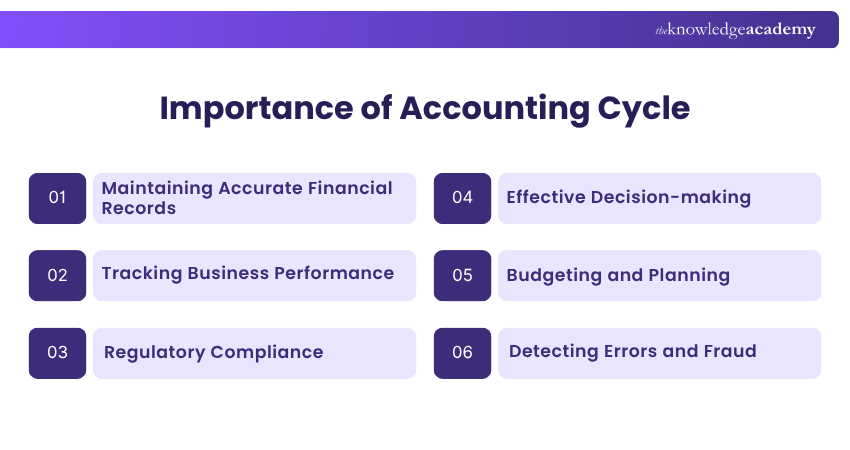
1) Maintaining Accurate Financial Records
At the heart of any successful business is accurate financial record-keeping. The accounting cycle ensures that every financial transaction, whether it's a sale, purchase, or expense, is properly recorded in the books. This meticulous recording provides a clear picture of the company's financial health, helping stakeholders understand its performance and make strategic choices.
2) Tracking Business Performance
The accounting cycle enables businesses to track their performance over specific periods, usually monthly, quarterly, and annually. By analysing financial statements, organisations can identify trends, evaluate profitability, and assess the effectiveness of their strategies. This insight allows them to make necessary adjustments to stay competitive and achieve long-term growth.
3) Regulatory Compliance
Following a structured accounting cycle can support compliance with applicable accounting standards and financial reporting requirements, such as relevant GAAP or IFRS accounting standards.
4) Effective Decision-making
Effective decision-making is a cornerstone of successful businesses. The accounting cycle provides essential data that executives and managers use to make informed choices. Whether it's expanding into new markets or assessing the viability of a project, having accurate and up-to-date financial information is crucial. The accounting cycle delivers this information in a structured and timely manner.
5) Budgeting and Planning
Budgeting is a critical aspect of managing any organisation. The accounting cycle ensures that companies have the data they need to create realistic budgets and financial forecasts. It allows them to allocate resources efficiently, set achievable goals, and monitor progress. This strategic planning helps businesses remain financially stable and adaptable to changing market conditions.
6) Detecting Errors and Fraud
Errors in financial records can have serious consequences for a business. The accounting cycle includes review and reconciliation activities that can help identify recording errors and unusual transactions. Additional internal controls and audit procedures may also help organisations detect or prevent fraud.
Learn how to control liquidity, working, and business cash cycles with our Cash Flow Management Course – Register now!

Olivia Taylor makes complex financial subjects easier for professionals to understand and apply. Her content connects accounting principles with the practical requirements of financial control, organisational planning and responsible decision-making.
View Detail

 If you wish to make any changes to your course, please


