


We may not have the course you’re looking for. If you enquire or give us a call on 01344203999 and speak to our training experts, we may still be able to help with your training requirements.
Understanding Training Data: The Backbone of Machine Learning
ByNilotpal SarmahLast updated on: 12 October 2026
Training data helps machine learning models learn patterns, make predictions, and generalise to new inputs, while its quality, relevance, coverage, and consistency strongly influence model performance.

Quick Look
1. Training data provides examples from which machine learning models learn patterns.2. Data quality, relevance, and coverage directly affect model performance.3. Labelled data supports supervised learning, while unlabelled data supports pattern discovery.4. Training and testing data serve different purposes and should remain separate.5. Representative data can support better generalisation across new inputs.
Training data provides the examples that machine learning models use to identify patterns and learn relationships. Depending on the task, it can include images, text, numerical values, audio, or other forms of data.
The quality and relevance of this data influence how effectively a model learns and performs on new inputs. This blog explores how training data works, its common forms, quality factors, benefits, challenges, and its role in machine learning.
Understanding Training Data
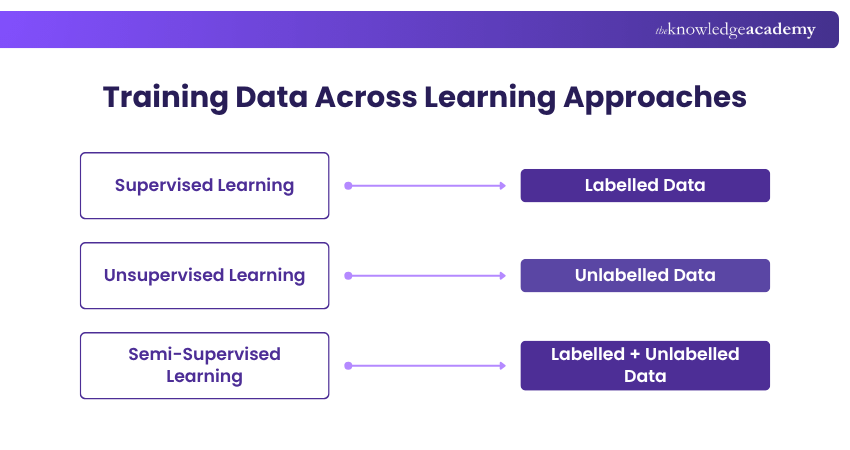
Training data is the collection of examples used to develop a machine learning model. Depending on the learning approach, it can include labelled or unlabelled data such as images, text, numerical values, or audio.
1. It provides examples from which the model can identify patterns and relationships.
2. It can contain labelled, unlabelled, or a combination of both forms of data.
3. Its relevance and quality influence how effectively the model generalises to new inputs.
4. It forms the basis of the model's learning process during training.

How Does Training Data Work?
During training, machine learning models process examples to identify patterns and adjust internal parameters. The exact training process depends on the learning method, model architecture, and type of data being used.
Key Points:
a) Models identify statistical patterns from training examples.
b) Optimisation methods update internal parameters during training.
c) More data can help when it is relevant, representative, and high quality.
d) Model evaluation checks how effectively learned patterns apply to unseen data.
Example: For image classification, a model can learn from labelled examples of cats and non-cats and identify patterns that help classify new images.
Types of Training Data
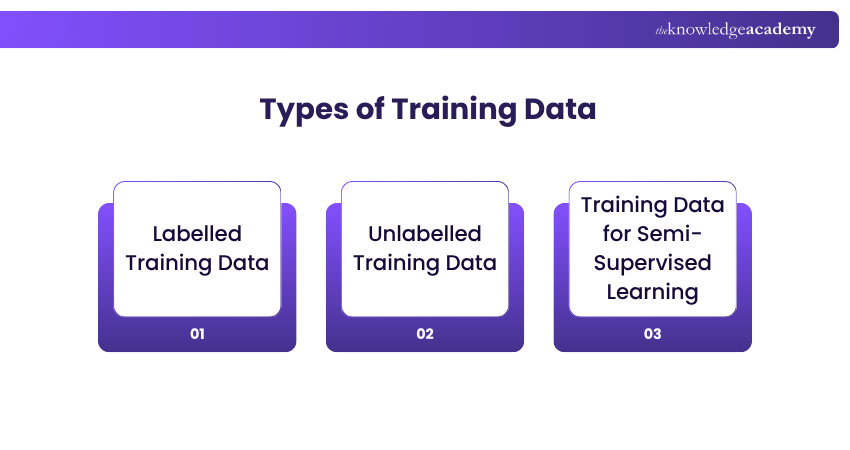
Training datasets can contain labelled data, unlabelled data, or a combination of both. These forms support different learning approaches, including supervised, unsupervised, and semi-supervised learning.
While labelled and unlabelled data are the two main forms discussed here, semi-supervised learning combines both rather than introducing a separate data type. Let’s look at the types below:
1) Labelled Training Data
a) Labelled data contains examples paired with target labels or values.
b) In supervised learning, models use these examples to learn relationships between inputs and targets.
c) It is commonly used for tasks such as classification and regression.
d) Collecting and labelling suitable data can be time-consuming and expensive.
e) For example, medical images used for classification may be labelled as “benign” or “malignant”.
2) Unlabelled Training Data
a) Unlabelled data does not contain predefined target labels.
b) Models can use it to discover patterns, similarities, or underlying structures.
c) It is commonly used in tasks such as clustering and dimensionality reduction.
d) It is often easier to collect at scale, although extracting useful patterns requires suitable techniques.
e) For example, unlabelled customer reviews can be grouped by similarity or topic without predefined categories.
3) Training Data for Semi-Supervised Learning
a) Semi-supervised learning uses a combination of labelled and unlabelled data.
b) It is useful when obtaining labels for every example is costly or time-consuming.
c) The labelled examples provide known targets, while the unlabelled data provides additional information about the underlying data distribution.
d) For example, an image dataset may contain 1,000 labelled images alongside 9,000 unlabelled images.
Build practical skills with the Python with Machine Learning Training – Join now!
Key Factors Influencing Training Data Quality
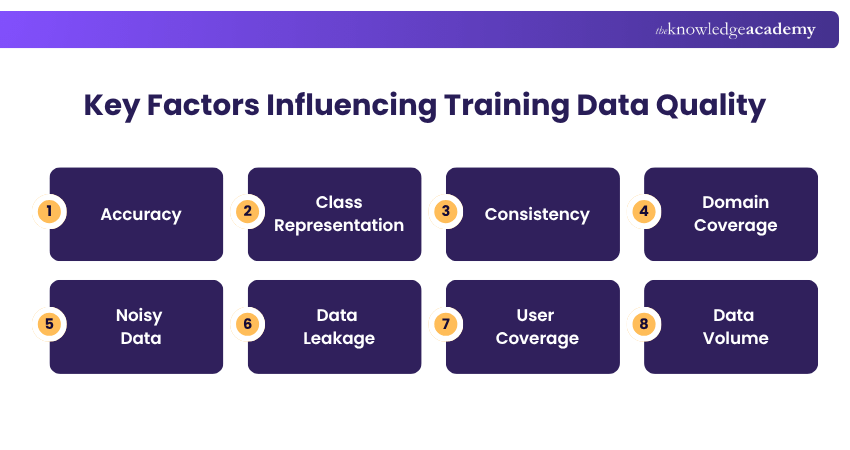
Training data quality strongly influences how effectively machine learning models learn and generalise. Even well-designed algorithms can perform poorly when trained on inaccurate, inconsistent, or unrepresentative data. Key quality factors include:
1) Accuracy
a) Accurate labels, values, and measurements are important for reliable model training.
b) Incorrect labels or noisy measurements can reduce model performance.
Example: Mislabeling a cat image as a dog can cause the model to learn incorrect associations.
2) Class Representation
a) Class representation refers to how different target categories are distributed within a training dataset.
b) When some classes have very few examples, models may struggle to learn their patterns and may favour more frequently represented classes.
c) Evaluating class distributions and using appropriate techniques, such as class weighting or resampling, can help address imbalances when required.
Example: In a fraud detection dataset, fraudulent transactions may be much less common than legitimate ones. Without suitable handling, a model may favour the majority class and fail to identify important fraudulent cases.
3) Consistency
a) Consistent data across examples is important.
b) Inconsistent data (different formats, missing values) can affect how reliably the model learns from the available information.
c) Ensuring uniformity helps the model learn effectively.
Example: If some data points have missing values and others don’t, the model might struggle to learn patterns properly.
4) Domain Coverage
a) Domain coverage refers to how well the training data represents conditions expected in the intended use case.
b) Limited coverage can reduce a model's ability to generalise beyond the conditions represented during training.
c) Representative diversity can support more consistent performance across relevant scenarios.
Example: A facial recognition model trained on limited demographic or environmental conditions may perform less reliably on underrepresented cases.
5) Noisy Data
a) Noisy data contains errors, irrelevant information, or unwanted variation that can obscure useful patterns and affect model performance.
b) Data cleaning and validation can reduce noise, although they do not guarantee reliable predictions.
c) Noise can result from inaccurate measurements, input errors, or irrelevant features.
Example: A malfunctioning sensor can record values that do not accurately reflect real conditions.
6) Data Leakage
a) Data leakage occurs when information that would not be available during real-world prediction, or information from validation or testing data, unintentionally influences model training or development.
b) It can make model performance appear stronger during development than it is in practice.
c) Careful data splitting, feature selection, and preprocessing can help reduce leakage. Preprocessing steps that learn from data should generally be fitted only on the training set and then applied to validation or test sets.
Example: A model designed to predict an outcome should not use information that becomes available only after that outcome has occurred.
7) User Coverage
a) User coverage refers to how well a dataset represents the relevant user groups for its intended application.
b) Limited coverage can contribute to uneven or less reliable model performance across different groups.
c) Representative coverage helps teams evaluate whether model performance remains consistent across the intended audience.
Example: A recommendation system trained mainly on younger users may perform less reliably for older users.
8) Volume of Data
a) Data volume refers to the amount of training data available for model development.
b) Larger datasets can provide broader learning opportunities when the data remains relevant and high quality.
c) Insufficient data can limit generalisation, while very large datasets can increase storage, processing, and computing requirements.
Example: A driving model trained on limited road scenarios may not perform reliably across unfamiliar weather, traffic, or road conditions.
Trainer’s Pro Tip
Don’t judge training data by volume alone. Prioritise accuracy, relevance, representative coverage, and consistency, as adding more data will not improve a model if the dataset still contains noise, leakage, or poor-quality examples.
Learn master data analysis for smarter decisions with the Advanced Data Science Certification – Join now!
Advantages of High-Quality Training Data
High-quality training data can improve model reliability, generalisation, and overall usefulness. Some key advantages include:
1) Supports Reliable Automation
a) High-quality training data can improve the reliability of models used in automated workflows.
b) Reliable models can support repetitive or data-intensive tasks with less manual processing.
c) This can improve consistency and operational efficiency when the system is appropriately designed and monitored.
Example: In healthcare, machine learning systems can support clinicians by analysing medical data and highlighting information for further review.
2) Enhances Machine Learning Performance
a) Relevant, accurate, and representative training data can improve model performance.
b) High-quality data helps models learn useful patterns with fewer errors and inconsistencies.
c) Representative training data can support stronger generalisation to unseen inputs.
Example: Fraud detection models can use high-quality transaction data to identify patterns associated with potentially suspicious activity.
3) Can Support Better Business Outcomes
a) High-quality training data can help organisations develop more reliable machine learning models.
b) Accurate and representative data can support useful predictions and analytical insights.
c) These insights can inform operational and business decisions when interpreted appropriately.
Example: Retail organisations can use recommendation models to personalise product suggestions based on relevant customer interaction data.
Common Challenges in Generating Training Data
Creating and maintaining high-quality training data can require significant time, resources, and specialist knowledge. Common challenges include:
a) Collecting and labelling suitable data can be time-consuming and costly.
b) Specialist and domain expertise may be required to define appropriate quality standards.
c) Maintaining accuracy and representative coverage while reducing unwanted bias can be difficult.
d) Data cleaning, validation, and augmentation require suitable tools and clearly defined processes.
The Role of Training Data in Machine Learning
Training data provides the examples from which machine learning models learn patterns and relationships. Relevant, accurate, and representative data can support stronger performance and generalisation to new inputs. Let’s learn about it below:
a) Learning Patterns: Training data provides examples from which models identify useful relationships.
b) Generalisation: Models need to apply learned patterns effectively to previously unseen data.
c) Model Optimisation: Training processes adjust model parameters to improve performance against defined objectives.
d) Error Reduction: In supervised learning, optimisation compares model outputs with known targets and adjusts parameters to reduce error.
Insufficient, inaccurate, or unrepresentative training data can reduce the reliability of model outputs.
Training Data vs Testing Data: Key Differences
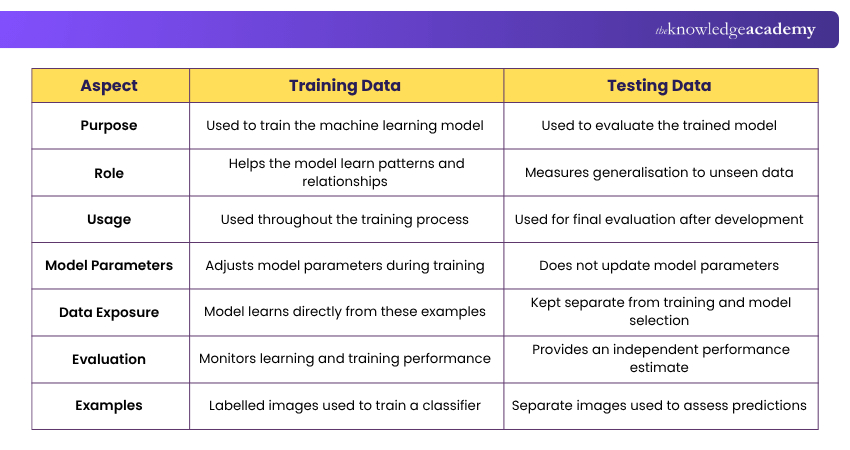
Training and testing data have different roles in machine learning. Training data helps a model learn patterns, while testing data evaluates how well the trained model performs on previously unseen examples. The following table explains their key differences:
Learn to make better predictions through data-driven insights by joining the Predictive Analytics Course now!

Nilotpal Sarmah is a Senior Content Writer with 11+ years of overall experience spanning engineering, operations and content development. His technical knowledge and extensive writing experience enable him to simplify specialised topics across IT and Tech, Business Skills, Project Management, Health and Safety, and ISO and Compliance.
View Detail

 If you wish to make any changes to your course, please


