


We may not have the course you’re looking for. If you enquire or give us a call on +27 800 780004 and speak to our training experts, we may still be able to help with your training requirements.
The Biggest Myths Surrounding PRINCE2® and Agile
ByGrace MitchellLast updated on: 14 October 2026
Are you wondering about the myths surrounding PRINCE2 and Agile? These popular project management frameworks often face misconceptions about their flexibility, effectiveness, and compatibility. This blog delves into common myths around PRINCE2 and Agile, clarifying how they can work together or individually to enhance project outcomes.

Quick Preview
1. PRINCE2 supports tailoring, allowing its controls and documentation to reflect project requirements.2. PRINCE2 is applicable to projects of different sizes and industries, not just large IT initiatives.3. Agile still requires appropriate architecture, useful documentation and clear accountability.4. Agile frameworks may distribute management responsibilities without prescribing a dedicated Project Manager role.5. PRINCE2 governance and Agile delivery practices can be combined to balance control with adaptability.
PRINCE2 means endless paperwork. Agile means no rules. These are two of the most common misconceptions in project management. Despite their widespread use, PRINCE2 and Agile are often misunderstood as conflicting approaches. Some professionals believe PRINCE2 is too rigid for changing requirements, while others assume Agile eliminates the need for planning, documentation and management responsibilities.
The reality is different. PRINCE2 provides a structured, tailorable approach to project governance and management, while Agile emphasises adaptability, collaboration and iterative value delivery. The two are not opposites, because each covers something the other does not.
Five Common PRINCE2® Myths
Here are five common myths about PRINCE2®, along with the reality behind each:
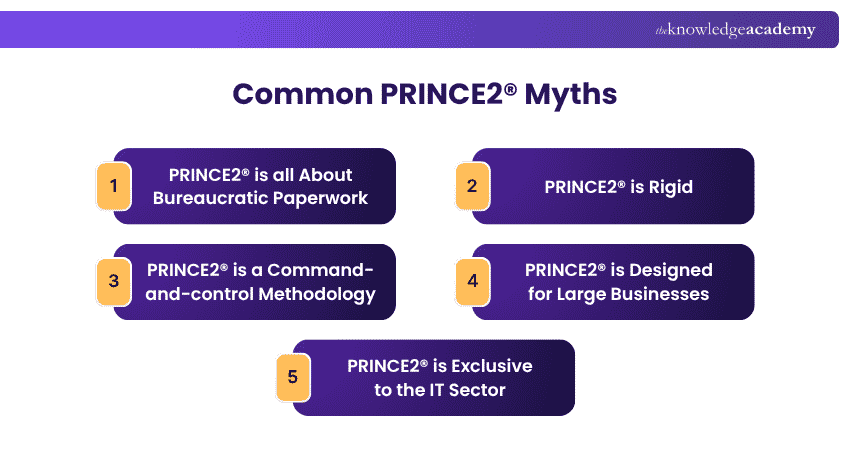
Myth 1: PRINCE2® is all About Bureaucratic Paperwork
Reality: PRINCE2® requires appropriate management information, not unnecessary documentation.
A common misconception is that successful PRINCE2 projects require extensive reports, templates and administrative activities. In practice, PRINCE2 encourages organisations to tailor their management products and communication methods according to project needs. For example, a small project may use concise reports and shared digital records, while a complex regulated project may require more formal documentation.
The objective is to maintain enough information to support decision-making, accountability and control without creating unnecessary administrative work. PRINCE2 7 also recognises that management products do not need to be traditional written documents and can take any suitable format, such as a dashboard, a shared board or an email.

Myth 2: PRINCE2® is Rigid
Reality: PRINCE2® is designed to be tailored to different project environments.
Some professionals assume that PRINCE2 requires every project to follow identical procedures, regardless of its size or complexity. In fact, “tailor to suit the project” is one of the seven PRINCE2 principles, so it applies to every PRINCE2 project. Processes, products and roles can be adapted, while the principles themselves stay in place.
For example, a project using iterative delivery may still apply PRINCE2 governance while allowing delivery teams to refine requirements through feedback. PRINCE2 7 explicitly accommodates agile, incremental and iterative delivery approaches.
Myth 3: PRINCE2® is a Command-and-control Methodology
Reality: PRINCE2® supports delegated authority through management by exception.
PRINCE2 defines governance responsibilities, including those of the Project Board and Project Manager. However, this does not mean senior management must approve every small decision. PRINCE2 uses the principle of management by exception, which allows authority to be delegated within agreed tolerances.
These tolerances can cover aspects such as time, cost, quality, scope, benefits, risk and sustainability, as appropriate to the management level and project. The Project Manager can manage work within the agreed limits. If an exception is forecast, the matter is escalated to the appropriate authority. This allows senior management to focus on significant decisions while giving project teams suitable management freedom.
Transform your project skills! Join the Agile Project Management Practitioner (AgilePM® V3) Course to deliver faster, adapt quickly, and achieve outstanding results.
Myth 4: PRINCE2® is Designed for Large Businesses
Reality: PRINCE2® can be applied to projects of different sizes.
Although PRINCE2 is commonly associated with large organisations and complex projects, its principles can also support smaller initiatives. The key is to apply the method proportionately. A small project may require fewer management layers, shorter reports and simpler review arrangements than a large-scale transformation programme.
For example, a small office relocation might need only the initiation stage plus one delivery stage, concise reports and a Project Manager who also acts as Team Manager. A large transformation programme would use several stages, a full management team and formal stage-boundary reviews.
Trainer Insight
Before creating any management product, ask who will use it and which decision it supports. If the answer is unclear, simplify the product or leave it out.
Myth 5: PRINCE2® is Exclusive to the IT Sector
Reality: PRINCE2® can be applied across many industries.
PRINCE2 has historical links to IT project management, but its application is not restricted to technology projects. It provides a general project management method that can be tailored to different sectors.
For example, PRINCE2 can support projects in:
a) Construction: Managing project stages, responsibilities and delivery risks.
b) Healthcare: Coordinating service improvement and operational change initiatives.
c) Education: Managing institutional development and technology implementation projects.
d) Manufacturing: Overseeing process improvement and facility expansion.
e) Government: Managing public-sector projects with defined governance requirements.
Five Common Agile Myths
The five common myths about Agile methodology are as follows:
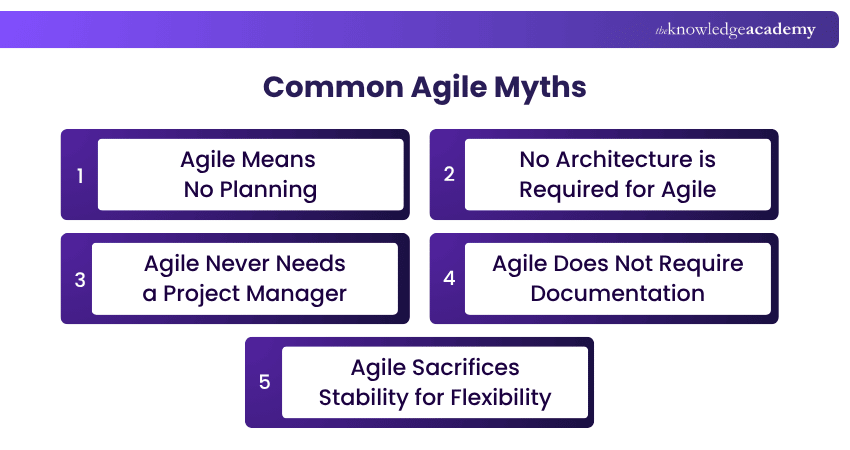
Myth 1: Agile Means No Planning
Reality: Agile plans continuously in short cycles instead of planning everything up front.
A common misconception is that Agile teams simply start building and work out the details as they go. In practice, Agile teams plan at several levels. A product vision and roadmap set the direction, the product backlog is ordered by value and refined regularly, and each sprint begins with sprint planning, where the team agrees a sprint goal and selects the work to deliver.
Agile planning is adaptive, so plans are updated as feedback and new information arrive instead of being fixed at the start. For example, a team building a mobile app may agree a high-level roadmap for the quarter and refine the detail of the next sprint only shortly before it begins. This keeps plans realistic while allowing priorities to change.
Myth 2: No Architecture is Required for Agile
Reality: Agile teams still need suitable architecture to support effective delivery.
Agile encourages teams to adapt their solutions as they gain new information, but this does not mean architecture can be ignored. Architecture helps teams establish important technical decisions concerning system structure, integration, scalability, security and maintainability. However, Agile teams do not necessarily need to define every architectural detail before development begins.
They can establish sufficient initial architecture and refine it as the product evolves. For example, a team developing an online application may define essential security and integration requirements early while adapting other architectural decisions during development. The objective is to balance architectural planning with the ability to respond to changing needs.
Myth 3: Agile Never Needs a Project Manager
Reality: Agile frameworks may not prescribe a dedicated Project Manager role, but management responsibilities still need to be fulfilled.
Some Agile frameworks distribute responsibilities among different accountabilities rather than assigning everything to a traditional Project Manager. For example, Scrum defines three specific accountabilities:
a) Product Owner
b) Scrum Master
c) Developers
It does not prescribe a separate Project Manager accountability within the Scrum Team.
Trainer Insight
Focus on responsibilities, not job titles. Even when an Agile framework has no dedicated Project Manager role, stakeholder coordination, budgeting and managing dependencies still need a clear owner.
Myth 4: Agile Does Not Require Documentation
Reality: Agile encourages useful documentation rather than eliminating it entirely.
A common misconception is that Agile teams should focus only on delivering working products and avoid creating documentation. However, documentation remains important for sharing knowledge, maintaining consistency and supporting future development. The level of documentation depends on the project's complexity, stakeholder needs and regulatory requirements.
For example, an Agile team developing a banking application may need to maintain security requirements, API documentation and compliance records while delivering features iteratively. Agile encourages teams to prioritise valuable documentation over unnecessary paperwork. The goal is to keep information relevant, accessible and updated without slowing down delivery.
Myth 5: Agile Sacrifices Stability for Flexibility
Reality: Agile can combine adaptability with structured practices that support stability.
Agile teams may respond frequently to changing priorities, but this does not mean they should operate without clear objectives or quality standards. Frameworks such as Scrum introduce defined accountabilities, events and commitments to support transparency and consistent delivery. For example, Scrum uses Sprint Goals to provide focus and a Definition of Done to establish shared quality expectations.
The Product Backlog can evolve as priorities change, while changes during a Sprint should not endanger the Sprint Goal. These practices allow teams to respond to new information while maintaining direction, quality and accountability.
Become an Agile leader! Dive into AgilePM® Foundation & Practitioner (AgilePM® V3) Training and revolutionise your project management approach for lasting results!
Can PRINCE2® and Agile Work Together?
Yes. PRINCE2 provides structured governance, defined responsibilities and management controls, while Agile supports iterative delivery, collaboration and responsiveness to change. PRINCE2 does not require any particular delivery method, as it separates managing the project from delivering its products, so delivery teams can use Scrum or Kanban inside a PRINCE2 project.
For example, the Project Board could approve the Business Case and set limits for time, cost and scope, while the delivery team works in Sprints. If the work is forecast to go beyond those limits, the Project Manager escalates it to the Board for a decision.
PRINCE2 Agile (Version 2) is the official guidance for combining the two, showing how PRINCE2’s principles, practices and processes can be tailored for agile ways of working.
Learn to adapt quickly without losing project direction by joining the PRINCE2 Agile® Foundation and Practitioner (Version 2) Training now!

Grace Mitchell creates practical Project Management content covering project delivery, governance, stakeholde engagement and programme coordination. Her knowledge of established methodologies helps readers understand complex project environments and approach project delivery with greater structure and confidence.
View Detail

 If you wish to make any changes to your course, please


