


 Top Rated Course

We may not have the course you’re looking for. If you enquire or give us a call on 01344203999 and speak to our training experts, we may still be able to help with your training requirements.
SSL vs TLS: Key Differences and Security Explained
The Knowledge Academy 16 July 2026SSL is an older encryption protocol for secure data transfer, while TLS is the stronger, updated successor, ensuring better security and privacy online. The encrypted link between a server and a client is achieved through encryption, authentication, and data integrity checks, which help protect against eavesdropping and message forgery.

Training Outcomes Within Your Budget!
We ensure quality, budget-alignment, and timely delivery by our expert instructors.
Table of Contents

The lightning-fast connectivity that the digital world boasts can sometimes be a curse, especially in the context of cyber crime. Your online banking details, passwords and personal chats can be vulnerable to prying eyes. This is why security protocols like Secure Socket Layer (SSL) and Transport Layer Security (TLS) work quietly behind the scenes to encrypt your data and verify who you’re talking to.
While they share the same goal, TLS is the newer, more advanced protocol, whereas SSL now serves as a historic stepping stone in the evolution of internet security. This blog examines the key differences between SSL vs TLS, highlighting their features and explaining why TLS has become the standard in web security. So read on!
Table of Contents
1) What is Secure Socket Layer (SSL)?
2) What is Transport Layer Security (TLS)?
3) SSL vs TLS: Key Differences
4) SSL vs TLS: Key Similarities
5) Conclusion
What is Secure Socket Layer (SSL)?
Secure Socket Layer (SSL) is a widely used security protocol that forms an encrypted connection between a web server and a browser. This ensures all exchanged data stays private and secure. By using cryptographic protocols, it safeguards sensitive information, such as login credentials, credit card details, and personal data, from interception or tampering.
SSL certificates also confirm a website’s identity, allowing users to verify they are accessing a legitimate site. While SSL has been largely replaced by the more secure Transport Layer Security (TLS), the term SSL remains common in everyday usage, often referring to TLS as well.
Secure Socket Layer (SSL) Features
Here are the main features of SSL:
1) Encryption: SSL scrambles the data sent between a website and your browser so that no one else can read it. It uses special encryption keys to lock the information, keeping things like passwords, payment details and personal data safe from hackers.
2) Authentication: SSL ensures that you are connecting to the genuine website, not a fake one. It does this through SSL certificates issued by trusted organisations, which confirm the site’s identity before your browser shares any sensitive information.
3) Data Integrity: SSL checks that the information sent between your browser and the website hasn’t been changed or tampered with. If anything is altered during the journey, the connection is terminated to prevent the use of unsafe or corrupted data.
4) Fortezza Algorithm: The Fortezza algorithm was an older encryption method used in early SSL versions like SSL 3.0. It relied on special hardware cards to secure communications. While it’s no longer used today, it helped shape stronger security methods in later SSL/TLS versions.

What is Transport Layer Security (TLS)?
Transport Layer Security (TLS) is a security protocol that keeps online communication private and safe. It replaces the older SSL protocol and works by encrypting data sent between applications, like browsers and websites, so hackers can’t read or change it. It’s widely used to secure websites (HTTPS), emails, and other online services, protecting sensitive information such as passwords, payment details and personal data during transmission.
TLS also ensures that data is exchanged only with trusted parties by verifying digital certificates. It provides stronger cryptographic algorithms and session key management, making it resilient against modern cyberattacks. Over time, TLS has become the global standard for securing digital communications across industries.
Transport Layer Security (TLS) Features
Here are the key features of TLS:
1) Enhanced Encryption: TLS offers stronger and more advanced encryption methods than the older SSL protocol, making it harder for attackers to break into communications. It supports modern algorithms, such as AES and Elliptic-curve Cryptography.
2) Forward Secrecy: TLS supports forward secrecy, a feature that generates unique encryption keys for each communication session. Even if someone were to gain access to a server’s private key in the future, they would not be able to decrypt past communications.
3) Improved Performance: TLS is designed to be faster and more efficient than SSL. It uses optimised algorithms and streamlined processes to reduce the time it takes to set secure connections, meaning websites and online services load more quickly.
SSL vs TLS: Key Differences
Here are the key differences between SSL and TLS:
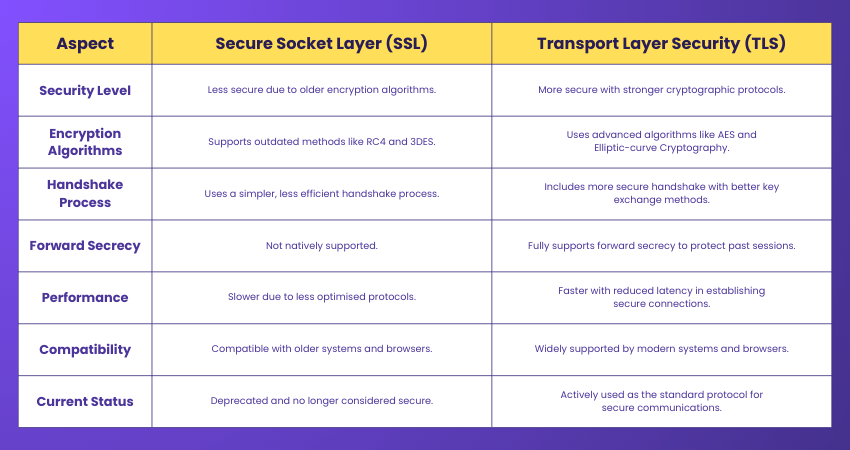
1) Security Level
SSL is less secure because it relies on outdated encryption algorithms and has several known vulnerabilities. In contrast, TLS offers stronger protection with modern encryption standards and robust cryptographic protocols, making it far more reliable for secure communication.
2) Encryption Algorithms
SSL supports older and weaker methods such as RC4 and 3DES, which are no longer considered safe. TLS, however, uses advanced algorithms like AES, ChaCha20, and Elliptic-curve Cryptography. This ensures higher levels of security and data protection.
3) Handshake Process
The handshake process in SSL is simpler but less efficient, leaving room for weaknesses. On the other hand, TLS improves on this by offering a more secure and efficient handshake. It’s got stronger key exchange methods that provide better overall protection.
Train and turn any tech troubles into triumphs. Sign up for our comprehensive IT Support and Solution Training now!
4) Forward Secrecy
Forward secrecy is not supported in SSL, meaning past sessions can be exposed if private keys are compromised. In contrast, TLS fully supports forward secrecy, ensuring that even if keys are leaked, previous communications remain secure.
5) Performance
SSL tends to be slower due to its less optimised protocols. It requires more processing time during encryption and decryption. TLS, on the other hand, is designed for efficiency and offers faster performance, reducing latency when establishing secure connections.
6) Compatibility
SSL remains compatible with many older systems and browsers, but it is no longer recommended for secure communication. On the other hand, Modern systems and browsers widely support TLS and have become the current industry standard.
7) Current Status
SSL is now deprecated and not considered safe to use for securing data. It is vulnerable to several known exploits. In contrast, TLS is widely adopted and recognised as the standard protocol for secure online communication today. It continues to evolve with stronger versions, offering enhanced protection for users.
SSL vs TLS: Key Similarities
SSL and TLS are both security protocols that encrypt data between servers, applications, users and systems. They also verify the identity of the two parties communicating over a network, enabling them to exchange information safely. Here are the key similarities:
Terminology
TLS directly replaced SSL, and all SSL versions are now outdated. However, the term “SSL” is still widely used to describe TLS connections. In many cases, “SSL” or “SSL/TLS” refers to the TLS protocol and its certificates.
Build your tech foundation the right way with our comprehensive IT Fundamentals Training - Sign up now!
Purpose
Both SSL and TLS are designed to provide secure communication through encryption and authentication. They use digital certificates to support the handshake process, which establishes an encrypted link between a browser and a web server.
Usage in HTTPS
HTTP is a set of rules for communication between clients and servers. HTTPS is the secure version of HTTP, achieved by using SSL/TLS. Before connecting to a website, your browser checks the site’s TLS or SSL certificate to confirm it meets security standards. In the browser’s address bar, a secure connection is shown as https:// instead of http://, with the “s” indicating “secure.”
Conclusion
SSL and TLS both aim to secure online communications, but TLS is the modern, more secure choice. While “SSL” is still a common term, today’s secure connections almost always use TLS. Understanding the differences between SSL vs TLS can help you recognise why TLS is the go-to choice for ensuring privacy and maintaining trust in the digital world.
Turn web hosting knowledge into your gateway to digital success with our Introduction to Domain Names and Web Hosting Training - Register now!
Frequently Asked Questions
What are the Four SSL Protocols?

The four main SSL protocols are:
1) Handshake Protocol: Sets secure connection and exchanges keys between the client and server.
2) Change Cypher Spec Protocol: Tells both sides to switch to the agreed-upon encryption settings.
3) Alert Protocol: Sends warning or error messages.
4) Record Protocol: Handles application data's secure transmission.
Can TLS Work Without SSL?
Yes, TLS can work without SSL. TLS is the newer and more secure version, built as a separate protocol. While early versions could work with SSL for compatibility, modern TLS operates independently and no longer requires SSL at all.

The Knowledge Academy


Global Training Provider
The Knowledge Academy is a world-leading provider of professional training courses, offering globally recognised qualifications across a wide range of subjects. With expert trainers, up-to-date course material, and flexible learning options, we aim to empower professionals and organisations to achieve their goals through continuous learning.


 If you wish to make any changes to your course, please


