


We may not have the course you’re looking for. If you enquire or give us a call on 01344203999 and speak to our training experts, we may still be able to help with your training requirements.
Six Sigma vs PMP®: How to Choose the Right One?
ByVidhya NairLast updated on: 10 October 2026
This blog is a detailed comparison of Six Sigma vs PMP®, including tips to choose the best certification and how you can benefit from these certifications.
Every successful business has two kinds of heroes. Some work behind the scenes, fixing inefficiencies that others barely notice. Others stand at the centre of the action, coordinating people, deadlines and resources to bring ambitious plans to life. Neither role is more important, but each requires a different set of skills.
That's what makes the comparison between Six Sigma and PMP® so interesting. One focuses on improving processes, while the other centres on managing projects. But which certification is the better investment for your career? Let's find out.
What is Six Sigma Certification?
Six Sigma certification is a professional credential that validates an individual's ability to identify problems, reduce errors and improve business processes using data-driven techniques. It focuses on improving quality, reducing process variation and increasing efficiency across organisations.
It uses measurement, statistical analysis and structured problem-solving to improve quality and process performance. One of its best-known approaches is DMAIC, which stands for Define, Measure, Analyse, Improve and Control. It provides a structured way to improve existing processes:
a) Define: Identify the problem, objectives and customer requirements.
b) Measure: Collect relevant data and understand current process performance.
c) Analyse: Determine the root causes of defects, variation or inefficiency.
d) Improve: Develop and implement solutions to address identified causes.
e) Control: Monitor the improved process to help sustain the results.
Six Sigma certifications are available at different levels, commonly known as White Belt, Yellow Belt, Green Belt, Black Belt and Master Black Belt. Each level represents a different degree of knowledge and expertise in process improvement.
What is PMP® Certification?
A Project Management Professional (PMP®) certification by the Project Management Institute (PMI) is a globally recognised project management credential. It validates a professional's knowledge, skills and experience in leading and managing projects successfully. Unlike Six Sigma with various levels of certification, PMP® is a single certification and covers a broader project management context.
PMP® certification focuses on applying predictive, Agile and hybrid approaches to manage projects effectively. It is suitable for experienced project professionals who want to strengthen their project management expertise and advance their careers.
Differences Between Six Sigma and PMP®
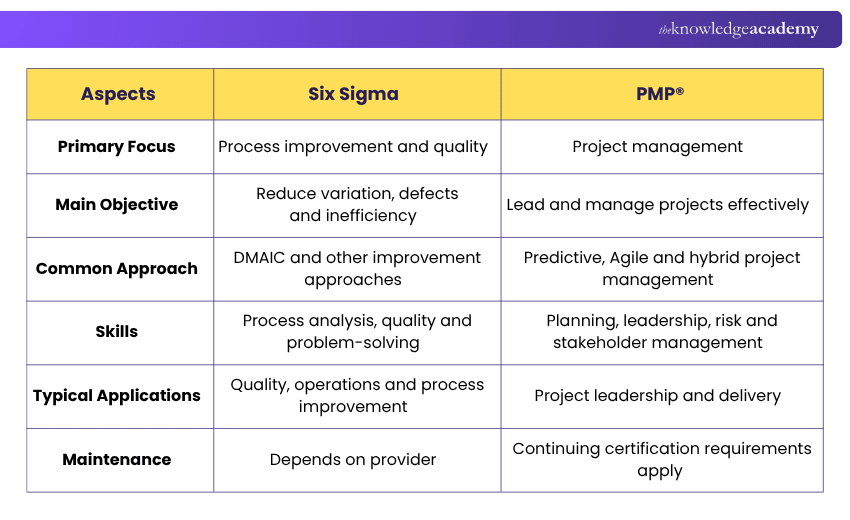
Six Sigma and PMP® are both valuable certifications that help professionals improve business performance, but they differ in their focus, approach and career opportunities. While Six Sigma concentrates on improving processes and reducing defects, PMP® focuses on managing projects and achieving organisational goals.
Let's explore the key differences between Six Sigma and PMP® to understand what sets them apart:
Now, let’s explore their differences in detail:
1) Primary Focus
Six Sigma focuses primarily on process improvement, quality, efficiency and reducing defects or variation. PMP® focuses on managing projects and delivering outcomes while addressing areas such as teams, stakeholders, risks and organisational priorities.
Trainer's Insight
Start with the type of problem you want to solve. If your work centres on improving processes and quality, Six Sigma may align better. If you lead projects, teams and delivery, PMP® may be more relevant.
2) Approach and Methodology
Six Sigma commonly uses structured improvement approaches such as DMAIC for improving existing processes. PMP® differs because it is a certification rather than a methodology. Project management professionals may work with predictive, Agile or hybrid approaches depending on the project and organisational environment.
3) Skills You Develop
Six Sigma can help develop skills in:
a) Process analysis
b) Root cause analysis
c) Quality improvement
d) Data-driven problem-solving
e) Process measurement and control
PMP® focuses on broader project management capabilities involving areas such as:
a) Project planning and delivery
b) Team leadership
c) Stakeholder engagement
d) Risk management
e) Communication
f) Project performance
4) Certification Structure
Six Sigma commonly follows a belt-based structure. Typical levels include:
a) White Belt: Introduces fundamental Six Sigma concepts.
b) Yellow Belt: Builds foundational knowledge and supports participation in improvement initiatives.
c) Green Belt: Develops deeper process-improvement and problem-solving capabilities.
d) Black Belt: Focuses on advanced Six Sigma application and leading improvement initiatives.
e) Master Black Belt: Represents advanced expertise and commonly involves mentoring, coaching and strategic Six Sigma leadership.
However, PMP® does not follow a comparable belt hierarchy. It is a standalone professional project management certification.
5) Eligibility and Requirements
The requirements for Six Sigma depend on the specific belt level and certification provider. There is no single universal eligibility requirement that applies to every Six Sigma certification.
To qualify for the PMP® certification, you must have relevant project management experience and meet one of the following eligibility requirements:
a) A high school diploma with five years of project management experience.
b) An associate’s degree or vocational qualification with four years of project management experience.
c) A bachelor’s degree or higher with three years of project management experience.
d) A bachelor’s or postgraduate degree from a PMI GAC-accredited programme with two years of project management experience.
e) Professionals must also complete 35 hours of project management training. Alternatively, they can hold an active CAPM certification to meet the training requirement. In both cases, they must have the required project management experience gained within the past 10 years.
6) Industry Applications
Six Sigma originated in manufacturing environments but process improvement principles have broader applications wherever organisations need to improve quality, efficiency or consistency. On the other hand, PMP® can be relevant wherever organisations deliver work through projects, including sectors such as IT, construction, healthcare, finance and manufacturing.
Trainer's Insight
Don't choose solely by industry. Look at the responsibilities of your target role because project management and process improvement skills can both appear across multiple sectors.
7) Certification Maintenance
Six Sigma certification renewal requirements vary depending on the certification provider and level.
PMP® certification holders must renew their certification every three years by earning 60 Professional Development Units (PDUs). These can be earned through activities such as training, learning, volunteering and contributing to the project management profession. Professionals also need to submit their earned PDUs and pay the renewal fee to keep their certification valid.
Establish yourself as a leader in process improvement with the Six Sigma Master Black Belt Training – Sign up now!
Similarities Between Six Sigma and PMP®
Although PMP® and Six Sigma focus on different areas, they share several similarities in helping professionals improve business performance and achieve organisational goals. Here are some of their key similarities:
1) Focus on Business Improvement: Both aim to improve organisational performance by enhancing efficiency, reducing waste and achieving better results.
2) Problem-solving Approach: Both encourage professionals to identify problems, analyse their causes and develop effective solutions.
3) Data-driven Decision Making: Both emphasise using relevant data and performance metrics to make informed decisions and track progress.
4) Structured Approaches: Both encourage professionals to apply established frameworks, tools and best practices to achieve consistent and measurable results.
5) Risk Management: Both help professionals identify potential risks and take appropriate measures to minimise their impact.
6) Career Advancement: Both certifications can enhance professional credibility, develop valuable skills and create opportunities for career growth.
7) Industry Versatility: Both are applicable across various industries, including IT, healthcare, manufacturing, finance and construction.
Six Sigma or PMP®: Tips for Choosing the Right Certification
To solve your confusion about choosing either of these certifications, start by assessing the pros and cons of each of these certifications. The benefits and drawbacks will be different depending on the career path you set for yourself.
Neither of these certifications is better than the other. You have to make an informed decision by understanding the different areas each of these focuses on. The value of each certification depends on your career goals, industry and the skills required for your target role. Here are the things to consider before deciding which certification may fit your role:
1) Career Goals: Consider how these certifications can contribute to your career path and goals. For example, PMP® is suitable if you want to become a PMP®-certified Project Manager. Whereas if you're going to advance your career in operations management or quality control/assurance, you may find Six Sigma more suitable. Consider your current job role and how you want to advance your career before considering the certifications.
2) Existing Experience: Consider your current experience and the certification requirements. PMP® requires relevant project management experience, while Six Sigma eligibility varies by certification level and provider.
3) Career Opportunities: Employers look for project management professionals with either or both certifications. PMP® is suitable across many career fields and industries, resulting in various options. Six Sigma also offers opportunities across various industries, particularly in roles involving quality management, operational efficiency and continuous process improvement.
Quick Checklist: Six Sigma or PMP®?Consider Six Sigma if you:□ Focus on process improvement and quality□ Work with defects, variation or inefficiencies□ Prefer data-driven problem-solving□ Work in quality, operations or continuous improvement□ Want to develop process optimisation skillsConsider PMP® if you:□ Lead or manage projects□ Coordinate teams and stakeholders□ Manage project risks and delivery□ Work with predictive, adaptive/agile or hybrid approaches□ Want to strengthen broader project management capabilities
Keep This in Mind
1) Six Sigma is ideal for professionals who want to improve processes, reduce defects and enhance operational efficiency.
2) PMP® is better suited for those looking to lead projects, manage teams and achieve project objectives.
3) Both certifications can complement each other, especially for professionals involved in project management and process improvement.
4) The right choice depends on your career goals, current experience and the responsibilities of your target role.
5) Consider the skills employers expect in your target role to choose a certification that supports your long-term career growth.
Build a strong foundation in process improvement with Six Sigma Green Belt Training – Join now!

Vidhya Nair is a Senior Copywriter with 7+ years of experience across copywriting, content writing and communication. Her extensive research and editorial experience supports her ability to present topics across Business Skills and Human Resources with clarity and purpose.
View Detail

 If you wish to make any changes to your course, please


