


 Top Rated Course

We may not have the course you’re looking for. If you enquire or give us a call on + 1-866 272 8822 and speak to our training experts, we may still be able to help with your training requirements.
What is Service-Oriented Architecture (SOA)? Explained
Richard Harris 16 July 2026Service-oriented Architecture (SOA) is a design approach where services communicate over a network to deliver functionality, promoting flexibility and reuse. It breaks systems into small, independent services that work together. Each service can be updated or replaced without affecting the whole system, saving time and cost.

Training Outcomes Within Your Budget!
We ensure quality, budget-alignment, and timely delivery by our expert instructors.
Table of Contents
Imagine visiting your favourite online store. One service checks your login, another updates the product listings, another manages your payment, and yet another tracks your delivery. Each service runs independently, yet together they create a seamless shopping experience. That is the strength of Service-oriented Architecture (SOA).
In this blog, we’ll cover what Service-oriented Architecture (SOA) is, how it works, its principles, core components, and real-world examples. We’ll also uncover its benefits, showing how it drives flexibility, efficiency, and smooth system performance.
Table of Contents
1) What is Service-oriented Architecture (SOA)?
2) How Does Service-oriented Architecture Work (SOA)?
3) Principles of Service-oriented Architecture (SOA)
4) Components of Service-oriented Architecture (SOA)
5) Examples of Service-oriented Architecture (SOA)
6) Benefits of Service-oriented Architecture (SOA)
7) Limitations of Service-oriented Architecture (SOA)
8) Conclusion
What is Service-oriented Architecture (SOA)?
Service-oriented Architecture (SOA) is a way of designing software where applications are built from small, reusable parts called services. Each service does one specific job and works on its own. These services communicate with each other through a network, making it easier to connect, update, and reuse them in different systems.
In SOA, services are designed to be independent and self-contained, which means they can work on their own without depending too much on others. They use common rules and standards to share data and tasks across systems. This makes it possible for services built in different languages or platforms to work together smoothly.

How Does Service-oriented Architecture Work (SOA)?
SOA works by dividing software into smaller services, each handling a specific task. These services communicate over a network using standard protocols, staying independent but working together to complete larger processes.
When a request is made, the right service responds and may connect with others if needed. For example, in online banking, one service checks your balance, other processes transfers, and another sends notifications, all working together to deliver a smooth experience.
Key Points:
1) Services interact through well-defined interfaces and communication protocols
2) Loose coupling ensures changes in one service do not break others
3) Different services can be combined to form complete workflows
4) Old and new systems can work together smoothly
5) Reuse of services helps cut down development time and cost
Learn foundational AWS cloud concepts and services in-depth with our AWS Cloud Practitioner Training – Join now!
Principles of Service-oriented Architecture (SOA)
There are no fixed rules for building Service-oriented Architecture (SOA), but there are some common principles that most follow. Here are the principles of SOA:
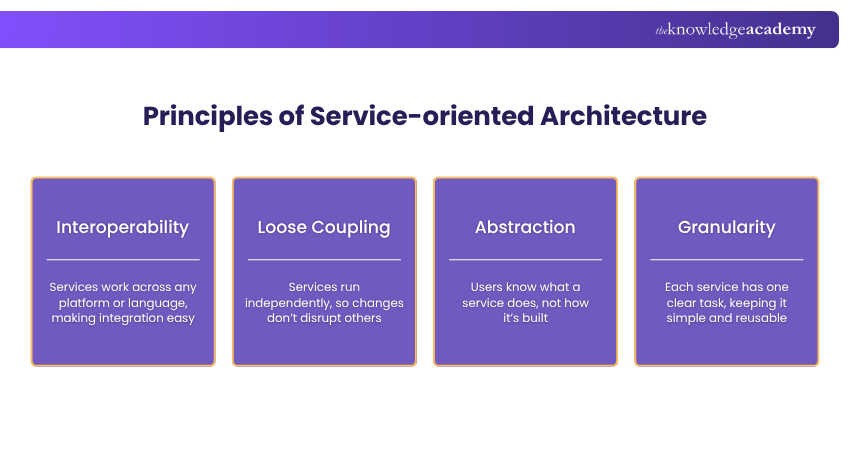
1) Interoperability
In SOA, every service includes documents that describe its function and usage rules. They can work on any platform or language, such as C# or Python. Since services are independent, changes or updates to one service usually do not affect the functioning of others.
2) Loose Coupling
Services should have as few connections as possible to outside systems or resources. They should also be stateless, meaning they don’t keep information from past uses. This makes it easier to change or update a service without affecting other apps or services.
3) Abstraction
People or systems using a service don’t need to know how it’s built or how its code works. They just need to know what it does and how to use it, which is explained in documents like service contracts. This makes services easier to use and share.
4) Granularity
Each service should focus on doing one clear business task. Developers can then join different services together to handle bigger or more complex jobs. This helps keep each service simple and easy to manage.
Components of Service-oriented Architecture (SOA)
SOA has key parts that create, provide, use, and manage services. Here are its main components:

1) Service
In SOA, the main part is the service, which can be private or public. It has three parts: the service implementation (code that does the work), the service contract (requirements, results, and details), and the service interface (how it connects with other services or systems).
2) Service Provider
This is the one who creates or gives the service. It can be made by the same organisation or provided by another company. The service provider makes sure the service works and is available for others to use.
3) Service Consumer
This is the person, system, app, or even another service that uses the service. The service contract explains the rules for how the provider and consumer should work together. The consumer sends a request, and the service sends back the result.
4) Service Registry
Also called a service directory, this is a list of all the services that are available. It stores descriptions and information about how to use each service. This helps people or systems find and connect to the right service quickly.
Understand how to optimise cloud solutions for business efficiency with our Cloud Computing Training – Join now!
Examples of Service-oriented Architecture (SOA)
SOA is used in many real situations to connect different services and make systems work smoothly. Here are some of the examples:
1) Universal Login
Many companies want employees to log in just once with one password to use all the apps they need. SOA makes this possible by using special login services that all the company’s apps can share.
2) In-app Analysis
One big benefit of using cloud systems is that apps can easily add extra features through cloud services. These can be simple, like making a graph from data, or more advanced, like adding AI features to an app by using a set of service calls.
3) Online Retailers
SOA makes it easier to build and manage online shopping sites. Different services can handle tasks like showing product stock, tracking orders, making secure payments, and giving AI-based suggestions, such as “customers also like.”
Benefits of Service-oriented Architecture (SOA)
SOA offers many advantages that make systems easier to build, connect, and maintain. Here are the main benefits:
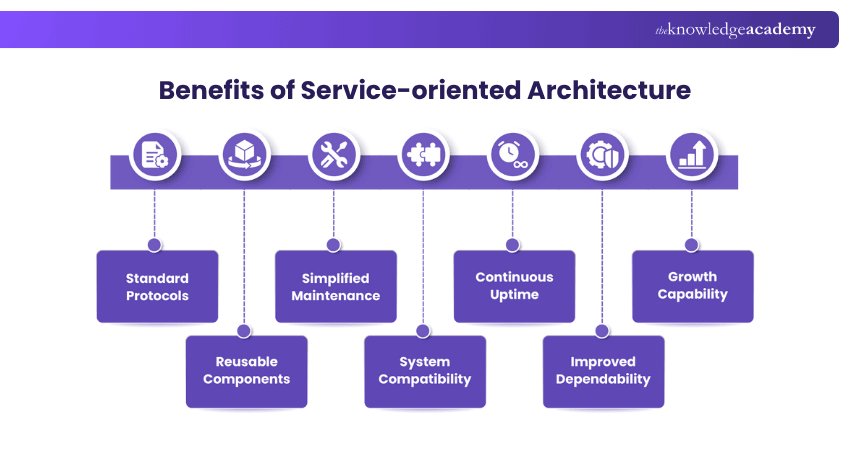
1) Standard Protocols
SOA uses the same rules for all services. This helps them work together without problems. It also keeps things safe and organised. When rules are the same, everything runs smoothly.
2) Reusable Components
One service can be used in many apps. You don’t need to make it again. This saves time and money. It also makes building new apps faster.
3) Simplified Maintenance
Each service works by itself. If you fix one, the others still work. This makes updates easy. It also helps add new features quickly.
4) System Compatibility
Different systems can work together in SOA. They can be built in different languages and still connect. This helps old and new systems work as one. It saves time and effort.
5) Continuous Uptime
Services are ready anytime. If one stops, the others keep going. This means less downtime. Users can keep working without problems.
6) Improved Dependability
Small services are easier to check and fix. This makes apps work better. Problems are easier to find. Users can trust the system more.
7) Growth Capability
Services can run on many servers. This helps handle more users or work. New services can be added easily. The system can grow as the business grows.
Enhance your career opportunities by mastering this widely used tool. Join our Terraform Training now!
Limitations of Service-oriented Architecture (SOA)
SOA has some drawbacks that can affect performance, maintenance, and reliability. Here are the main limitations:
1) Scalability Limitations
SOA can be harder to scale when many services share the same resources. If services need to work together closely to finish a task, it can slow the system as it grows. This can make it difficult to handle more users or bigger workloads.
2) System Interdependencies
Over time, SOA systems can become more complicated. Services may start depending on each other too much, which makes them harder to change or fix. If services call each other in a loop or share the same database, the system can also slow down.
3) Failure Vulnerability
If SOA uses a central tool like an Enterprise Service Bus (ESB), it can create one weak point. If the ESB stops working, services and clients cannot talk to each other. This goes against SOA’s goal of having a system that works in a decentralised way.
Conclusion
Service-oriented Architecture (SOA) helps build flexible and reusable systems by breaking software into small, independent services. It saves time, lowers costs, and improves performance while making it easier to connect different systems. Also, it can support business growth and create adaptable systems that meet changing needs effectively.
Learn Cloud infrastructure and deployment for scalable solutions effectively. Join our Cloud Computing Courses now!
Frequently Asked Questions
When not to use Service-oriented Architecture?

Avoid SOA when your system is small, simple, and doesn’t need many different parts. Using SOA for small projects can make things more complicated than needed.
What is Service-oriented Architecture Best Suited for?
Service-oriented Architecture (SOA) works best for connecting different systems, updating old applications, and building systems that can grow and change easily. It is most useful in big, complex setups like large companies and cloud-based systems.

Richard Harris


Senior Full Stack Developer and Technology Educator
Richard Harris is a highly experienced full-stack developer with deep expertise in both frontend and backend technologies. Over his 12-year career, he has built scalable web applications for startups, enterprises and government organisations. Richard’s writing combines technical depth with clear explanations, ideal for developers looking to grow in modern frameworks and tools.


 If you wish to make any changes to your course, please


