




We may not have the course you’re looking for. If you enquire or give us a call on 01344203999 and speak to our training experts, we may still be able to help with your training requirements.
Prototype Model in Software Engineering: A Complete Guide
ByVishnu SankarLast updated on: 03 October 2026
Explore the benefits and applications of the prototype model in software development, which allows for early visualisation, feedback, and refinement of software projects. Discover how the prototype model in software engineering streamlines development, improves communication and ultimately leads to more successful software solutions.
Quick Look
1. Prototype Model: Creates an early version of software to clarify requirements and gather feedback.2. Main Types: Includes rapid throwaway, evolutionary, incremental, and extreme prototyping.3. Core Process: Covers requirement gathering, quick design, prototype development, testing, and refinement.4. Key Benefits: Supports early feedback, better requirement understanding, and flexible development.5. Main Challenges: May lead to scope creep, repeated iterations, and unrealistic stakeholder expectations.6. Applications: Commonly used in software, web, UI, and game development projects.
The prototype model in software engineering provides a paradigm shift, redefining the traditional approach to development. This innovative methodology involves creating early representations or working models of software solutions to explore requirements, design ideas, and functionality. By placing clients and developers in a symbiotic feedback loop, the prototype model propels projects towards higher efficiency and alignment with end-users' needs.
This blog will explore the phases, advantages, challenges, and real-world implications of the prototype model in software engineering. Let’s dive in to learn more!
What is the Prototype Model in Software Engineering?
The prototype model is a software development approach useful for projects with vague or changing requirements. It creates a preliminary version of the software product, called a prototype, that shows the basic features and functionality that the customers want.
The prototype is then tested and improved by the customers and the developers until the customers are happy with the final prototype, which forms the basis for the final product. The prototype model has some benefits, such as increasing customer involvement, reducing risks, and improving quality. However, it also has some drawbacks, such as being time-consuming, costly, and hard to document.

Types of Prototyping Models
Prototyping models are software development approaches that involve creating preliminary versions of the software product, called prototypes, that demonstrate the basic features and functionality that the customers want. There are four types of prototyping models:
1) Rapid Throwaway Prototyping
This technique offers a valuable method of exploring ideas and getting customer feedback for each of them. In this method, a developed prototype does not necessarily need to be a part of the ultimately accepted prototype. Customer feedback helps identify requirements and design issues early, so the insights gained can improve the design of the final system.
The rapid throwaway prototyping technique suits projects with unclear or changing requirements or when the developers want to experiment with different alternatives. The main advantage of this technique is that it allows developers to identify and eliminate the flaws in the design quickly. The main disadvantage is that it can be wasteful and time-consuming, as the prototype is discarded after each iteration.
2) Evolutionary Prototyping
In this method, the prototype developed initially is incrementally refined based on customer feedback till it is finally accepted. Compared to rapid throwaway prototyping, evolutionary prototyping can save time and effort when the prototype is intended to evolve towards the final system, as development does not restart from scratch for each iteration.
Evolutionary prototyping is particularly useful when requirements are unclear, incomplete, or expected to change. Development begins with an initial working version containing the most important capabilities, which is then repeatedly refined using stakeholder feedback. Unlike throwaway prototyping, the prototype is progressively engineered into or towards the final system, so maintainable architecture and code quality become increasingly important.
3) Incremental Prototyping
In this type of Incremental prototyping, the expected product is broken into different small pieces of prototypes and developed individually. Ultimately, when all individual pieces are appropriately developed, the various prototypes are collectively merged into a single final product in their predefined order. It’s a very efficient method that reduces the complexity of the development process, where the goal is split into sub-parts, and each sub-part is developed individually.
Development time may be reduced when independent parts of the system can be prototyped and tested in parallel. However, integration dependencies can affect the overall delivery timeline. However, separately developed prototypes may not integrate smoothly if interfaces, dependencies, and the overall system architecture are not planned carefully.
The Incremental technique is suitable for projects with modular and independent components or when the developers want to deliver a functional product in stages. The main advantage of this technique is that it allows developers to focus on one part of the system at a time and get customer feedback. The main disadvantage is that it requires careful and complete planning of the entire system before prototyping starts, as any changes in the requirements or design can affect the integration of the prototypes.
4) Extreme Prototyping
This method is mainly used for Web Development. It consists of three sequential independent phases:
a) A basic prototype with all the existing static pages is presented in Hypertext Markup Language (HTML) format in this phase. This phase is used to create the user interface and navigation of the web application and get feedback from the customers. It helps the developers to design and test the layout and appearance of the web pages quickly. However, a basic prototype does not include any functionality or data processing of the web application.
b) In the second phase, functional screens are made with a simulated data process using a prototype services layer. This phase is used to create the web application's functionality and logic and get customer feedback. The phase allows the developers to quickly implement and test the features and behaviour of the web application, although without any actual data or services of the web application.
c) This is the final step, where all the services are implemented and connected with the final prototype. This phase is used to create the data and services of the web application and integrate them with the user interface and functionality.
This extreme prototyping method makes the project cycling and delivery robust and fast. Moreover, it keeps the entire developer team focused and centralised on product deliveries rather than discovering all possible needs and specifications and adding necessary features. This technique is suitable for projects with web-based and dynamic applications or when developers want to use an agile and iterative approach to web development.
The main advantage of this technique is that it allows developers to rapidly prototype and test the web application and get customer feedback. The main disadvantage is that implementing and integrating all the services with the final prototype can be complex and risky.
Trainer’s Insight
Define what each prototype is meant to validate before building it, such as usability, requirements, workflow, or technical feasibility. This helps teams avoid unnecessary iterations and keeps feedback focused.
Unlock advanced tools in systems with the Systems Modelling Techniques Course Start enhancing your designs today.
Phases of the Prototype Model
The prototype model is characterised by its iterative nature, which allows for the development of a functional prototype followed by continuous refinement based on feedback.
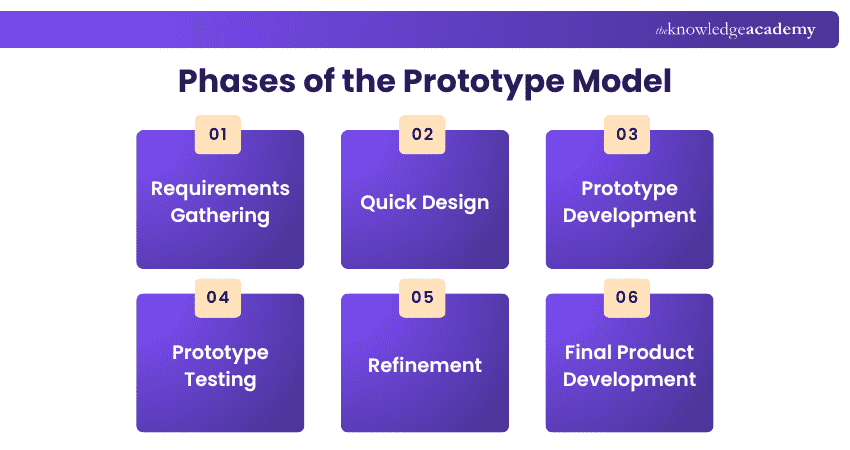
1) Requirements Gathering: During this phase, developers engage in in-depth discussions with stakeholders to identify the primary objectives of the software. However, unlike traditional methods, where all requirements are gathered up front, the prototype model focuses on capturing the essential features and functionalities that will be incorporated into the initial prototype.
2) Quick Design: With the initial requirements in hand, developers create a quick and simplified design of the software's user interface and core functionalities. This design serves as a blueprint for the prototype, outlining the basic layout, user interactions, and essential features. The goal is to establish a foundation that can be built upon in subsequent phases.
3) Prototype Development: Based on the quick design, developers begin creating the actual prototype of the software. This prototype is a working model that focuses on demonstrating the core features and functionalities of the software. It might not include all the intricate details and advanced features that would be present in the final product.
4) Prototype Testing: Once the prototype is developed, it undergoes testing to identify any issues, bugs, or areas of improvement. This testing phase involves both developers and clients working collaboratively to evaluate the prototype's functionality and user experience. Clients interact with the prototype, providing real-time feedback on its usability and alignment with their requirements.
5) Refinement: Feedback obtained from prototype testing forms the basis for the refinement phase. Developers analyse the feedback and begin making necessary changes and improvements to the prototype.
6) Final Product Development: Once the prototype has sufficiently validated the requirements and design, the final system is developed and tested. Depending on the prototyping approach, the prototype may either be discarded or evolved towards the production system.
These changes involve addressing identified issues, adding missing functionalities, and enhancing the user interface. The prototype is iteratively refined based on client feedback, ensuring that it becomes a more accurate representation of the final product with each iteration.
Pro Tip
Set clear goals for each prototype iteration. Focus feedback on specific areas such as requirements, usability, workflow or functionality rather than trying to perfect everything at once.
Advantages of the Prototype Model
The prototype model in software engineering offers several distinct advantages. It promotes enhanced collaboration between developers and clients, promoting active involvement and feedback throughout development.
Early detection of issues is facilitated by creating a functional prototype, enabling timely identification and resolution of potential problems. The model's inherent flexibility and iterative approach accommodate changing requirements and allow for continual improvements, ensuring that the final product aligns more accurately with client expectations.
The prototype model facilitates a deeper understanding of project requirements as developers and clients gain more precise insights into the software's functionalities and design, resulting in a refined and effective product.
Uncover the secrets of seamless software development with our specialised Software Development Lifecycle Training - Sign up now!
Challenges of the Prototype Model
The flexibility that allows for iterative improvements can also lead to scope creep, where evolving client demands may extend project timelines and increase complexity. Incomplete initial requirements might hinder the effectiveness of the prototype, requiring additional iterations to address client needs fully.
The iterative nature of the model can sometimes lead to time and resource constraints, as multiple refinement cycles may consume more resources than initially planned.
There's a risk of unrealistic expectations, as clients might mistake the prototype for the final product, potentially leading to disappointment if outcomes differ from prototype functionality or design.
Real-world Applications
The prototype model finds diverse real-world applications across various domains of software development. In software development projects, it aids in creating user-centric solutions by iteratively refining functionality and design based on user feedback.
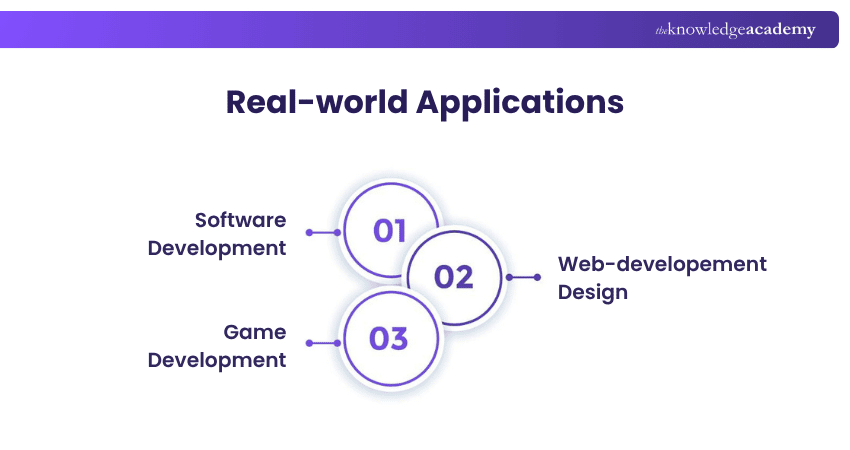
Web application design benefits from prototyping by allowing developers to test and optimise user interfaces and interactions, leading to more intuitive and engaging web experiences. In user interface design, prototypes are tangible visualisations of design concepts, enabling designers to fine-tune layouts and interactions before implementation.
Comparison with Other Development Models
Different differences emerge when comparing the prototype model with other prevalent development methodologies. In contrast to the linear progression of the waterfall model, the prototype model adopts an iterative approach, facilitating flexibility and responsiveness to changing requirements.
While sharing similarities with Agile regarding iteration, Agile often emphasises delivering functional increments of software in each cycle, while the prototype model concentrates on evolving a functional prototype.
The spiral model's focus on risk assessment and management diverges from the prototype model's emphasis on creating a working model to gather feedback, making the latter particularly suitable for projects requiring continuous user engagement and adaptable development paths.
Guidelines for Effective Prototype Development
Effective prototype development hinges on several essential guidelines. Clear and open communication with clients ensures their expectations align with the prototype's purpose and capabilities. Prioritising core features in the prototype design allows for a focused demonstration of essential functionality.
Managing stakeholder expectations is crucial, as educating them about the iterative nature of the process helps prevent misconceptions about the prototype's status as a final product. Balancing the number of iterations and available resources is essential to avoid project overruns while maintaining a consistent pace of refinement.
Boost your systems development skills with the Systems Development Essentials Training. Start building efficient, robust systems today.

Vishnu Sankar is a Senior Content Writer with 5+ years of experience across content development, software development, web development and system administration. His technical background and professional training support his expertise in IT and Tech, while his extensive research and writing experience covers Project Management and Health and Safety.
View Detail

 If you wish to make any changes to your course, please


