




We may not have the course you’re looking for. If you enquire or give us a call on 01344203999 and speak to our training experts, we may still be able to help with your training requirements.
What is Program Management: Key Concepts, Benefits & Examples
ByVidhya NairLast updated on: 10 October 2026
Learn what program management is and explore its key components, benefits, tools, and techniques for coordinating related projects and supporting strategic organisational goals.
Quick Look
1. Program management coordinates related projects to achieve strategic organisational outcomes.2. Governance, planning, stakeholder engagement, risk management and benefits realisation are key program components.3. Program management supports resource coordination and alignment across related projects.4. Tools such as dashboards and Earned Value Management (EVM) can help monitor program performance and progress.5. Program management differs from project management in its broader strategic focus and its emphasis on benefits.
A company launches a new product, opens in a new market and upgrades its systems in the same year. Each project can run well on its own, yet teams compete for the same people, deadlines collide and no one is sure whether the combined effort is moving the business forward.
Program management addresses this by looking across related projects, rather than at each one in isolation. It helps organisations keep dependencies, resources and priorities connected so that the work adds up to the strategic outcomes it was meant to deliver.
What is Program Management?
Program management is the practice of coordinating a group of related projects and activities so that together they achieve strategic objectives and deliver the intended benefits. It covers planning, organising and monitoring the work, and managing the dependencies between projects.
Unlike a single project, a program is judged on the value it delivers as a whole. This means managers must look beyond individual deadlines and budgets. Their job is to keep every project pointed at the same outcome.

Importance of Program Management in an Organisation
Program management helps organisations coordinate related projects so that their activities, resources, and outcomes remain aligned with strategic objectives. This broader perspective also helps identify dependencies and risks that may extend across several projects.
Some organisations use a Project Management Office (PMO), programme office, or similar governance function to support standards, reporting, templates, governance processes, and coordination. The structure and responsibilities of these offices vary depending on the organisation.
Key Components of Program Management
Effective program management relies on several interconnected components. Here are some of the components:
a) Program Governance: Program governance involves setting up clear frameworks for oversight, responsibility, and informed decision making across the program. It also clarifies stakeholder duties and areas of accountability while establishing effective communication channels.
b) Program Planning and Strategy: Program planning and strategy focus on developing a comprehensive plan that aligns with the organisation's strategic objectives. This includes setting goals, defining project scopes, identifying dependencies, and creating a roadmap for achieving desired outcomes.
c) Program Organisation and Stakeholder Management: This component involves establishing the program's organisational structure and managing the stakeholders involved. It includes identifying key stakeholders, understanding their needs and expectations, and implementing strategies to engage and communicate with them effectively.
d) Program Execution and Delivery: Program execution is the phase where projects within the program are implemented, monitored, and controlled. It involves managing resources, tracking progress, resolving issues, and ensuring the delivery of project outcomes within the defined timeline and budget.
e) Program Risk and Issue Management: Risk and issue management in program management involves identifying, assessing, and addressing risks and issues that can arise during the program lifecycle. This includes proactive risk mitigation strategies, contingency planning, and timely resolution of issues to minimise their impact on the program's success.
Strengthen the principle of programme management with the Programme Management Green Belt Course - Join today!
Benefits of Program Management
Program management offers benefits ranging from stronger strategic alignment to improved stakeholder engagement. Some key benefits include:
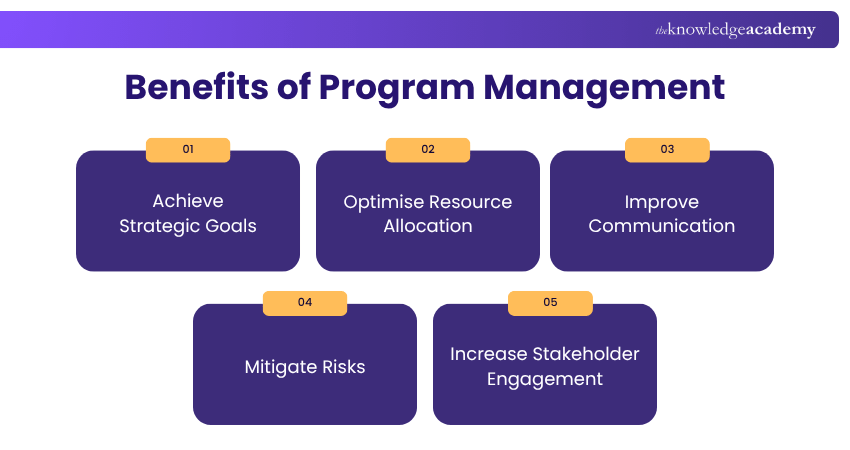
a) Enhanced Alignment with Strategic Objectives: Program management helps ensure that projects within the program remain aligned with the organisation's strategic objectives. It helps prioritise projects and allocate resources in a way that supports each project's contribution to the organisation's overall goals.
b) Improved Resource Utilisation and Efficiency: Program management allows for better resource allocation by sharing resources, avoiding duplication of efforts, and optimising the use of resources based on project priorities. This approach can result in improved efficiency and cost savings.
c) Effective Coordination and Communication: Program management promotes effective coordination and communication among project teams, stakeholders, and senior management. It establishes clear channels for information sharing, facilitates collaboration, and ensures all parties work towards a common goal. This enhances project outcomes and reduces conflicts.
d) Increased Stakeholder Satisfaction and Engagement: Program management involves effective stakeholder management. It ensures that stakeholders are engaged throughout the program lifecycle, their expectations are managed, and their feedback is incorporated. This increases stakeholder satisfaction, support, and commitment to the program's success.
Trainer’s Pro Tip
When managing a program, look beyond individual project progress. Track shared dependencies, risks, resources, and intended benefits across projects to keep the overall program aligned with strategic objectives.
Examples of Program Management
Program management can be applied whenever several related projects contribute to a broader strategic objective. Examples include:
Digital Transformation
A retail bank wants to move customers to digital services. It runs a cloud migration, a new mobile app, a cyber security upgrade and staff training as separate projects, but the app cannot launch until the migration is complete and staff cannot be trained until the app is ready. Program management sequences these dependencies and tracks whether the bank is actually reducing branch visits and service costs, which was the original goal.
Product Launch
A consumer electronics company is releasing a new device. Product development, manufacturing, marketing and customer support each run as projects, but a manufacturing delay affects the campaign date and support training. Program management keeps the launch date, budget and messaging aligned, so the product reaches shops with demand and support already in place.
Business Expansion
A food delivery company is entering a new country. Projects cover hiring local staff, signing restaurant partners, adapting the app and meeting local regulations, and each depends on the others. Program management coordinates them so the launch happens on time, and success is judged by orders and customer growth rather than by tasks completed.
Differences Between Program Management and Project Management
While program management and project management share some similarities, they are distinct disciplines. Here are a few key differences between program management and project management:
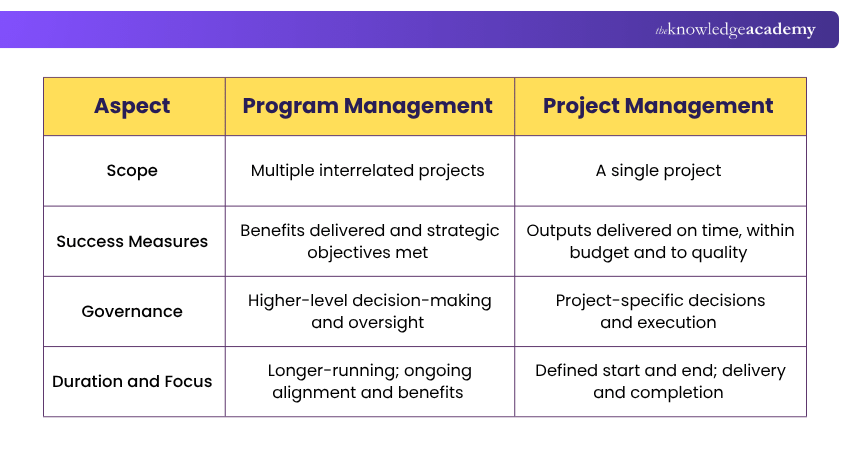
a) Scope: Program management involves managing multiple interrelated projects, while project management deals with individual projects. Program management takes a broader strategic perspective, aligning related projects with organisational objectives and coordinating dependencies across them.
b) Success Measures: Program management measures success by the benefits delivered and the extent to which strategic objectives are met. On the other hand, project management measures success by whether defined outputs are delivered on time, within budget and to the required quality. A project can meet every deadline and still contribute little to the program's wider benefits.
c) Governance: Program management operates with a comprehensive governance structure encompassing higher-level decision-making and oversight, ensuring alignment with organisational strategies. In contrast, project management employs a more focused governance approach, concentrating on project-specific decisions and execution within established parameters.
d) Duration and Focus: Programs usually run longer than projects and continue until the intended benefits are realised, often adapting as organisational priorities change. Projects have a defined start and end and focus on delivering a specific output. As a result, program management leans towards ongoing alignment and benefits, while project management leans towards delivery and completion.
Strengthen programme management capabilities with PM² Project Management Training - Join today!
Tools and Techniques for Effective Program Management
Various tools and techniques can support program planning, execution, monitoring, coordination, and control. Common examples include:
a) Project Management Software: Project management software can support program coordination by providing a centralised platform for planning, scheduling and tracking related project activities. Examples of popular project management software include Microsoft Project, Asana and Jira.
b) Program Dashboards: Program dashboards offer visual representations of key metrics, such as project status, timelines, budget utilisation, and resource allocation. These dashboards give managers a clear overview of the program's performance.
c) Risk Management Tools: Risk management tools facilitate the identification, assessment and mitigation of risks within the program. These tools assist in creating risk registers, conducting risk assessments and developing risk response plans. Techniques such as SWOT analysis and Monte Carlo simulation can also support risk analysis.
d) Communication and Collaboration Tools: Effective communication and collaboration are important in program management. Digital collaboration platforms, team messaging tools, and video conferencing applications help teams share information and coordinate activities.
e) Earned Value Management (EVM): EVM is a technique used to measure and monitor a program's progress and performance. It integrates scope, schedule, and cost data to provide insights into project health and forecast future performance. EVM helps in tracking project variances and making informed decisions.
f) Program Evaluation and Review Technique (PERT): PERT is a project scheduling and planning tool that analyses the time required to complete tasks and determines the critical path. It helps identify dependencies, estimate project durations, and allocate resources effectively.
g) Change Control Tools: Change control tools help manage requests to change a program's scope, schedule or budget. A change request log, an impact assessment template and approval workflows allow each change to be recorded, assessed against the program's objectives and approved or rejected by the right authority before it is implemented.
h) Lessons Learned Reviews: Lessons learned reviews capture what worked and what did not at key points in the program and on its completion. The findings are recorded in a lessons learned repository and shared with teams, so that later projects and phases can avoid earlier mistakes and repeat successful approaches.
i) Performance Analysis Tools: Performance analysis tools assist in evaluating the program's progress against predefined goals and metrics. Key Performance Indicators (KPIs) and balanced scorecards can be used to assess performance against defined objectives and measures.
Advance your project management expertise with PMP® Training - Sign up now!

Vidhya Nair is a Senior Copywriter with 7+ years of experience across copywriting, content writing and communication. Her extensive research and editorial experience supports her ability to present topics across Business Skills and Human Resources with clarity and purpose.
View Detail

 If you wish to make any changes to your course, please


