




We may not have the course you’re looking for. If you enquire or give us a call on 01344203999 and speak to our training experts, we may still be able to help with your training requirements.
What is Probability: The Ultimate Guide
ByNilotpal SarmahLast updated on: 24 September 2026
Probability is a branch of mathematics and data science that quantifies uncertainty by assigning values between 0 and 1 to events. Probability values range from 0 to 1, where 0 represents an event with no probability under the model and 1 represents certainty.

The Main Idea
1. Probability measures uncertainty using values between 0 and 1.2. Events, sample spaces, and outcomes form its basic building blocks.3. Different probability approaches are used depending on the situation and the information available.4. Probability formulas and theorems help analyse relationships between events.5. Probability supports decision-making in areas such as forecasting, risk, and data analysis.
Have you ever imagined how businesses predict market trends with 95% accuracy? In today’s fast-paced world, such precision feels almost magical. The secret lies in probability; the mathematical backbone of decision-making that guides every strategic move.
From analysing financial models to planning daily tasks, mastering probability transforms ambiguity into clarity. Embrace this journey to discover how one simple concept can revolutionise your approach to risk and reward!
What is Probability in Mathematics?
Probability is defined as the measure of how likely an event is to happen, usually expressed as a value between 0 and 1. A probability of zero indicates that the event is impossible, while a probability of one signifies absolute certainty. This concept helps quantify uncertainty in a mathematical framework, allowing for predictions and informed decision-making.
A common real-life example of probability is weather forecasting. For instance, when a forecast states there is a 70% chance of rain, it means that under similar conditions in the past, rain occurred 70% of the time.
Key Terms in Probability
Here are some foundational concepts or terminology used in probability:
a) Sample Space: This is the set of all possible outcomes in a probability experiment. For instance, in the case of a coin toss, it’s heads and tails.
b) Sample Point: This defines one of the possible results of an experiment. For example, sample points are 1 to 6 when rolling a fair six-sided die.
c) Experiment: This refers to a process with uncertain results. Examples include card selection, coin tossing, or rolling a die.
d) Event: This defines a subset of the sample space that represents specific outcomes, such as getting “3” when rolling a die.
e) Favourable Outcome: This outcome produces the desired or expected consequence.

Events in Probability
According to probability theory, an event is a set of outcomes of an experiment. Let's say P(E) represents the probability of event E, then we get:
a) P(E) = 0 for an impossible event
b) P(E) = 1 for a certain event
c) 0 ≤ P(E) ≤ 1
Probabilities can also be used to compare different events. For example, if P(A) > P(B), event A is more likely to occur than event B. The sample space, S, is the set of all possible outcomes of an experiment, while n(S) represents the total number of outcomes in the sample space.
For a finite sample space where all outcomes are equally likely:

The complement of event E, written as E′, represents the event that E does not occur. Hence,
We can also conclude that, P(E) + P(E’) = 1
Probability Formulas
The probability formulas for the events A and B are summarised below:
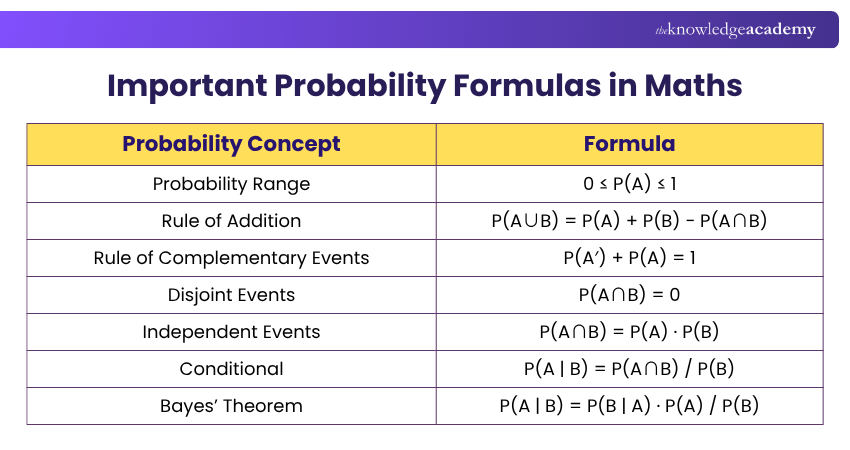
Different Types of Probability
There are a few major types of probabilities, namely theoretical probability, experimental probability and axiomatic probability. These are explored in detail below:
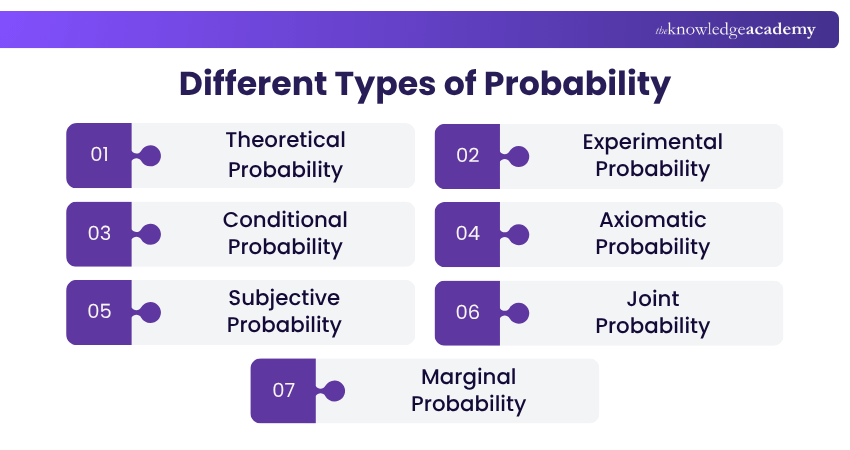
1) Theoretical Probability
Theoretical probability is the probability of an event calculated using mathematical reasoning, without performing an actual experiment. It is based on all possible outcomes and assumes that the outcomes are equally likely.
The formula is:

For instance, if a coin is tossed, the theoretical probability of getting a head will be 1/2.
2) Experimental Probability
Experimental probability, also known as empirical probability, is determined by observing the results of an actual experiment or repeated trials. It is calculated by comparing the number of times a particular event occurs with the total number of trials performed.
To obtain more reliable results, an experiment is often repeated many times. As the number of trials increases, the experimental probability may become closer to the theoretical probability, although this is not guaranteed for every finite set of trials.
The formula is:


Pro Tip
Ask where your probability value comes from. If it comes from equally likely outcomes, think theoretical probability. If it comes from observed trials, think experimental probability.
3) Conditional Probability
Conditional probability measures the likelihood of an event occurring given that another event has already happened. It updates the probability of an event by taking into account additional information or known conditions.
Mathematically, it is defined as

where P(B) > 0.
This concept is vital in fields like statistics, risk analysis, and decision-making, where outcomes are influenced by prior events.
4) Axiomatic Probability
Axiomatic probability defines probability using a set of fundamental rules, known as Kolmogorov’s axioms. These axioms provide a mathematical foundation for probability and apply to different types of probability models.
a) Non-negativity: The probability of any event cannot be negative. P(A)≥0
b) Normalisation: The probability of the entire sample space is equal to 1. P(S)=1
c) Countable Additivity: If two or more events are mutually exclusive, the probability of their union is equal to the sum of their individual probabilities. For mutually exclusive events:

5) Subjective Probability
Subjective probability is an approach for likelihood assessment that relies on personal judgment, intuition, and experience rather than on objective statistical data. It is especially useful in cases of limited historical data or when there are too complex outcomes for conventional probability models.
This method allows individuals to make decisions under uncertainty by drawing on their own insights, although it can be influenced by personal biases. Despite these limitations, subjective probability is often employed in economics, psychology, and risk management, among other key fields where expert opinions play a crucial role.
6) Joint Probability
Joint probability is defined as the likelihood of two coinciding events. It is expressed as P(A and B) or P(A ∩ B) and, when the events are independent, can be calculated by multiplying the probability of one event by the probability of the other.
In cases where the events are dependent, the calculation incorporates the conditional probability. This concept is fundamental in fields, including statistics, risk management, and data science, where understanding the interaction between events is crucial for making informed decisions.
7) Marginal Probability
Marginal probability refers to an event's likelihood of occurring without consideration of any other variables. It is derived by summing joint probabilities and integrating over all possible outcomes of the other variables in the dataset. This provides an overall measure of an event's probability. Marginal probability is essential in fields like statistics, risk management, and data analysis.
Here's a quick comparison:
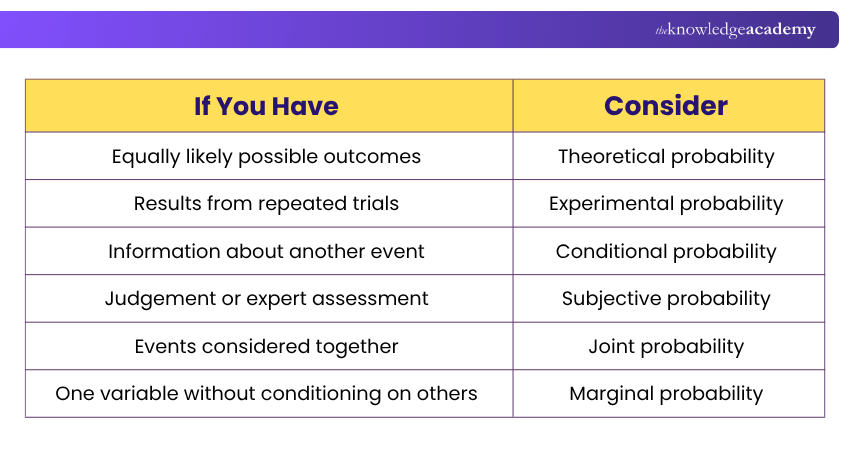
Want to unlock the power of data to gain deeper insight into your industry? Sign up for our detailed Statistics Course now!
Probability Theorems
The following probability theorems find widespread application in mathematics:
1) Addition Theorem: If A and B are two events, the probability of their union is:

2) Multiplication Theorem: This describes the probability of the two independent events, A and B intersection:

3) Law of Total Probability: If {B1, B2,...,Bn} is a partition of the sample space, the probability of an event A is:

4) Bayes' Theorem: Bayes’ Theorem calculates the probability of an event based on prior knowledge of conditions that may be related to that event. The formula for Bayes' Theorem is:

5) Complement Rule: The complement rule states that the probability of an event not occurring is equal to 1 minus the probability that it occurs.

6) Independence Rule: Two events A and B are independent if:

7) Conditional Probability Formula: The probability of event A under the condition that B has occurred is:

8) Bernoulli’s Theorem (Law of Large Numbers): As the number of repeated independent trials increases, the observed relative frequency tends to approach the theoretical probability. This theorem is expressed as follows:

Master the art of informed decision-making with our comprehensive Decision Tree Modelling Using R Course – Sign up now!
Examples of Probability
Here are a couple of examples to illustrate the concept of probability
Example 1: Let's say there are eight balls in a container, out of which four are red, three are blue and one is yellow. Then the probability of picking a red ball can be determined by dividing the number of red balls in the container by the total number of balls in the container
So, the answer is 4/8 or 1/2
Example 2: Let's say you have to calculate the probability that an even number is obtained when you roll a dice. You must consider the six possible outcomes when a fair six-sided dice is rolled: 1, 2, 3, 4, 5 or 6. Out of these possible outcomes, half are even (2, 4, 6) and half are odd (1, 3, 5). Therefore, the probability of getting an even number is:
1) P(even)= (Number of even outcomes)/(Total number of outcomes)
2) P(even)= 3/6
3) P(even)= 1/2
Common Probability Mistakes to Avoid
1) Confusing an outcome with an event
2) Assuming events are independent without checking
3) Adding overlapping event probabilities without subtracting their intersection
4) Confusing probability with odds
5) Expecting experimental probability to exactly equal theoretical probability in a finite number of trials
Applications of Probability
Probability boasts a broad variety of applications in real life. Some basic applications include the following events:
1) Card Selection: When drawing a card from a deck, probability quantifies the selection chances of a particular card, enhancing strategic play in various games.
2) Coin Tossing: In a coin toss, probability assigns equal likelihood to heads or tails, illustrating the basic randomness and fairness principles.
3) Dice Rolling: When throwing a die, probability determines the chance of each face appearing, serving as a classic example of understanding random events.
4) Lucky Draw: Probability is used for winning chance estimation in a lucky draw, providing insights into the mechanics behind seemingly unpredictable outcomes.
5) Risk Modelling: In diverse industries, probability is essential for risk assessment and modelling, helping with overall potential hazard forecasts and devising effective mitigation strategies.
6) Weather Forecasting: Meteorologists apply probability for weather change prediction, ensuring that forecasts are rooted in statistical data and trend analysis.
7) Sports Prediction: In sports analytics, probability calculates a team's winning chances through players' performance and team dynamics evaluation, thereby informing tactical decisions.
8) Market Analysis: In the share market, probability is crucial in determining price hikes and market shifts, guiding investors in making informed decisions.
How to Figure out the Odds of Something?
To figure out the odds of an event, start by calculating its probability. Then, convert that probability into odds by dividing it by one minus the probability.
For example, if an event has a probability of 20% (0.20):
Subtract 0.20 from 1 → 1 - 0.20 = 0.80
Divide 0.20 by 0.80 → 0.20 ÷ 0.80 = 0.25
This gives odds of 0.25, which can be expressed as "1 to 4" (or equivalently, "1:4"). This means the event is four times more likely not to happen than to happen.
How to Calculate the Probability of Something not Happening?
You can use the following formula to calculate the probability of something not happening:
P(A') = 1−P(A)
Here, P(A) = Probability of the event occurring.
P(A') = Probability of the event not occurring.
Probability Problem-solving Checklist
Before you calculate, check this:
☐ Identify the Experiment: What uncertain process is taking place?☐ Define the Sample Space: What are all the possible outcomes?☐ Identify the Event: Which outcome or group of outcomes matters?☐ Check the Event Relationship: Are the events independent, mutually exclusive or conditional?☐ Choose the Right Rule: Basic, addition, multiplication, complement or conditional?☐ Calculate Carefully: Substitute the correct values into the formula.☐ Check the Result: A probability must fall between 0 and 1.
Lead the data evolution with our Python Data Science Course - Join now!

Nilotpal Sarmah is a Senior Content Writer with 11+ years of overall experience spanning engineering, operations and content development. His technical knowledge and extensive writing experience enable him to simplify specialised topics across IT and Tech, Business Skills, Project Management, Health and Safety, and ISO and Compliance.
View Detail

 If you wish to make any changes to your course, please


