




We may not have the course you’re looking for. If you enquire or give us a call on 01344203999 and speak to our training experts, we may still be able to help with your training requirements.
Home
 Resources
Project Management
PRINCE2® vs PMP®: Which Project Management Certification is Right for You?
Resources
Project Management
PRINCE2® vs PMP®: Which Project Management Certification is Right for You?
Resources
Project Management
PRINCE2® vs PMP®: Which Project Management Certification is Right for You?
PRINCE2® vs PMP®: Which Project Management Certification is Right for You?
ByNilotpal SarmahLast updated on: 08 October 2026
PRINCE2® teaches a structured, tailorable method. PMP® validates project leadership across predictive, agile and hybrid approaches. Find out which suits you.
Quick Overview
1. PRINCE2 offers a structured, tailorable method for managing projects.2. PMP validates project leadership capability across different approaches.3. Their exams assess different skills, from knowledge and application of a defined method to judgement across approaches.4. Both require renewal, with different maintenance requirements.
Two Certifications. Two Different Signals.
PRINCE2 says:
“I understand a structured method for managing projects.”
PMP says:
“I have the experience and capability to lead projects across different approaches.”
That distinction changes everything.
PRINCE2 → Method and governance
PMP → Experience and project leadership
Both can support project management development, but the right choice depends on what you want the certification to demonstrate.
With that in mind, let’s compare their structure, eligibility, assessment and renewal requirements.
What is PRINCE2?
PRINCE2 stands for PRojects IN Controlled Environments. It is a structured and tailorable project management method built around seven principles, seven practices and seven processes, with people integrated throughout the method. It also defines project management roles and responsibilities.
The current version is PRINCE2 Project Management (Version 7). It is designed to be tailored according to the needs, size, complexity, and context of a project rather than applied identically in every situation.
PRINCE2 Project Management (Version 7) also gives greater attention to people management, communication, sustainability, digital and data management and tailoring. It allows different delivery approaches, including agile, waterfall and hybrid approaches, to operate within its project governance structure.
What is PMP?
PMP stands for Project Management Professional. It is a professional certification awarded by the Project Management Institute (PMI) and is intended for professionals with experience leading projects.
Unlike PRINCE2, PMP is not a specific project management methodology. It validates a professional's ability to apply project management knowledge, skills and judgement across predictive, agile and hybrid ways of working.
The PMBOK® Guide is PMI's flagship project management publication and includes The Standard for Project Management. It is an important reference for project professionals, but the PMP® exam is not based solely on the PMBOK® Guide.
The PMP Examination Content Outline (ECO) defines the domains, tasks and content assessed in the exam, which evaluates project management knowledge and its application in project situations.
PRINCE2 vs PMP: Key Differences
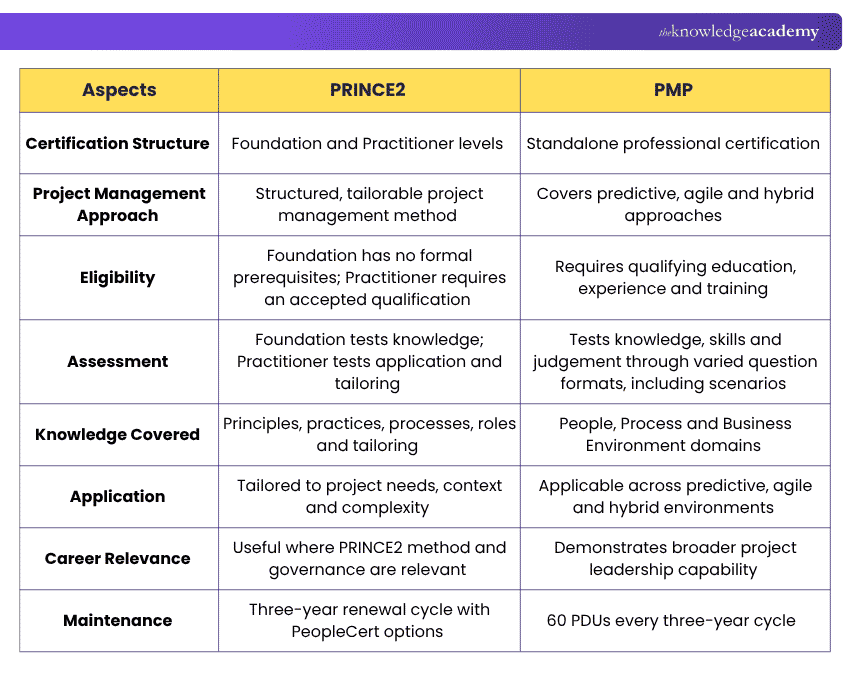
The central difference between PRINCE2 and PMP is what each certification demonstrates. PRINCE2 teaches and assesses a defined project management method, while PMP validates broader project leadership capability across different approaches. Here is a quick comparison:
1) Certification Structure
PRINCE2
PRINCE2 follows a two-level certification structure:
PRINCE2 Project Management Foundation (Version 7): Assesses understanding of the PRINCE2 method, including its seven principles, seven practices, seven processes, roles, responsibilities and tailoring.
PRINCE2 Project Management Practitioner (Version 7): Assesses whether candidates can apply and tailor the PRINCE2 method to different project situations. This creates a progressive pathway from understanding the method to applying it in practice.
PMP
PMP is a standalone professional certification rather than part of a Foundation–Practitioner pathway. It is intended for professionals who already have qualifying project management experience.
PMI offers other credentials, including CAPM, but these are separate certifications rather than lower or higher levels of PMP.
2) Project Management Approach
PRINCE2
PRINCE2 provides a defined project management method. Its principles guide decisions, its practices address areas that require ongoing management and its processes provide a structured path through the project lifecycle.
The method provides governance and control while remaining tailorable to different project environments.
PMP
PMP does not prescribe one project management methodology. It validates whether a professional can apply appropriate knowledge, skills and judgement across predictive, agile and hybrid approaches.
The current PMP exam reflects this methodology-neutral approach across all three examination domains.
Trainer’s Insight
Avoid choosing based only on which credential appears more advanced. Consider what you need to demonstrate. PRINCE2 focuses on understanding and applying a defined method, while PMP focuses on demonstrating broader project leadership capability across different ways of working.
3) Eligibility and Prerequisites
PRINCE2
PRINCE2 Foundation has no formal certification prerequisite.
PRINCE2 Practitioner requires candidates to hold an accepted qualification. PeopleCert currently accepts qualifications including:
a) PRINCE2 Project Management Foundation (Version 7)
b) PRINCE2 6th Edition Foundation or Practitioner
c) PRINCE2 5th Edition Foundation or Practitioner
d) Project Management Professional (PMP)
e) Certified Associate in Project Management (CAPM)
f) APM Project Professional Qualification (PPQ)
g) APM Project Management Qualification (PMQ)
h) IPMA Levels A, B, C or D
i) Junior Project Management Professional (CSPM-2)
j) Medium Project Management Professional (CSPM-3)
PMP
PMP requires both professional project management experience and qualifying training.
PMP requires professional project management experience and 35 hours of qualifying project management training before a candidate can take the exam. An active CAPM certification fulfils the 35-hour training requirement. Under PMI's current requirements, there are four main education-and-experience pathways:
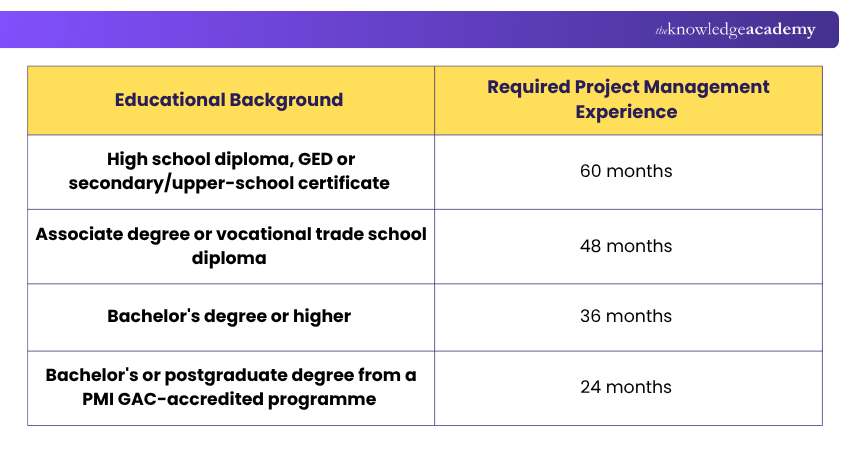
The project leadership experience must have been gained within the last 10 years before application, and overlapping months cannot be counted more than once.
4) Exam Format and Assessment
PRINCE2
PRINCE2 uses separate Foundation and Practitioner exams.
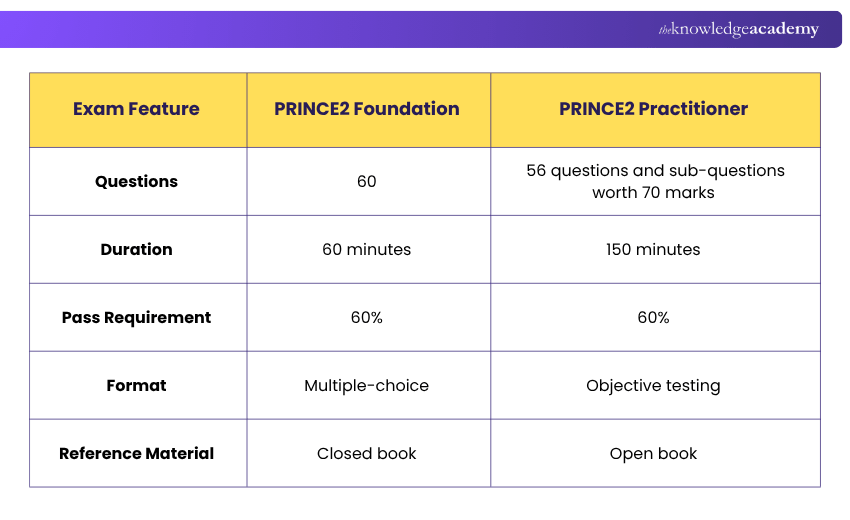
Foundation assesses understanding of the PRINCE2 method, while Practitioner assesses the ability to apply and tailor it to project scenarios.
PMP
The PMP exam consists of 180 questions and allows 240 minutes for completion. The current exam includes scenario-based questions, case studies, and interactive formats that assess how candidates interpret information and apply project management knowledge.

5) Knowledge and Skills Covered
PRINCE2
PRINCE2 Project Management (Version 7) develops knowledge in areas including:
a) Seven principles
b) Seven practices
c) Seven processes
d) Roles and responsibilities
e) People management and collaboration
f) Sustainability
g) Digital and data management
h) Communication
i) Tailoring
These areas support structured project governance and management across the project lifecycle.
PMP
The current PMP exam covers three domains:
a) People – 33%
b) Process – 41%
c) Business Environment – 26%
Since 9 July 2026, places greater emphasis on areas such as AI, sustainability, stakeholder engagement, value delivery and business impact.
Predictive, adaptive/agile and hybrid approaches are integrated across the examination rather than restricted to one domain.
6) Application and Tailoring
PRINCE2
PRINCE2 is designed to be tailored according to a project's needs, size, context and complexity.
Organisations can adjust how the method is applied rather than using exactly the same level of documentation, governance and control for every project.
PRINCE2 can also operate alongside different delivery approaches, including agile, waterfall and hybrid delivery.
PMP
PMP is not a methodology, but choosing and tailoring the right approach is part of what it assesses. It validates knowledge and judgement that professionals can apply across different project environments.
This shows PMP-certified professionals can work with predictive, agile and hybrid approaches depending on the needs of the project and organisation.
7) Recognition and Career Relevance
PRINCE2
PRINCE2 can be particularly relevant where organisations use structured project governance and the PRINCE2 method.
The certification can support roles that require knowledge of defined project responsibilities, governance, practices and processes.
PMP
PMP can be particularly relevant for experienced project professionals who want to demonstrate project leadership capability across different industries and ways of working.
The most relevant certification ultimately depends on the role, organisation and project environment rather than geography alone.
Candidates should therefore review current job requirements in their target market before choosing between them.
8) Certification Maintenance
PRINCE2
PRINCE2® Project Management certifications operate on a three-year renewal cycle.
PeopleCert provides three main ways to keep certifications current:
a) Retake and pass the same certification exam
b) Earn another certification within the same PeopleCert Product Suite
c) Use the PeopleCert Plus Continuing Professional Development (CPD) route
For the CPD route, holders need continuous PeopleCert Plus membership for three years and must log 20 CPD points in each year for three consecutive years.
PMP
PMP also operates on a three-year certification cycle.
PMP holders must earn 60 Professional Development Units (PDUs) during each cycle.
The requirement includes:
a) At least 35 Education PDUs
b) A maximum of 25 Giving Back PDUs
c) At least 8 Education PDUs in Ways of Working
d) At least 8 Education PDUs in Power Skills
e) At least 8 Education PDUs in Business Acumen
The remaining 11 Education PDUs can be earned in any PMI Talent Triangle area.
Before You Commit Checklist
Before You Commit, Check:
□ Do I meet the certification prerequisites?□ Does my current or target employer use PRINCE2?□ Do the roles I am targeting request PMP?□ Do I need to learn a defined method or validate existing experience?□ Am I prepared for the certification's ongoing renewal requirements?
PRINCE2 vs PMP: Which One Should You Choose?
There is no single winner in the PRINCE2 vs PMP comparison. The right choice depends on your experience, learning goals and the type of project environment in which you want to work.
PRINCE2 may suit you if:
a) You want to learn a structured project management method.
b) You are new to formal project management and want an accessible starting point.
c) Your organisation already uses PRINCE2.
d) You want clear guidance on project governance, roles, practices and processes.
e) You want a method that can be tailored to different projects and delivery approaches.
PMP may suit you if:
a) You already have the professional project experience required by PMI.
b) You want to validate broader project leadership capability.
c) You work across predictive, agile or hybrid environments.
d) You want a methodology-neutral project management certification.
e) PMP is frequently requested for the roles you are targeting.
Keep This in Mind
The value of either credential depends on how well it aligns with your experience, role and project environment. Rather than asking which certification is universally better, consider what capability you need to build or demonstrate and what employers in your target roles actually require.
Develop skills in planning, risk, quality, issues, and progress management with the PRINCE2® Foundation & Practitioner Training – Join now!

Nilotpal Sarmah is a Senior Content Writer with 11+ years of overall experience spanning engineering, operations and content development. His technical knowledge and extensive writing experience enable him to simplify specialised topics across IT and Tech, Business Skills, Project Management, Health and Safety, and ISO and Compliance.
View Detail

 If you wish to make any changes to your course, please


