


We may not have the course you’re looking for. If you enquire or give us a call on 01344203999 and speak to our training experts, we may still be able to help with your training requirements.
What is PRINCE2® Practitioner Certification?
ByDavid EvansLast updated on: 17 October 2026
PRINCE2 Practitioner is an advanced project management certification that validates a professional’s ability to apply and tailor PRINCE2 principles, practices and processes to different project situations. This blog covers the qualification’s prerequisites, exam format, syllabus and renewal options.
Quick Overview
1. Certification Eligibility: Candidates must hold an accepted qualification before taking the Practitioner exam.2. Exam Structure: The exam is open book, lasts 150 minutes and requires a minimum score of 60%.3. Syllabus Coverage: The assessment focuses on applying seven principles, seven practices and seven processes.4. Certification Pathway: Preparation involves studying official guidance, practising scenario-based questions and passing the exam.5. Certification Renewal: The qualification requires renewal every three years through one of PeopleCert's accepted pathways.
A project is running behind schedule. A key stakeholder requests a major change. The budget is already stretched.
Now comes the real challenge. What should happen next? Should the change be captured and its impact assessed, escalated to the Project Board, or should the plan be updated once a decision is made?
Knowing project management concepts is one thing. Knowing how to apply them when decisions matter is another.
That's where PRINCE2® Practitioner Certification comes into the picture.
It shifts the focus from simply understanding a project management method to making informed decisions in real project situations. This blog explores what it takes to become a PRINCE2 Practitioner and how the qualification can help you approach complex projects with greater confidence.
Overview of PRINCE2® Practitioner Certification
PRINCE2® Practitioner Certification is an advanced-level qualification that validates an individual's ability to apply and tailor the PRINCE2 project management methodology. It assesses how professionals use PRINCE2 principles, practices and processes in different project situations.
The certification helps professionals develop the knowledge needed to make informed project decisions, manage responsibilities and align project activities with business objectives.
Trainer Insight
PRINCE2 Foundation focuses on understanding the method, while Practitioner tests your ability to apply and tailor it to different project situations. When preparing for Practitioner, focus on how PRINCE2 concepts work together rather than studying each one in isolation.

Who Should Pursue PRINCE2® Practitioner Certification?
PRINCE2® Practitioner Certification is suitable for professionals who want to apply structured project management practices in different working environments. It can be particularly relevant for:
a) Project Managers: Professionals responsible for planning, directing and controlling project activities.
b) Aspiring Project Managers: Individuals preparing to take on greater project management responsibilities.
c) Project Coordinators: Professionals supporting project planning, communication and progress monitoring.
d) Team Leaders: Individuals responsible for coordinating teams and contributing to project delivery.
e) Project Management Office (PMO) Professionals: Individuals involved in project governance, reporting and maintaining project management standards.
PRINCE2® Practitioner Certification Requirements and Exam Details
Before pursuing PRINCE2® Practitioner Certification, it is important to understand the eligibility criteria, exam structure and topics covered. These requirements help candidates determine whether they are ready to take the examination.
PRINCE2® Practitioner Certification Prerequisites
To take the PRINCE2 Practitioner exam, candidates must hold at least one qualification accepted by PeopleCert.
Completion of one of the following certifications is required:
a) PRINCE2 Foundation (Version 7)
b) PRINCE2 6th Edition (Foundation or Practitioner)
c) PRINCE2 5th Edition (Foundation or Practitioner)
d) Project Management Professional (PMP)
e) Certified Associate in Project Management (CAPM)
f) Project Professional Qualification (PPQ)
g) Project Management Qualification (PMQ)
h) IPMA Level A (Certified Projects Director)
i) IPMA Level B (Certified Senior Project Manager)
j) IPMA Level C (Certified Project Manager)
k) IPMA Level D (Certified Project Management Associate)
l) Junior Project Management Professional (CSPM-2)
m) Medium Project Management Professional (CSPM-3)
Candidates should verify that their existing qualification meets PeopleCert's prerequisites before registering for the examination.
PRINCE2 Practitioner Exam Format
The PRINCE2 Practitioner exam evaluates how effectively candidates can apply the method to project scenarios. It focuses on practical application rather than simply recalling definitions.
The table below outlines the official examination details:
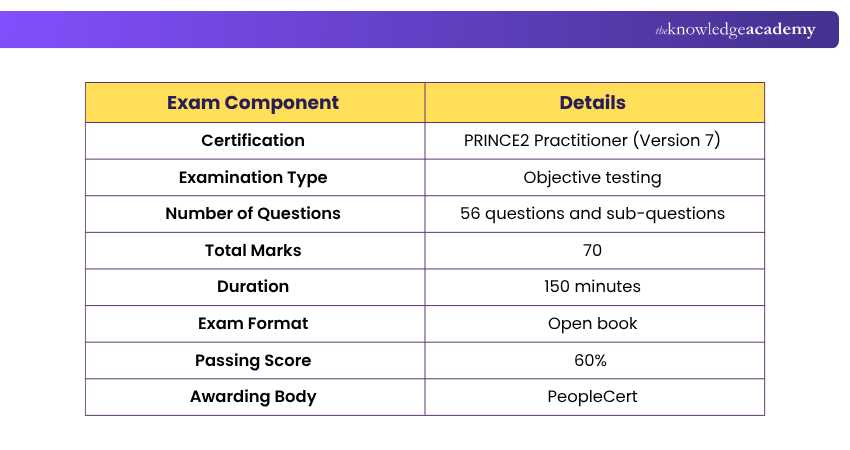
Although the exam is open book, candidates must understand how to use PRINCE2 in different situations. Familiarity with official guidance and regular practice with scenario-based questions can support effective preparation.
Pro Tip
An open-book exam does not mean every answer should be searched for during the test. Understand the PRINCE2 method beforehand and practise locating information quickly in the permitted official guidance. This can help you manage the available time effectively.
Develop skills in planning, risk, quality, issues, and progress management with the PRINCE2® Foundation & Practitioner Training – Register now!
PRINCE2 Practitioner Syllabus
The PRINCE2 Practitioner syllabus focuses on applying the PRINCE2 method to different project environments. It covers seven principles, seven practices and seven processes, alongside tailoring and people-related considerations.
1) PRINCE2 Principles
The seven PRINCE2 principles guide decisions and actions throughout a project. They include:
a) Ensure continued business justification
b) Learn from experience
c) Define roles, responsibilities and relationships
d) Manage by stages
e) Manage by exception
f) Focus on products
g) Tailor to suit the project
Candidates should understand how these principles influence project decisions and how to apply them in different situations.
2) PRINCE2 Practices
PRINCE2 Version 7 includes seven practices that address important aspects of project management:
a) Business Case: Establishes and maintains the justification for undertaking the project.
b) Organising: Defines the project's organisational structure, roles and responsibilities.
c) Plans: Explains how project products will be delivered and the resources required.
d) Quality: Establishes quality expectations and approaches for verifying project products.
e) Risk: Helps identify, assess and manage uncertainties affecting project objectives.
f) Issues: Provides an approach for capturing, assessing and managing issues, including requests for change, throughout the project.
g) Progress: Supports monitoring performance and controlling deviations from agreed plans.
These practices help professionals manage projects consistently while adapting the approach to the project's needs.
3) PRINCE2 Processes
The seven PRINCE2 processes guide a project from its initial idea through to closure.
a) Starting up a Project: Checks whether the project is worthwhile and has the necessary foundations before initiation.
b) Directing a Project: Enables the project board to provide direction and make key decisions.
c) Initiating a Project: Establishes a detailed understanding of the project and the approach needed to manage it.
d) Controlling a Stage: Supports the Project Manager in monitoring work, managing issues and taking corrective action.
e) Managing Product Delivery: Ensures agreed work packages are accepted, completed and delivered.
f) Managing a Stage Boundary: Reviews stage performance and prepares for decisions about subsequent stages.
g) Closing a Project: Confirms project completion, evaluates performance and supports an orderly closure.
Beyond these elements, PRINCE2 Version 7 also emphasises people management, communication, sustainability and the use of digital tools and data. Candidates learn how to consider these aspects when applying and tailoring the method.
Benefits of PRINCE2® Practitioner Certification
PRINCE2® Practitioner Certification helps professionals strengthen their project management skills and apply a structured approach to different project environments. Some of its key benefits include:
a) Clear Project Deliverables: Helps professionals define project outputs, establish quality expectations and ensure deliverables meet agreed requirements.
b) Effective Cost Control: Supports budget monitoring, resource planning and cost management to identify deviations and take corrective action.
c) Better Risk Management: Provides a structured approach to identifying, assessing and responding to potential project risks and opportunities.
d) Improved Decision-making: Encourages informed decisions based on business justification, project progress and clearly defined responsibilities.
e) Enhanced Stakeholder Satisfaction: Promotes effective communication, clear expectations and regular progress updates to support stakeholder engagement.
f) Stronger Team Coordination: Clarifies project roles, responsibilities and reporting relationships to improve accountability and collaboration.
g) Career Development Opportunities: Demonstrates the ability to apply and tailor PRINCE2, potentially supporting career progression in project management and related roles.
How to Get PRINCE2® Practitioner Certification?
Achieving PRINCE2® Practitioner Certification involves meeting the eligibility criteria, preparing for the examination and demonstrating the ability to apply PRINCE2 in practical situations.
Here are the key steps involved in achieving and maintaining PRINCE2® Practitioner Certification:
Step 1: Check Your Eligibility
Begin by confirming that you hold an accepted qualification. If you are new to PRINCE2 and do not hold another recognised prerequisite, completing PRINCE2 Foundation is a suitable starting point.
Step 2: Choose Your Preparation Method
You can prepare through instructor-led training, self-paced learning or independent study using official materials. Select a method that suits your experience, learning preferences and schedule.
Step 3: Study the PRINCE2 Practitioner Syllabus
Focus on the principles, practices and processes covered in Version 7. Pay particular attention to applying and tailoring the method in project situations rather than memorising definitions alone.
Step 4: Practise With Sample Papers
Use official sample papers and mock exams to familiarise yourself with the question format. Practising scenario-based questions can help you develop the ability to interpret project information and select appropriate responses.
Step 5: Register and Take the Exam
Once prepared, register for the PRINCE2 Practitioner exam through PeopleCert or an appropriate accredited training provider. Follow the examination requirements and aim to achieve at least 60% of the available marks.
Step 6: Maintain Your Certification
After passing the exam, keep your certification current by meeting PeopleCert's renewal requirements.
PRINCE2® Practitioner Certification has a three-year renewal cycle from the original certification date. If it is not renewed, PeopleCert marks the certification record as outdated. Candidates can maintain their certification through one of the following renewal pathways:
1) Continuous Professional Development (CPD): Maintain continuous PeopleCert Plus membership for three years and record 20 CPD points annually, including at least five points from Professional Experience activities each year.
2) Another Certification: Pass an accepted certification exam within the same Product Suite.
3) Retake the Examination: Pass the same Practitioner exam again.
Planning your renewal helps ensure your certification remains current and reflects your continued professional development.
Common Mistakes to AvoidWhen preparing for the PRINCE2 Practitioner exam, avoiding common mistakes can help improve your preparation and time management.Exam Preparation Checklist1. Memorising definitions without practising their application2. Assuming the open-book format removes the need for preparation3. Overlooking important details in scenario-based questions4. Spending too much time searching through permitted official guidance5. Skipping official sample papers and practice exams
Turn project chaos into clarity and lead with confidence through the PRINCE2® Training – Join today!

David Evans creates accessible resources that help professionals understand different approaches to planning and delivering projects. His content addresses changing requirements, collaborative working and the practical demands of contemporary project environments.
View Detail

 If you wish to make any changes to your course, please


