




We may not have the course you’re looking for. If you enquire or give us a call on + 1-866 272 8822 and speak to our training experts, we may still be able to help with your training requirements.
PMP on Resume: Where and How to List It With Example
ByDavid EvansLast updated on: 05 October 2026
The PMP Certification is a globally recognised credential for Project Management professionals. This blog explores the tips of adding the PMP on Resume, showing how it boosts job prospects and showcases Project Management expertise. It also covers common mistakes to avoid on resume. Read on to learn more about it.
A PMP® certification demonstrates verified project leadership knowledge and experience, but its impact depends on how clearly it is presented. Poor placement, incorrect formatting or excessive emphasis can prevent recruiters from recognising its value.
A strong PMP on resume should balance the credential with relevant skills, measurable achievements and industry experience. This blog explores career-level examples and common mistakes to help you present your qualifications professionally. Let's begin!
Where Should You List PMP on Resume?
Listing a PMP on resume involves key steps to ensure it highlights your certification and aligns with job requirements. Here’s a detailed list of how to do it:
1) Name Header (Top of Resume)
Place “PMP” directly after your name to give the credential immediate visibility. Use uppercase letters without full stops.
Example: James Taylor, PMP.

2) Professional Summary
Mention the credential naturally in your opening summary alongside your experience and strongest achievements. This quickly establishes your project management expertise.
Example: PMP-certified Project Manager with eight years of experience delivering complex technology projects.
3) Dedicated Certifications Section
Include the complete credential name, issuing organisation and year earned. You may also add its active status or credential ID when relevant.
Example: Project Management Professional (PMP), Project Management Institute, 2024 - Present.
4) Add to Your Work Experience
Mention PMP within your work experience only when it directly influenced your responsibilities or career progression. Keep the focus on measurable outcomes rather than repeating the certification alone.
Example: Selected to lead a major system migration after earning the PMP® certification, coordinating multiple teams and stakeholders.
Standout Elements of a Good PMP Resume
A strong PMP resume should demonstrate both professional knowledge and measurable project success. The following elements can help present your credentials, experience and capabilities clearly. Let's learn about them below:
1) Optimised Professional Summary
Begin with a concise summary that highlights your PMP credential, years of experience, industry expertise and strongest achievement. Tailor it to the position instead of using a general career statement.
Example:
PMP-certified Project Manager with eight years of experience leading cross-functional teams in healthcare technology. Managed digital transformation projects worth over £4 million and consistently delivered within scope and budget.
2) PMP® Certification Placement
Make the PMP credential easy for recruiters to find. You can include it after your name, within your professional summary and in a dedicated certifications section.
Example:
PMP-certified Project Manager with 10 years of experience delivering large-scale infrastructure projects across multiple regions.
3) Quantifiable Project Management Achievements
Replace general duties with specific outcomes that demonstrate your contribution. Use figures such as budget size, delivery time, savings, team size or performance improvements where they are accurate.
Example:
Weak: Managed enterprise software implementation projects.
Strong: Led five CRM implementations worth £2-7 million each, delivering an average of 15% ahead of schedule.
Trainer’s Insight
A PMP credential confirms project management knowledge and experience, but it does not replace evidence of performance. Support it with clear examples of how you controlled costs, managed risks, improved delivery or created measurable business value.
4) Project Management Methodologies
Highlight the approaches and tools that match the job description. These may include Scrum, Kanban, predictive methods, hybrid delivery, Jira, Microsoft Project and other relevant platforms. Avoid listing every tool you have encountered. Prioritise the ones you have applied successfully and support them with examples from your work experience.
Build practical project skills and prepare for exciting career possibilities with the PMI Project Management Ready Training - Join now!
PMP Resume Template for Various Career Levels
A PMP resume should reflect your career stage, level of responsibility and measurable contribution. Also, PMP applicants must meet PMI’s education, training and project leadership requirements. Let's learn more about it below:
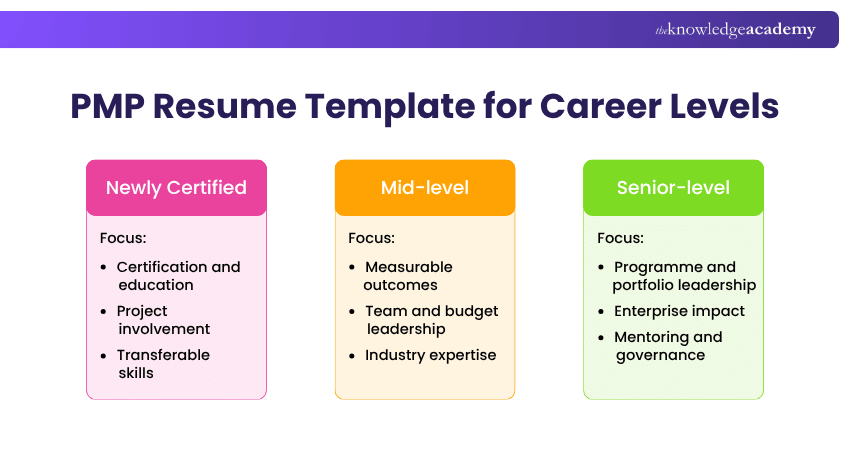
1) Entry-level PMP Resume
Early-career professionals should emphasise their PMP credential, education and practical project involvement. Include transferable skills and examples of contributing to planning, coordination, risk tracking or stakeholder communication.
Focus On:
1) PMP® certification and relevant education
2) Project coordination or team contributions
3) Transferable skills from previous positions
4) Volunteer or internal project experience
5) Relevant training and technical knowledge
2) Mid-level PMP Resume
Mid-level professionals should demonstrate growing responsibility and consistent delivery. Their resumes should focus on measurable project outcomes, team leadership and experience managing budgets, schedules and stakeholders.
Focus On:
1) Progression into greater project responsibility
2) Measurable improvements and delivery outcomes
3) Cross-functional team leadership
4) Budget, risk and resource management
5) Relevant industry or technical expertise
3) Senior-level PMP Resume
Senior professionals should focus on strategic leadership and organisation-wide impact rather than routine project duties. Their resumes should show how they have guided complex programmes, influenced decisions and supported long-term business goals.
Focus On:
1) Programme and portfolio leadership
2) Enterprise-wide projects and transformations
3) Strategic planning and governance
4) Mentoring and leadership development
5) Measurable organisational and commercial impact
How to Tailor Your PMP Resume for Different Industries?
A PMP resume should reflect the priorities, terminology and risks of the industry you are targeting. Review the job description carefully and highlight only the methods, regulations, tools and achievements that are relevant to that role. Let's look at it below:
1) IT Project Management
An IT project management resume should demonstrate your ability to coordinate technical teams, manage changing requirements and deliver technology solutions successfully. Tailor the content to the target role and highlight relevant systems, methods and measurable outcomes.
Highlight:
1) Agile, predictive or hybrid project delivery
2) Software Development Life Cycle (SDLC) knowledge
3) Coordination of Developers, testers and business stakeholders
4) DevOps, system integration or release management experience
5) Relevant tools such as Jira and Microsoft Project
2) Health Care Project Management
Healthcare resumes should demonstrate experience managing sensitive information, complex stakeholders and quality-focused projects. Include regulations only when they apply to the location and organisation, such as GDPR for applicable personal data processing.
Highlight:
1) Relevant regulatory and data protection requirements
2) Patient-centred project outcomes
3) Healthcare technology implementations
4) Quality and process improvement initiatives
5) Coordination with clinical and non-clinical stakeholders
3) Construction Project Management
A construction project management resume should demonstrate cost control, safety awareness and reliable delivery across complex, often high-value projects. Quantify the scale, budget and complexity of the projects managed to show the level of responsibility handled.
Highlight:
1) Large-scale budget and schedule management
2) Health, safety and environmental compliance
3) Contract, supplier and subcontractor coordination
4) Technical specifications and quality control
5) Results such as reduced costs or improved safety performance
4) Engineering Project Management
An engineering project management resume should show your ability to coordinate technical work, manage resources and deliver projects according to agreed specifications. Include the scale and complexity of the projects you have managed and quantify relevant outcomes.
Highlight:
1) Technical planning and requirements management
2) Budget, schedule and resource coordination
3) Engineering standards and regulatory compliance
4) Risk assessment and quality control
5) Results such as reduced costs, improved efficiency or timely delivery
Start managing projects with clarity, structure and professional confidence with the CAPM® Certification Training - Join today!
PMI's Use of PMP Marks Guidelines
Since a resume is one of the most common places the PMP® credential appears, it's worth understanding PMI's official rules for using it correctly, based on PMI's own trademark usage guidelines:
a) No ® Symbol Required After a Name: When "PMP" appears immediately following a certification holder's name, such as "Sarah Bennett, PMP" on a resume, business card, or email signature, PMI's own guidance confirms this use does not require the ® symbol, nor an attribution statement.
b) PMP is an Adjective, Not a Noun: PMI's guidelines state that certification marks should be used as an adjective followed by a generic noun, for example "PMP® Certification," rather than as a standalone noun.
c) Never Alter the Mark: PMI marks may not be changed in any way and must be used exactly as registered, avoid unofficial variations such as "PMI Certified Project Manager," which is not a real PMI credential.
d) Discontinue Use if Lapsed: Anyone whose PMI certification has lapsed should immediately stop using the credential until it is reinstated.
e) Use the ® Symbol Elsewhere: Outside the post-nominal (after-name) context, such as in body text or headings, PMI marks should generally include the ® symbol, since it signifies the mark's registered status.
f) Avoid Confusingly Similar Marks: Third parties may not incorporate PMI marks into their own product names, services, logos, or domain names.
Since PMI updates these guidelines periodically, it's worth checking PMI's official Trademark Usage Guidelines directly before finalising how the credential appears on a resume.
Common Mistakes to Avoid in PMP Resume
Even with a strong PMP® certification, certain mistakes on your resume can hinder your chances of landing a job. Here are some of them:
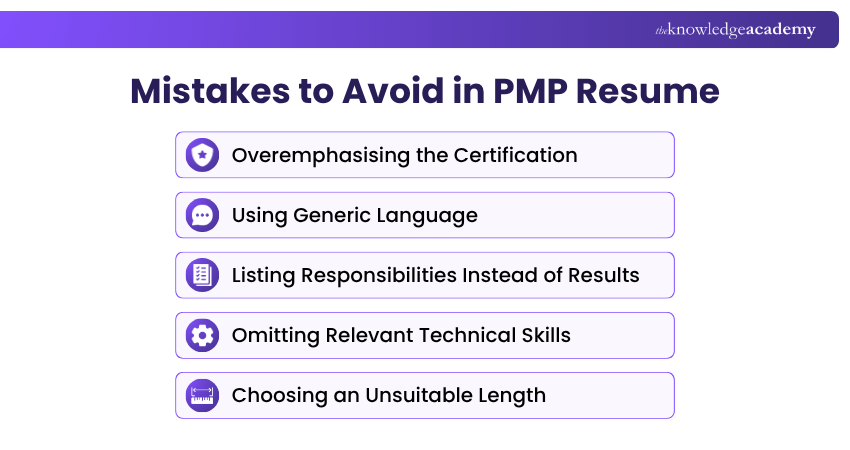
1) Overemphasising the Certification: Do not allow the PMP credential to overshadow your practical experience. Mention it clearly, then focus on how you have managed teams, budgets, risks and project outcomes.
2) Using Generic Language: Avoid unsupported phrases such as “results-driven leader” or unexplained project management jargon. Connect every important skill to a specific action, project or result.
3) Listing Responsibilities Instead of Results: Routine duties do not show the value you delivered. Use measurable achievements such as reduced costs, shorter delivery times or improved stakeholder satisfaction wherever accurate data is available.
4) Omitting Relevant Technical Skills: Include the tools, platforms and technical knowledge relevant to the target role. However, list only the skills you can use confidently and support them with practical experience.
5) Choosing an Unsuitable Length: There is no universal rule that every PMP resume must be exactly two pages. Keep it concise and relevant while allowing additional space for extensive senior-level experience when necessary.
Your PMP® certification can strengthen your resume, but it should support rather than replace evidence of achievement. Use the correct format, confirm that the credential is active and connect it with measurable project outcomes. Tailor each application to the role and industry while keeping every claim accurate and verifiable.
Build project leadership confidence and deliver complex initiatives with greater control by registering for the PMP® Training now!

David Evans creates accessible resources that help professionals understand different approaches to planning and delivering projects. His content addresses changing requirements, collaborative working and the practical demands of contemporary project environments.
View Detail

 If you wish to make any changes to your course, please


