


We may not have the course you’re looking for. If you enquire or give us a call on 01344203999 and speak to our training experts, we may still be able to help with your training requirements.
What is PMI-ACP® Certification: A Complete Guide
ByVidhya NairLast updated on: 17 October 2026
PMI Agile Certified Practitioner (PMI-ACP)® Certification recognises professionals' knowledge and experience in applying agile principles, practices and approaches. It covers approaches such as Scrum, Kanban, Lean, Extreme Programming, and more.
PMI-ACP at a Glance
1. Who It's For: Professionals working with agile approaches across different roles.2. Eligibility: Educational qualification, qualifying agile experience and 21 hours of formal agile training.3. Exam Structure: 120 questions over 180 minutes, covering four domains.4. Certification Renewal: 30 PDUs required every three years.5. Career Relevance: Applicable to roles involving agile project delivery, product development and team collaboration.
Manager: “The client has changed the requirements again.”
Team: “But we have already started working on the original plan!”
Manager: “Then how do we adapt without losing progress?”
Situations like this are familiar to many project teams. Priorities evolve, feedback changes expectations and teams need to make better decisions without losing sight of their goals.
Agile approaches help teams respond to these challenges. However, applying them effectively requires an understanding of different agile principles and practices. This is where PMI-ACP® Certification becomes relevant. It recognises professionals with knowledge and experience in applying these approaches.
Read on to explore what PMI-ACP involves, who can apply and how to prepare for the certification exam.
What is PMI-ACP® Certification?
The PMI Agile Certified Practitioner (PMI-ACP)® is a certification from the Project Management Institute (PMI). It validates professionals' knowledge and experience in applying agile principles, practices, and frameworks while collaborating effectively within agile teams.
The certification covers agile principles, tools, practices and approaches, including Scrum, Kanban, Extreme Programming (XP) and Test-Driven Development (TDD). This broad coverage helps professionals develop knowledge of different agile approaches and understand how they can be applied across project environments.
Trainer Insight
Knowing Scrum or Kanban is useful, but PMI-ACP preparation should go beyond memorising framework definitions. Focus on understanding why teams choose particular agile practices and how these practices can support different project needs.
Who Should Apply for PMI-ACP?
PMI-ACP® Certification is designed for professionals who work with agile approaches. Before applying, candidates should understand who the certification is suitable for and check whether they meet PMI's eligibility requirements.
PMI-ACP® Certification is suitable for professionals working with agile approaches, including Project Managers, Product Owners, Scrum Masters and agile team members. However, applicants must meet PMI's educational, agile experience and training requirements to be eligible for the examination.
PMI-ACP® Certification Prerequisites
To apply for PMI-ACP® Certification, candidates must meet PMI's educational, agile experience and training requirements. The table below outlines the eligibility criteria:
|
Requirement |
Eligibility Criteria |
|
1. Educational Qualification |
High school (or secondary school) diploma or higher, or an accepted equivalent such as GCSEs, a Secondary School Certificate or GED |
|
2. Agile Experience |
Meet ONE of the following: |
|
3. Agile Training |
Complete 21 hours of formal training in agile practices, frameworks and methodologies through a PMI Authorised PMI-ACP Exam Prep Course, Authorised Training Partner Prep Course or an eligible third-party training course |
PMI-ACP® Certification Exam Format
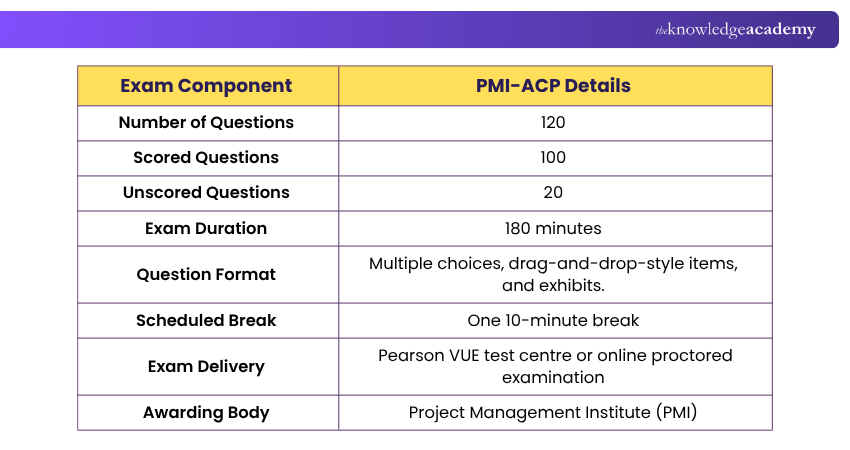
Knowing the PMI-ACP exam format can help candidates plan their preparation and manage their time effectively. The following table outlines the question types, examination duration, scheduled break and available testing options:
PMI-ACP Examination Domains
The PMI-ACP exam assesses candidates across four key domains, each focusing on different aspects of agile practices and project delivery. The table below shows their respective weightings:
|
Examination Domain |
Weighting |
|
Mindset |
28% |
|
Leadership |
25% |
|
Product |
19% |
|
Delivery |
28% |
These domains assess how professionals apply agile principles, support teams, manage products and deliver value in agile environments.
Quick Eligibility Check
Before applying, make sure you can answer Yes to all three questions:
1. Do I have a high school or secondary school diploma, or an accepted equivalent?2. Do I satisfy at least one of PMI's four agile experience pathways?3. Have I completed the required 21 hours of formal agile training?If you meet all three requirements, review PMI's official application guidance before proceeding.
Obtain the knowledge and confidence to excel in diverse project environments with the PMP® Certification Training – Register now!
How to Apply for PMI-ACP® Certification?
After you have checked whether you are eligible to obtain the ACP Certification, it's time to go through the application process in detail. Here's how you can apply for the PMI-ACP® Certification:
Step 1: Check Eligibility and Create a PMI Account
Create or sign in to your PMI account and check that you meet the PMI-ACP eligibility requirements. PMI membership is optional and is not required to apply for the certification.
Step 2: Complete Your PMI-ACP Application
The application form is available on PMI’s website, which consists of the following sections:
1) General Information: Details such as name, address, educational background and other personal information
2) Qualifying Agile Experience: Provide details of your relevant agile experience or qualifying certification according to the eligibility pathway you meet.
3) Training Experience in Agile: You must confirm that you have acquired 21 hours of contact training on Agile practices.
Step 3: Pay the Exam Fee and Schedule Your Exam
After submitting your application, wait for PMI's approval. Once approved, pay the examination fee and schedule your PMI-ACP exam through the available testing options. You can continue preparing using PMI's official examination resources and practice questions.
Note: Candidates have a one-year examination eligibility period and may attempt the PMI-ACP exam up to three times within that period, subject to PMI's retake policy.
Quick Update – PMI-ACP® Certification Renewal
PMI-ACP holders must earn 30 Professional Development Units (PDUs) every 3 years to maintain their certification. This includes at least 18 Education PDUs, with a maximum of 12 Giving Back PDUs. Candidates must also earn at least four PDUs in each PMI Talent Triangle skill area: Ways of Working, Power Skills and Business Acumen.
How to Prepare for the PMI-ACP Exam?
Preparing for the PMI-ACP exam involves understanding the examination domains, reviewing agile practices and testing your knowledge through practice questions. The following tips can help you organise your preparation:
1) Take up a Certification Course: Training providers offer PMI-ACP preparation courses to help candidates understand the examination topics and practise applying agile concepts. Depending on the provider and course format, training may include instructor-led sessions, practical exercises, practice questions and feedback to support examination preparation.
2) Refer to Handbooks: PMI provides the current PMI-ACP Examination Content Outline, Certification Handbook, official exam-preparation resources, and a reference list. Candidates can also use relevant agile publications, including the latest Agile Practice Guide, Agile Estimating and Planning by Mike Cohn, and Agile Project Management: Creating Innovative Products by Jim Highsmith.
3) Browse YouTube: YouTube videos can help candidates review agile concepts and understand practical examples. Choose resources aligned with the current PMI-ACP Examination Content Outline to avoid outdated information.
4) Join Online Study Groups: Online discussion boards can prove extremely helpful as the candidates can interact with their peers and coaches. This also allows them to clear doubts and get information that has been overlooked.
Common PMI-ACP Exam Preparation Mistakes to Avoid
1. Relying only on one agile framework2. Using preparation materials that do not match the current exam outline3. Memorising concepts without understanding practical applications4. Neglecting practice questions and timed mock exams5. Focusing on individual topics while ignoring the four examination domains6. Leaving difficult concepts until the final days before the exam
Benefits of PMI-ACP® Certification
PMI-ACP® Certification offers professional recognition and demonstrates knowledge of agile practices across different frameworks. Some of its key benefits include:
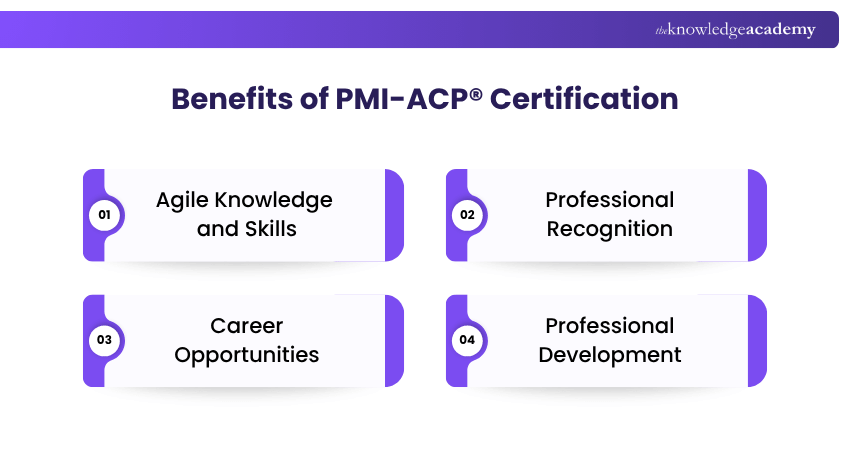
1) Agile Knowledge and Skills: Agile approaches are used by organisations to support collaboration, adaptability and value delivery. PMI-ACP® Certification can help professionals demonstrate knowledge and experience in applying these approaches.
2) Professional Recognition: The certification provides recognition of agile knowledge and experience across different industries and regions, subject to employer requirements.
3) Career Opportunities: PMI-ACP® can support professionals pursuing agile-focused roles by demonstrating knowledge and experience in agile approaches.
4) Professional Development: PMI-ACP® Certification can support professional development by recognising knowledge and experience in agile approaches, although career progression depends on individual skills, experience and opportunities.
Career Opportunities After PMI-ACP® Certification
PMI-ACP® Certification may be relevant to several agile-focused roles, depending on professional experience, skills and employer requirements. Some related career opportunities include:
1) Agile Project Manager: Coordinates agile projects, manages stakeholders, and supports iterative delivery of project objectives.
2) Agile Coach: Helps teams adopt agile practices, improve collaboration, and strengthen ways of working.
3) Scrum Master: Facilitates Scrum events, removes impediments, and supports effective team collaboration.
4) Software Development Manager: Leads development teams, coordinates software delivery, and supports agile development practices.
5) Technical Project Manager: Manages technology-focused projects, coordinates technical teams, and tracks delivery against project goals.
6) Agile Business Analyst: Analyses business needs, supports backlog refinement, and helps translate requirements into agile deliverables.
7) Product Owner: Prioritises the product backlog, clarifies requirements, and helps maximise value delivered by the team.
These roles highlight where agile knowledge and experience may be useful, although specific career opportunities depend on professional skills and employer requirements.
Improve your project management skills with the PMP® Training - Join today!

Vidhya Nair is a Senior Copywriter with 7+ years of experience across copywriting, content writing and communication. Her extensive research and editorial experience supports her ability to present topics across Business Skills and Human Resources with clarity and purpose.
View Detail

 If you wish to make any changes to your course, please


