




We may not have the course you’re looking for. If you enquire or give us a call on 01344203999 and speak to our training experts, we may still be able to help with your training requirements.
PMBOK 8th Edition: Key Updates Explained for PMP Candidates
ByThe Knowledge AcademyLast updated on: 16 July 2026
The PMBOK 8th Edition introduces updated Project Management principles, practices, and guidance to help professionals improve project delivery and outcomes. It prioritises adaptability, value delivery and effective stakeholder collaboration. It helps Project Managers respond confidently to evolving business needs and project complexities.
Are your Project Management skills ready for the latest industry standards? As projects become dynamic and organisations increasingly adopt Agile, hybrid, and technology-driven approaches, Project Managers must stay up to date with evolving best practices. The PMBOK 8th Edition brings together revised Project Management principles and practices to navigate current project environments.
It equips professionals with the knowledge needed to adapt to change, improve decision-making, and achieve better project outcomes. In this blog, we will explore what the PMBOK 8th Edition is, its core principles, performance domains, new focus areas, key differences from the previous edition, and the benefits it offers to modern Project Managers. Let's get started!
Table of Contents
1) What is PMBOK 8th Edition?
2) What are the Core PMBOK 8th Edition Principles?
3) Seven Project Management Performance Domains
4) What are the Five New Focus Areas?
5) What is the Difference Between PMBOK 7th and 8th Edition?
6) What are the Benefits of PMBOK 8th Edition for Modern Project Managers?
7) Conclusion
What is PMBOK 8th Edition?
The Project Management Body of Knowledge (PMBOK® Guide) Eighth Edition is the latest global standard published by the Project Management Institute (PMI)® for managing projects across predictive, Agile, hybrid, and adaptive environments. Instead of replacing the principles-based foundation of the Seventh Edition, it builds on it with clearer and more actionable guidance for modern project management.
The PMBOK 8th Edition continues to promote flexibility and offers clearer operational guidance that project professionals can apply regardless of industry or project size. It also strengthens its focus on stakeholder engagement, governance, sustainability, and the role of Artificial Intelligence (AI) in modern project work.

What are the Core PMBOK 8th Edition Principles?
The PMBOK 8th Edition retains the core principles introduced in the previous edition but consolidates them to six principles. It combines strategic thinking with technical expertise to better support modern Project Management practices. The following are the six core principles of Project Management:
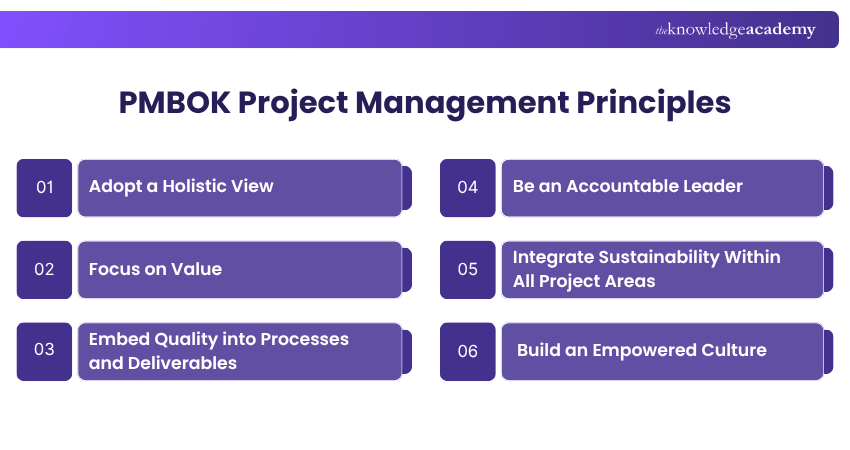
1) Adopt a Holistic View
Projects exist within a wider organisational and business environment. This principle encourages Project Managers to consider how strategy, governance, stakeholders, risks, technology, and external influences interact throughout the project lifecycle. Taking a holistic view helps teams understand the broader impact of decisions and ensures project outcomes support long-term organisational objectives.
2) Focus on Value
Every project should create meaningful value for customers, stakeholders, and the organisation. Rather than measuring success solely by delivering on time and within budget, Project Managers should ensure that project outcomes contribute to strategic goals, solve business problems, and generate lasting benefits. Project value should be reviewed continuously as project priorities and stakeholder expectations evolve.
3) Embed Quality into Processes and Deliverables
Quality should be built into every stage of the project instead of being checked only at the end. The PMBOK 8th Edition encourages teams to establish clear quality standards, follow consistent processes, and continuously improve how work is performed. Embedding quality throughout the project reduces rework, improves customer satisfaction, and increases confidence in the final deliverables.
4) Be an Accountable Leader
Effective Project Managers lead with integrity, accountability, and professionalism. They create an environment where responsibilities are clearly defined, decisions are transparent, and team members feel supported and responsible for their tasks. Accountable leaders encourage collaboration, resolve conflicts constructively, and empower individuals to contribute towards shared project goals.
5) Integrate Sustainability Within All Project Areas
Modern projects should balance business success with Environmental, Social, and Governance (ESG) considerations wherever appropriate. This principle encourages Project Managers and organisations to evaluate the long-term impact of project decisions, promote responsible resource management, and adopt sustainable business practices while continuing to deliver value. By doing so, projects align with organisational goals and contribute to broader community well-being.
6) Build an Empowered Culture
Successful projects rely on motivated teams that are trusted to make informed decisions and work collaboratively. The PMBOK 8th Edition promotes a culture of openness, continuous learning, knowledge sharing, and psychological safety, allowing individuals to innovate, solve problems, and adapt to changing project requirements. This empowers teams to take ownership of their work and reduce the need for micromanagement.
Learn foundational Project Management skills for career advancement by registering for the PMI Project Management Ready Course today!
Seven Project Management Performance Domains
Performance domains represent the key areas that contribute to successful project outcomes. They provide a flexible framework for managing project oversight, delivery timelines, cost, people, and risk across the project lifecycle. The seven Project Management performance domains of the PMBOK 8th Edition are listed below:
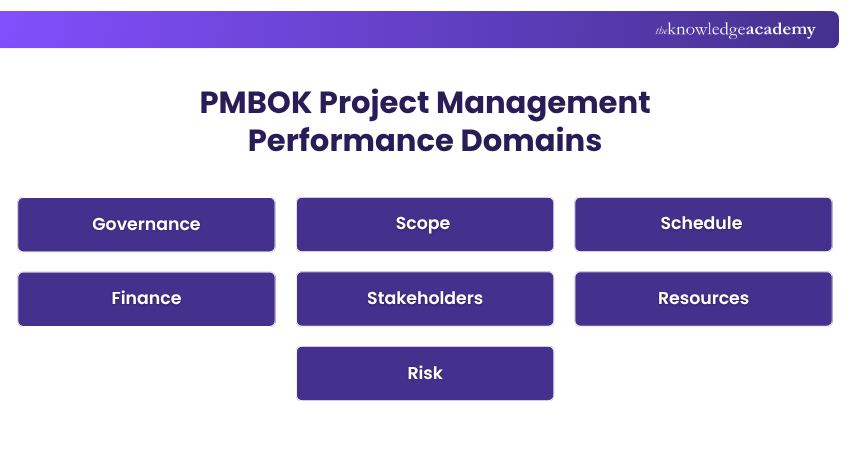
1) Governance Performance Domain
The governance performance domain establishes clear decision-making structures, oversight responsibilities, compliance requirements, and alignment with organisational objectives. Effective governance ensures projects remain accountable, support strategic priorities, and deliver value throughout the project lifecycle.
2) Scope Performance Domain
The scope performance domain defines the project's deliverables while ensuring requirements remain aligned with business objectives, stakeholder expectations, and customer needs. Effective scope management helps prevent unnecessary work, minimise scope creep, and keep projects focused on delivering intended outcomes.
3) Schedule Performance Domain
The schedule performance domain focuses on effective planning, sequencing, monitoring, and adjustment of project timelines and milestones to achieve delivery commitments. It enables teams to manage dependencies, track progress, and respond proactively to changes that may affect project schedules.
4) Finance Performance Domain
The finance performance domain focuses on budgeting, cost control, financial forecasting, investment decisions, and delivering measurable business value. Effective financial management ensures project resources are used efficiently while supporting organisational goals and maximising Return on Investment (ROI).
5) Stakeholders Performance Domain
The stakeholders performance domain focuses on identifying stakeholders, understanding their expectations, maintaining engagement, and managing relationships throughout the project lifecycle. Strong stakeholder management promotes collaboration, builds trust, fosters value creation, and supports informed decision-making.
6) Resources Performance Domain
The resources performance domain covers people, technology, equipment, suppliers, and other resources required to achieve project objectives. Effective resource management ensures teams have the skills, tools, and support needed to deliver successful project outcomes. It also helps balance workloads and improve productivity.
7) Risk Performance Domain
The risk performance domain focuses on identifying threats and uncertainties, evaluating their potential impact, implementing response strategies, and continuously monitoring emerging risks throughout the project lifecycle. Proactive risk management helps reduce threats while identifying opportunities that can improve overall project performance.
What are the Five New Focus Areas?
The PMBOK 8th Edition introduces five focus areas that provide a clearer structure for managing projects from initiation to closure. The following are the five new focus areas of Project Management:
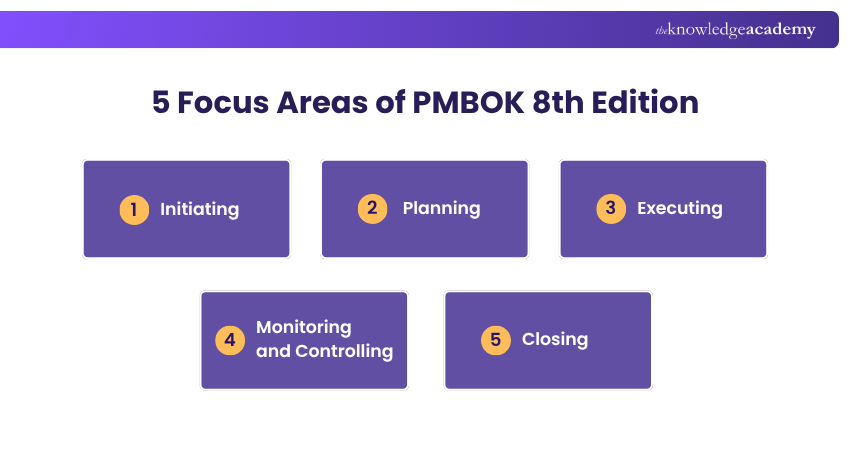
1) Initiating
The initiating focus area establishes the project's purpose, objectives, and expected value. It includes identifying stakeholders, assessing feasibility, establishing governance, and securing approval before project work begins.
2) Planning
The planning focus area develops a roadmap for project delivery by defining the scope, schedule, budget, resources, risks, and communication approach. It ensures the project is well-prepared while remaining flexible enough to adapt to change.
3) Executing
The executing focus area deals with delivering project work by coordinating people, resources, and activities. It promotes collaboration, stakeholder engagement, quality management, and effective leadership throughout execution.
4) Monitoring and Controlling
The monitoring and controlling focus area tracks project performance, manages risks and changes, and ensures work remains aligned with project objectives. Continuous monitoring supports informed decision-making and enables timely corrective actions.
5) Closing
The closing focus area formally completes the project by obtaining final approvals, documenting lessons learned, releasing resources, and handing over deliverables. It helps capture valuable insights for future projects.
Strengthen your ability to contribute to project teams with CAPM® Certification Training – Sign up soon!
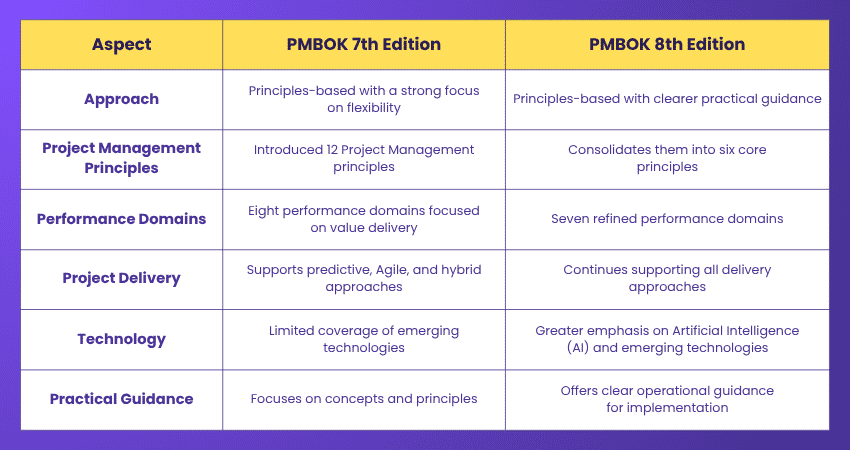
What is the Difference Between PMBOK 7th and 8th Edition?
Although the PMBOK 7th Edition provided a major shift towards principles-based Project Management, many professionals wanted practical guidance for managing projects. The PMBOK 8th Edition addresses this feedback by combining strategic principles with practical implementation across different delivery approaches.
What are the Benefits of PMBOK 8th Edition for Modern Project Managers?
As projects become more technology-driven, Project Managers need guidance that is both flexible and practical. The PMBOK 8th Edition addresses these needs by helping professionals improve planning, manage risks, and deliver consistent value throughout the project lifecycle. Below are some of the key benefits of the PMBOK 8th Edition:
1) Improves Strategic Alignment: PMBOK 8th Edition helps align projects with organisational goals, ensuring every project contributes to measurable business value.
2) Supports Flexible Delivery: It supports predictive, Agile, hybrid, and adaptive approaches, allowing teams to tailor Project Management practices to different project environments.
3) Strengthens Governance: This updated edition promotes clear accountability, informed decision-making, and effective oversight throughout the project lifecycle.
4) Embraces Modern Project Management: PMBOK 8th Edition expands its guidance to include AI and Project Management Offices (PMOs), helping Project Managers leverage modern tools and practices to improve project outcomes.
5) Enhances Stakeholder Engagement: PMBOK 8th Edition encourages continuous communication and collaboration, helping build trust and manage stakeholder expectations effectively.
6) Improves Risk and Resource Management: It provides structured guidance for managing risks and optimising resources, enabling teams to improve project performance and delivery.
7) Encourages Continuous Improvement: By promoting lessons learned and continuous learning, PMBOK 8th Edition helps organisations refine their Project Management practices over time.
Conclusion
The PMBOK 8th Edition reflects how Project Management continues to evolve in response to changing business needs and increasing organisational complexity. With its stronger emphasis on adaptability, governance, and emerging technologies, it equips Project Managers to deliver greater value. By applying these principles and practices effectively, professionals can improve project outcomes and stay prepared for the evolving demands of the industry.
Master PMP skills and lead projects with confidence. Sign up for PMP® Training now!

The Knowledge Academy develops accessible learning content across Project Management, IT, Cybersecurity, Data Science, Business Analysis, HR, Accounting and Finance, Leadership and Health and Safety. Its resources combine subject research with clear explanations to help professionals build practical knowledge across a wide range of disciplines.
View Detail

 If you wish to make any changes to your course, please


