


We may not have the course you’re looking for. If you enquire or give us a call on 01344203999 and speak to our training experts, we may still be able to help with your training requirements.
PgMP® Requirements: Navigating the Path to PgMP®
ByVishnu SankarLast updated on: 16 October 2026
Program Management Professional (PgMP)® is an advanced certificate that demonstrates advanced skills and proficiency in program management. This blog explores the PgMP® certification, eligibility pathways, relevant experience, the application process and examination details to help professionals prepare for certification.
Quick Look
1. PgMP® is PMI’s certification for experienced Program Managers who lead related projects to deliver strategic objectives.2. Eligibility depends on education, with three pathways that require between 36 and 84 months of program management experience.3. Candidates also need project management experience or an active PMP®, and all experience must fall within the past 15 years.4. The path to certification includes an application, a panel review of experience and a 170-question, 240-minute exam.5. Benefits include career progression, global recognition and continuing professional development.
You might have what it takes to be a Project Manager! But do you have what it takes to become a PgMP®-certified Program Manager? If not yet, that is quite alright, because the certification is designed for experienced professionals who are moving from managing projects to leading whole programs.
Program Managers oversee multiple related projects within a program, coordinating their activities to achieve strategic objectives and benefits that may not be realised if the projects were managed separately. The PgMP® requirements confirm that candidates can manage programs at an advanced level. Let’s start with what the certification involves.
What is PgMP®?
The Program Management Professional (PgMP)® is a certification from the Project Management Institute (PMI) for experienced Program Managers. It validates the ability to lead multiple related projects so that they deliver strategic objectives and benefits for an organisation.
The certification focuses on five areas: strategic program management, governance, benefits management, stakeholder management and program life cycle management. Earning it shows that a professional has the experience and knowledge to manage programs effectively and achieve strategic goals.
PgMP® Essential Requirements
To earn PgMP® certification, candidates must meet specific educational and professional experience requirements established by PMI. There are three eligibility pathways, and candidates must satisfy all the requirements of one pathway. All qualifying experience must be unique and non-overlapping, and must fall within the past 15 years. Here are the pathways:
a) Path A: A secondary degree like a high school diploma, associate degree or the global equivalent.
Candidates following Path A must have at least 48 months of professional project management experience or hold an active PMP® certification, along with 84 months of qualifying program management experience.
b) Path B: A bachelor's degree or higher, or its global equivalent. The degree does not need to specialise in management.
Candidates following Path B must have at least 48 months of professional project management experience or hold PMP® certification, along with 48 months of qualifying program management experience.
c) Path C: A bachelor's or a postgraduate degree from a PMI Global Accreditation Center (GAC)-accredited programme.
Candidates following Path C must have at least 36 months of professional project management experience or hold PMP® certification, along with 36 months of qualifying program management experience.
Path to a PgMP® Certification
STEP 1: Check EligibilitySTEP 2: Complete the ApplicationSTEP 3: Pass the Panel ReviewSTEP 4: Pay and Schedule the ExamSTEP 5: Study for the ExamSTEP 6: Take the Exam
PgMP® Exam
The PgMP® exam is a computer-based test of 170 multiple-choice questions, which candidates have 240 minutes to complete. Candidates take it only after passing the panel review of their program management experience. The questions cover strategic program management, governance, benefits management, stakeholder management and program life cycle management.
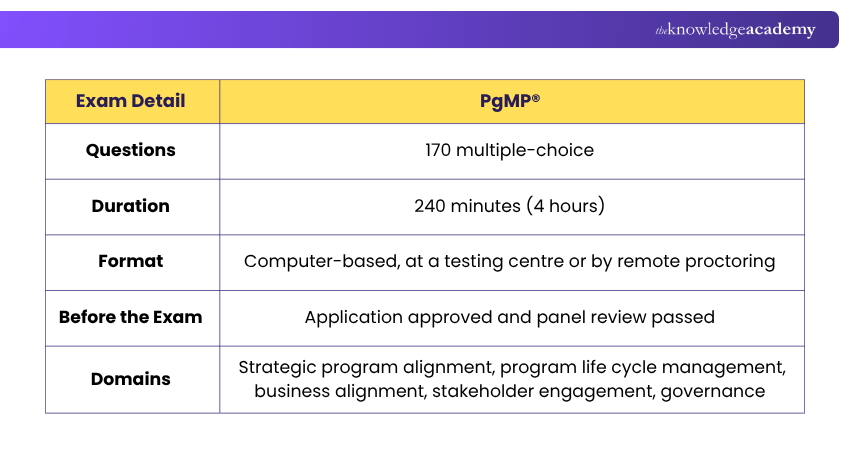
The exam can be taken at a testing centre or through remote proctoring, and PMI provides study resources to help candidates prepare.
Bonus Tip
Don't prepare for PgMP® by memorising terminology alone. Practise applying programme management concepts to scenarios involving governance, stakeholder engagement, benefits management and strategic alignment.
Strengthen portfolio management skills with the Portfolio Management Professional PfMP® Certification Training - Join today!
Advantages of PgMP®
Earning the PgMP® certification offers professionals several benefits. Some key advantages include:
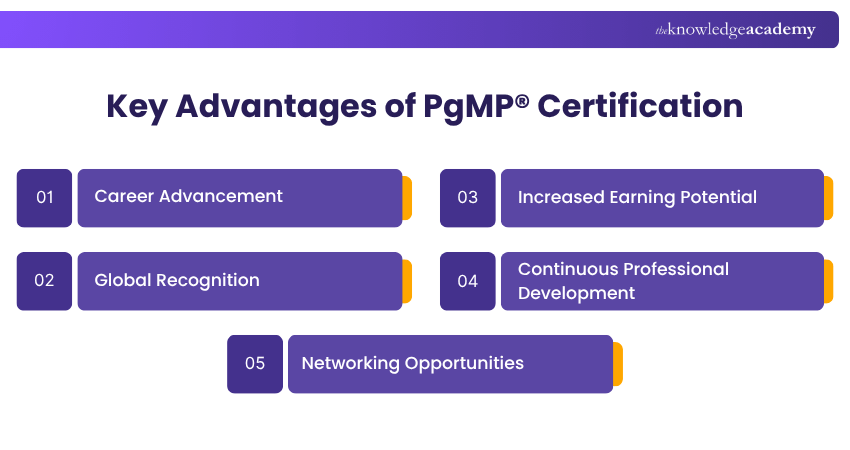
a) Career Advancement: PgMP® is recognised as an advanced credential for experienced Program Managers, which can support progression into senior leadership roles.
b) Global Recognition: The certification is respected worldwide, which benefits professionals who aspire to work internationally.
c) Increased Earning Potential: PMI reports higher earnings among surveyed PgMP®-certified professionals than their non-certified counterparts. However, pay depends on location, experience, industry and responsibilities, and certification does not guarantee an increase.
d) Continuous Professional Development: Holders must earn 60 Professional Development Units (PDUs) every three years, which keeps them up to date with developments in program management.
e) Networking Opportunities: The certification gives access to PMI communities, events and professional development activities, which help professionals connect with peers.
Kickstart your project management journey today with the PMP® Certification Training - Join now!

Vishnu Sankar is a Senior Content Writer with 5+ years of experience across content development, software development, web development and system administration. His technical background and professional training support his expertise in IT and Tech, while his extensive research and writing experience covers Project Management and Health and Safety.
View Detail

 If you wish to make any changes to your course, please


