




We may not have the course you’re looking for. If you enquire or give us a call on 01344203999 and speak to our training experts, we may still be able to help with your training requirements.
Personal Ethics: A Guide to Moral Principles
ByVidhya NairLast updated on: 03 October 2026
From everyday choices to critical moments, discover how personal ethics can provide a foundation for making thoughtful and responsible decisions.
What drives your decisions every day? For some, it's a strong moral compass; for others, it's that gut feeling you just can't ignore. At the heart of it all are personal ethics, the principles that reflect our values and beliefs. They help us tackle life's challenges and shape how we connect with others.
In this blog, we're diving into the world of personal ethics. We'll explore what they are, why they matter, and how they can lead to a more fulfilling and respectful life. Ready to discover how embracing personal ethics can transform your decisions and relationships? Read on!
What are Personal Ethics?
Personal Ethics are the moral principles and values that guide how an individual thinks, behaves, and makes choices. They help people determine what they believe is right or wrong and influence how they respond to different situations.
These principles influence everyday choices, behaviours, and interactions with others. Personal ethics operate at an individual level and may be shaped by factors such as upbringing, culture, religion and personal experiences. Some of the key components that make an individual's moral direction include:
1) Honesty: Being truthful and sincere in actions
2) Integrity: Upholding moral ethics firmly
3) Respect: Value others’ opinions and rights
4) Empathy: Understand and share others’ emotions genuinely
5) Fairness: Making decisions impartially and treating others fairly
6) Disciplined: Maintain self-control
7) Responsibility: Fulfilling commitments reliably
8) Trustworthiness: Be reliable and keep promises
9) Open-mindedness: Embracing new ideas
10) Adaptability: Adjusting to changes and challenges

The Importance of Personal Ethics
Personal ethics shape one’s character and behaviour. Here are the reasons why it matters:
a) Lead Effectively: These ethics empower leaders to lead consistently by following a transparent and respected ethical code. This boosts confidence and trust within the team, motivating others to follow the leader and make positive contributions to the organisation.
b) Build Trust and Support: Persistent ethical behaviour in all situations builds trust and credibility among peers, improving the dependability and respect of leaders and professionals.
c) Provide a Solid Foundation: Having strong personal ethics assists individuals in dealing with difficult events by directing their decisions and behaviours in harmony with a defined moral compass.
d) Streamline Decision-making Process: Clear ethical principles can provide a framework for evaluating choices and decisions and considering whether actions align with personal values.
e) Set Behavioural Standards: Ethics form a benchmark for proper behaviour, leading people towards ethical choices and actions in both professional and personal spheres of life.
f) Strengthen Personal Accountability: People with strong personal ethics are often self-motivated and are ready to go the extra mile to accomplish their goals effectively.
Pro Tip
Before making a difficult decision, ask whether your choice aligns with your core values and whether you would be comfortable explaining the reasoning to others.
Learn to build trust in your organisation with our Business Ethics Course – Register now!
Examples of Personal Ethics in the Workplace
Personal ethics can greatly impact one’s professional and personal life. Here are some examples of how personal ethics can be demonstrated in the workplace:
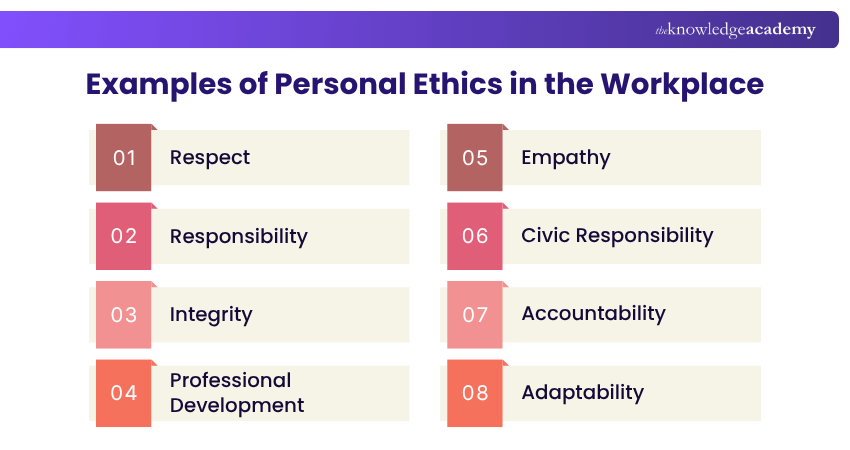
1) Respect
Respect remains essential for successful communication and cooperation. When respect is a core value in the workplace, employees often experience greater job satisfaction because it facilitates a positive and supportive environment.
2) Responsibility
Responsibility is another critical element of establishing trust within organisations. Taking responsibility for your actions and keeping promises can greatly improve the success of your team.
3) Integrity
Integrity means acting honestly and consistently, even when no one is watching. In the workplace, it involves keeping commitments, following ethical standards, admitting mistakes, and making fair decisions. Demonstrating integrity can build trust among colleagues, managers, and clients while contributing to a reliable and ethical work environment.
4) Professional Development
Continuous learning and growth are greatly appreciated in the workplace. It increases motivation and flexibility and improves employee performance, making professional development a crucial personal value. This fosters a culture of responsibility, integrity, and respect for continuous improvement.
5) Empathy
Having empathy as a leader is vital for creating a supportive and communicative work environment. It enhances collaboration, resolves disputes, and boosts the overall involvement of your employees.
6) Civic Responsibility
Participating in civic duties, such as volunteering and environmental initiatives, boosts a company's societal influence and enhances its reputation.
Pause and Reflect
If someone observed your actions for a week without knowing what values you claim to hold, what values would they assume are important to you? The answer can reveal whether your stated principles and everyday behaviour are aligned.
7) Accountability
Accountability involves taking ownership of your decisions, actions and their consequences. In the workplace, it means acknowledging mistakes, meeting responsibilities and taking appropriate steps to correct problems.
8) Adaptability
Being able to adapt to new situations and events is essential in ever-changing workplaces. Flexible employees have a big impact on team effectiveness and the ability of an organisation to bounce back from challenges.
9) Fairness
Fair treatment for all employees promotes trust and boosts their morale. It emphasises the importance of making decisions grounded in merit and moral principles.
10) Trustworthiness
Being honest and reliable establishes a strong professional relationship and fosters effective teamwork. Trustworthy employees follow through on commitments and communicate openly with others. This helps build confidence among colleagues and creates a more dependable work environment.
Trainer’s Insight
Ethical reflection includes questioning your own assumptions. Before deciding that something is fair or right, consider whether personal experiences, habits or biases could be influencing how you see the situation.
11) Teamwork
Successful teamwork relies on working together, communicating effectively, and displaying mutual respect. Teamwork is also essential for attaining success in the workplace, as it enhances productivity and promotes innovation.
12) Confidentiality
Maintaining confidentiality helps protect sensitive information and preserve trust in the workplace. It also supports compliance with organisational policies, ethical standards and applicable legal requirements.
13) Professionalism
Professionalism, which includes respect, integrity, and accountability, enhances credibility and supports career growth, making it a cornerstone of personal ethics in the workplace.
Create a respectful workplace with our Ethics in Workplace Training – Join today!
Benefits of Personal Ethics Statement
A personal ethics statement offers clarity and direction to individuals in both personal and professional life. Here are some of the benefits:
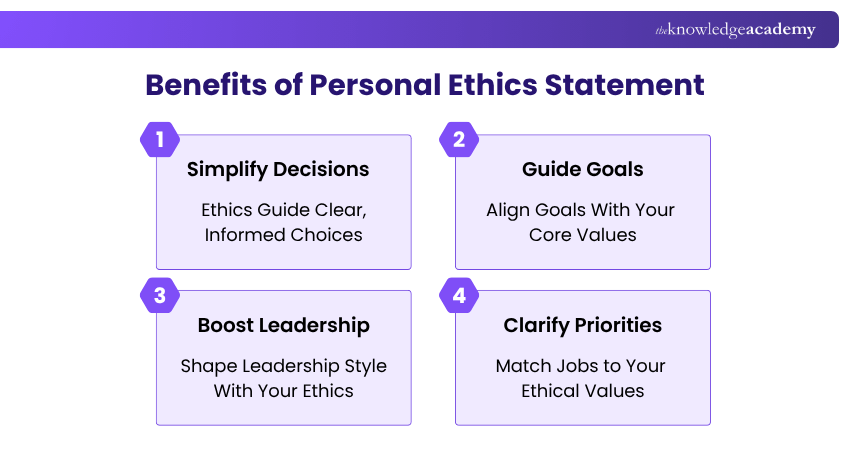
1) Simplify Decision making
Crafting a personal ethics statement not only clarifies your priorities but also simplifies decision-making. This is particularly crucial for leaders and high-level executives who frequently face complex choices. By establishing a clear set of criteria, you can more easily evaluate your options and make informed decisions.
2) Enhance Goal Setting
Once you select your focus areas, your personal ethics statement can steer your developmental goals. You can pinpoint opportunities and prepare future steps to pursue by identifying your core values. This clarity will help you align with your principles as you grow personally and professionally.
3) Develop Leadership Skills
Creating a personal ethics statement can immensely boost your leadership skills, particularly when pursuing roles or positions that demand a robust ethical foundation. Understanding your core values and principles can help you choose a leadership style that promotes team growth and success.
4) Clarify Priorities
Understanding your values can help you consider whether particular roles, organisations or responsibilities align with what matters to you. This can support more informed career choices and help identify potential conflicts between personal values and professional expectations.
Quick Assessment
Use these questions to assess how clearly your personal ethics guide your behaviour:
1. Can you identify five values that influence your decisions?2. Do your actions remain consistent with those values when situations become difficult?3. Can you explain why you consider a decision ethically appropriate?4. How would you respond if two important values conflicted?5. Does your current personal or professional behaviour reflect the principles you say you value?
Difference Between Personal and Professional Ethics
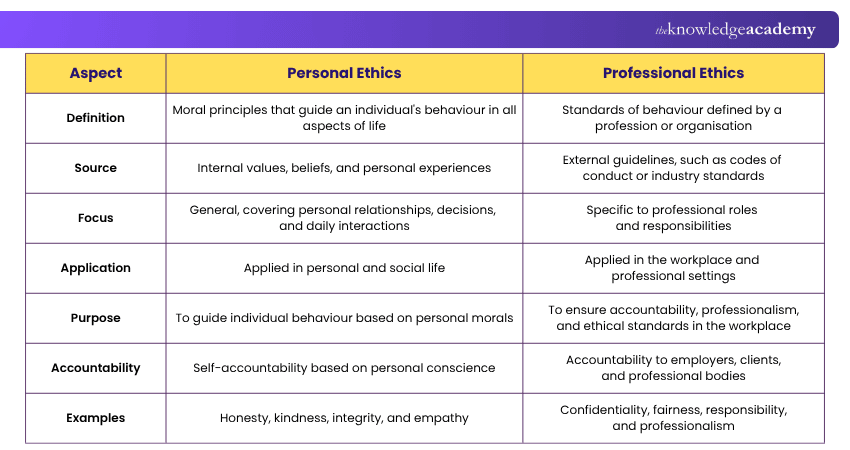
Although personal and professional ethics both guide behaviour and decision-making, they differ in where they come from and how they are applied. Here are the differences between personal and professional ethics:
1) Definition
Personal Ethics: Personal ethics are an individual's moral principles and values that guide their choices and behaviour in everyday life.
Professional Ethics: Professional ethics are standards of conduct that guide how individuals are expected to behave within their workplace or profession.
2) Focus
Personal Ethics: Focus on personal beliefs about what is right, fair, and responsible.
Professional Ethics: Focus on maintaining appropriate, responsible, and ethical behaviour while carrying out professional duties.
3) Source
Personal Ethics: Often develop through family, culture, education, experiences, personal beliefs, and reflection.
Professional Ethics: Usually come from professional codes of conduct, organisational policies, industry standards, and legal requirements.
4) Scope
Personal Ethics: Apply broadly to an individual's personal choices, relationships, and everyday behaviour.
Professional Ethics: Apply mainly within a professional role, workplace, or specific industry.
5) Application
Personal Ethics: Influence how individuals make decisions and interact with others in their daily lives.
Professional Ethics: Guide workplace decisions, responsibilities, professional relationships, and conduct.
6) Examples
Personal Ethics: Honesty, kindness, fairness, respect, empathy, and responsibility.
Professional Ethics: Confidentiality, accountability, integrity, competence, impartiality, and managing conflicts of interest.
Empower teams to make responsible decisions with Team and Management Ethics Training – Join now!

Vidhya Nair is a Senior Copywriter with 7+ years of experience across copywriting, content writing and communication. Her extensive research and editorial experience supports her ability to present topics across Business Skills and Human Resources with clarity and purpose.
View Detail

 If you wish to make any changes to your course, please


