




We may not have the course you’re looking for. If you enquire or give us a call on 01344203999 and speak to our training experts, we may still be able to help with your training requirements.
Objectives of GST: A Comprehensive Overview
ByShristi RoyLast updated on: 30 September 2026
Goods and Services Tax (GST) is a unified indirect tax introduced to streamline India's tax system. The objectives of GST include promoting ease of doing business, curbing tax evasion, and ensuring transparency in the tax collection process. This blog delves into the primary goals and benefits of GST. Read on to learn more!
Key Topics Covered
1. Understanding GST: What GST is and how India’s indirect tax framework works.2. GST Decision-making: The role of the GST council.3. Objectives of GST: The key goals behind the introduction of GST.4. Impact of GST: How its objectives influence taxation, businesses, and supply chains.5. Advantages of GST: Major benefits of the GST framework.6. Disadvantages of GST: Key challenges businesses may encounter.
"One Nation, One Tax," this mantra encapsulates the vision of India's new tax system. Before GST, businesses had to navigate multiple indirect taxes imposed at different levels, making taxation and compliance more complex. GST introduced a more integrated approach, bringing several indirect taxes under a common framework and changing how businesses manage tax across the country. Let's learn more about it in the blog!
What is Goods and Services Tax (GST)?
GST is a comprehensive indirect tax imposed on the supply of goods and services in India in multiple stages. It was put into effect on 1st July 2017 to substitute indirect taxes such as VAT, service tax, and excise duty.
GST uses a value-added system, where tax is gathered at every phase of production or distribution, but eligible businesses can generally claim Input Tax Credit (ITC) on GST paid on eligible business purchases, subject to applicable conditions. This results in a simplified and cohesive tax system, simplifying compliance for businesses and encouraging transparency.
GST is divided into Central GST (CGST) and State GST (SGST) for transactions within the same state and Integrated GST (IGST) for trade between different states. The aim is to eliminate the ripple effect of taxes, lessen the burden of compliance rules, and promote the unrestricted flow of goods throughout India. The Union Territory GST (UTGST) applies to intra-Union Territory supplies in Union Territories without a legislature. Understanding the types of GST is essential for businesses to determine how GST applies to different transactions.
GST at a Glance
GST brought several indirect taxes under a common framework, with key objectives including simplifying taxation, reducing cascading taxes, improving compliance, increasing transparency, and supporting a more integrated national market.
Who Takes GST-related Decisions?
The GST council is a high-level committee responsible for important decisions regarding GST implementation throughout India. Its responsibilities include:
a) Making recommendations on GST-related laws and policy matters
b) Making recommendations on GST rates
c) Making recommendations on threshold limits and other matters specified under the GST framework
Led by the Union Finance Minister, the council, which includes representatives of the states and union territories, plays a vital role in making recommendations on key GST matters, such as registration, ITC in GST, refund claims, and GST returns. Similarly, the council tax Reduction plays a crucial role in ensuring fairness and uniformity in the council tax system. Its significance is essential in maintaining consistency and ensuring the smooth functioning of tax systems across the nation.

Objectives of Goods and Services Tax (GST)
The goods and services tax is created to benefit the economy in all possible ways. Let’s discuss some of the main objectives of GST:
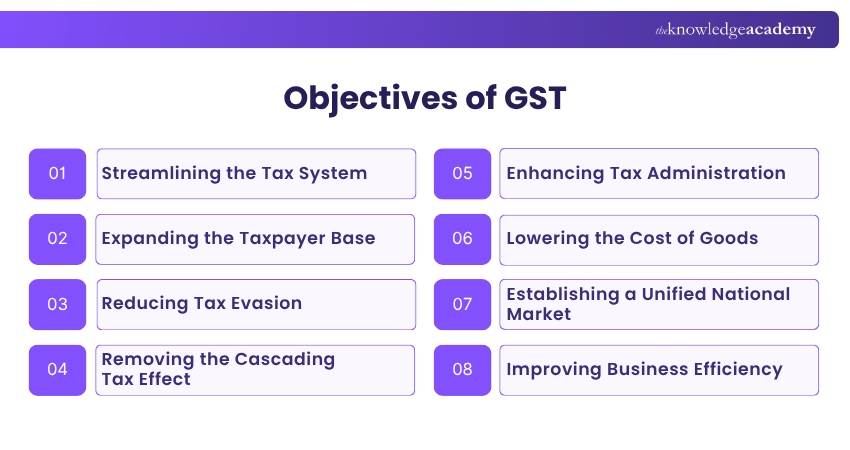
1) Streamlining the Tax System
GST simplifies the tax system by combining indirect taxes into a single tax, decreasing the administrative workload for businesses and the government. This simplification helps to improve the efficiency and manageability of tax compliance. All GST operations, such as registration, tax filing, and the GST refund process, are carried out online using the GST portal, backed by a digital-first strategy. This digital system makes compliance easier, reduces mistakes, and speeds up tax processing.
Impact:
Streamlining the tax system through GST has significantly improved the business environment in India. Digitising tax processes has reduced paperwork, minimised errors, and simplified compliance, saving time. This is particularly beneficial for small and medium enterprises (SMEs), which frequently face challenges with complex tax laws. Moreover, a simpler tax system has boosted compliance rates, increasing government revenue collection.
2) Expanding the Taxpayer Base
GST was designed to broaden the tax base by bringing more economic activity into a common indirect tax framework and encouraging formalisation. Expanding the tax base i can support tax revenues and bring more businesses within the formal tax system. This process may also help formal businesses build financial records that can support access to credit and other financial services.
Impact:
The broadening of the tax base through GST has brought many informal businesses into the formal sector, resulting in positive effects like better financing opportunities, increased consumer confidence, and enhanced eligibility for government programs and benefits. Having a broader tax base means the economy can provide a wider revenue base for the government to support public expenditure.
3) Reducing Tax Evasion
GST promotes a clearer and simpler tax system. With GST, all transactions and sales are recorded in a single system, making it harder for businesses to hide or adjust sales numbers to avoid paying taxes. The input tax credit mechanism also creates an incentive for eligible businesses to maintain appropriate purchase and sales records. As a result, the government can more easily monitor transactions and ensure the accurate collection of taxes, leading to a significant decrease in tax evasion.
Impact:
The consequences of decreasing tax evasion via GST are significant. Initially, it encourages equality; ensuring all individuals contribute fairly reduces the burden on upright taxpayers. Additionally, it boosts government income without increasing tax rates, allocating more resources to public services like education, healthcare, and infrastructure.
Decreasing tax evasion results in a fair competition environment for every company. When companies fulfil their tax obligations, it becomes more challenging for dishonest businesses to gain an advantage over competitors by evading taxes. Thus, it promotes fair competition and ultimately results in improved consumer services and better prices.
Know tax filing processes with the Tax Filing Course today!
4) Removing the Cascading Tax Effect
Before the implementation of GST, businesses frequently struggled with the "tax on tax," which involved passing on multiple layers of taxation to the end consumer, resulting in increased prices of products and services. GST solves this problem by establishing an extensive input tax credit mechanism, enabling companies to claim taxes paid on input services. This system greatly minimises the domino effect, ensuring that tax is imposed solely on the added value at each level of the distribution process. Therefore, customers enjoy reduced prices and a clearer tax system.
Impact:
The removal of the cascading effect of taxes can make the tax component of pricing more transparent by reducing tax-on-tax effects. It can also improve the competitiveness of businesses where eligible input tax credits reduce embedded taxes.
Moreover, it has played a role in enhancing the efficient distribution of resources in the economy. For companies, this results in better profit margins and lower tax obligations, creating a favourable atmosphere for development and expansion.
Bonus Tip
Input Tax Credit (ITC) is central to reducing the cascading effect of GST, but businesses should not assume that every GST payment automatically becomes an available credit. Eligibility and utilisation depend on applicable GST rules and compliance requirements, making accurate invoices and records important.
5) Enhancing Tax Administration
GST improves tax management by streamlining compliance procedures and consolidating multiple tax systems within a unified structure. The digital setup of GST enables electronic registration, return filing, payment, and transaction reporting, minimising errors and making the tax process more efficient. Companies must keep clear and open records of their sales and purchases to simplify audits and evaluations. Moreover, adopting standardised procedures among states ensures uniformity in tax administration, simplifying the process for taxpayers and tax authorities.
Impact:
GST's enhancements in tax administration result in increased compliance rates decreased tax evasion and boosted government revenue. Efficient procedures lead to quicker refunds and simpler access to tax credits, incentivising businesses to adhere to regulations.
GST transparency builds trust between taxpayers and authorities, promoting a collaborative atmosphere. Additionally, the decreased workload for tax authorities enables them to concentrate on important projects and improve tax collection and enforcement effectiveness, ultimately leading to a stronger economy.
6) Lowering the Cost of Goods
GST reduces the prices of goods by removing the cascade effect of taxes that previously affected consumers. In the previous tax system, businesses frequently encountered numerous levels of taxation, which resulted in higher prices. GST simplifies this procedure by implementing a thorough input tax credit system that enables companies to recover taxes spent on inputs. This ensures that tax is only imposed on the increase in value at each step of the distribution process, lessening the total tax load.
In addition, GST ensures consistency and predicatability by standardising tax rates throughout the nation. This decreases the expenses companies must meet regulations and promotes favourable pricing competition. Lower operational expenses allow companies to sell goods at discounted rates, ultimately giving customers a direct advantage.
Impact:
The reduction in the price of goods due to GST has a notable impact. Consumers benefit from lower prices, which make necessary goods and services more cost-effective. This heightened ability to buy things can boost demand, fuelling economic expansion.
Furthermore, exporters benefit from the improved competitiveness of products in the international market. The enhanced profit margins and lower tax burdens benefit businesses by creating a conducive atmosphere for increased growth and expansion, ultimately boosting the economy.
7) Establishing a Unified National Market
The Goods and Services Tax (GST) simplifies India's market by bringing all states under one GST framework, replacing the previous mix of state and central taxes that differed by state. This legislation promotes consistency in taxation, streamlining the tax system and reducing several tax-related barriers to the interstate movement of goods and services.
By promoting a unified and diverse economic atmosphere, GST promotes equality in competition and allows companies, especially new and small ones, to grow their businesses across the country under a more consistent indirect tax framework.
Impact:
The objectives of GST have greatly lessened the logistical and regulatory challenges that companies used to encounter while operating in multiple states. GST has played a role in reducing the prices of products and services and enhancing the effectiveness of distribution networks.
This helps companies by decreasing expenses related to transactions and expanding consumer reach to more products at reduced costs, which boosts demand and fuels economic expansion.
Trainer’s Insight
The phrase “One Nation, One Tax” describes the idea of a common GST framework rather than a single tax rate for every product or service. Different categories can attract different GST rates, while CGST, SGST/UTGST, and IGST apply according to the nature and location of the supply.
8) Improving Business Efficiency
GST enhances business efficiency by simplifying the tax structure and streamlining compliance processes. Businesses can simplify tax management by replacing many indirect taxes with one single tax. The integrated GST system enables companies to claim eligible input tax credit, subject to applicable conditions, reducing their tax burden and enhancing cash flow. Moreover, the digital framework that sustains GST allows companies to streamline tasks like registration, submitting returns, and handling claims, resulting in considerable time and cost savings.
Impact:
Businesses are greatly affected by the wide-ranging repercussions of the efficiency improvements resulting from the implementation of GST. Firstly, efficiency in meeting requirements decreases the amount of time and resources used for tax tasks, enabling companies to concentrate on fundamental operations and strategic plans.
Furthermore, enhanced cash flow allows companies to increase their investment in growth prospects, stimulating innovation and growth. Ultimately, a streamlined tax system promotes fair competition, boosting market competitiveness and encouraging equality among businesses. In general, the GST fosters a climate that is favourable for advancement, efficiency, and financial success.
Learn to calculate your VAT taxes with the VAT Training – Register now!
9) Unifying Indirect Taxes
One main goal of GST is to combine most current indirect taxes levied by state and central governments, such as excise duty, service tax, and VAT, among others. This merging has greatly decreased multiple taxes, regulatory obligations, and the chance of being taxed twice, streamlining the tax environment for companies. Furthermore, it has streamlined the government's tax administration processes, improving the effectiveness of tax collection and enforcement.
Impact:
The consolidation of different indirect taxes into one GST framework has made tax administration more straightforward and reduced disagreements over tax jurisdiction and interpretation. This has established a steady and anticipated tax setting, promoting investment from both local and foreign sources. Also, the implementation of GST has resulted in lower tax collection expenses and enhanced operational efficiency for the government.
10) Optimising Supply Chains
Prior to the introduction of GST, traders and manufacturers had to deal with a complex paperwork procedure when supplying goods. One important result of GST is the removal of checkpoints on state boundaries, which frequently led to traffic congestion and delays in the shipment of goods. Eliminating these checkpoints has lowered transit times, leading to reduced expenses for warehousing and storage.
Impact:
Eliminating check posts due to GST has significantly improved the effectiveness of transporting goods, resulting in quicker delivery times and decreased operating expenses for companies. This enhancement reduces supply chain delays and improves overall market competitiveness. In addition, it helps facilitate the movement of goods between states, which boosts economic development and supports trade domestically.
Advantages of GST
GST offers numerous benefits to stakeholders, including state and central governments, businesses, and citizens. Let’s explore the advantages of GST:
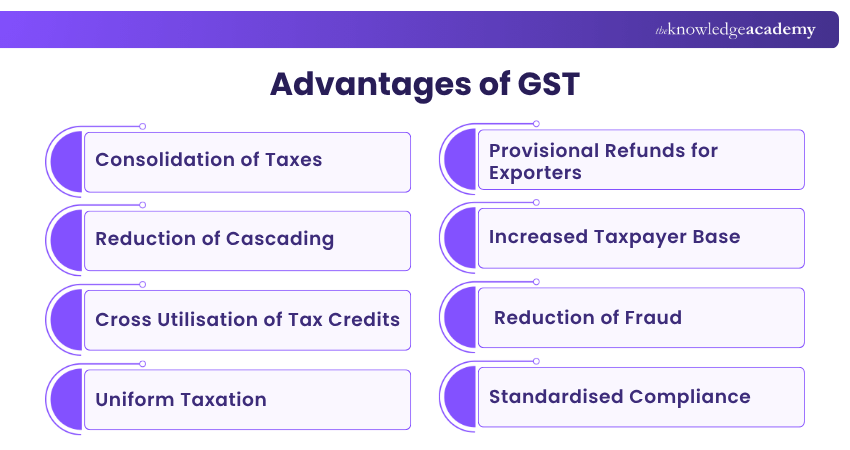
a) Consolidation of Taxes: It combines multiple indirect taxes from central and state governments into a common GST framework.
b) Reduction of Cascading: It minimises the cascading effect, making Indian industries and products more competitive.
c) Cross Utilisation of Tax Credits: It enables eligible input tax credit to be utilised in accordance with the set-off rules prescribed under GST.
d) Uniform Taxation: IGST, CGST, and SGST introduce uniformity in taxation for both imports and local products.
e) Provisional Refunds for Exporters: Eligible exporters may claim GST refunds in accordance with the applicable refund provisions and procedures.
f) Increased Taxpayer Base: It can contribute to a broader taxpayer base and greater formalisation.
g) Reduction of Fraud: Digital reporting and transaction trails can help tax authorities identify discrepancies and combat tax evasion.
h) Standardised Compliance: It creates a consistent set of laws, procedures, and tax rates, facilitating better compliance.
i) Technology-driven Platform: Its automated interface simplifies registration, filing, and payment of returns, as well as claims.
j) Enhanced Transparency: GST improves overall transparency in the taxation system.
k) Lower Tax Burden: Reducing the tax burden on industries lowers the prices of goods, leading to increased consumer spending and stimulating the economy.
l) Boost to Domestic Demand: GST can enhance domestic demand and production, creating more employment opportunities.
Bonus Tip
GST does not affect every business, product, or service in the same way. The practical impact can depend on factors such as the applicable GST rate, availability of input tax credit, type of supply, business model, and compliance requirements.
Disadvantages of GST
With benefits, GST comes with lots of drawbacks and challenges. Let’s discuss some of the major disadvantages of GST:
a) Complexity for Small Businesses: Small businesses often find GST complicated, especially if they are not accustomed to online processes. Keeping up with GST regulations can be labour-intensive.
b) Higher Costs for Certain Services: Services such as dining out or getting a haircut may become more expensive due to increased tax rates, leading to higher costs for customers.
c) Technological Challenges: GST requires reliable internet and computer skills. Businesses in areas with poor connectivity or limited technological expertise may struggle to comply with GST regulations.
d) Initial Confusion: The rollout of GST was confusing, with many businesses facing difficulties understanding the new rules and navigating the GST software.
e) Extensive Paperwork: Despite the intention to simplify taxation, GST still involves significant paperwork and regular online filing, which can be overwhelming for small businesses.
f) Cash Flow Issues: Businesses must pay GST at the time they bill customers, not when they receive payment, which can create cash flow challenges, especially for those who typically receive delayed payments.
g) Variable Tax Rates: While some essential items like food may be taxed less or not at all, other goods may incur higher taxes, leading to increased prices.
h) Service Challenges Across States: Although the movement of goods across state lines is smoother, providing services across different states remains complicated and can create confusion.
GST was introduced to create a more integrated, transparent, and efficient indirect tax framework. However, its practical impact can vary depending on the nature of the transaction, applicable rates, ITC eligibility, and compliance requirements. Understanding both its objectives and its operational requirements is essential for seeing the complete picture.
Turn tax complexity into clarity by joining the Tax Courses today!

Shristi Roy is a Content Writer with experience in journalism, article writing and web content development. Her experience researching and writing about Business Skills and Accounting and Finance enables her to communicate specialised information through clear, engaging narratives.
View Detail

 If you wish to make any changes to your course, please


