




We may not have the course you’re looking for. If you enquire or give us a call on 01344203999 and speak to our training experts, we may still be able to help with your training requirements.
Top 10 NLP Models (Natural Language Processing)
ByNilotpal SarmahLast updated on: 02 October 2026
Curious to learn how computers can interpret human languages? The answer lies in Natural Language Processing (NLP) Models, a crucial AI component that helps machines understand, process and generate human language. Continue reading this blog to understand the top 10 NLP models, their importance, and key types to achieve a detailed understanding.
The Rundown
1. Discover how different NLP model architectures approach language tasks.2. See how NLP evolved from statistical methods to Transformer-based models.3. Compare influential models based on their key architectural differences.4. Learn what factors matter when selecting a model for a specific task.5. Understand why older models still influence modern NLP development.
Artificial Intelligence (AI) has completely transformed how machines interact with human beings. This is possible through the applications of NLP models, which have significantly gained traction in recent times. NLP continues to grow in importance as organisations adopt generative AI, conversational systems, semantic search, automated translation and other language-based applications. This growing adoption creates new opportunities for those seeking to build their careers in the field of AI.
Why are NLP Models Important?
NLP models have revolutionised how computers understand and process human language. They allow machines to analyse context, infer intent, and identify sentiment or emotional cues, further improving communication across industries. The importance of NLP models is described as follows:
1) Bridging Human-machine Communication: NLP models are essential because they help bridge the gap between human communication and machine understanding. They can enable computers to analyse context, infer intent and identify sentiment or emotional cues in language, making interactions more natural and user-friendly.
2) Enhancing AI Applications: These models are critical in AI applications, such as chatbots, virtual assistants, and sentiment analysis, where understanding subtle nuances is vital for communicating effectively.
3) Improving Industry Efficiency: NLP models improve efficiency across industries. In healthcare, for example, NLP can help extract and organise information from clinical records to support healthcare professionals and administrative processes.
4) Breaking Language Barriers: NLP models support translation and multilingual communication, making global interactions more accessible and efficient. This approach assists businesses in expanding their reach and can improve accessibility in digital communication.
5) Extracting Insights from Unstructured Data: NLP models can extract insights from large volumes of unstructured data, such as social media posts, emails and documents. This approach uncovers valuable trends and information for informed decision-making.
Quick Check
Before choosing an NLP model, ask yourself: What language task am I solving? Do I need understanding, generation or both? What computing resources are available? Does the model need to respond quickly or operate within a constrained environment? Answering these questions can help narrow the options before comparing individual models.
Different Types of Natural Language Models
Natural Language Processing (NLP) models are diverse and capable of handling specific language-related tasks. These models leverage different techniques to interpret, analyse, and generate human language effectively. These categories can overlap, as a language model may belong to more than one type depending on its architecture and training approach. Here are the key types of Natural Language Processing models:
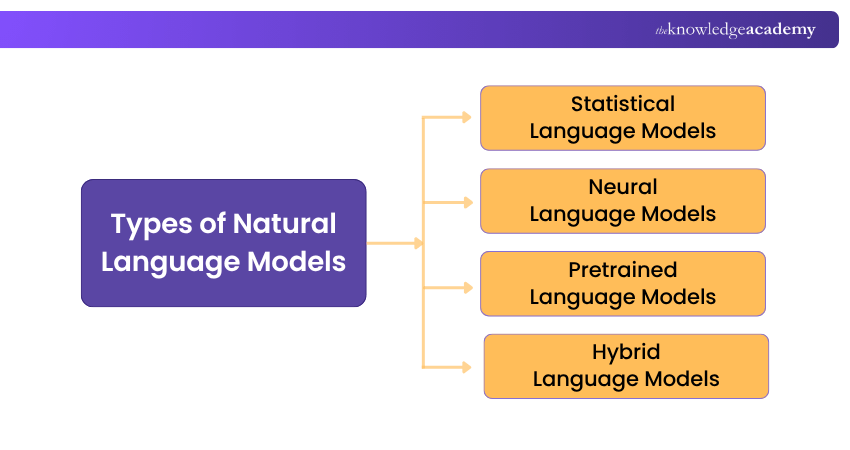
1) Statistical Language Models: Statistical models, such as N-gram models, use probabilities of word sequences to predict the next word. They can work well for basic tasks such as text prediction, but have limited ability to capture long-range dependencies and broader context compared with modern neural language models.
2) Neural Language Models: NLPs utilise more advanced architectures, ranging from Recurrent Neural Networks (RNNs) to Transformers. RNNs process text sequentially, while Transformers use attention mechanisms to capture relationships between words or tokens more effectively across longer sequences. This makes them highly effective for tasks such as translation, summarisation and language generation.
3) Pretrained Language Models: Pretrained language models undergo training on large datasets to develop a deep understanding of language patterns before being fine-tuned or adapted for specific tasks. The key examples include Bidirectional Encoder Representations from Transformers (BERT), which performs well in understanding contextual nuances, and Generative Pre-trained Transformer (GPT), known for its capabilities in text generation.
4) Hybrid Language Models: Hybrid language models combine different modelling techniques or components for specific use cases to provide greater flexibility and adaptability. For example, they may integrate neural models with statistical methods, rules, retrieval systems or knowledge-based approaches to address complex NLP tasks.
Trainer’s Pro Tip
Don’t choose an NLP model simply because it is larger or newer. Start with the task you need to solve, then consider factors such as accuracy requirements, computational resources, response speed and deployment environment. A smaller specialised model may sometimes be more practical than a much larger general-purpose model.
Lead projects smarter with AI insights and transform project delivery with the Artificial Intelligence (AI) For Project Managers Training – Sign up now!
Popular Natural Language Processing Models
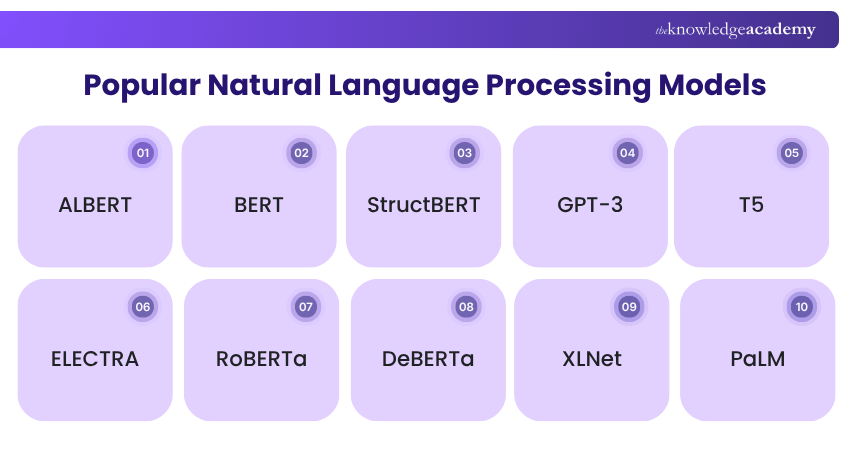
From understanding context and intent to generating meaningful responses, these NLP models are applied across various domains. This includes translation, sentiment analysis, and conversational AI. Here are some popular and influential Natural Language Processing (NLP) models that have shaped the development of modern NLP:
1) ALBERT
ALBERT (A Lite BERT) is a parameter-efficient variant of BERT developed by Google researchers. It uses factorised embedding parameterisation and cross-layer parameter sharing to reduce the number of parameters while retaining strong language understanding capabilities.
2) BERT
Bidirectional Encoder Representations from Transformers (BERT) learns contextual representations by considering both left and right context during pre-training. It efficiently performs tasks like sentiment analysis and question answering using self-attention mechanisms.
3) StructBERT
StructBERT extends BERT by incorporating word-level and sentence-level structural objectives during pre-training, helping it learn richer language representations for downstream natural language understanding tasks.
4) GPT-3
GPT-3, introduced by OpenAI in 2020, is a 175-billion-parameter autoregressive language model that demonstrated strong few-shot and in-context learning capabilities across numerous language tasks. It played an important role in the development of modern Generative AI, although newer generations of language models have since been introduced.
5) T5
Text-to-Text Transfer Transformer (T5) approaches NLP tasks through a unified text-to-text framework. Instead of using separate output structures for different tasks, T5 represents tasks such as translation, summarisation, classification and question answering as text input followed by text output. This design made it an influential model for transfer learning in NLP.
6) ELECTRA
ELECTRA is a Transformer-based model designed to make language-model pre-training more computationally efficient. Rather than predicting only masked words like BERT, it learns to identify tokens that have been replaced by another model. This replaced-token detection objective enables ELECTRA to learn useful language representations efficiently.
7) RoBERTa
RoBERTa (Robustly Optimised BERT Pretraining Approach) builds on BERT by optimising its pre-training process. It was trained for longer with larger batches and more data while modifying key training choices, resulting in improved performance across several NLP benchmarks.
8) DeBERTa
Decoding-enhanced BERT with Disentangled Attention (DeBERTa) improves upon BERT-style language understanding by representing a token's content and position separately within its attention mechanism. It also uses an enhanced mask decoder to incorporate positional information during masked-token prediction.
This approach helps the model capture relationships between words and their relative positions and has delivered strong results across Natural Language Understanding (NLU) tasks.
9) XLNet
XLNet is a Transformer-based language model that uses permutation-based autoregressive pre-training to learn bidirectional context. In its original research, XLNet outperformed BERT across 20 NLP tasks under comparable experimental settings, including question answering, natural language inference and sentiment analysis.
10) PaLM
Pathways Language Model (PaLM), introduced by Google Research, is a dense decoder-only Transformer whose largest original version contained 540 billion parameters and was trained using the Pathways system. It demonstrated strong capabilities across language understanding, generation, reasoning, multilingual tasks and code generation.
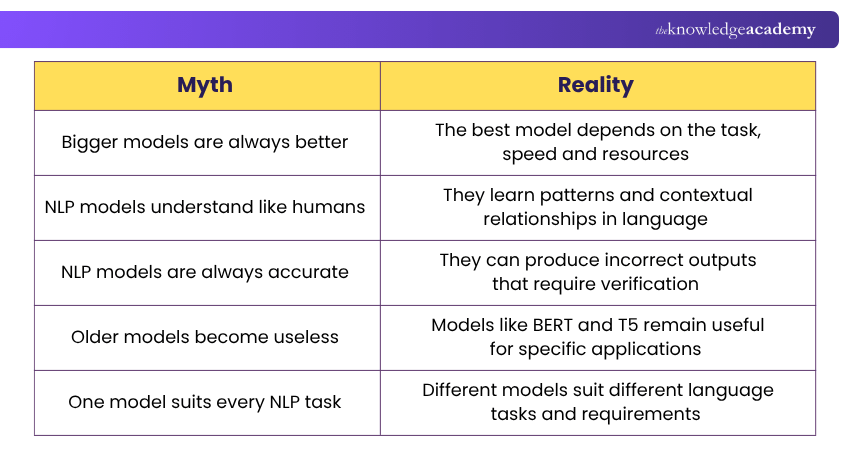
Myth vs Reality
Learn AI basics that shape the future and power modern innovation with the AI Course For Beginners – Join now!

Nilotpal Sarmah is a Senior Content Writer with 11+ years of overall experience spanning engineering, operations and content development. His technical knowledge and extensive writing experience enable him to simplify specialised topics across IT and Tech, Business Skills, Project Management, Health and Safety, and ISO and Compliance.
View Detail

 If you wish to make any changes to your course, please


