




We may not have the course you’re looking for. If you enquire or give us a call on +44 1344 203 999 and speak to our training experts, we may still be able to help with your training requirements.
Top 10 Nginx Alternatives: Explore Beyond Nginx
ByThe Knowledge AcademyLast updated on: 03 October 2026
Curious about learning the Alternatives to Nginx? If so, this blog presents various options with distinct features to meet multiple web server requirements. You can explore the dynamic landscape of web servers beyond Nginx with our insightful blog on Nginx Alternatives.

What’s Inside This Blog?
This guide helps you look beyond Nginx and understand which alternatives fit different server and traffic-management needs.
1. A quick look at Nginx and the features that make it widely used2. 10 strong alternatives including Caddy, Apache, HAProxy, Traefik, Envoy, and more3. Best-fit use cases for web serving, reverse proxying, caching, and load balancing4. Key strengths of each option to help you compare performance, flexibility, and scalability5. Practical guidance to help you choose an alternative based on your application environment
Nginx stands as a stalwart, renowned for its speed, efficiency, and robust performance. However, in the ever-evolving landscape of technology, it is crucial to explore and discover alternative solutions. Hence, this blog delves into the world of web servers, shining a spotlight on the top 10 Nginx alternatives that offer a myriad of features and functionalities.
As websites and web applications continue to grow in complexity and scale, the choice of web server becomes increasingly significant. While Nginx remains a popular choice for its speed and reliability, there are some Nginx alternatives worth exploring. So, if you are seeking a web server optimised for high-performance dynamic content, this blog has you covered.
We'll delve into the intricacies of Nginx alternatives, highlight their standout features, use cases, and suitability for different scenarios. Dive into this blog to explore the diverse landscape of web servers. This blog will also empower you to make informed decisions and consider the perfect fit for your web hosting needs.
Best Nginx Alternatives
You can discover the top-notch alternatives to Nginx in the following points. From these points, you can explore the best options beyond Nginx for optimal performance and scalability:
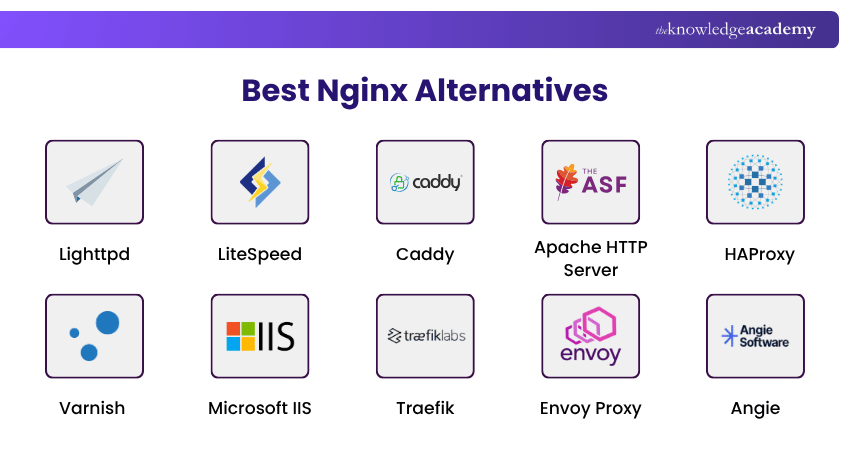
1) Lighttpd
Lighttpd, pronounced "light," is a lightweight and flexible web server known for its speed and efficiency. It is designed with a focus on high-performance and low resource consumption, making it an excellent Alternative to Nginx. Lighttpd excels in serving static content quickly and efficiently. It's particularly suited for websites with a high volume of static files, such as images, videos, and CSS files. Its modular architecture allows for easy customisation and scalability, making it a popular choice for developers.

2) LiteSpeed
LiteSpeed Web Server is a high-performance, commercial web server that offers impressive speed and scalability. Its web Server is designed as a drop-in replacement for Apache and is also a high-performance alternative to Nginx. Migrating from Nginx may require configuration changes. It also offers advanced caching mechanisms and a user-friendly interface for easy management. LiteSpeed is known for its excellent performance with dynamic content, making it a versatile option for various web applications.
3) Caddy
Among the other Nginx alternatives, Caddy is an open-source, modern web server written in Go. It stands out for its simplicity and ease of use, making it a useful choice among developers and sysadmins. What sets Caddy apart is its automatic HTTPS configuration, which simplifies the process of securing websites with SSL/TLS certificates. HTTPS, reverse proxying and modern HTTP support. Its intuitive setup structure makes it an appealing choice for individuals seeking a simple yet secure web server solution.
Unlock the power of networking with our Introduction to Networking Training – Register today!
4) Apache HTTP Server
Apache HTTP Server is a widely used open-source web server and a strong alternative to Nginx. Its modular architecture allows administrators to extend its functionality for different hosting requirements. Apache supports features such as virtual hosting, URL rewriting, SSL/TLS, caching, reverse proxying, and load balancing through dedicated modules. It is particularly suitable for environments that require flexible server configuration and extensive module support. Apache remains actively maintained, with the latest 2.4.x releases continuing to receive updates.
5) HAProxy
HAProxy is a powerful, open-source TCP/HTTP load balancer and proxy server known for its high performance and reliability. While it is primarily used as a load balancer, HAProxy can also function as a reverse proxy. HAProxy excels in managing numerous simultaneous connections while maintaining minimal latency. It offers advanced load-balancing algorithms, SSL termination, and health checks for backend servers. HAProxy's configuration can be complex, but it provides extensive documentation and community support to harness its full potential.
Did You Know?
HAProxy’s Runtime API allows administrators to make certain live changes, such as enabling or disabling backend servers, without reloading the load balancer. However, these changes are temporary and remain in memory only until the next reload or restart.
6) Varnish
Varnish Cache is a widely used HTTP accelerator and caching reverse proxy that can significantly improve website performance. Varnish operates as a caching layer positioned ahead of a web server, swiftly delivering cached content to users. It excels in caching both static and dynamic content, thereby lessening server burden and accelerating webpage loading times. It excels in scenarios where a website experiences heavy traffic or where content needs to be served quickly. Integrating Varnish with an existing web server setup can greatly enhance performance and scalability.
7) Microsoft IIS
Microsoft Internet Information Services (IIS) comes bundled with Windows Server operating systems and functions as a web server. Although not as prevalent within the open-source realm as Nginx or Apache, IIS boasts robust features. IIS seamlessly integrates with various Microsoft products and technologies, making it the preferred option for Windows-centric settings. It accommodates diverse web technologies like ASP.NET and PHP, and offers functionalities like URL rewriting, FTP publishing, and web-based management tools. For organisations heavily invested in the Microsoft ecosystem, IIS can be a solid Alternative to Nginx.
8) Traefik
Traefik is a modern, open-source reverse proxy and load balancer designed for microservices architectures. It integrates with container and orchestration environments such as Docker and Kubernetes. One of Traefik's key features is its dynamic configuration, which automatically detects and routes traffic to services. It offers native support for popular container platforms, making it easy to set up and manage in containerised environments. Such Nginx alternatives also support automatic SSL certificate management, simplifying the process of securing web applications.
9) Envoy Proxy
Envoy Proxy is an open-source edge and service proxy designed for modern distributed applications. It supports advanced traffic routing, load balancing, health checks, TLS termination, and service discovery, making it a strong Nginx alternative for microservices and cloud-native environments. Envoy also supports HTTP/1.1, HTTP/2, HTTP/3, and gRPC traffic, while providing detailed observability for monitoring network performance. It is particularly suitable for organisations that need scalable traffic management across complex application architectures.
10) Angie
Angie is a free, open source web server forked from Nginx by former core developers, designed as a true drop in replacement. It supports existing Nginx configurations with minimal changes and regularly ports upstream security fixes while adding features like built in ACME certificate management, native Prometheus metrics, and HTTP/3 support. Angie follows a quarterly release cycle, but its community and documentation remain smaller than Nginx or Apache, making support resources more limited for now.
Pro tip
Do not choose an Nginx alternative based only on published performance claims. Test it with traffic patterns that resemble your real application, including realistic concurrency and request types.
Supercharge your web server skills with our intensive NGINX Training – Join us now!

The Knowledge Academy develops accessible learning content across Project Management, IT, Cybersecurity, Data Science, Business Analysis, HR, Accounting and Finance, Leadership and Health and Safety. Its resources combine subject research with clear explanations to help professionals build practical knowledge across a wide range of disciplines.
View Detail

 If you wish to make any changes to your course, please


