




We may not have the course you’re looking for. If you enquire or give us a call on 01344203999 and speak to our training experts, we may still be able to help with your training requirements.
Network Protocols: Key Concepts and Types Explained
ByRichard HarrisLast updated on: 26 September 2026
Network protocols are standardised rules that enable devices to exchange data and communicate across networks. This blog explains different types of network protocols, how they work, and their common applications.

The Rundown
1. Network protocols define how devices exchange data across a network.2. Common types include communication, security, and network management protocols.3. Protocols support functions such as addressing, routing, transmission, and error handling.4. Examples include TCP/IP, HTTP, TLS, SNMP, and SSH.5. Network protocols are organised across layers to support communication between devices.
Ever wonder how the internet delivers your urgent messages, favourite videos, and data across the globe in seconds? It's almost like there's a common language that connects every device across the web. The answer lies in network protocols. Whether it’s TCP/IP directing traffic, HTTPS securing transactions, or DHCP assigning IP addresses, protocols keep the digital world running smoothly.
This blog explores these protocols in detail, covering popular examples, types, how they work, and more. Read on to understand how network protocols support modern digital connectivity.
What is a Network Protocol?
A network protocol is a set of standards and rules governing how data is exchanged between devices in a network. These protocols define various aspects of communication, including:
1) Format of data packets
2) Order of transmission
3) Error handling
These standardised protocols are necessary for devices to communicate with each other and help maintain consistent data exchange across networks. Here are some key points to remember about network protocols:
1) Network protocols define the format and structure of data packets.
2) Data is broken into smaller units called packets for transmission.
3) Depending on the protocol, transmitted data units can contain information such as source and destination addresses, sequence numbers and error-detection values.
4) Protocols ensure packet formatting consistency and compatibility across devices.
5) They establish rules for sending, receiving, and ordering packets.
6) Protocols may support errors, retransmissions, and flow control to help manage congestion.
7) Protocols help optimise communication efficiency and reliability between networked devices.

Who Uses Network Protocols?
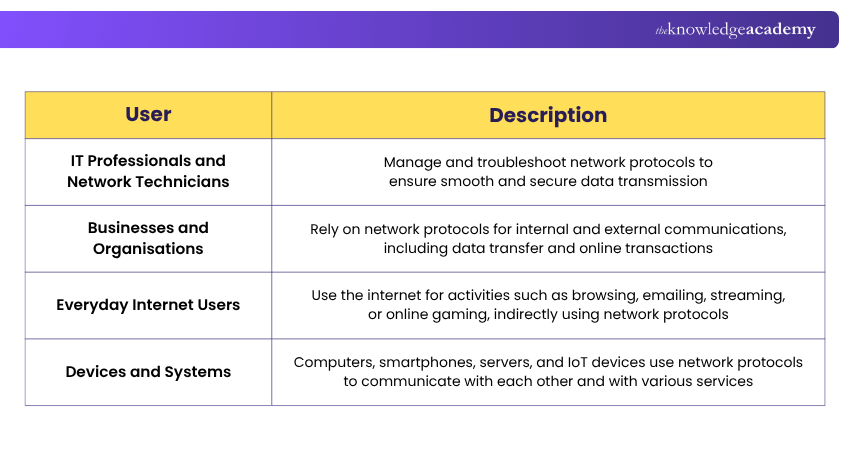
A wide range of individuals and systems use network protocols, including the following:
Types of Network Protocols
Network protocols provide the framework for data exchange across interconnected devices. Understanding the different types of network protocols helps explain how information moves through a network infrastructure.
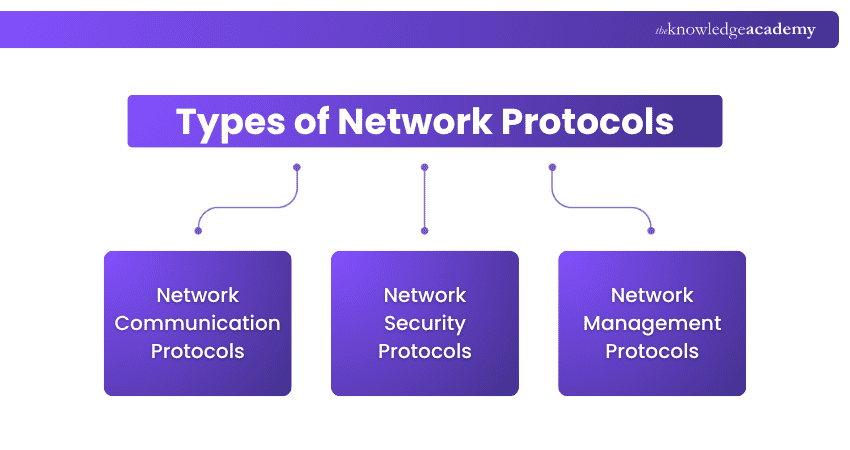
1) Network Communication Protocols
Communication protocols define how data is exchanged between devices across a network. They help establish connections and ensure information reaches the correct destination.
a) Examples of communication protocols include UDP (User Datagram Protocol), TCP/IP (Transmission Control Protocol/Internet Protocol), HTTP (Hypertext Transfer Protocol), and SMTP (Simple Mail Transfer Protocol).
b) These protocols help data travel efficiently and reliably across networks, supporting communication between connected devices.
c) One of the primary functions of communication protocols is addressing.
d) They establish rules for identifying the source and destination of data packets, enabling devices to communicate effectively.
e) Through mechanisms like IP addressing, communication protocols facilitate packet routing across the network and help direct data towards its intended destination.
Build practical knowledge of domain management, hosting services, and website deployment with our Introduction to Domain Names and Web Hosting Training. Register now!
2) Network Security Protocols
Network security protocols are an important part of modern networking infrastructure, helping protect networks and data from a range of cyber threats.
a) As more devices become interconnected and reliance on digital communication grows, strong security measures become increasingly important.
b) These protocols include diverse mechanisms to safeguard sensitive data, prevent unauthorised access, and mitigate security breaches.
c) Encryption protocols, such as TLS and IPsec, play a key role in securing data transmissions.
d) These protocols encode information so that only authorised parties can decipher it, helping protect data confidentiality.
3) Network Management Protocols
Managing a complex network infrastructure requires effective monitoring and control, which is where network management protocols are used. These protocols support device configuration, monitoring, troubleshooting, and performance optimisation.
a) Examples of network management protocols include SNMP (Simple Network Management Protocol), ICMP (Internet Control Message Protocol), and DHCP (Dynamic Host Configuration Protocol).
b) These protocols help administrators manage network resources, monitor performance, and identify or resolve network issues more effectively.
c) Network management protocols serve as the administrative backbone of complex network infrastructures.
d) They facilitate efficient oversight, control, and optimisation of network resources.
e) These protocols enable administrators to perform a wide range of tasks remotely, supporting the smooth operation of networks.

How do Network Protocols Work?
Understanding how network protocols function helps explain communication in modern computer networks. Let’s look more closely at how these protocols operate.
1) Standardisation and Protocols
Network protocols rely on standardised rules and conventions to support consistent communication between devices.
a) These standards are set by organisations like the Internet Engineering Task Force (IETF) and the Institute of Electrical and Electronics Engineers (IEEE).
b) Aligning with these standards helps devices from different manufacturers communicate more consistently.
c) Such standardisation enables compatibility, regardless of hardware or software differences.
2) Packetisation
One of the fundamental concepts of network protocols is packetisation. Before transmission, data may be divided into smaller units as it moves through the networking stack. Depending on the protocol and layer, these units may be called segments, packets or frames. Protocol headers can contain information such as source and destination addresses, sequence numbers and error-detection data.
The benefits of packetisation include the following:
a) It enables efficient transmission over the network
b) It allows data to be sent in smaller chunks instead of a continuous stream
3) Addressing and Routing
Network protocols handle addressing and routing to help packets reach their intended destination. Each device on a network is given a specific identifier, such as an IP address, which allows routers to route packets correctly. Routing protocols include the following:
a) Border Gateway Protocol (BGP)
b) Open Shortest Path First (OSPF)
They determine a suitable path for packet transmission based on factors such as network topology, congestion levels, and quality of service requirements.
Trainer’s Pro Tip
When troubleshooting a network issue, identify the affected protocol and layer first. This can help narrow the problem to areas such as addressing, routing, transmission, or application-level communication.
4) Transmission Control
Transmission control is another important aspect of network protocols. Protocols like TCP (Transmission Control Protocol) support reliable, connection-oriented communication through acknowledgement, retransmission, and flow control mechanisms.
5) Error Detection and Recovery
Protocols can use error-detection mechanisms such as checksums to identify corrupted data. Reliable protocols such as TCP can retransmit data when loss or corruption is detected. For example, protocols like TCP use checksums to detect errors in transmitted data packets. If an error is found, the protocol can request retransmission of the corrupted packet to help ensure the data arrives intact.
6) Protocol Stack
Network protocols are often organised in a hierarchical structure known as a protocol stack. A widely used example in modern networking is the TCP/IP stack, which consists of multiple layers, including the following:
a) Application layer
b) Transport layer
c) Internet layer
d) Link layer
7) Interoperability and Compatibility
Interoperability and compatibility are essential considerations in network protocol design. Protocols need to work with existing infrastructure and remain compatible with different devices to support communication across heterogeneous networks. Standardisation efforts help address these concerns by establishing common protocols and encouraging broader adoption.
8) Evolution and Adaptation
Network protocols continue to evolve to meet changing networking requirements. New protocols are developed for emerging technologies and challenges, while existing protocols are updated to improve performance and address vulnerabilities. This evolution helps protocols remain effective and secure as technology changes.
Network Protocols Examples
Network protocols play an important role in modern communication by supporting data exchange between interconnected devices. Let’s look at some prominent examples of network protocols and explore their roles and applications.
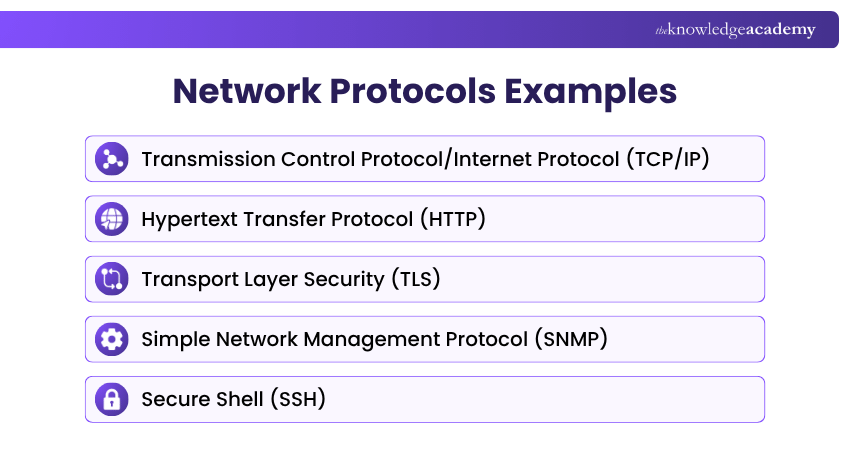
1) Transmission Control Protocol/Internet Protocol (TCP/IP):
TCP/IP is a widely used protocol suite in modern networking for transmitting data across the internet. It comprises two main protocols: TCP and IP. TCP supports reliable data delivery by establishing connections, segmenting application data for transmission, tracking delivery and retransmitting lost data when necessary.
IP is responsible for addressing and routing packets so they can travel from the source device to the correct destination across interconnected networks.
2) Hypertext Transfer Protocol (HTTP):
As the protocol behind the World Wide Web (WWW), HTTP supports the retrieval and display of web pages in browsers. It works on a client-server model, in which a client, including a web browser, sends requests to a server hosting a website, and the server responds with the requested content. HTTP dictates the format of these requests and responses, enabling seamless browsing experiences for users worldwide.
3) Transport Layer Security (TLS):
TLS protocols play a key role in securing communications over the internet. They establish encrypted connections between servers and clients, helping protect sensitive data from eavesdropping and tampering. TLS protocols are commonly used in secure browsing (HTTPS), email encryption (SMTPS, POP3S, IMAPS), and various types of Virtual Private Networks (VPN).
4) Simple Network Management Protocol (SNMP):
SNMP facilitates the remote management and monitoring of network devices. It allows network administrators to collect details about the status and performance of switches, routers, servers, and other network components. SNMP operates on a manager-agent model, where a central management station (manager) communicates with network devices (agents) to retrieve data, configure settings, and detect faults.
5) Secure Shell (SSH):
SSH, or Secure Shell, is a cryptographic network protocol that provides secure remote connections to network devices and servers. It provides a safer alternative to traditional remote login methods, such as Telnet, by encrypting communication sessions between clients and servers. SSH supports authentication methods including passwords, public-key cryptography, and multi-factor authentication, helping protect access to sensitive systems and data.
What are the Four Layers of Network Protocols?
The four layers commonly used to organise network protocols in the TCP/IP model are:
1) Application Layer: Provides network services directly to user applications, such as web browsing, email, and file transfer. Examples include HTTP and FTP.
2) Transport Layer: Manages end-to-end communication between devices and controls how data is delivered. Examples include TCP and UDP.
3) Internet Layer: Handles logical addressing and routes data packets between different networks. Examples include IP and ICMP.
4) Link Layer: Manages communication over the local network and transfers data between devices on the same network. Examples include Ethernet and Wi-Fi.
Strengthen your understanding of core IT concepts and networking fundamentals with our IT Fundamentals Training. Join today!

Richard Harris creates technically detailed yet accessible content on full-stack development, software architecture and modern development frameworks. His knowledge of frontend and backend technologies helps developers understand how scalable, efficient and high-performing applications are designed and built.
View Detail

 If you wish to make any changes to your course, please


