


We may not have the course you’re looking for. If you enquire or give us a call on 01344203999 and speak to our training experts, we may still be able to help with your training requirements.
What is Microsoft Azure Machine Learning: A Complete Guide
ByRichard HarrisLast updated on: 13 October 2026
Explore what Microsoft Azure Machine Learning is, including its workflow, core features, model training, deployment, MLOps capabilities, and real-world use cases.

What You'll Discover
1. Azure Machine Learning supports model training, deployment, and monitoring.2. Studio, Designer, SDKs, CLI, and notebooks support different ML workflows.3. AutoML, managed compute, and registries support scalable model development.4. Online and batch endpoints support real-time and large-scale inference.5. MLOps supports model versioning, monitoring, retraining, and governance.
Microsoft Azure Machine Learning is a cloud service that supports the development, training, deployment, and lifecycle management of machine learning solutions. It supports Data Scientists, Machine Learning Engineers, and development teams working with frameworks such as PyTorch, TensorFlow, and scikit-learn.
The platform provides tools for experimentation, scalable training, model management, deployment, monitoring, and MLOps. This blog explores how Azure Machine Learning works, its workflow, key features, and practical use cases.
What is Azure Machine Learning?
Machine learning uses algorithms and data to identify patterns and build models that can generate predictions or support decisions. Rather than relying only on explicitly programmed rules, ML models learn patterns from training data and apply them to new inputs.
ML-based predictions support applications such as recommendation systems. For example, online retailers can analyse user interactions and use machine learning models to suggest products based on patterns in previous behaviour.
Cloud computing provides scalable infrastructure for developing and running machine learning workloads. Microsoft Azure Machine Learning is a managed cloud platform for developing, training, deploying, and monitoring machine learning models throughout their lifecycle.
Teams can work with Azure Machine Learning through Azure Machine Learning Studio, the Python SDK, Azure CLI, REST APIs, notebooks, and integrated development environments. These options support different development and operational workflows.
Azure Machine Learning also includes Designer, a drag-and-drop interface for creating machine learning pipelines. It supports visual, low-code workflows while allowing teams to incorporate reusable components and custom code where required.

Key Tools and Components of Azure Machine Learning
Azure Machine Learning provides tools and resources for developing, training, managing, deploying, and monitoring machine learning models in a scalable cloud environment. Key tools and capabilities include:
1) Azure Machine Learning Studio and Designer: Azure Machine Learning Studio is the web interface for working with workspaces, jobs, data assets, models, compute resources, endpoints, and other machine learning resources. Within studio, designer provides a drag-and-drop interface for building machine learning pipelines.
Designer supports reusable components for performing specific machine learning tasks and can also incorporate custom components into SDK v2 and CLI v2 workflows. However, classic v1 components and custom v2 components cannot be combined within the same pipeline.
2) Jupyter Notebooks: Azure Machine Learning compute instances provide managed development environments that support Jupyter and JupyterLab. These tools allow Data Scientists to write and run code, explore data, train models, and document experiments within the workspace environment.
3) Azure Machine Learning Extension for Visual Studio Code: The Azure Machine Learning extension for Visual Studio Code, currently in preview, allows developers to manage Azure Machine Learning resources, connect to compute instances, work with models, and support deployment workflows from VS Code.
4) Model Registration: Azure Machine Learning allows trained models to be registered and versioned within a workspace. Registered models can be organised by name and version and later used for deployment or further lifecycle management.
5) Machine Learning Registries: Azure Machine Learning registries provide a central location for sharing and managing reusable assets across workspaces. Registries can store models, components, environments, and data assets, supporting collaboration and model promotion across development, testing, and production environments.
Features and Concepts of Azure Machine Learning
Azure Machine Learning provides features that support model development, scalable training, deployment, automation, and lifecycle management. Key capabilities include AutoML, managed compute, model management, managed endpoints, Python development, and MLOps.
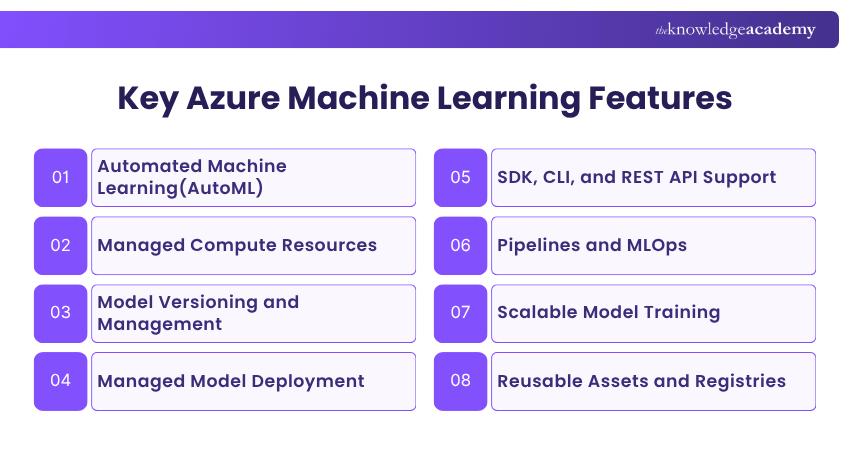
1) Automated Machine Learning (AutoML)
Automated Machine Learning (AutoML) automates iterative tasks involved in model development. Azure Machine Learning can evaluate multiple algorithms and parameter configurations to help identify suitable models for supported tasks such as classification, regression, forecasting, computer vision, and natural language processing.
2) Managed Compute Resources
Azure Machine Learning supports managed compute resources such as compute instances, compute clusters, and serverless compute. It can also integrate with Azure Databricks and use supported Kubernetes compute resources, depending on the workload.
3) Model Versioning and Management
When a model is registered with the same name as an existing model, Azure Machine Learning can store it as a new version. Metadata and tags can also be added during registration to help organise, search, and compare registered models.
4) Managed Model Deployment
Azure Machine Learning supports managed online endpoints for near-real-time inference and batch endpoints for large-scale asynchronous scoring. Managed online endpoints reduce infrastructure management and support monitoring and controlled model rollouts, while batch endpoints use configured compute resources to run asynchronous scoring jobs.
5) SDK, CLI, and REST API Support
Azure Machine Learning provides the Python SDK v2 (azure-ai-ml), CLI v2, and REST APIs for integrating machine learning workflows into development and operational processes. These interfaces can manage jobs, assets, models, endpoints, and other resources programmatically. The SDK works with widely used frameworks such as scikit-learn, TensorFlow, and PyTorch.
6) Pipelines and MLOps
Azure Machine Learning supports reusable pipelines that automate tasks such as data preparation, model training, and evaluation. Its Machine Learning Operations (MLOps) capabilities help teams manage model lifecycles through automated workflows, continuous integration and deployment, monitoring, and retraining. These features improve consistency, reproducibility, and collaboration across machine learning projects.
7) Scalable Model Training
Azure Machine Learning supports scalable training through managed compute clusters and serverless compute. Teams can use scalable computing resources and distributed training techniques to handle larger workloads, adjusting available capacity according to training requirements.
8) Reusable Assets and Registries
Azure Machine Learning registries allow teams to share reusable models, components, environments, and data assets across workspaces. This helps teams reuse approved assets across development, testing, and production workflows without recreating them in each workspace.
Build foundational Azure AI knowledge with the Microsoft Azure AI Fundamentals AI-900 Training today!
Workflow of Azure Machine Learning
An Azure Machine Learning workspace provides a central environment for managing jobs, data assets, models, compute resources, endpoints, and related machine learning resources. A typical Azure Machine Learning workflow can be organised into four stages: preparing data, building and training models, deploying models, and monitoring and managing the ML lifecycle.
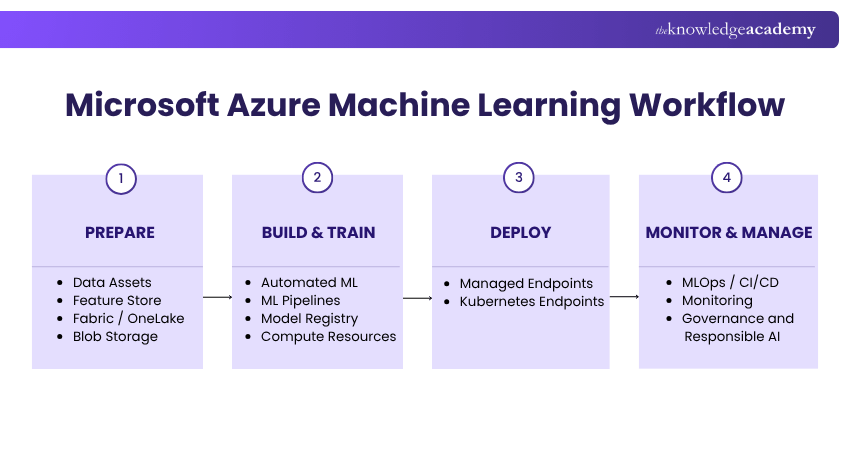
1) Preparing the Data
Preparing data involves identifying, accessing, and organising the information required for model development. Azure Machine Learning uses data assets to reference and manage data used in jobs and pipelines.
Current data asset types include uri_file, uri_folder, and mltable. These assets can reference local files, Azure Machine Learning datastores, Azure Storage, or supported public URLs. Data assets also support versioning and help improve reproducibility and lineage across ML workflows.
2) Build, Train, and Evaluate the Model
Once the required data is prepared and made available to the workflow, the next step is building, training, and evaluating the model.
Model: A machine learning model is produced by training an algorithm on data so that it can learn patterns and generate predictions or other outputs for new inputs. Model development can involve selecting an algorithm, preparing training data, tuning hyperparameters, evaluating performance, and iterating on the results.
Compute resources provide the infrastructure required to develop, train, and run machine learning workloads. Azure Machine Learning supports several compute options depending on development, training, and inference requirements, including:
a) Compute Instance: A managed cloud workstation for development and experimentation.
b) Compute Cluster: An autoscaling managed cluster for training and distributed workloads.
c) Serverless Compute: Managed compute that reduces the need to manage infrastructure directly.
d) Kubernetes and Attached Compute: Existing Kubernetes clusters and supported external compute resources can be attached to an Azure Machine Learning workspace for specific training or inference workloads.
3) Deploy the Model
Once a model is ready for deployment, it can be registered and deployed through Azure Machine Learning endpoints. Managed online endpoints support real-time inference, while batch endpoints support long-running, asynchronous scoring for larger datasets and workloads.
Azure Machine Learning supports container-based model deployment and dependency management through configured environments. Managed online endpoints reduce the need to manage the underlying infrastructure. Teams can also use Azure Machine Learning Kubernetes compute for supported real-time and batch inference workloads.
4) Monitor and Manage
Azure Machine Learning supports model versioning, monitoring, retraining, and redeployment as part of an MLOps workflow. Teams can monitor model and endpoint performance, manage reusable assets, and retrain or redeploy models as data, requirements, or performance conditions change.
Trainer’s Pro Tip
Treat model deployment as part of an ongoing lifecycle rather than the final step. Monitor performance, track changes in data, and retrain or redeploy models when accuracy or business requirements shift.
Real-world Use Cases of Azure Machine Learning
Azure Machine Learning can support a range of use cases by providing scalable compute, model development tools, deployment options, and lifecycle management capabilities. Common applications include financial modelling, predictive maintenance, recommendation systems, and demand forecasting.
1) Financial Modelling
Azure Machine Learning can support financial modelling scenarios by training models on historical and real-time data to identify patterns, generate forecasts, or support analytical decision-making. However, model outputs should be evaluated and governed appropriately before they are used in financial workflows.
2) Predictive Maintenance
Azure Machine Learning can be used to train models that analyse operational or sensor data and identify patterns associated with equipment performance. These models can support maintenance planning by highlighting conditions that require further investigation.
3) Recommendation Engines
Recommendation systems can use interaction data and other relevant features to identify patterns and generate personalised suggestions. Azure Machine Learning can support the training, evaluation, deployment, and monitoring of models used in recommendation workflows.
4) Demand Forecasting
Azure Machine Learning can train forecasting models using historical data and relevant business variables. Organisations can use these models to support planning for areas such as inventory, demand, capacity, and resource allocation.
Develop practical Azure administration skills with the Microsoft Azure Administrator AZ-104 Course – Join now!

Richard Harris creates technically detailed yet accessible content on full-stack development, software architecture and modern development frameworks. His knowledge of frontend and backend technologies helps developers understand how scalable, efficient and high-performing applications are designed and built.
View Detail

 If you wish to make any changes to your course, please


