


 Top Rated Course

We may not have the course you’re looking for. If you enquire or give us a call on +44 1344 203 999 and speak to our training experts, we may still be able to help with your training requirements.
Top Microsoft Azure Benefits
The Knowledge Academy 22 August 2026Microsoft Azure offers businesses scalable infrastructure, improved resilience, flexible cloud resources and access to a wide range of digital services. This blog explores the key benefits of Microsoft Azure and how organisations can use them to support their technology and business needs.

Training Outcomes Within Your Budget!
We ensure quality, budget-alignment, and timely delivery by our expert instructors.
Table of Contents
Related Courses
- Retired : Designing and Implementing Enterprise-Scale Analytics Solutions Using Microsoft Azure and Microsoft Power BI DP500
- Microsoft Azure Administrator AZ104
- Retired: Data Engineering On Microsoft Azure DP-203 Certification
- Microsoft Azure Security Technologies AZ500
- Designing And Implementing Microsoft DevOps Solutions AZ400

Businesses need technology that can adapt as their applications, data, and customer demands change. Relying only on fixed physical infrastructure can make this difficult, especially when workloads grow or new requirements appear.
Microsoft Azure provides cloud-based services for computing, storage, networking, data, security, AI, and more. Organisations can choose the services they need and use them according to their workload and business requirements.
But what makes Azure valuable to businesses?
In this blog, we’ll explore the key Microsoft Azure benefits, the features behind them, and real-world examples of how organisations use Azure.
Key Takeaways
1. Microsoft Azure provides scalable cloud resources that can adapt to changing workload requirements.2. Azure can reduce dependence on physical infrastructure and support more flexible IT environments.3. Security, backup, availability and recovery capabilities can help organisations build more resilient cloud solutions.4. Azure supports faster development, data analytics, hybrid environments and global application deployment.5. The value of Azure depends on selecting services that match an organisation's workload, security and business requirements.
What is Microsoft Azure?
Microsoft Azure is Microsoft's Cloud Computing platform for building, deploying and managing applications and IT resources. It provides cloud-based capabilities across computing, storage, networking, databases, analytics, AI, security, and other technology areas.
Organisations can use Azure entirely in the cloud or combine its capabilities with existing on-premises infrastructure. Its broad range of services allows businesses to select resources according to their workloads rather than relying solely on traditional physical infrastructure.

How Does Microsoft Azure Work?
Microsoft Azure delivers computing resources and services through Microsoft's global cloud infrastructure. Users select the services required for a workload, configure the necessary resources, and connect them to applications, data, and other systems.
For example, an application could use Azure compute resources to run, cloud storage to hold files, a database to manage information and networking services to communicate securely. Azure management, monitoring, and security capabilities help control these resources.
Think of Azure as a Digital Toolbox
You need:
Processing → ComputeSpace for data → StorageConnections → NetworkingProtection → SecurityIntelligence → AI & AnalyticsControl → Management
What are the Key Features of Microsoft Azure?
Microsoft Azure provides a broad range of cloud capabilities that support its business and technical benefits. These include:
1) Compute and Scalability: Azure Virtual Machines, App Service and other compute options help organisations run and scale different types of workloads.
2) Storage and Data Services: Azure provides cloud storage, databases and data-processing services for different application and information requirements.
3) Security and Identity: Azure includes capabilities for identity management, encryption, network protection, secrets management and security monitoring.
4) Networking and Hybrid Cloud: Virtual networking and hybrid capabilities help organisations connect cloud resources with existing environments.
5) Management and Automation: Azure provides tools for monitoring, managing and automating cloud resources and operational tasks.
6) Data, AI and IoT: Azure includes analytics, AI, Machine Learning and IoT capabilities that support data-driven and intelligent applications.
Benefits of Microsoft Azure
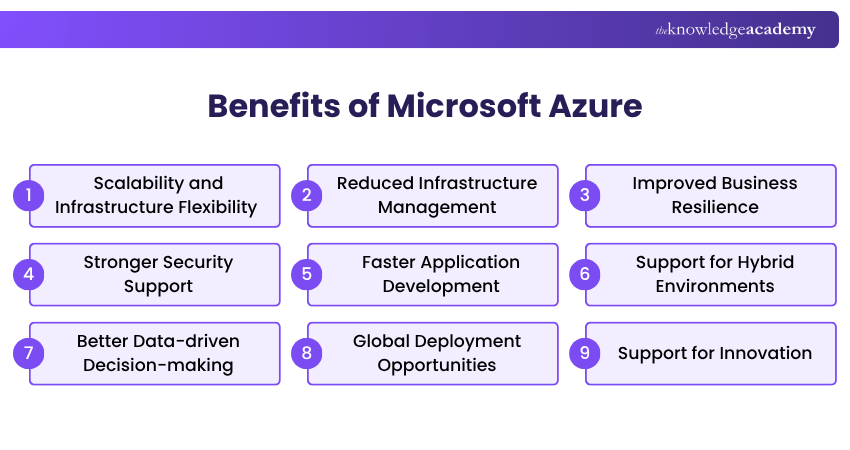
Microsoft Azure can support organisations in different ways depending on how its services are used and the workloads they need to manage. The following are some of the key benefits organisations can gain from using Microsoft Azure:
1) Scalability and Infrastructure Flexibility
Azure allows organisations to adjust cloud resources according to changing workload requirements. Applications can use different combinations of compute, storage, databases and networking services instead of relying on infrastructure purchased for a fixed level of capacity.
This flexibility helps businesses respond to seasonal peaks, growth and changing application requirements while selecting infrastructure that suits individual workloads.
Business value: Cloud resources can adapt more easily to changing technical and business demands.
2) Reduced Infrastructure Management
Using Azure can reduce some of the work involved in purchasing, maintaining, and operating physical infrastructure. Managed Azure services can also shift selected platform and infrastructure responsibilities to Microsoft, depending on the service model being used.
Automation, centralised management, and monitoring can further reduce repetitive administrative work. However, organisations remain responsible for areas such as their data, identities, configurations, and other controls according to the shared responsibility model.
Business value: IT teams can reduce selected infrastructure-management tasks and focus more attention on applications and business services.
3) Improved Business Resilience
Service disruption can affect applications, employees, and customers. Azure backup, recovery, redundancy, and availability capabilities can form part of an organisation's wider resilience strategy.
For example, the current blog discusses Azure Site Recovery as a way of supporting disaster recovery for workloads. Appropriate recovery strategies can help organisations restore critical services when infrastructure problems occur.
Business value: Reduced operational impact when systems or infrastructure fail.
4) Stronger Security Support
Cloud adoption introduces security requirements that extend across data, identities, applications and networks. Azure provides security capabilities that can be integrated across these areas.
Encryption, identity controls, network security and monitoring can work together to help organisations implement layered protection. However, organisations remain responsible for correctly configuring and managing the controls relevant to their workloads.
Business value: Multiple security capabilities can be managed as part of the wider cloud environment.
5) Faster Application Development
Development teams often need infrastructure before they can build, test, or deploy applications. Cloud services can provide access to computing, databases, development tools, and managed services without requiring every supporting component to be built internally.
Azure development and DevOps capabilities can also support automation across parts of the software lifecycle. The existing article highlights automated builds, deployments and application monitoring within its DevOps use case.
Business value: Teams can move from development to deployment more efficiently.
6) Support for Hybrid Environments
Complete cloud migration is not always the right first step. Organisations may need to retain certain applications, data or infrastructure on premises while moving other workloads to the cloud.
Azure hybrid capabilities provide a way to connect these environments. This can support gradual modernisation and give organisations more control over how and when individual workloads are moved.
Business value: Cloud adoption can happen progressively rather than through a single large migration.
7) Better Data-driven Decision-making
Information stored across an organisation has limited value if it cannot be effectively processed and analysed. Azure's data and analytics capabilities can help organisations integrate information, process large datasets and build analytics solutions.
When these capabilities are combined with cloud storage and computing resources, businesses can create data workflows that support reporting, analysis and operational decision-making.
Business value: Data can be converted into more useful insights for business decisions.
8) Global Deployment Opportunities
Azure operates cloud infrastructure across regions in many geographic locations. Organisations can deploy supported services in suitable Azure regions based on factors such as user location, service availability, latency, data residency and resilience requirements.
However, service and availability-zone support varies by region, so organisations should confirm regional capabilities when planning workloads.
Business value: Organisations gain more options for supporting applications and users across different geographic markets.
9) Support for Innovation
New technology initiatives often require experimentation before organisations know whether they will deliver value. Azure gives teams access to cloud, data, AI, IoT and development capabilities within a broader technology ecosystem.
Teams can therefore explore new applications and technology approaches without every experiment requiring a completely separate infrastructure environment.
Business value: Organisations gain a flexible foundation for testing and developing new digital solutions.
Microsoft Azure Benefits in the Real World
The benefits of Azure can be seen across different industries and workloads. Here are a few examples:
1) Scalability: Egyptian retailer B.TECH used Microsoft Azure to improve scalability during high-demand periods. Microsoft reports that the organisation achieved 99.9% service availability and reduced time-to-market by 30%.
2) Data and Analytics: Marks & Spencer built an Azure-based data platform using services including Azure Data Lake Storage, Azure Databricks and Azure Synapse Analytics to improve scalability and provide teams with better access to data and insights.
3) Resilience: AXIS Capital migrated its physical data centres to Azure, strengthening disaster recovery and operational resilience while avoiding future infrastructure capital expenditure.
4) Industrial IoT: P&G uses Azure IoT Operations and Azure Arc to support real-time manufacturing data and predictive models. Microsoft reports reductions of up to 90% in the time required to deploy new model versions.
5) DevOps: MetLife adopted Azure DevOps to strengthen its development security operations processes, reducing automated testing and build times while supporting earlier error detection
Conclusion
Microsoft Azure offers benefits ranging from scalable infrastructure and improved resilience to hybrid cloud support, data analytics and faster application development. However, the value organisations gain from Azure depends on selecting and configuring services according to their workloads, security requirements and business goals. By matching Azure capabilities to clear organisational needs, businesses can build more flexible and resilient cloud environments.
Improve security measures with our Microsoft Azure Fundamentals AZ-900 Course – Join now!
Frequently Asked Questions
Is Microsoft Azure Beneficial for Small Businesses?

Yes. Small businesses can use Azure without owning and maintaining large amounts of physical infrastructure. They can select cloud services according to their requirements and scale resources as their applications, data, or customer demand changes.
What Should a Business Consider Before Adopting Microsoft Azure?
Businesses should consider their workload requirements, security needs, existing infrastructure, budget, compliance obligations, technical skills, and cloud strategy. Azure provides many services, so the greatest value comes from choosing capabilities that match a clear business or technology need.
How Can Businesses Measure the Value of Microsoft Azure?
Businesses can assess Azure's value by comparing cloud adoption against relevant outcomes such as application performance, infrastructure efficiency, service availability, development speed, operational effort, and the ability to support changing workload demands.

The Knowledge Academy


Global Training Provider
The Knowledge Academy is a world-leading provider of professional training courses, offering globally recognised qualifications across a wide range of subjects. With expert trainers, up-to-date course material, and flexible learning options, we aim to empower professionals and organisations to achieve their goals through continuous learning.


 If you wish to make any changes to your course, please


