




We may not have the course you’re looking for. If you enquire or give us a call on 01344203999 and speak to our training experts, we may still be able to help with your training requirements.
Introduction to Method Overloading in Java
ByThe Knowledge AcademyLast updated on: 05 October 2026
This blog explains method overloading in Java, a feature that can improve program readability, and demonstrates how to implement it with code examples.
Overview
1. Method overloading is resolved during compile time.2. Methods can be overloaded by changing their parameter lists.3. Parameter number, type, or order can distinguish overloaded methods.4. Return type alone cannot be used to overload a method.5. Method overloading and method overriding are different Java concepts.
Method overloading in Java is an important feature that simplifies the work of Java users. Java offers several useful features, including method overloading, along with extensive libraries that support a wide range of programming tasks.
Java is widely used across different platforms and applications. Improving your knowledge of Java features and programming concepts can therefore strengthen your understanding of the language. Method overloading in Java occurs when multiple methods share the same name but have different parameter lists. Let’s dive in to learn more.
What is Method Overloading in Java?
Java supports multiple methods with the same name in a class, provided they have different parameter lists. The methods can differ in the number, types, or order of their parameters. This feature is known as Java method overloading.
The primary significance of this feature is that it can improve program readability by allowing related operations to use the same method name. Java chooses an applicable overloaded method at compile time, which is why method overloading is often described as compile-time polymorphism.
Let’s delve into the method overloading feature with an example. In this case, we define two methods with the same name – add – but with different parameters. Utilising the same method name for related operations can make the program easier to read and understand. The Java code used in this example would be as follows:
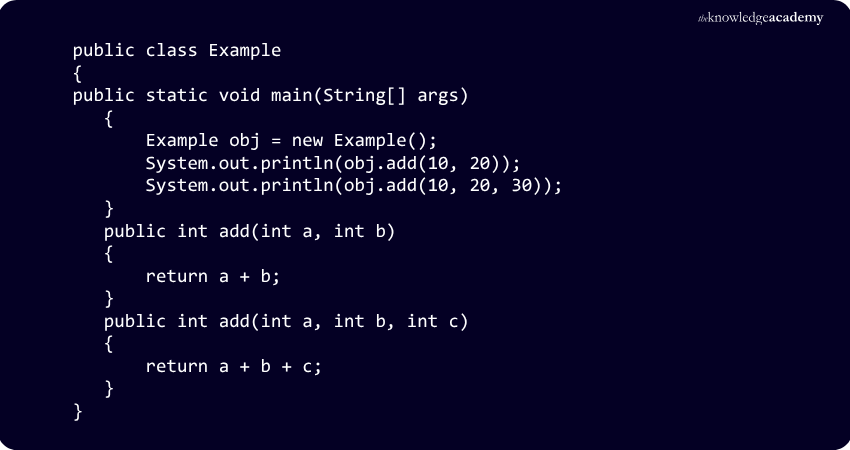
The first method, add(int a, int b), takes two int parameters and returns their sum, while the second method, add(int a, int b, int c), takes three int parameters and returns their sum.


Benefits of Method Overloading in Java
The definition of method overloading is highly similar to that of constructor overloading in Java, but they're not the same. The former is a popular feature in Java, with multiple advantages. The following are some benefits of using method overloading:
a) Method overloading significantly improves the readability of programs.
b) The feature allows related operations to be performed using the same method name.
c) Method overloading can make related operations easier to organise and understand when the same operation accepts different numbers or types of arguments.
d) Method overloading can simplify method calls by providing a consistent name for related operations.
e) Method overloading allows related operations to use the same method name, which can make code easier to organise and maintain.
f) Java also supports constructor overloading, which allows multiple constructors with different parameter lists to initialise objects in different ways.
g) Using method overloading, you can access the methods that perform related functions that use the same name, with a minor difference in the argument number or type.
Did You Know?
Java cannot distinguish overloaded methods based only on their return types. The parameter lists must be different for valid method overloading. This distinction helps the compiler determine which method should be called based on the supplied arguments.
How do You Initiate Method Overloading in Java?
Method overloading can be implemented by changing the number, types, or order of parameters. The best way to understand concepts in Java is via examples. Here is a detailed look at the different ways to initiate method overloading in Java with examples:
1) Change in the Number of Parameters
One of the ways to accomplish method overloading is by changing the number of parameters. Methods with the same name can accept different numbers of parameters. Here is an example of changing the number of parameters while using method overloading in Java:
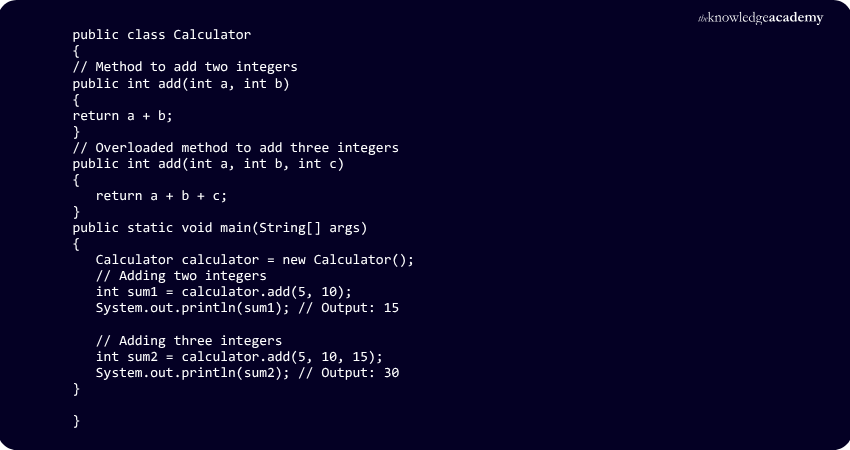
Here, a 'Calculator' class with two methods named 'add' is used. The first method takes two 'int' parameters and returns their sum as an 'int'. The second method is an overloaded version of the first but takes three 'int' parameters instead of two.
The appropriate add method is selected based on the number of arguments passed in the method call.
This concept is like constructor overloading in Java, where multiple constructors can exist within a class, each with different parameter types or counts, allowing flexible object creation.

Learn how to make an enterprise application for an organisation with the Introduction to Java EE Training – Register now!
2) Change in the Data Types of Parameters
Method overloading can also be accomplished by defining methods with the same name but different parameter types. Here is an example of method overloading in Java where multiple methods have different parameter types:
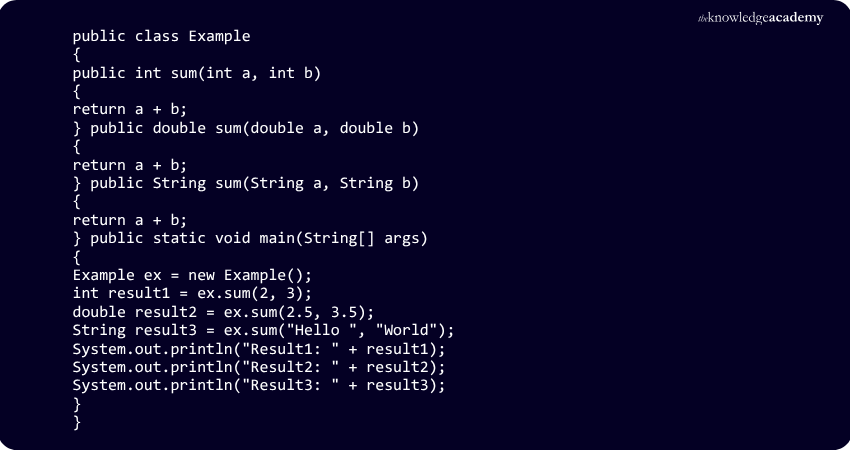
The first method takes two integers as input and returns an integer. The second method takes two doubles as input and returns a double, while the third method takes two strings as input and returns a string. Then an object of the Example class is created in the main method.
The sum method is called with different types of arguments, and the returned values are assigned to variables of the corresponding types. Finally, the results are printed using System.out.println statements.
The sum method is called with different arguments, and the variables with varying data types are assigned the results. Finally, the results are printed using 'System.out. println' statements.

From the output we understand the following:
a) The first call to the sum method with 2 and 3 as arguments returns 5.
b) The second call to the sum method with 2.5 and 3.5 as arguments return 6.0.
c) The third call to the sum method with "Hello " and "World" as arguments concatenates the two strings and returns "Hello World."
d) The System.out.println statements then print out the values of the result1, result2, and result3 variables, respectively.
Trainer’s Pro Tip
When creating overloaded methods, choose parameter combinations that make each method call clear to the compiler and the developer. Avoid creating too many similar overloads, as this can make the code difficult to understand, leading to ambiguous method calls.
3) Change in the Order of Parameter Types
Method overloading can also be achieved by changing the order of parameter types while keeping the method name and number of parameters the same. This works when the parameters have different data types, allowing the compiler to distinguish between the overloaded methods based on the order of the arguments.
For example:
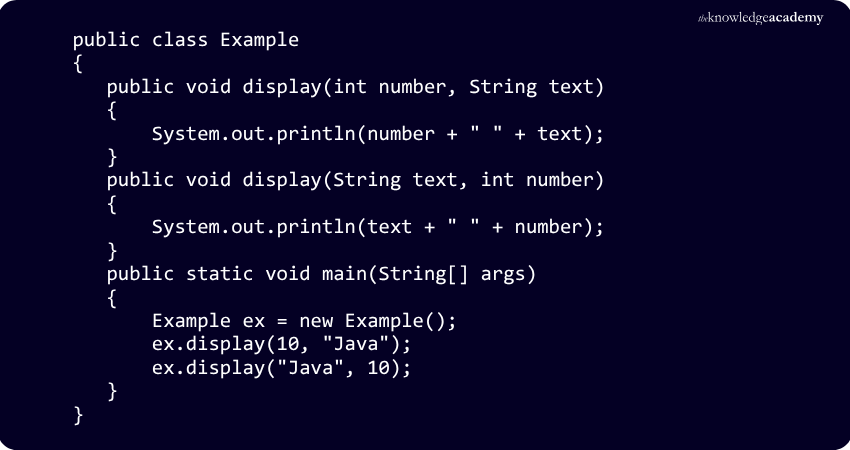
In this example, both methods are named display and accept two parameters. However, the first method accepts an int followed by a String, while the second accepts a String followed by an int. Since the order of the parameter types is different, Java treats them as overloaded methods.
When display(10, "Java") is called, Java selects the first method. When display("Java", 10) is called, it selects the second method.

Method Overloading vs Method Overriding
Static methods can be overloaded in Java. However, static methods are not overridden in the same way as instance methods. When a subclass defines a static method with the same signature as a static method in its superclass, the subclass method hides the superclass method.
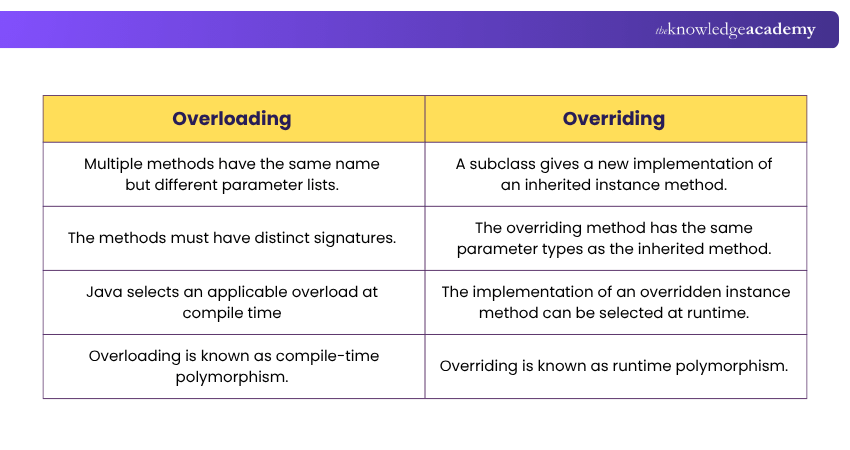
Overloading and overriding differ in several aspects. While overloaded methods have different parameter lists, overriding involves a subclass providing a new implementation of an inherited instance method with an override-compatible signature. Overloading involves multiple accessible methods with the same name but different signatures, while overriding occurs through inheritance.
Instance method overriding uses dynamic method dispatch and is commonly associated with runtime polymorphism. In contrast, method overloading is resolved at compile time based on the applicable method signatures and arguments.
Method Overloading ChecklistBefore creating overloaded methods, check whether:1. The methods perform related operations.2. The methods share the same name.3. Their parameter lists are different.4. The difference is based on parameter number, type or order.5. The overloads remain easy to understand.6. The method call clearly indicates the intended operation.
Build strong enterprise applications and enhance your career prospects with the Java Courses – Join today!

The Knowledge Academy develops accessible learning content across Project Management, IT, Cybersecurity, Data Science, Business Analysis, HR, Accounting and Finance, Leadership and Health and Safety. Its resources combine subject research with clear explanations to help professionals build practical knowledge across a wide range of disciplines.
View Detail

 If you wish to make any changes to your course, please


