




We may not have the course you’re looking for. If you enquire or give us a call on 01344203999 and speak to our training experts, we may still be able to help with your training requirements.
Little’s Law: Definition, Formula, Benefits, and Examples
ByWilliam BrownLast updated on: 16 July 2026
Little’s Law states that the average number of items in a system equals the arrival rate multiplied by the average time an item spends in the system. It is a simple yet powerful law that explains how work flows through a system by explaining the items in progress, the time taken to complete them, and the rate at which work is finished.

Ever feel like work keeps piling up, but nothing seems to finish faster? Tasks wait in queues, deadlines slip, and teams struggle. This is where Little’s Law becomes surprisingly relatable. It helps by explaining why overloaded systems slow down and how the flow of work impacts delivery time in everyday projects and operational scenarios.
In this blog, you will learn about Little’s Law, its formula, importance, benefits, and more. By understanding how work in progress, completion time, and throughput are connected, you will see how this law helps teams plan better, reduce delays, and improve efficiency.
Table of Contents
1) What is Little’s Law?
2) The Formula Behind Little’s Law
3) What is the Importance of Little’s Law in Flow Management?
4) Applying Little’s Law in Kanban Systems
5) Little’s Law in Project Management
6) Key Benefits of Using Little’s Law
7) Example of Little’s Law
8) Conclusion
What is Little’s Law?
Little’s Law explains how work moves through a system. It applies to everyday situations, such as hospitals, shops, and transport, as well as workplaces where tasks, paperwork, or products are processed. In simple terms, it helps you understand why more work in progress leads to longer completion times.
Little’s Law was developed by John Little. It was formally proven in 1961, showing that the relationship between items in a system, completion time, and throughput remains across queuing scenarios. This makes it a key principle of operations research and process improvement.

The Formula Behind Little’s Law
Little’s Law explains the workflow using a simple mathematical relationship. It states that the average number of items in a system equals the rate at which items pass through the system multiplied by the time each item spends in it. The formula is provided below:

In this formula:
1) L is the average number of items in the system, often known as work-in-progress (WIP).
2) λ (lambda) is the average arrival or completion rate, also known as throughput.
3) W represents the average time an item spends in the system, referred to as lead time.
What is the Importance of Little’s Law in Flow Management?
In Flow Management, Little’s Law is a valuable tool for analysing and improving flow in any system where work queues up. Showing a clear relationship between work-in-progress, throughput, and lead time helps teams to identify bottlenecks and understand how changes in one area affect the process.
Its real power lies in creating predictability instead of precise forecasting. Since Little’s Law is based on averages, it helps managers design systems that behave as expected over time. This predictability makes it easier to plan capacity, manage workload, and set realistic Service Level Expectations (SLEs).
Lead complex improvement projects and deliver scalable results with Six Sigma Black Belt Course now!
Applying Little’s Law in Kanban Systems
Many principles of Kanban and Lean are driven by Little’s Law, especially the practice of limiting work-in-progress. Controlling work-in-progress creates a seamless and predictable flow in Kanban systems, enabling teams to better understand throughput and manage lead times. In Kanban, the law is expressed using the formulas provided below:
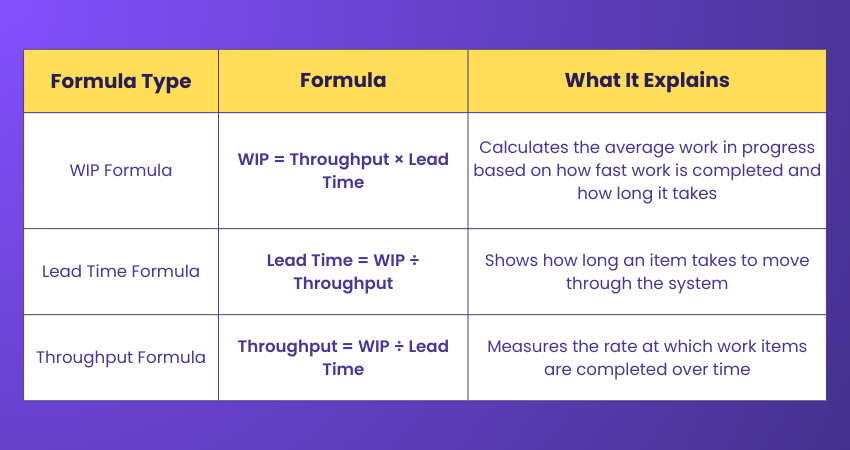
Little’s Law in Project Management
Little’s Law is widely used in Project Management to understand and control the flow of work across teams and processes. Project environments often use the departure rate, assuming work enters and leaves the system at the same average pace. In this situation, the law is expressed as:
WIP = Throughput × Cycle Time
Here, work-in-progress is the number of active work times, throughput is the number of completed items, and cycle time is how long work takes to be processed. Limiting work-in-progress helps improve predictability and communicate delivery commitments with confidence.
Learn the fundamentals of process improvement and data-driven thinking with Six Sigma Yellow Belt Course – Join now!
Key Benefits of Using Little’s Law
Little’s Law offers several advantages. Let’s look at some of the key benefits below:
1) Simplicity and Universality: Little’s Law is easy to understand and apply. It works across many fields, such as manufacturing, healthcare, retail, IT systems, and Project Management.
2) Performance Measurement and Improvement: Linking work-in-progress, throughput, and time helps to identify bottlenecks and inefficiencies. This enables teams to improve flow and performance.
3) Process Predictability: Little’s Law supports stable and predictable workflows by clarifying how work enters and exits a system. It enables better forecasting and delivery planning.
Example of Little’s Law
Consider a simple business scenario. Imagine your own ice cream shop during summer, and you want to know how many customers are typically inside your store at any given time, so you can plan staff and space properly.
Suppose, on average, 20 customers arrive per hour, and each customer spends about 15 minutes (0.25 hours) choosing, paying, and leaving. Using Little’s Law:
L = λ × W (λ referring to people arriving at the store per hour and W refers to hours in one cycle time). This leads to:
L = 20 × 0.25 = 5
This means, on average, five customers are in the shop at any time. With this you can make informed decisions about staffing levels, counter space, and whether you need to expand to meet customer demands.
Conclusion
Little’s Law impact on how we understand and manage work is powerful. Clearly showing the connection between work-in-progress, throughput, and time helps teams steer towards smarter, data-driven decisions. It encourages a focus on flow rather than pressure, making processes easier to control and improve.
Strengthen problem-solving skills, drive quality improvements, and improve process efficiency with Six Sigma Certification now!

William Brown is a senior business analyst with over 15 years of experience driving process improvement and strategic transformation in complex business environments. He specialises in analysing operations, gathering requirements and delivering insights that support effective decision making. William’s practical approach helps bridge the gap between business goals and technical solutions.
View Detail

 If you wish to make any changes to your course, please


