


We may not have the course you’re looking for. If you enquire or give us a call on 01344203999 and speak to our training experts, we may still be able to help with your training requirements.
Home
 Resources
IT Service Management
ITOM vs ITSM: Key Differences, Examples, and How They Work Together
Resources
IT Service Management
ITOM vs ITSM: Key Differences, Examples, and How They Work Together
ITOM vs ITSM: Key Differences, Examples, and How They Work Together
BySienna RobertsLast updated on: 21 October 2026
IT Operations Management (ITOM) and IT Service Management (ITSM) help organisations maintain reliable technology and deliver effective IT services. This blog explores ITOM vs ITSM, including their key differences, functions, processes, practical examples and how they work together to support business operations.
At a Glance
1. Primary Focus: ITOM manages the operational health of IT infrastructure, while ITSM focuses on delivering and improving IT services.2. Key Activities: ITOM includes monitoring, performance management and automation, while ITSM includes incident, problem and service request management.3. Shared Responsibilities: Both contribute to service reliability, risk management and efficient IT operations.4. Connected Workflows: ITOM provides technical information and operational responses that support ITSM activities.5. Organisational Needs: ITOM and ITSM provide complementary capabilities that organisations can prioritise according to their operational and service requirements.
Everything Looks Green on the Dashboard. So Why Are Users Still Complaining?
Servers? Running. Networks? Stable. Applications? Available.
On paper, everything looks perfect. Yet support tickets keep piling up, employees face delays, and service complaints remain unresolved.
So, what's missing?
The answer may lie in the gap between keeping technology operational and ensuring it delivers the expected service experience. This is where the ITOM vs ITSM comparison becomes important.
ITOM focuses on keeping operational systems reliable, while ITSM takes a broader view of how technology supports services and users. Understanding their differences reveals why technical performance alone does not always tell the full story.
What is ITOM?
IT Operations Management (ITOM) refers to the processes, practices and technologies used to manage and maintain an organisation's IT infrastructure and operational environment. It focuses on ensuring that servers, networks, applications, databases, cloud resources and other IT components remain available, performant and reliable to support business operations.

Key Concepts of ITOM
ITOM involves several operational concepts that help organisations maintain reliable technology environments.
1) Infrastructure Visibility: Understanding the IT components, applications and dependencies within an organisation helps teams identify potential operational risks.
2) Operational Visibility: Assessing resource utilisation, response times and system health helps teams understand how effectively their IT environment is functioning.
3) Automation and Orchestration: Automating suitable routine tasks can reduce manual effort, while orchestration coordinates related activities across systems.
4) Resource Optimisation: Reviewing computing, storage and network resources helps organisations manage capacity, performance and expenditure.
5) Operational Reliability: Planning for failures, recovery and maintenance helps reduce the impact of disruptions.
Together, these concepts support the management of complex IT environments.
Core ITOM Processes
ITOM involves several processes and operational activities that help organisations maintain stable and reliable IT environments. These include:
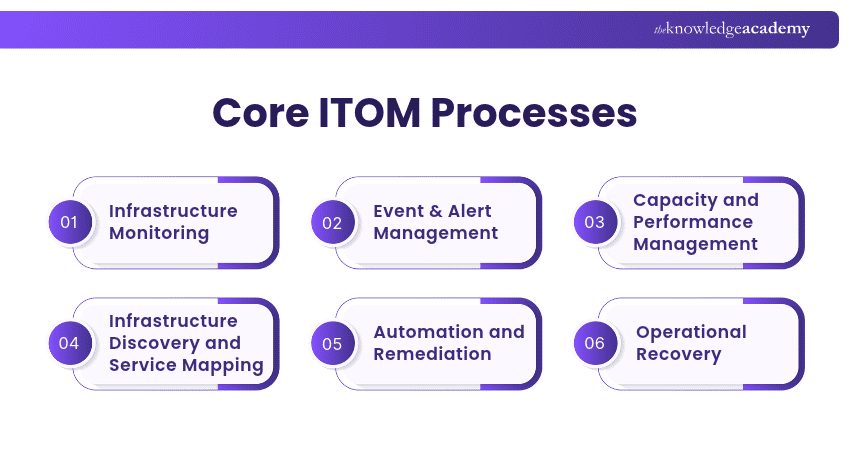
1) Infrastructure Monitoring: Tracks the health, availability and performance of servers, networks, applications and other IT resources to identify potential issues.
2) Event & Alert Management: Detects, analyses and responds to relevant operational events, helping teams identify conditions that require attention.
3) Capacity and Performance Management: Evaluates resource usage, system performance and future capacity requirements to support efficient IT operations.
4) Infrastructure Discovery and Service Mapping: Identifies infrastructure components and maps their relationships to help teams understand dependencies, investigate technical issues and assess service impact.
5) Automation and Remediation: Automates suitable operational tasks and remediation workflows to reduce manual intervention and support faster recovery.
6) Operational Recovery: Supports the restoration of affected infrastructure and applications following technical failures or disruptions.
Example of ITOM
Imagine an online retailer preparing for a major promotional event. The company expects increased website traffic and wants to maintain reliable application performance. Its ITOM monitoring tools track server utilisation, application response times and available capacity.
As traffic increases, the monitoring system identifies higher resource usage. If suitable auto-scaling policies are configured, the cloud platform may automatically allocate additional computing resources. Operations teams can then review alerts and performance data to determine whether further intervention is required.
Pro Tip: Monitor What Matters
Focus on key metrics such as service availability, response times, error rates and resource usage rather than tracking everything. Setting appropriate alert thresholds also helps teams detect important issues and reduce unnecessary notifications.
What is ITSM?
IT Service Management (ITSM) is a structured approach to designing, delivering, managing and continually improving IT services to meet organisational objectives and user needs. It focuses on how people, processes, technology and external providers work together to deliver services, covering activities such as incident management, service request management and change enablement.
Key Concepts of ITSM
The following concepts help explain how ITSM supports effective service delivery.
1) Service-oriented Approach: ITSM considers technology in terms of the services and outcomes it supports.
2) Value Creation: Services should contribute to outcomes that matter to users, customers and the organisation.
3) Defined Responsibilities: Clear roles, workflows and accountability support consistent management of service activities.
4) Service Relationships: Communication and collaboration between service providers, consumers and stakeholders support effective delivery.
5) Service Quality and Experience: Understanding service expectations and user experiences helps organisations assess service effectiveness and identify areas requiring improvement.
Frameworks such as ITIL provide guidance for applying service management principles and practices. ISO/IEC 20000-1 also specifies requirements for a service management system.
Core ITSM Practices
ITSM uses several management practices to coordinate service delivery, manage disruptions and support continual improvement. Common examples include:
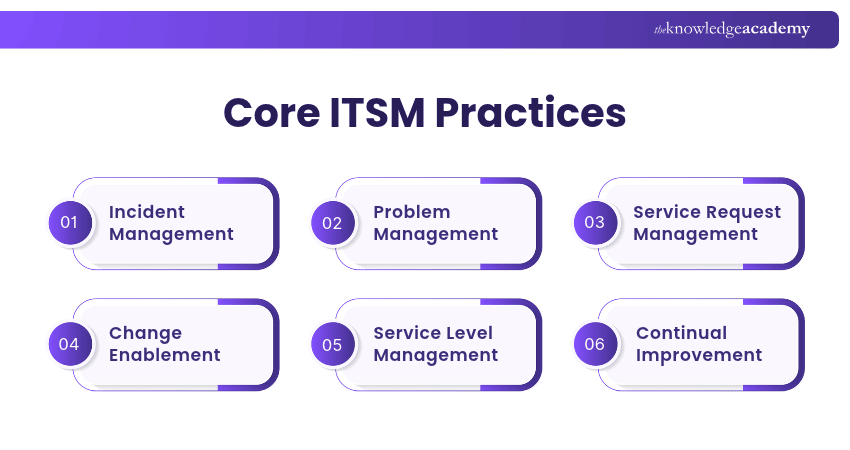
1) Incident Management: Minimises the negative impact of incidents by restoring normal service operations as early as possible.
2) Problem Management: Identifies actual and potential causes of incidents and manages workarounds and known errors to reduce incident likelihood and impact.
3) Service Request Management: Handles predefined, user-initiated service requests, such as access requests, information requests for standard equipment or software.
4) Change Enablement: Assesses change risks, manages authorisation and coordinates change schedules to maximise successful changes.
5) Service Level Management: Defines, monitors and manages agreed service targets to maintain a shared understanding of service expectations.
6) Continual Improvement: Identifies and implements improvements to IT services, practices and processes to better meet organisational needs.
Example of ITSM
Consider an employee who unexpectedly loses access to an essential business application. The employee contacts the service desk, where the issue is recorded as an incident. The support team assesses its impact, checks available information, and assigns the work to an appropriate specialist.
Technical personnel investigate and resolve the access problem, while the incident management workflow tracks progress and supports communication with the employee. Once access is restored, the incident record is updated. If similar failures occur repeatedly, problem management may investigate their underlying causes.
Learn to use metrics and success factors to evaluate service effectiveness with the ITIL® 5 Service Certification Training – Sign up now!
Key Differences Between ITOM and ITSM
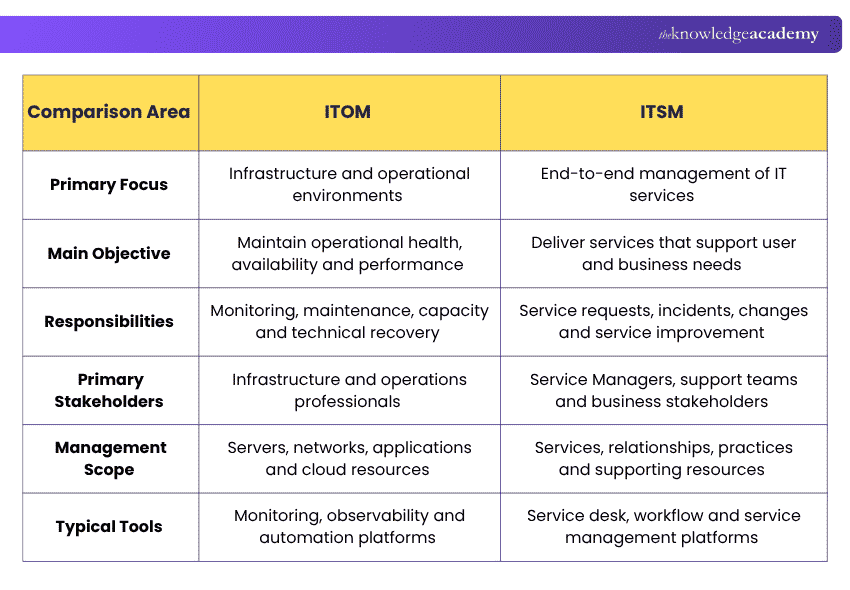
Although ITOM and ITSM share several responsibilities, they differ in their primary focus and management scope. The following table highlights their main differences.
1) Focus and Objectives
The primary difference between ITOM and ITSM lies in what each discipline aims to manage.
ITOM: Focuses on the operational performance of systems and infrastructure. Its objectives include maintaining availability, managing capacity and supporting reliable technical operations.
ITSM: Focuses on the management of IT services. Its objectives include meeting agreed service expectations, coordinating support and improving outcomes for users and the organisation.
For example, ITOM may monitor the availability of a database server, while ITSM considers how database-related disruptions affect the business service that depends on it.
2) Stakeholders and Responsibilities
ITOM Stakeholders: Infrastructure Engineers, Network Administrators, System Administrators, cloud operations teams and Site Reliability Engineers may participate in operational activities.
ITSM Stakeholders: Service Managers, Service Owners, Service Desk Professionals, Technical Specialists, business representatives and service consumers participate in service management activities.
Operational teams monitor and maintain technical resources, while service management roles coordinate service expectations, support and improvement. Responsibilities may overlap depending on the organisation.
3) Processes and Practices
ITOM commonly involves infrastructure monitoring, event management, automation and capacity planning, while ITSM covers broader practices such as incident management, service requests, change enablement and service level management. These activities can overlap, particularly where monitoring and operational responses support service management workflows.
Remember: Define Clear Responsibilities
Shared activities work best when teams understand who investigates technical issues, coordinates incidents and communicates service updates. Clear responsibilities help prevent delays during disruptions.
4) Service and Infrastructure Management
ITOM concentrates on the technical environment that enables services to function, including the operational management of computing resources, networks, applications and supporting infrastructure. ITSM considers the complete service relationship, including service requirements, support arrangements, agreed outcomes and improvement activities.
For example, in an employee email service, ITOM activities monitor servers, connectivity, storage and application performance. Meanwhile, ITSM activities manage email access requests, coordinate incident responses, monitor service targets and identify improvement opportunities. Both areas contribute to effective service delivery because functioning infrastructure alone does not guarantee that a service meets user requirements.
5) Tools and Technologies
ITOM and ITSM often use different categories of tools, although integrated platforms may support both.
Common ITOM Tools:
1) Infrastructure and network monitoring tools
2) Application performance monitoring platforms
3) Log management and observability solutions
4) Configuration discovery and service mapping tools
5) Operational automation and orchestration platforms
Common ITSM Tools:
1) Service desk and ticketing systems
2) Incident and request management platforms
3) Service catalogue solutions
4) Change enablement workflows
5) Service level reporting tools
Organisations should select tools based on their operational requirements, integration capabilities, available resources and existing technology environments.
Build practical knowledge of AI-enabled product management practices with the ITIL® 5 Product Certification Training – Join now!
How do ITOM and ITSM Work Together?
ITOM and ITSM complement each other by connecting operational information with coordinated service management activities. Consider an organisation experiencing a failure in its online payment service.
Worked Example: From System Alert to Service Restoration
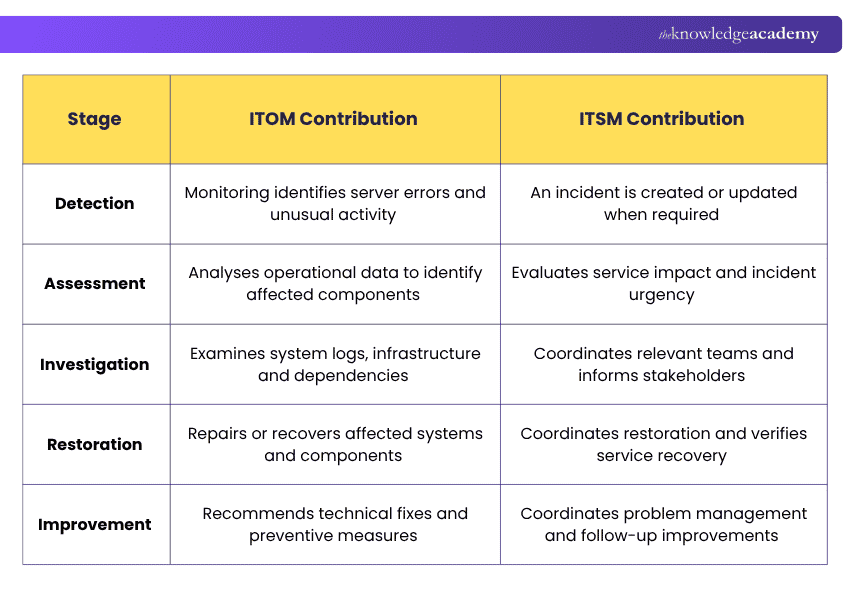
The responsibilities in this example may overlap, with organisations using either an integrated platform or connected systems to coordinate their response. ITOM contributes operational visibility and technical capabilities, while ITSM provides a broader structure for managing service restoration, communication and improvement.
When Do Organisations Need ITOM, ITSM or Both?
Organisations do not generally need to choose between ITOM and ITSM. Instead, they should prioritise capabilities based on their challenges. For example, limited infrastructure visibility may require ITOM improvements, while inconsistent service requests may highlight the need for stronger ITSM practices. The following guide can help identify where to focus.
Quick Decision Guide: What Should You Prioritise?
|
Organisational Challenge |
Area to Prioritise |
Reason |
|---|---|---|
|
Limited visibility into server, network or application performance |
ITOM |
Strengthens operational monitoring and troubleshooting |
|
Frequent infrastructure capacity issues |
ITOM |
Supports resource planning and performance management |
|
Delays in handling employee service requests |
ITSM |
Improves request coordination and service workflows |
|
Unclear service responsibilities or inconsistent support |
ITSM |
Establishes clearer ownership and service management practices |
|
Recurring outages affecting business services |
Both |
Combines technical investigation with incident and problem management |
|
Complex cloud environments supporting multiple business services |
Both |
Connects infrastructure visibility with service delivery requirements |
Gain expertise in aligning IT services with business goals effectively with the ITIL® Certification Training – Join now!

 If you wish to make any changes to your course, please


