




We may not have the course you’re looking for. If you enquire or give us a call on 01344203999 and speak to our training experts, we may still be able to help with your training requirements.
IPv6 Address Types: A Comprehensive Guide
ByThe Knowledge AcademyLast updated on: 30 September 2026
Curious about IPv6 address types? IPv6 offers different address types, including unicast, multicast, and anycast, each serving unique networking purposes. This blog will explore these IPv6 addresses, their key functions, and practical use cases, ensuring you understand how they shape modern internet communication.
Quick Preview
IPv6 uses three main address types to support different communication needs:
1. Unicast: Sends data to one specific interface.2. Multicast: Sends data to multiple interfaces within a defined group.3. Anycast: Sends data to one interface from a group sharing the same address, typically based on routing proximity.
As you move through the blog, you’ll also see how global unicast, unique local, and link-local addresses fit within IPv6 unicast addressing.
Have you ever wondered what makes the internet run smoothly with millions of devices connected simultaneously? The answer lies in IP addresses. As the world moves toward faster and more secure networks, understanding IPv6 address types is becoming increasingly important. IPv6 isn’t just a fancy upgrade from IPv4, it’s a gamechanger for how devices communicate.
Different IPv6 address types handle different communication needs, helping devices exchange data efficiently across local and global networks. Understanding how these addresses work provides a stronger foundation for learning IPv6 networking and modern network communication. Let's get started!
Types of IPv6 Addresses
Internet Protocol Version 6 (IPv6) represents the next evolutionary step in networking to overcome the limitations of its predecessor, IPv4. As the number of internet-connected devices continues to grow, IPv6 provides a much larger 128-bit address space.
Now, unlike IPv4's 32-bit addresses, IPv6 uses 128-bit addresses, providing an enormously larger address space than IPv4. This supports the continued growth of the Internet of Things (IoT) and helps ensure sustainable address allocation.
IPv6 addresses identify network interfaces and enable packets to be delivered to individual interfaces or groups of interfaces. The IPv6 addressing architecture includes three fundamental address types: unicast, multicast, and anycast. Certain unicast and multicast addresses also serve specialised purposes within IPv6 networks.
Moreover, different types of IPv6 addresses exist to cater to various communication scenarios in the digital world. Unicast addresses facilitate one-to-one communication, multicast addresses enable efficient group communication; anycast addresses direct packets to one member of a group. This diversity provides flexibility and supports different communication requirements across IPv6 networks.

1) Unicast
Unicast addresses are a fundamental type of IPv6 address that enable one-to-one communication between a source and a specific destination interface. These addresses ensure the direct delivery of data from a single source to a specific destination.
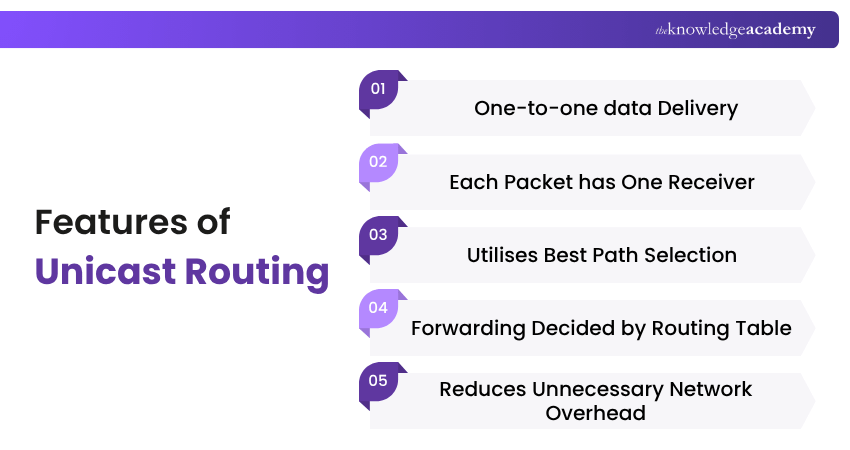
The most common types of IPv6 unicast addresses are listed below:
a) Global Unicast Addresses: Global Unicast Addresses in IPv6 are similar to public IPv4 addresses because they are routable across the internet. A common IPv6 global unicast addressing structure uses a 48-bit global routing prefix, a 16-bit subnet ID, and a 64-bit interface ID, although the exact prefix length can vary depending on the address allocation.
The global routing prefix is typically allocated through Regional Internet Registries (RIRs) and Internet Service Providers (ISPs), while the subnet portion is managed by the organisation or network administrator.
b) Unique Local Addresses: Unique Local Addresses (ULA) in IPv6 provide an addressing solution for internal network communication within an organisation. With the prefix "FC00::/7" and a 40-bit Global ID, 16-bit Subnet ID, and 64-bit Interface ID, ULAs ensure localised connectivity, supporting local communication while helping reduce the risk of address conflicts.
The 40-bit Global ID provides a high probability of uniqueness, helping reduce the risk of address collisions. ULAs support internal addressing and are not normally routed on the global Internet. Appropriate firewalls and access controls are still required for network security.
c) Link-local Addresses: Link-local addresses in IPv6 are used for communication between devices on the same local network link. They use the FE80::/10 prefix and enable devices on the same local link to communicate directly, with routers not forwarding link-local traffic to other links. Link-local addresses facilitate efficient and localised network operations.
Link-local addresses play a pivotal role in Neighbour Discovery Protocol (NDP) and are often used in scenarios where immediate, localised communication is essential, contributing to the seamless functioning of devices within the confines of a specific network or link.
Trainer’s Insight
An easy way to distinguish the main unicast address types is to think about their scope:
Global Unicast → Global communicationUnique Local → Local/ internal communicationLink-local → Same-link communication
2) Multicast
IPv6 multicast addressing is a communication paradigm in networking that enables the efficient delivery of data from one sender to multiple recipients. Unlike unicast, which is one-to-one communication, multicast allows a sender to address a specific group of recipients simultaneously.
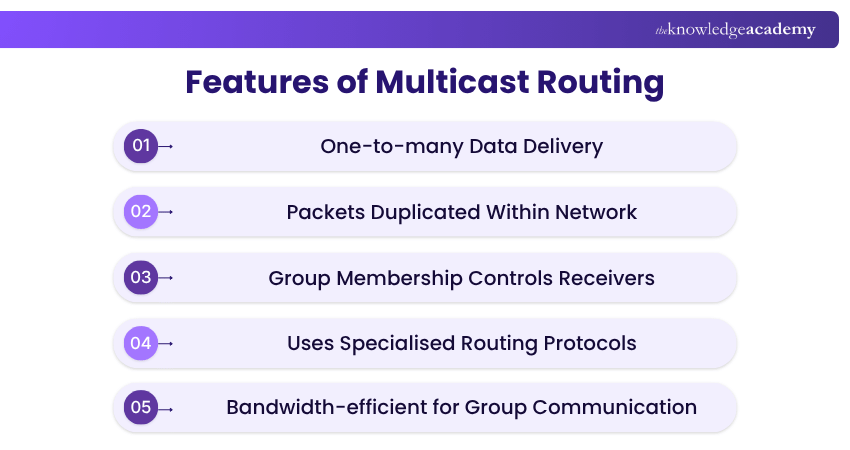
IPv6 multicast addresses start with the prefix "FF00::/8" in IPv6, signalling their dedicated role in group communication. Multicast can improve bandwidth efficiency by allowing network infrastructure to replicate traffic only where needed to reach multicast group members.
As networks continue to evolve, IPv6 multicast addressing remains a key technology, contributing to the seamless and effective dissemination of information to diverse audiences.
Now, the solicited-node multicast address is a specific type of multicast address used in IPv6 for efficient neighbour discovery in local networks. It plays a crucial role in the Neighbour Discovery Protocol (NDP), part of the IPv6 protocol suite.
The structure of a solicited-node multicast address is derived from the lower 24 bits of a device's unicast or anycast IPv6 address. Specifically, it takes the well-known multicast prefix "FF02::1:FF00:0/104" and appends the lower 24 bits of the corresponding IPv6 address.
This process creates a solicited-node multicast address based on the lower 24 bits of the corresponding unicast or anycast address. Different IPv6 addresses with the same lower 24 bits can map to the same solicited-node multicast address.
For example, if a unicast address is "2001:0db8:85a3:0000:0000:8a2e:0370:7334," the corresponding solicited-node multicast address would be "ff02::1:ff70:7334." These addresses are instrumental in neighbour solicitation messages, allowing devices to efficiently discover and communicate with their neighbours on the local network.
Bonus Tip
IPv6 does not use broadcast addresses. Instead, it uses multicast addressing to communicate with selected groups of interfaces. This means traffic can be sent to the devices that need it rather than being broadcast to every device on a network segment.
3) Anycast
Anycast IP routing in IPv6 introduces a unique communication paradigm where a single destination address is shared by multiple nodes, and the data is sent to the nearest member according to the routing protocol’s path selection of the anycast group. Unlike unicast, which involves one-to-one communication, anycast allows multiple nodes to share the same address, directing traffic to one member of the anycast group according to the routing protocol’s path selection.
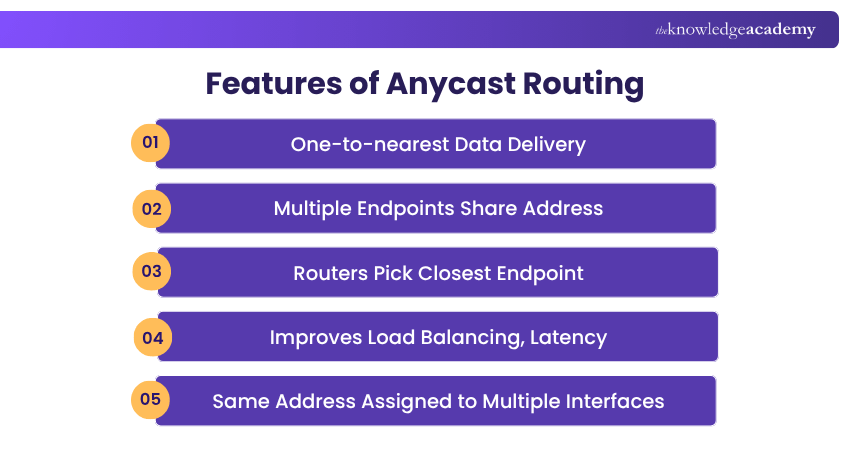
Anycast can improve efficiency, resilience, and coarse-grained traffic distribution by directing requests to one of several available nodes. It is commonly used in distributed services where redundancy and scalability are important. However, the selected node is determined by routing metrics and is not necessarily the geographically closest or least-loaded server.
Learn the basics of networking concepts by signing up for the Cisco Certified Network Professional Boot Camp Week 1 Course now!

The Knowledge Academy develops accessible learning content across Project Management, IT, Cybersecurity, Data Science, Business Analysis, HR, Accounting and Finance, Leadership and Health and Safety. Its resources combine subject research with clear explanations to help professionals build practical knowledge across a wide range of disciplines.
View Detail

 If you wish to make any changes to your course, please


