




We may not have the course you’re looking for. If you enquire or give us a call on 01344203999 and speak to our training experts, we may still be able to help with your training requirements.
What is Internal Business Environment? A Comprehensive Guide
ByThe Knowledge AcademyLast updated on: 03 October 2026
This blog takes a deep dive into the internal business environment, exploring its factors, benefits, and how to build such an environment. Read on to learn more!
What You Should Know
1. Internal factors are interconnected, so changes to technology, policies, workforce capabilities or structure can influence several other areas of an organisation.2. Businesses have greater influence over internal factors, allowing them to review and improve areas such as policies, resources, processes and leadership practices.3. Skilled employees, suitable resources and effective leadership can strengthen an organisation’s ability to respond to external opportunities and challenges.4. Open communication, clear goals, employee engagement, supportive leadership and continuous improvement can contribute to a more positive internal environment.5. Internal strengths need ongoing review, as resources, policies and practices must evolve with changing organisational and external conditions.
A business runs on more than its products or its market position, it runs on the people, systems and culture operating within it day to day. The internal business environment captures exactly that: the culture, leadership, resources and relationships that shape how an organisation functions from the inside out.
Two organisations can face the exact same market conditions and still perform very differently, and that difference usually comes down to what's happening internally. Understanding these internal factors is often the clearer, more actionable starting point for improving how a business actually operates.
What is the Internal Business Environment?
The internal business environment refers to the factors, conditions and resources within an organisation that influence how it operates, makes decisions and works towards its objectives. These can include:
1) Culture
2) Work processes
3) Members
4) Management
5) Resources
6) Technical capabilities
This internal environment influences, and is influenced by the decisions, activities, and behaviours of people within the organisation. Members of an internal environment include individuals associated with the organisation, such as owners, shareholders, directors, and employees. It plays an important role in shaping team dynamics and decision-making, making it a vital aspect of any successful organisation.

The Importance of Internal Business Environment
The internal environment is important because businesses have greater influence over internal factors than external ones. It determines how effectively an organisation can use its people, resources and capabilities to respond to external opportunities and challenges. It also helps managers and supervisors monitor employee productivity, progress and overall performance.
A strong internal environment also supports the creation and delivery of products and services by improving communication, processes and resource use. It helps reinforce organisational values and culture while encouraging employee learning, development and job satisfaction.
Trainer's Insight
Businesses facing the same external conditions can respond differently depending on their internal capabilities. Skilled people, suitable resources, clear responsibilities and effective leadership can help an organisation respond to change more effectively.
Factors Influencing Internal Business Environment
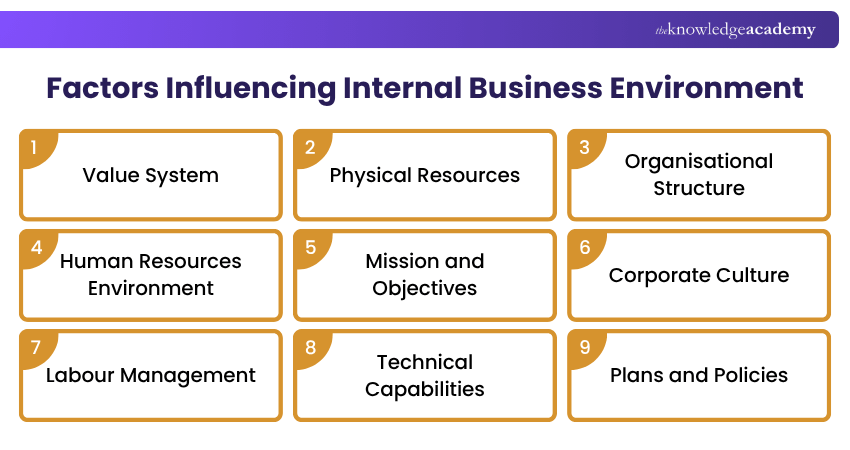
From physical resources and human resources to labour management and policies, there are multiple factors that influence an internal business environment and highlight their interconnectedness, which drives organisational performance and culture. Let’s explore them in detail:
1) Value System
The value system, also referred to as an organisation's philosophy, represents the principles and standards that guide how the organisation operates and how it expects employees to behave. It can influence decision-making, workplace practices and relationships with employees and customers.
It provides employees with a framework for carrying out their responsibilities and making decisions that align with the organisation's principles.
2) Physical Resources
Physical resources refer to the tangible assets of an organisation, such as machinery and tools. These resources are crucial to an organisation’s success, and modern assets offer a significant competitive advantage.
For instance, an organisation with automated machinery can achieve higher productivity in less time compared to one that relies on manually operated equipment. Consequently, companies may invest in updated equipment and technologies when these improvements can increase production efficiency and support their business objectives.
3) Organisational Structure
Organisational structure outlines how information must flow within an organisation and the roles of the Board of Directors, management, and shareholders. Its impact on decision-making is significant, as more management levels can cause more delays.
For instance, organisations with four management levels may take longer to address worker issues than those with fewer levels. In these circumstances, the board of directors with effective managerial skills plays a key role in critical decisions and policy design.
Looking for strategies for continuous employee development? Sign up for the Learning and Development Courses now!
4) Human Resources Environment
Human resources are an important part of the internal environment because employees contribute the knowledge, skills, experience and capabilities required for an organisation to operate effectively.
Human resources professionals also help shape the internal environment through activities such as recruitment, employee development, performance management and addressing workplace concerns. An effective HR function can help strengthen relationships between employees and management by supporting communication and appropriate workplace practices.
5) Mission and Objectives
The mission and objectives of an organisation are what decide the future position of the organisation and its place in the market. They can guide business planning, decision-making and the allocation of resources.
Every business plan is developed, and every resource is utilised with the goal of achieving the objectives of the organisation’s internal environment.
Pro Tip
When reviewing an internal factor, connect it back to the organisation's objectives. Instead of asking only, “Do we have good technology?”, ask, “Does our technology help us achieve what the business is trying to accomplish?” The same principle applies to people, resources, structure and policies.
6) Corporate Culture
Corporate culture, also known as organisational culture, refers to the beliefs, values, and assumptions shared by an organisation’s management and employees. This element of an organisation shapes its unique social and psychological ethos and influences employee interactions, decision-making processes, and information sharing. Corporate culture evolves from the following:
a) Collective beliefs
b) Value systems
c) Management strategies
d) Communication
e) Workplace environment
Over time, culture can also be influenced by an organisation's history, leadership and symbols. This culture affects how an organisation operates and can create a distinct identity that influences both internal dynamics and external perceptions.
7) Labour Management
The individuals responsible for creating and delivering a business’s products or services are collectively called its workforce or labour. Labour management involves the practices and standards a company adopts to align with international principles, national laws, and customer expectations regarding labour. Many of these standards are also legal requirements.
Labour management essentially drives how an organisation manages its employees and labourers, influencing its internal environment in the process. Businesses are typically expected to ensure safe, fair workplaces with ethical practices in areas such as employment terms, hiring and wages.
8) Technical Capabilities
Technical capabilities refer to an organisation’s technical expertise and the technologies it employs. Much like physical resources, organisations equipped with advanced technology can gain significant competitive advantage over their rivals. In today’s tech-driven era, the importance of technical capabilities grows every day. It plays a crucial role in improving efficiency, innovation, and overall competitiveness.
9) Plans and Policies
Plans and policies are essential internal factors that guide an organisation's operations and decision-making. While plans outline strategic goals and the steps needed for growth, policies provide rules governing behaviour and processes. Together, they promote efficiency and accountability, supporting crucial elements such as:
a) Resource management
b) Risk mitigation
c) Alignment with long-term objectives
Regularly reviewing and updating these frameworks helps organisations be responsive to external changes. For instance, Human Resource professionals address employee concerns by referring to company policies. Clear and well-structured policies enhance organisational efficiency and provide a foundation for effective decision-making.
Understand team dynamics and how to nurture collaboration and trust in your organisation in the comprehensive Team Development Training - Sign up now!
How to Build a Positive Internal Business Environment?
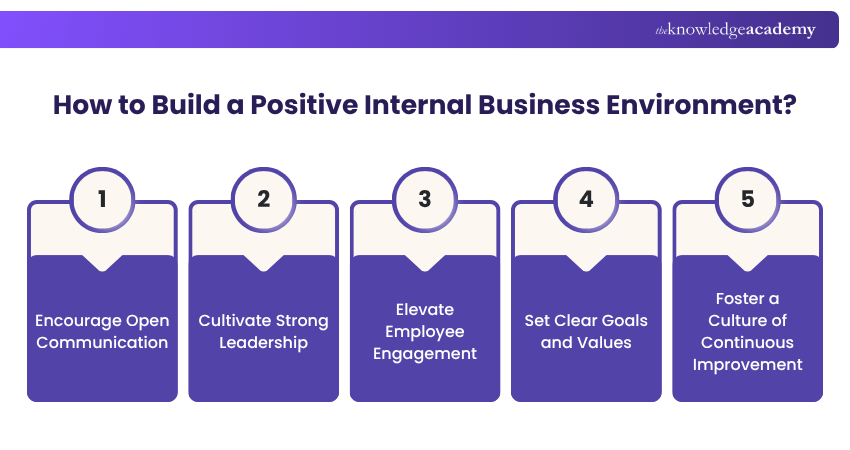
Now that you have a deeper insight into the essential factors of an internal business environment, let’s explore the steps to build such an environment below:
1) Encourage Open Communication
a) Encourage transparent and open communication channels across the organisation.
b) Create a culture where employees feel confident sharing ideas, concerns, and feedback.
c) Build a collaborative environment that supports informed decision-making and timely problem-solving.
2) Cultivate Strong Leadership
a) Invest in developing effective and supportive leaders.
b) Offer leadership training and mentorship programs. This will equip Managers with the skills to inspire and guide their teams.
c) Build a strong leadership team to set a positive tone for the organisation and enhance employee morale.
3) Elevate Employee Engagement
a) Develop initiatives to boost employee engagement and satisfaction.
b) Recognise and reward employees for their achievements.
c) Give people the chance to grow their careers and acquire new skills.
d) Promote work-life balance to support employee well-being.
e) Encourage employee participation and provide opportunities for people to contribute ideas and feedback that can support organisational improvement.
4) Set Clear Goals and Values
a) Establish clear organisational goals and values that resonate with employees.
b) Effectively communicate these objectives across all levels of the organisation.
c) Ensure employees understand the company’s purpose and direction.
d) Foster alignment of employee efforts with organisational goals to drive success.
5) Foster a Culture of Continuous Improvement
a) Promote a culture of innovation.
b) Encourage employees to take calculated risks and think creatively.
c) Create an environment that embraces change and seeks growth opportunities.
d) Enable the organisation to remain competitive and adaptable in a dynamic business landscape.
Learn essential strategies for managing time and resources efficiently in the Organisational Skills Course - Register now!
Difference Between Internal and External Business Environment
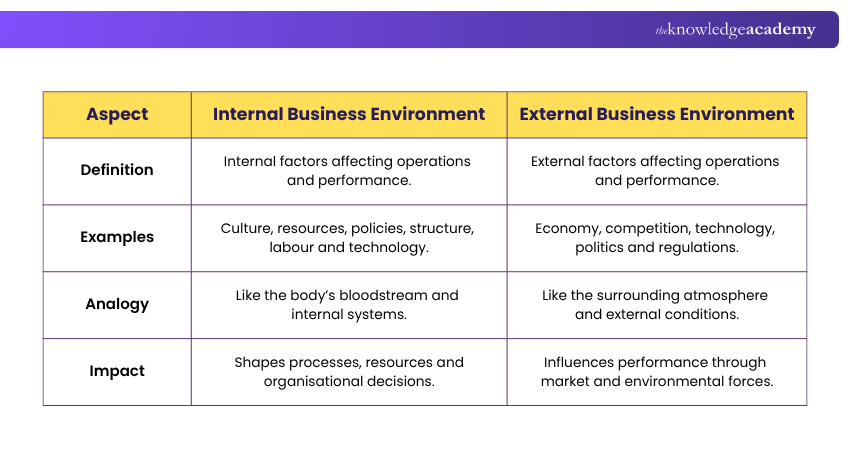
While the internal environment covers factors within an organisation's control, such as culture, resources and leadership, the external environment consists of forces operating outside it, like competitors, regulations and economic conditions. The two are closely connected: external pressures often shape internal decisions, while a strong internal environment determines how well an organisation can respond to what's happening outside it.
Understanding where a factor sits matters because internal and external issues typically call for very different responses. To make that distinction clearer, here's a side-by-side comparison:

The Knowledge Academy develops accessible learning content across Project Management, IT, Cybersecurity, Data Science, Business Analysis, HR, Accounting and Finance, Leadership and Health and Safety. Its resources combine subject research with clear explanations to help professionals build practical knowledge across a wide range of disciplines.
View Detail

 If you wish to make any changes to your course, please


