




We may not have the course you’re looking for. If you enquire or give us a call on 01344203999 and speak to our training experts, we may still be able to help with your training requirements.
Importance of Technology: A Detailed Explanation
ByJyoti TuraLast updated on: 03 October 2026
Technology involves applying scientific knowledge to practical needs, transforming industries and enhancing everyday life. In this blog, you will learn about the importance of technology, its pivotal role in transforming healthcare, education, and business, and how it continues to drive innovation and shape our future.
Quick Snapshot
Technology shapes how we communicate, work, learn, shop, and access healthcare. It improves efficiency, decision-making, innovation, and connectivity, while also introducing challenges such as privacy risks, job disruption, environmental impact, and the digital divide.
Imagine a world without smartphones, the internet, or advanced medical equipment, it's almost impossible, isn't it? The importance of technology in our lives today is undeniable, driving every aspect of our daily routines and future aspirations. It bridges gaps, simplifies tasks, and opens a multitude of possibilities previously thought unattainable.
From streamlining business operations and fostering global communication to advancing healthcare and education, technology's impact is profound and far-reaching. Let's delve into the importance of technology, exploring how it transforms industries, empowers individuals, and shapes the future of our world.
Why is Technology Important?
Here is the importance of technology:
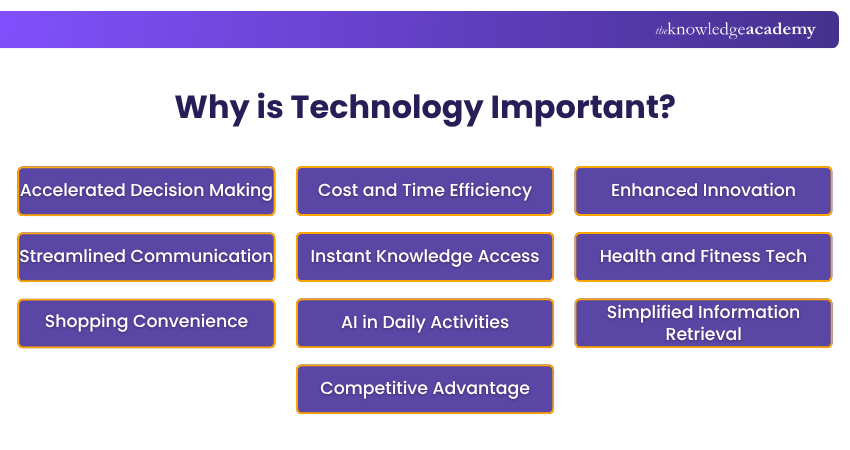
1) Accelerated Decision-making
Technology enables accelerated decision-making by providing real-time data, advanced analytics, and predictive insights. With powerful software and algorithms, businesses can analyse large amounts of data quickly, understanding trends and patterns that inform strategic choices.
This speed allows for more responsive and informed decisions, reducing the time between data collection and action. In personal life, technology assists individuals in making quicker decisions through access to information and tools that evaluate options efficiently. Overall, technology transforms Decision-Making Processes, making them faster and potentially better informed through timely data and analytical insights.
2) Cost and Time Efficiency
Technology significantly enhances cost and time efficiency across various sectors. Automated processes replace manual tasks, reducing labour costs and minimising errors. In manufacturing, technology streamlines production lines, cutting down on time and resource wastage.
In offices, software solutions automate routine tasks, allowing employees to focus more on strategic activities. Technology also facilitates remote work, reducing commuting time and expenses. Overall, the integration of technology leads to more efficient operations, enabling businesses and individuals to achieve more in less time and at a lower cost.

3) Enhanced Innovation
Technology drives enhanced innovation by providing tools and platforms for creativity and experimentation. Advanced software, Artificial Intelligence, and Machine Learning enable the development of new products, services, and processes. In research, technology facilitates groundbreaking discoveries and accelerates the pace of innovation.
For businesses, technology opens new markets and opportunities for differentiation. Individuals can leverage technology to bring their ideas to life, from app development to digital art. By fostering a culture of innovation, technology propels progress and keeps society moving forward.
4) Streamlined Communication
Technology plays a vital role in making communication faster, easier and more efficient. Digital platforms, such as email, instant messaging, and video conferencing, enable instant and efficient communication across distances. Social media and collaboration tools allow for real-time interaction and information sharing.
This connectivity enhances personal relationships and business operations, enabling seamless collaboration and coordination. Technology also breaks down geographical barriers, allowing for global communication and the exchange of ideas. This connectivity fosters Globalisation, enabling businesses and individuals to collaborate seamlessly across borders. As a result, a well-planned IT Communications Strategy makes communication faster, more convenient, and more effective.
5) Instant Knowledge Access
Technology provides instant access to a vast reservoir of knowledge and information. The internet, with search engines, online libraries, and educational platforms, allows individuals to find answers to almost any question in seconds. This immediate access to information supports learning, problem-solving, and informed decision-making.
Educational apps and e-books can make learning more accessible to people across different locations, provided they have suitable devices and connectivity. By democratising knowledge, technology empowers individuals to continuously expand their understanding and skills, fostering a more informed and educated society.
6) Health and Fitness Tech
Health and fitness technology has revolutionised the way individuals manage their well-being. Wearable devices, such as fitness trackers and smartwatches, check physical activity, heart rate, and sleep patterns, giving valuable insights into personal health.
Mobile apps offer workout plans, diet tracking, and mental health support. Telemedicine platforms enable remote consultations with healthcare professionals, making medical advice more accessible. By integrating technology into health and fitness routines, individuals can better monitor their routines, stay motivated and support healthier lifestyle choices.
7) Shopping Convenience
Technology has transformed shopping into a convenient and efficient experience. E-commerce platforms allow consumers to browse, compare, and purchase products from the comfort of their homes.
Mobile apps and online payment systems streamline the buying process, offering various payment options and secure transactions. Technology also enables personalised shopping experiences through recommendation algorithms and targeted advertising.
Additionally, innovations like Augmented Reality allow shoppers to virtually try products before purchasing. Overall, technology makes shopping easier, faster, and more enjoyable.
Register for our Software Engineering Courses today and learn the skills to innovate and lead in the tech industry.
8) AI in Daily Activities
Artificial Intelligence (AI) integrates into daily activities, enhancing convenience and productivity. AI-powered Virtual Assistants, such as Siri and Alexa, manage schedules, answer questions, and control smart home devices. In business, AI automates routine tasks, improves customer service through chatbots, and provides data-driven insights.
AI also enhances personal experiences, from personalised content recommendations to smart shopping assistants. By incorporating AI into everyday life, technology simplifies tasks, increases efficiency, and offers more personalised interactions and services.
9) Simplified Information Retrieval
Technology simplifies information retrieval, making it quick and effortless. Search engines like Google provide immediate access to a vast array of information, while databases and Cloud Storage offer organised and easily navigable repositories of data. Mobile devices and apps enable on-the-go access to information. This ease of retrieval supports learning, research, and informed decision-making.
In professional settings, technology enhances productivity by allowing employees to find necessary information rapidly. Simplified information retrieval transforms how we access and use data, making it a cornerstone of modern life.
10) Competitive Advantage
Technology provides a competitive advantage by enabling businesses to innovate, optimise operations, and deliver superior customer experiences. Advanced analytics and data-driven strategies help companies make better informed decisions and respond effectively to market trends.
Automation and efficient processes reduce costs and increase productivity. Technology also enables personalised marketing and improved customer engagement. By leveraging technological advancements, businesses can differentiate themselves, respond swiftly to changes, and maintain a leading edge in their industry.
11) Boosted Efficiency
Boosted efficiency is one of the primary benefits of technology. Automated systems and tools streamline workflows, reduce manual errors, and increase output. In manufacturing, technology enhances production speed and precision. In offices, software solutions automate repetitive tasks, allowing employees to focus on strategic activities.
Technology also facilitates better Time Management and resource allocation. By optimising processes and reducing waste, technology enables both individuals and organisations to achieve more with less effort, ultimately improving overall efficiency and productivity.
Impact of Modern Technology on Business
Let's explore the impact of modern Technology on Business:
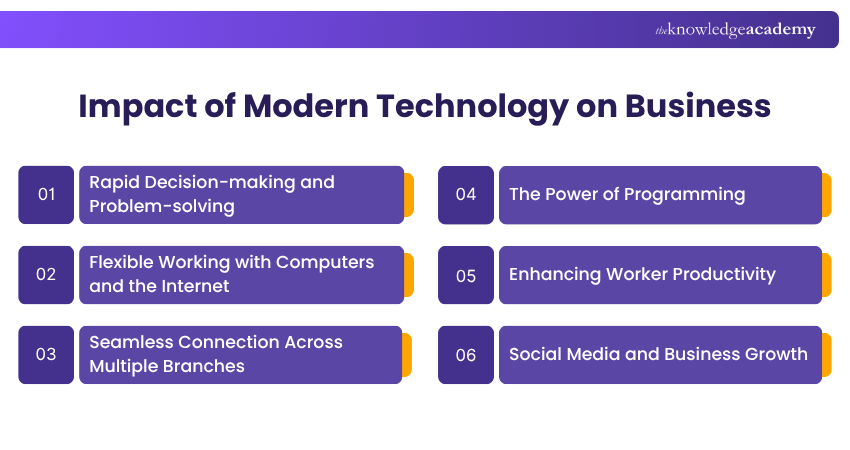
1) Rapid Decision-making and Problem-solving
Have you noticed how quickly decisions are made in businesses these days? That's thanks to advanced technology. With specialised tools and software, leaders can easily access real-time data to make better decisions swiftly. This enables them to solve problems efficiently, like a superhero with a tech-savvy sidekick.
2) Flexible Working with Computers and the Internet
Gone are the days when work is confined to the office. With the advent of computers and the internet, With computers and the internet, many businesses and employees in suitable roles can now work and collaborate across different locations. It's like carrying a magic door to your office in your pocket.
3) Seamless Connection Across Multiple Branches
Consider large companies with branches worldwide. How do they communicate and share important documents? The answer is technology. Instead of long waits or sending someone across cities, they simply click a few buttons to access information from distant offices. It's like having a super-fast mailman!
4) The Power of Programming
Software controls many modern devices, from televisions and appliances to traffic-management systems. Developers create this software using programming languages, while connected devices exchange information through communication protocols. Learning programming helps people understand how software is designed to perform specific tasks.
5) Enhancing Worker Productivity
Why are tasks completed so quickly nowadays? It's the magic of technology. Machines and computers handle numerous repetitive tasks, reducing worker fatigue and helping minimise certain human errors. While the initial investment might be high, these technologies act like super-workers, saving both time and money in the long run.
6) Social Media and Business Growth
Social media has transformed how businesses market their products, communicate with customers, and build brand awareness. Platforms such as Facebook, Instagram, and X enable companies to reach wider audiences, share updates instantly, gather feedback, and engage directly with customers. It also supports targeted advertising, market research, and community building.
Transform your career and start designing the future now with our Software Design and Architecture Training today.
Types of Technological Innovations and Their Applications
In this section, we will explore the types of technological innovations and their applications:
1) Operational Efficiency Augmentation
Technological innovations in operational efficiency focus on streamlining processes and reducing waste. Automation, Data Analytics, and Artificial Intelligence are pivotal in enhancing productivity and cutting costs.
For instance, predictive maintenance uses IoT sensors to anticipate equipment failures, minimising downtime and extending machinery lifespan. Similarly, Supply Chain Management software optimises inventory levels, ensuring timely delivery and reducing excess stock.
These innovations lead to more agile and responsive operations, improving overall efficiency and competitiveness.
2) Revolutionising Healthcare
Technological advancements are transforming healthcare by improving diagnostics, treatment, and patient care. Telemedicine allows remote consultations, making healthcare accessible to people in underserved areas.
Wearable health devices assess vital signs in real-time, enabling proactive health management. Innovations like robotic surgery and AI-powered diagnostic tools enhance precision and outcomes, reducing recovery times and costs.
Additionally, electronic health records streamline patient information management, ensuring better coordination and continuity of care.
3) Automotive Technological Integration
The automotive industry is witnessing a revolution through technological integration. Electric Vehicles (EVs) are gaining popularity, driven by advancements in battery technology and sustainability concerns. Autonomous driving technologies, powered by AI and Machine Learning, are being developed to improve aspects of transportation safety and efficiency.
Connected car technologies improve the driving experience by providing real-time navigation, vehicle diagnostics, and entertainment options. These innovations are reshaping the future of mobility, making it more sustainable and intelligent.
4) Communication Evolution
Technological innovations have revolutionised communication, making it faster and more efficient. 5G technology offers higher data speeds, lower latency and greater network capacity than earlier mobile generations, supporting applications ranging from real-time communication to connected IoT devices.
Social media platforms and messaging applications have transformed how we connect and share information, breaking down geographical barriers. Video conferencing tools have become indispensable, especially in remote work settings, facilitating seamless collaboration and communication.
5) Manufacturing Innovations
Innovations in manufacturing, like additive manufacturing (3D printing), Robotics, and smart factories, are driving efficiency and customisation. 3D Printing makes it easier to develop prototypes quickly and manufacture intricate parts with less material waste.
Robotics automate repetitive tasks, improving precision and productivity. Smart factories leverage IoT and AI to monitor and optimise production processes in real-time, leading to enhanced quality control and reduced operational costs.
6) Business Transformation
Technological innovations are transforming business operations and strategies. Cloud Computing offers scalable and flexible resources, enabling businesses to operate more efficiently and cost-effectively. Big data analytics gives insights into consumer behaviour and market trends, driving informed decision-making.
Customer Relationship Management (CRM) systems enhance customer service and retention by centralising customer information. These technologies empower businesses to innovate, adapt, and thrive in a competitive landscape.
The Drawbacks of Technology
These are the drawbacks of technology:
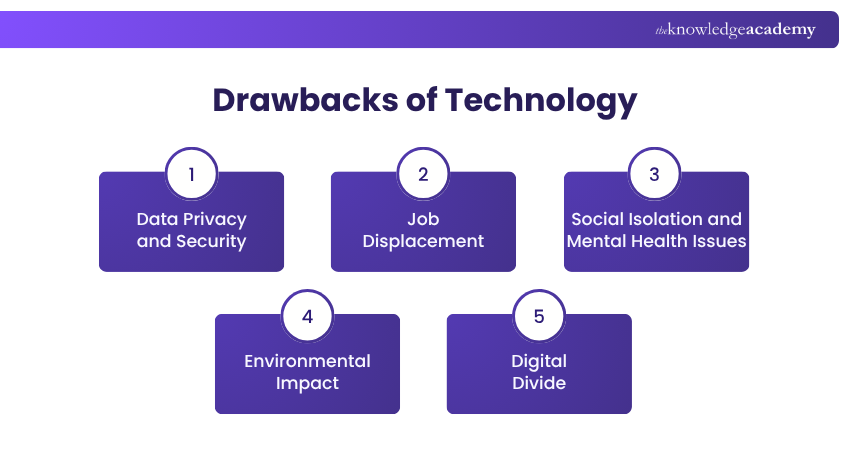
a) Data Privacy and Security: With the evolution of digital devices and online platforms, personal data is increasingly vulnerable to cyberattacks, data breaches, and identity theft, making it challenging to protect sensitive data.
b) Job Displacement: Automation and artificial intelligence can automate certain tasks and may displace some roles, while also changing existing jobs and creating demand for new skills. Recent research suggests that many AI-exposed occupations are more likely to be transformed than completely replaced, increasing the need for reskilling and upskilling.
c) Social Isolation and Mental Health Issues: Excessive use of smartphones and social media can reduce face-to-face interactions, which may contribute to feelings of loneliness and depression, while the pressure to maintain an idealised online presence can negatively impact self-esteem and well-being.
d) Environmental Impact: The production and removal of electronic devices contribute to e-waste, posing significant environmental hazards, and the extraction of critical minerals and other raw materials for these devices can lead to ecological degradation and resource depletion.
e) Digital Divide: Unequal access to reliable internet connectivity, affordable digital services, suitable devices and digital skills can prevent individuals and communities from fully benefiting from technology, reinforcing existing social and economic inequalities.
Ultimately, technology is not just about what machines can do, but how thoughtfully we use them to create smarter, safer, and more connected lives.
Advance your expertise, sign up for our Systems Engineering Training today and learn the skills to design and manage complex systems.

Jyoti Tura is a Senior Web & UX/UI Manager with 7+ years of experience in front-end development, web development and user-focused interface design. Her technical expertise and managerial responsibilities support her knowledge across IT and Tech, Leadership and Management.
View Detail

 If you wish to make any changes to your course, please


