




We may not have the course you’re looking for. If you enquire or give us a call on 01344203999 and speak to our training experts, we may still be able to help with your training requirements.
What is Human Resource Planning? A Complete Guide
ByThe Knowledge AcademyLast updated on: 05 October 2026
Human resource planning is the process of analysing and forecasting workforce needs to ensure an organisation has the right employees. Effective human resource planning reduces talent gaps, enhances productivity, aligns HR strategies with business goals, and supports long-term workforce stability.

Quick Overview
1. Human resource planning helps organisations forecast workforce needs and prepare for future talent requirements.2. The human resource planning process involves analysing the current workforce, forecasting changes, identifying gaps, implementing plans, and reviewing outcomes.3. Effective planning can help reduce skill shortages, support employee development, and align workforce needs with business goals.4. Human resource planning also helps organisations respond to challenges such as turnover, absences, promotions, and changing market conditions.5. HR tools and workforce analytics can support recruitment, performance tracking, forecasting, and employee development.
Let’s say that your business is thriving, but suddenly, key employees leave, roles go unfilled, and deadlines start slipping. Panic mode? That’s what happens when there’s no human resource planning in place. In essence, it is about making sure that your workforce is prepared for both current challenges and future opportunities.
Without this strategy, you will risk skill shortages, high turnover, and stalled progress. But with the right approach, you can build a resilient, future-ready team. In this blog, we’ll break down everything you need to know about human resource planning. Read on to learn more!
What is Human Resource Planning (HRP)?
Human Resource Planning (HRP) is the process of assessing an organisation's current workforce and forecasting future needs, so the business always has the right people with the right skills in place. This involves evaluating current staff, skill sets, budget, and growth plans to predict what the organisation will need down the line.
In practice, this often means matching hiring decisions directly to where the actual work is heading. For example, a company with more design projects than application development projects may need to hire more designers than developers.

What is the Goal of Human Resource Planning?
The objective of human resource planning is to ensure the company has the right number of employees with the required skills to meet its business needs. By implementing human resource planning effectively, the company can:
a) Enhance Employee Performance and Value: Identify skill gaps early and invest in development rather than replacement. This often costs less than hiring externally to fill the same gap.
b) Gain a Competitive Advantage: Build a workforce ready to act quickly on new opportunities. Competitors still recruiting from scratch will be a step behind.
c) Adapt to Challenges and Change: React faster since gaps and risks are already mapped out. This turns disruption into a manageable situation rather than a crisis.
d) Control Recruitment and Labour Costs: Avoid costly, last-minute hiring by planning ahead. Rushed hires are also more likely to be a poor fit long-term.
e) Support Succession Planning: Prepare internal candidates for key roles in advance. This reduces disruption when someone leaves or is promoted unexpectedly.
f) Improve Employee Retention: Offer clearer development paths that reduce turnover. Employees are less likely to leave when they can see a future within the company.
g) Align Workforce Capacity with Strategy: Match staffing and skills to where the business is heading. This prevents the workforce from lagging behind strategic decisions.
h) Reduce Over- or Understaffing Risk: Avoid excess headcount costs or productivity loss from being short-staffed. Both extremes quietly erode profitability over time.
Five Steps in Human Resource Planning
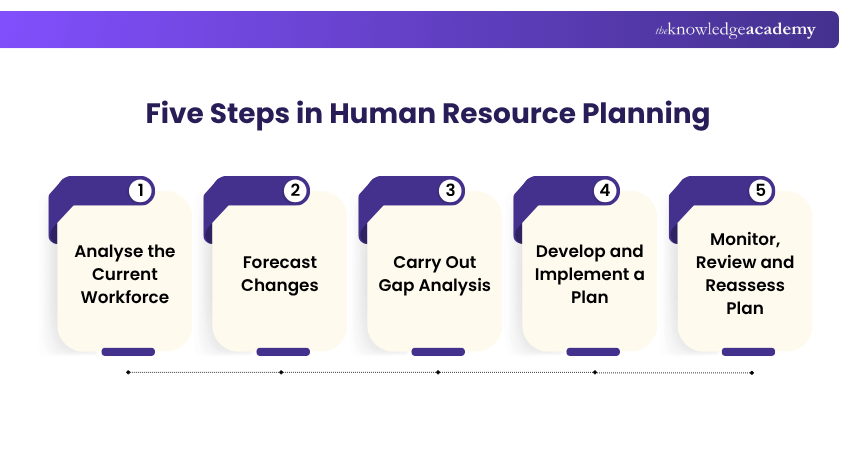
The HRP process can improve productivity and adaptability. You can achieve these outcomes by following the five steps in your planning process, which include:
1) Analyse the Current Workforce
Before planning for the future, you need to understand your current workforce. This means assessing skills, experience, and performance to identify strengths and gaps.
Think of it like a football team: before recruiting, the coach evaluates who’s excelling, who needs training, and where reinforcements are required. Similarly, HR reviews skills, employee engagement, and turnover rates to ensure the business has the right talent to succeed.
2) Forecast Changes
Workforces evolve as markets shift, technology advances, and business needs change. HR must anticipate future workforce demands to avoid last-minute challenges.
For example, a retail business must prepare for peak seasons by forecasting hiring needs. Likewise, companies facing automation or industry shifts must plan for upskilling or restructuring to stay competitive.
3) Carry Out Gap Analysis
Once you know where you are and where you’re headed, gap analysis helps identify missing skills or roles.
Think of it like a puzzle: you have most of the pieces, but some are missing. Do you train existing employees or hire fresh talent? A tech company expanding into cybersecurity, for example, must decide whether to upskill IT staff or recruit new experts.
4) Develop and Implement a Plan
The next step is to develop and implement a plan to address the HR supply and demand gap and achieve the human resource objectives. It involves designing and executing various HR strategies and actions that aim to attract, develop, retain, and motivate the human resources that the organisation needs.
The plan should also outline the roles and responsibilities, timelines, budgets, and expected outcomes for each HR strategy and action. Examples of HR strategies may include launching a recruitment campaign, implementing training and development programmes, and offering competitive compensation and benefits.
An HR plan can also involve implementing performance management and feedback systems. It can also create career paths and succession plans.
Trainer’s Pro Tip
Review workforce data regularly rather than waiting for staffing gaps to appear. Tracking skills, turnover, performance, and upcoming business needs can help HR teams plan recruitment and development more effectively.
5) Monitor, Review and Reassess Plan
The fifth and final step in the planning process is to monitor, review, and reassess the plan. This helps evaluate its effectiveness and efficiency, allowing for adjustments as needed to support continued improvement. It involves measuring and analysing the results and impacts of HR strategies and actions on human resources, organisational objectives, and plans.
It also helps identify the best practices and lessons learned, as well as the challenges and risks that must be addressed. For example, an HR plan review could reveal that the recruitment campaign successfully attracted qualified candidates. However, the training and development programmes needed to be more comprehensive in preparing them for the new product line.
Are you passionate about human resources and ready to take your career to the next level? Join our Certified HR Advisor Course today!
Importance of Human Resource Planning
Human Resource Planning (HRP) isn’t just a concept; it’s a driving force behind productivity and profitability. A well-executed human resource planning process enables businesses to attract and retain the right talent, equipped with both the technical and soft skills needed to excel in their roles. HRP is essential for several reasons:
1) Enhances Employee Value: HRP assesses current employees’ skills and training needs, allowing businesses to upskill their existing staff. This not only reduces recruitment costs but also fosters employee growth and loyalty.
2) Adapts to Industry Shifts: HRP enables organisations to anticipate talent needs and adapt to industry changes. This allows for agile role transitions and effective budgeting for new positions in emerging areas.
3) Maintains a Competitive Edge: HRP empowers businesses to make informed hiring and training decisions. It helps ensure these decisions consider employee preferences, work-life balance, and other attractive job factors.
4) Supports Long-term Growth: HRP helps HR professionals forecast hiring needs, department expansions, and retirements. This ensures a balanced workforce and enables smart budgeting for future growth.
Challenges of Human Resource Planning
While human resource planning offers clear benefits, putting it into practice isn't always straightforward. Several recurring obstacles can make the process harder to execute effectively. Here are the key challenges:
a) Time and Effort Required: Gathering workforce data, forecasting needs, and building a plan takes significant time, which can strain HR teams already managing day-to-day responsibilities.
b) Financial Investment: Effective human resource planning often requires spending on tools, training, and specialist support, costs that smaller organisations may find harder to justify upfront.
c) Imperfect Forecasting: Workforce forecasts are based on assumptions about future demand, and unexpected shifts in the business can quickly make those projections inaccurate.
d) Market Fluctuations: Economic downturns, industry disruption, or sudden changes in demand can undermine even a well-researched HR plan almost overnight.
e) Technology and Data Integration: Bringing together data from multiple HR systems can be difficult, especially when tools don't integrate smoothly or data quality is inconsistent.
f) Employee Resistance to Internal Changes: Restructuring roles or shifting responsibilities as part of a plan can create uncertainty or pushback from employees affected by the change.
Transform the way you manage talent with our HR Strategy Training. Register now!
What Tools are Used for Human Resource Planning?
Human resource planning isn't just about hiring; it’s about building a strong, future-ready workforce. With the right human resource planning tools, you can recruit talent, track performance, forecast workforce needs, and support employee development, making HR more strategic and efficient.
Let’s look at the essential human resource planning tools:
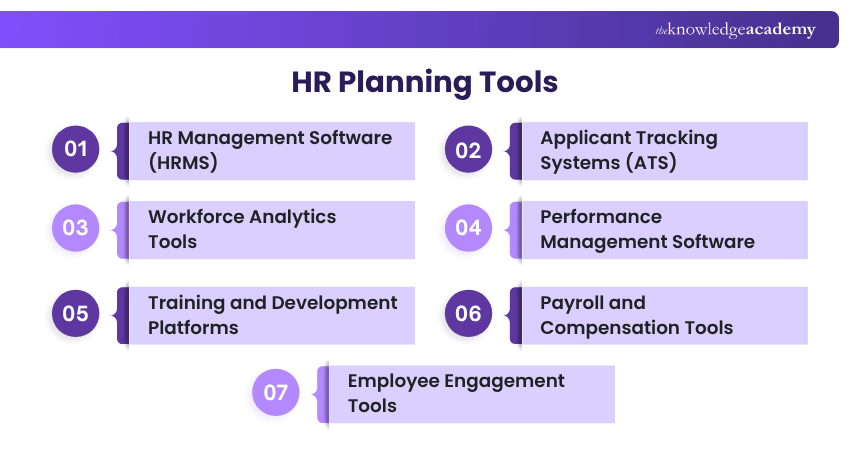
a) HR Management Software (HRMS): Keeps track of employee records, payroll, and benefits (SAP, Workday, BambooHR).
b) Applicant Tracking Systems (ATS): Help HR teams streamline hiring and identify suitable candidates (Greenhouse, iCIMS, Lever).
c) Workforce Analytics Tools: Provide real-time insights for workforce planning (Microsoft Power BI, Oracle HCM).
d) Performance Management Software: Tracks employee goals, feedback, and progress (15Five, Lattice).
e) Training and Development Platforms: Help employees upskill and grow (LinkedIn Learning, Udemy).
f) Payroll and Compensation Tools: Automate salary processing and benefits management (ADP, Gusto).
g) Employee Engagement Tools: Gather feedback to improve workplace culture (SurveyMonkey, Workday Peakon Employee Voice).
Extend this knowledge by learning how AI can support recruitment, workforce analytics, and employee engagement with our AI Automation Course for HR - Sign up now!

The Knowledge Academy develops accessible learning content across Project Management, IT, Cybersecurity, Data Science, Business Analysis, HR, Accounting and Finance, Leadership and Health and Safety. Its resources combine subject research with clear explanations to help professionals build practical knowledge across a wide range of disciplines.
View Detail

 If you wish to make any changes to your course, please


