


We may not have the course you’re looking for. If you enquire or give us a call on 01344203999 and speak to our training experts, we may still be able to help with your training requirements.
How to Pass PMI-ACP® Exam: A Complete Guide
ByVishnu SankarLast updated on: 17 October 2026
The PMI-ACP® exam validates a professional’s knowledge of Agile principles, practices, and tools across multiple frameworks. Passing the PMI-ACP® exam requires focused preparation, strong Agile fundamentals, and consistent practice with study plans and continuous review of Agile concepts. It enhances career credibility and Agile excellence.

Before You Start
1. Use the PMI-ACP® examination content outline as the foundation of your preparation.2. Develop conceptual understanding instead of relying only on memorisation.3. Follow a realistic study plan based on your existing Agile knowledge and available time.4. Practise exam-style questions and understand why each answer is right or wrong.5. Use mock exams to identify knowledge gaps and improve your exam readiness.
"Dear Candidate,
I'm not here just to ask you what Agile means. I want to know whether you can recognise a problem, understand the situation and choose an appropriate Agile response. Memorising every definition won't necessarily impress me.
Yours sincerely,
The PMI-ACP Exam Questions"
Sounds intimidating? It doesn't have to be. With the right preparation, you can strengthen your understanding of Agile practices and improve your ability to tackle scenario-based questions. In this blog, we'll explore how to pass the PMI-ACP® exam by turning scattered preparation into a focused, manageable plan.
Pro Tips on How to Pass the PMI-ACP® Exam
Passing the PMI-ACP® exam requires more than understanding Agile concepts. It also involves smart preparation, consistent practice and the ability to apply your knowledge to real-world scenarios.
With the right strategies, you can make your study sessions more effective and approach the exam with greater confidence. Here are some practical tips to help you prepare and improve your chances of success.
1) Go Through the PMI-ACP Handbook
The first step is to review the PMI-ACP® Handbook. It is an important resource for understanding the certification process before you begin your exam preparation. It provides information about eligibility requirements, application procedures, exam scheduling and certification policies. Reviewing these details early can help you avoid confusion and prepare for the certification process more effectively.
The handbook also explains important procedures, including application audits, rescheduling, cancellations and certification maintenance. Understanding these requirements beforehand can help you plan your certification journey and avoid last-minute complications.
2) Use the PMI-ACP Examination Content Outline Document
The PMI-ACP® Examination Content Outline (ECO) is another helpful resource that individuals should review before starting their exam preparation. It outlines the exam domains, tasks and knowledge areas that individuals need to understand.
The document also offers information regarding Agile tools and techniques that are relevant to the exam. The outline can help individuals identify important topics, organise their study plans and focus their preparation on the areas assessed in the exam.
3) Take up a PMI-ACP® Certification Course
Today, many training providers, including PMI Authorised Training Partners (ATPs), offer PMI-ACP® certification courses to individuals preparing for the exam. These courses are designed to provide individuals with detailed knowledge of Agile principles and how to implement various tools, frameworks and techniques in real-world projects.
Completing a qualifying PMI-ACP® Certification Course can also help individuals meet PMI's requirement of 21 hours of formal Agile training, which is necessary for exam eligibility. Therefore, individuals preparing for the PMI-ACP® exam will find them helpful. Moreover, depending on the course provider, training may include interactive live sessions, opportunities to ask questions, practice tests and feedback on performance. These features can help learners strengthen their understanding and identify areas for improvement.
4) Prepare Using PMI-ACP Study Guides
PMI-ACP® Study Guides are another useful way to prepare for the exam. Various study guides and exam preparation books are available from different publishers to help individuals understand complex Agile topics and practise exam questions.
PMI also provides official preparation resources, including the Agile Practice Guide and a PMI-ACP® reference list. These resources may be available online or in physical bookstores, depending on the publisher. Depending on the resource type, they may include:
a) A detailed explanation of different topics
b) Topic-wise summaries
c) Glossaries comprising important Agile terminologies
d) Practice questions
e) Sample papers
Trainer's Insight
Build your study plan around the Exam Content Outline (ECO) rather than treating every Agile topic equally. It helps you prioritise preparation around what the examination is designed to assess.
5) Practice Sample Questions
Simply memorising Agile concepts without practising how to apply them may not be enough to prepare effectively for the exam. Practising sample questions regularly also gives individuals an understanding of the exam's question formats and the types of answers they may need to choose.
Once you have understood a topic, you can start practising questions and revisit them to track your progress and identify areas for improvement. Practising questions regularly can also build confidence and improve exam readiness.
Common PMI-ACP® Exam Preparation Mistakes Checklist
Before the exam, check that you are not making these common preparation mistakes:
□ Memorising Without Understanding: Make sure you can apply Agile principles to different scenarios, not just recall definitions.□ Ignoring the Exam Content Outline: Use the ECO to keep your preparation focused on relevant exam content.□ Using Too Many Resources: Stick to a manageable set of reliable study materials.□ Skipping Mock Exam Reviews: Analyse incorrect answers to understand where and why you went wrong.□ Leaving Practice Until the End: Practise questions regularly throughout your preparation.□ Overlooking Weak Areas: Spend extra revision time on topics where your performance needs improvement.
Build a strong foundation in project management and develop the skills to support successful projects by joining the CAPM® Certification Training today!
6) Appear for Mock Tests
Want to pass the PMI-ACP exam? The key is knowing the exam inside out. But how to do that? Well, the answer to this question is simple – take as many mock tests as possible. Mock tests are practice exams designed to help the candidates grasp the gist of the actual exam. They are helpful in self-assessing, improving and building confidence before the examination.
PMI also offers an official PMI-ACP® Practice Exam that helps professionals become familiar with exam-style questions and assess their preparation. Reviewing the results after each attempt can help candidates identify knowledge gaps and focus their revision more effectively.
Pro Tip
Consistency matters more than excessively long study sessions. Set achievable weekly goals for learning, practice and revision, then adjust them as your performance improves.
7) Join Online Discussion Boards
Online discussion boards allow individuals preparing for the PMI-ACP® exam to connect with fellow learners, trainers and mentors. Platforms such as Facebook and LinkedIn offer communities where individuals can discuss Agile concepts, clarify doubts and seek guidance from experienced professionals.
These groups also provide opportunities to exchange study plans, preparation tips and personal experiences. Connecting with PMI-ACP® certified professionals can offer valuable insights into the exam preparation process and help individuals stay motivated.
8) Learn to Apply the Agile Mindset
The PMI-ACP® exam tests more than your knowledge of Agile concepts. It also assesses how well you can apply Agile principles to different project situations. Therefore, understanding the reasoning behind Agile decisions is just as important as learning the terminology.
Here are some ways to develop an Agile mindset during your preparation:
a) Focus on Collaboration: Understand how Agile teams work together, communicate openly and make decisions collectively.
b) Embrace Change: Learn why Agile approaches encourage teams to respond to changing requirements rather than rigidly follow an initial plan.
c) Prioritise Customer Value: Practise identifying solutions that deliver value to customers and stakeholders.
d) Encourage Continuous Improvement: Understand how feedback, retrospectives and regular reviews help teams improve their performance.
e) Think Beyond Memorisation: When answering scenario-based questions, consider which response best reflects Agile principles and the situation described.
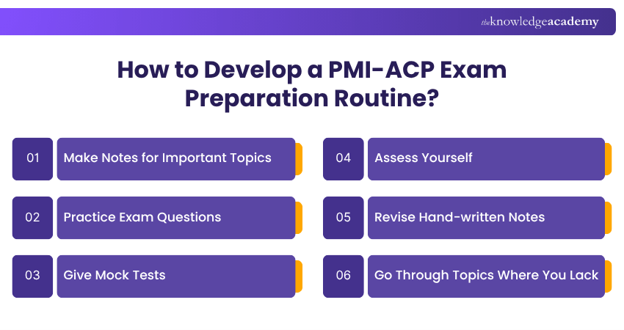
9) Develop a PMI-ACP® Exam Preparation Routine and Adhere to it
Preparing for the PMI-ACP® exam becomes easier when you follow a consistent study routine. Instead of studying for long hours occasionally, dedicate a fixed amount of time each day to learning Agile concepts and revising important topics. A well-structured routine can help you stay organised, manage your time effectively and avoid last-minute preparation.
Here are some practical tips to develop and maintain an effective study routine:
a) Set Fixed Study Hours: Allocate a specific time each day for exam preparation and follow it consistently.
b) Break Down the Syllabus: Divide the exam topics into smaller sections and set achievable daily or weekly learning targets.
c) Balance Learning and Revision: Include time for learning new concepts, revisiting previous topics and practising what you have learnt.
d) Track Your Daily Progress: Keep a record of completed topics and monitor whether you are meeting your study targets.
e) Allow Time for Breaks: Include short breaks between study sessions to maintain concentration and avoid burnout.
f) Stay Flexible: Adjust your routine when necessary, but ensure you remain consistent with your overall preparation goals.
10) What to do on the Day of the Exam?
Even after thorough preparation, candidates may feel nervous on exam day. Following practical exam-taking strategies can help them manage their time, understand questions and avoid unnecessary mistakes.
a) Read the instructions carefully before answering the questions.
b) Avoid spending too much time on difficult questions. Mark them for review, where permitted, and return to them before completing the relevant exam section.
c) Pay close attention to words such as ‘NOT’ or ‘EXCEPT’ to avoid misinterpreting the question.
d) Avoid calculating your expected score during the exam. All 120 questions should receive equal attention, as you cannot identify which 20 questions are unscored.
PMI-ACP® Exam Readiness Checklist
Before moving into final revision, use this checklist to assess your preparation:
□ I understand the current exam format and domains□ I can explain important Agile principles without relying heavily on notes□ I can apply Agile concepts to scenario-based questions□ I have identified and revised my weaker areas□ I regularly review why my practice answers are right or wrong□ I have practised managing my time under realistic exam conditions□ I have a focused final revision plan
Accelerate your career and become a certified project management professional! Join our PMP® Certification Training now!

Vishnu Sankar is a Senior Content Writer with 5+ years of experience across content development, software development, web development and system administration. His technical background and professional training support his expertise in IT and Tech, while his extensive research and writing experience covers Project Management and Health and Safety.
View Detail

 If you wish to make any changes to your course, please


