




We may not have the course you’re looking for. If you enquire or give us a call on 01344203999 and speak to our training experts, we may still be able to help with your training requirements.
How Does Artificial Intelligence Work: Explained
ByVishnu SankarLast updated on: 12 October 2026
Artificial Intelligence is driving innovation and transforming various industries across the globe. Discover how Artificial Intelligence works, from data processing to neural networks, transforming industries and everyday life. Read ahead to discover more interesting facts!
In a Nutshell
Artificial Intelligence works by processing data to recognise patterns and produce outputs such as predictions, recommendations, or generated content. In machine learning-based AI, models learn from data during training and apply those learned patterns to new inputs, enabling AI systems to perform tasks ranging from language processing to image recognition.
Artificial Intelligence (AI) is increasingly used across areas such as content creation, data analysis, automation and decision support. From content creation to workplace automation, it is now applicable across a variety of organisational areas. Developing AI skills can also help professionals adapt to increasingly AI-enabled roles. But have you ever wondered how does Artificial Intelligence work?
If you have, you are in the right place! This blog will not only help you understand how Artificial Intelligence works but walk you through its benefits and challenges too. Read until the end to understand its key concepts and applications.
What Does Artificial Intelligence (AI) Mean?
Artificial Intelligence refers to computer systems designed to perform tasks associated with human intelligence, such as recognising patterns, understanding language, making predictions, reasoning or supporting decisions. More precisely, AI refers to technologies that enable computer systems to perform tasks commonly associated with human intelligence, such as learning, reasoning, recognising patterns, understanding language, and making predictions or decisions.
Since AI is capable of all these things, it has emerged as one of the fascinating technological developments humans are now experiencing. Additionally, it has grown to be of utmost significance to modern enterprises and other forms of organisations.

What are the Objectives of Artificial Intelligence?
The objectives of Artificial Intelligence (AI) encompass a broad range of goals aimed at improving the capabilities of machines to perform tasks that usually require human intelligence. One of the primary objectives is the automation of repetitive tasks, increasing efficiency and freeing up human resources for more complex activities. This includes tasks like data entry, customer support, and basic decision-making processes.
AI can support consistent processing and reduce certain manual errors in suitable tasks, although its outputs still depend on data quality, model design and appropriate oversight. This is vital in fields like medical diagnostics, where accurate results can have significant implications for patient care.
Bonus Tip
Don’t start with AI simply because the technology is available. Start by defining the problem or task you want to improve, then determine whether AI is an appropriate solution and what data, resources, and oversight would be required.
How Does Artificial Intelligence Work?
AI systems generally work by using algorithms or models to process data, identify patterns, and produce outputs such as predictions, classifications, recommendations, or generated content. In machine learning-based AI, a model is first trained on data so that it can learn relevant patterns. Once trained, the model can process new inputs and generate outputs through a process known as inference.
AI systems do not necessarily learn every time they process new data. Many deployed models use previously learned parameters during inference and are updated only when they are retrained or otherwise modified.
The crucial point is to understand that AI is not merely a specific computer program or application, but rather a comprehensive field or science. Let’s explore how does Artificial Intelligence work in detail:
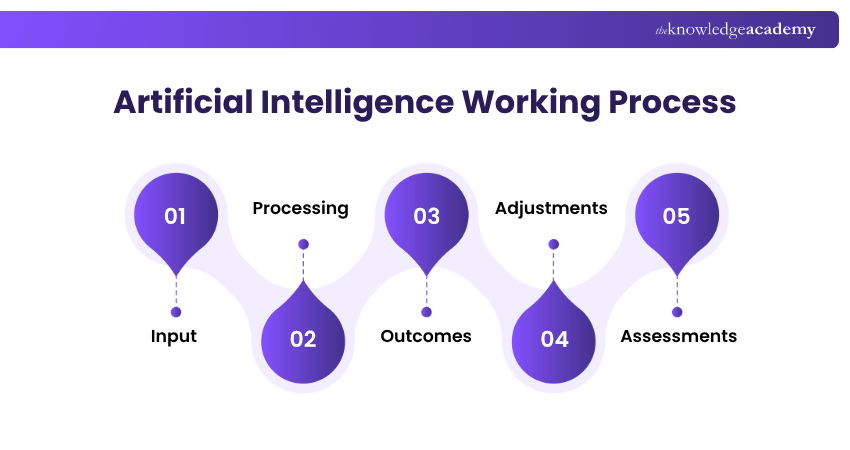
1) Input
Data is initially collected from various sources, including text, audio, and videos. Depending on the AI system, the data may need to be cleaned, labelled, transformed, or otherwise prepared before it can be used for training or processing.
Trainer’s Insight
More data does not automatically mean better AI. The relevance, quality, representativeness, and suitability of the data can be just as important as its quantity. Poor-quality or unrepresentative data can contribute to unreliable or biased model performance.
2) Processing
Once the data is gathered and input, the AI system processes it. The model processes the input using its learned parameters or programmed logic to identify relevant relationships, features or patterns required for the task.
3) Outcomes
After processing, a trained AI model can use learned patterns to produce an output for new input data. Depending on its purpose, the output could be a prediction, classification, recommendation, generated response, or another result.
4) Adjustments
An AI model’s performance can be evaluated against suitable metrics or expected outcomes. If its performance is inadequate, developers may adjust the data, model, parameters, training process, or other system components before evaluating it again. These improvements do not necessarily happen automatically each time the AI produces an incorrect output.
5) Assessments
In the final step, the AI performance is assessed to determine how reliably it performs its intended task. Evaluation and feedback can inform future improvements, monitoring, or retraining where necessary.
How AI Works?
Data → Training → Trained Model → New Input → Inference → Output → Evaluation
AI development can involve preparing relevant data and using it to train a model to recognise useful patterns. Once trained, the model can process new inputs during inference and produce an output. Its performance can then be evaluated to determine whether further improvements or retraining are needed.
Disciplines That Make Up AI
Understanding the differences between AI, Machine Learning (ML), and the various subfields within Artificial Intelligence can be challenging. Here's a concise overview of these disciplines:
1) Machine Learning
Machine Learning (ML) is an important subfield under AI and one of the key approaches used to develop modern AI systems. It involves learning patterns and relationships from data by identifying patterns and relationships within the data. ML algorithms use statistical techniques to improve at tasks over time, without being explicitly programmed for those tasks.
Machine learning models learn patterns from data and use those patterns to make predictions, classifications, recommendations, or other outputs on new inputs. ML encompasses both supervised learning, where the expected output is known from labelled datasets, and unsupervised learning, where algorithms identify patterns or structures in unlabelled data.
2) Neural Networks
Machine learning often utilises neural networks, which are algorithms loosely inspired by biological neural networks rather than direct replicas of the human brain. These networks include layers of interconnected nodes, or "neurons," that process and transmit information.
By modifying the strength of connections between neurons, the network can identify complex patterns, make predictions from new inputs, and improve its performance during training. Neural networks are useful for tasks like image recognition, speech understanding, and language translation.
3) Deep Learning
Deep learning is a significant subset of machine learning. It employs deep neural networks, which have multiple processing layers through which data is processed. This allows the machine to learn increasingly complex representations and patterns from data. Deep learning is highly effective at tasks like image and speech recognition, as well as Natural Language Processing, making it important for many modern AI applications involving complex data such as images, speech and language.
4) Natural Language Processing (NLP)
Natural Language Processing (NLP) focuses on enabling computer systems to process, analyse and generate human language. NLP combines computer science, machine learning, linguistics, and deep learning to analyse unstructured text or voice data and extract relevant information. NLP is used for tasks like speech recognition, natural language generation, spam detection, and virtual assistants.
5) Computer Vision
Computer vision applies AI and machine learning techniques to process and analyse visual data from images, videos, and other visual media. Computer vision uses AI and machine learning techniques, including deep learning in many modern systems, to analyse images and video. It is used for image recognition, classification, and object detection, and is crucial for applications like facial recognition and autonomous vehicles.
Step into the world of intelligent machines with the AI Course For Beginners – Sign up now!
Types of Artificial Intelligence (AI)
One common conceptual classification groups AI into four types based on functionality:
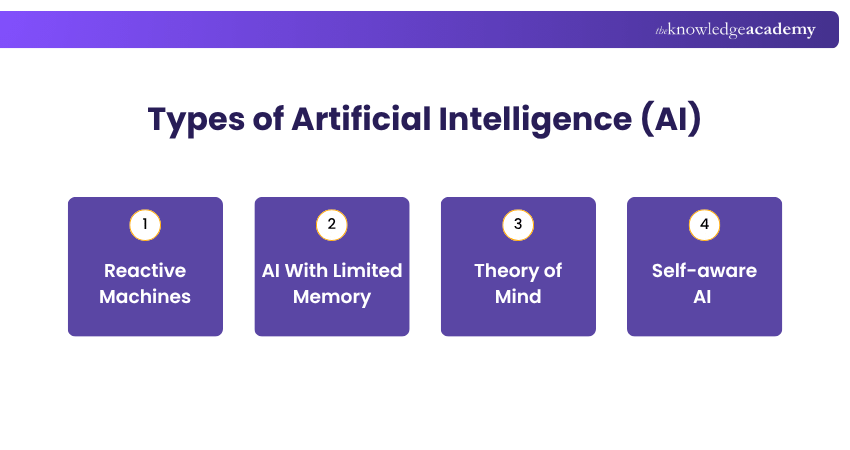
1) Reactive Machines
This type of AI is reactive; do not retain past interactions for future decision-making. These devices are made to carry out specific responsibilities. Reactive AI systems respond to current inputs according to their design without maintaining a memory of previous interactions for learning.
2) AI With Limited Memory
Limited-memory AI can use recent or historical information to support decisions or predictions. Limited-memory systems can use stored or recent information to support predictions or decisions over a relevant period. Autonomous vehicles with limited memory are an instance of limited memory AI.
3) Theory of Mind
Theory of Mind AI is a theoretical concept in which systems would be able to interpret aspects of human beliefs, intentions, emotions, or social context. These capabilities have not yet been implemented in machines. This kind of AI is the subject of extensive research.
4) Self-aware AI
Self-aware AI is a theoretical AI in which an AI system would possess consciousness or awareness of itself. No scientifically established self-aware AI currently exists.
Benefits of AI
AI can automate repetitive tasks, support data analysis, improve processing efficiency, and assist decision-making when used with appropriate data, controls, and human oversight. Let’s look at its benefits below:
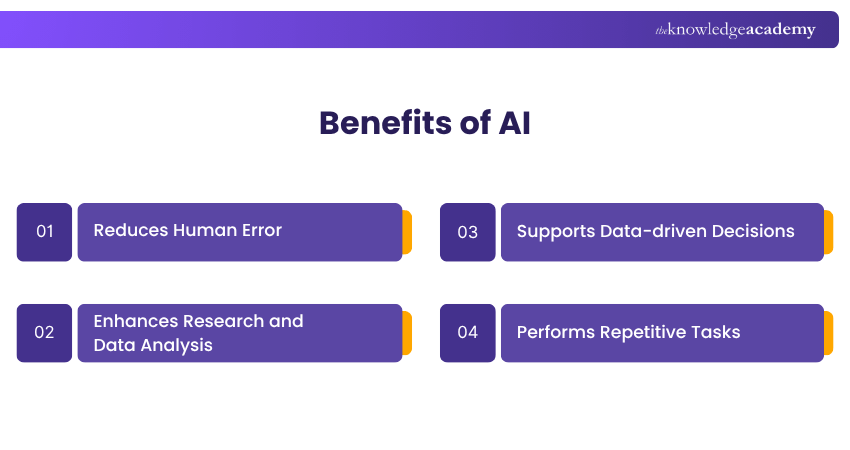
1) Reduces Human Error
AI can reduce certain manual errors by applying consistent rules or learned patterns to repetitive and data-intensive tasks. However, model errors, poor-quality data, and incorrect assumptions can still affect results.
2) Enhances Research and Data Analysis
AI can assist with information processing, pattern detection, forecasting and data analysis, depending on the system and task. AI can process large volumes of data and identify patterns more quickly in some analytical tasks, helping researchers and analysts examine information more efficiently. The data and analysis provided by AI enable data analysts to make more informed decisions proactively, improving overall efficiency.
3) Supports Data-driven Decisions
AI can analyse large datasets and identify patterns that support decision-making. However, outputs can still reflect bias in training data, model design, or deployment, so human review and appropriate governance remain important.
4) Performs Repetitive Tasks
AI can automate repetitive tasks, which can allow employees to spend more time on tasks requiring judgement, creativity or interpersonal skills. It can be used in HR for tasks like employee onboarding or integrated with chatbots on websites to handle customer inquiries and gather important data. This automation can streamline the different processes and improve efficiency.
Important Note
AI can automate tasks and support decision-making, but automation does not guarantee accuracy. AI outputs should be reviewed according to their context and level of risk, particularly when errors could affect people, finances, safety, or other important decisions.
Develop skills to teach machines to think with data by signing up for the Machine Learning Course now!
What are the Challenges of Artificial Intelligence?
While using AI might bring a lot of benefits, it also introduces certain challenges. Here are some of the challenges you might face working with AI:
1) Data Privacy and Security
AI systems may be trained to process large volumes of data, some of which can contain personal or sensitive information. Inadequate collection, storage, access controls, or system security can create privacy and security risks. Appropriate data governance, security measures, and compliance with applicable privacy requirements are therefore important when developing and deploying AI systems.
2) Availability and Quality
Many AI systems depend on relevant, representative, and sufficiently high-quality data. Collecting, cleaning, labelling, and governing this data can require significant time and expertise. In some applications, limited or unrepresentative data can reduce model reliability and increase the risk of biased or inaccurate outputs.
3) Implementation Complexity
Implementing AI can require suitable infrastructure, skilled professionals, integration with existing systems, strong data governance, and ongoing monitoring. Organisations also need to consider cost, security, explainability, regulatory requirements, and whether AI is appropriate for the problem being addressed.
Quick Check
What happens during AI inference?A. The model is always retrainedB. The model processes new input using learned parametersC. All training data is deletedD. The model automatically changes its architectureCorrect Answer: B

Vishnu Sankar is a Senior Content Writer with 5+ years of experience across content development, software development, web development and system administration. His technical background and professional training support his expertise in IT and Tech, while his extensive research and writing experience covers Project Management and Health and Safety.
View Detail

 If you wish to make any changes to your course, please


