


 Top Rated Course

We may not have the course you’re looking for. If you enquire or give us a call on 01344203999 and speak to our training experts, we may still be able to help with your training requirements.
Guitar Parts: A Complete Guide to Guitar Components
The Knowledge Academy 15 July 2026Guitar Parts include the headstock, neck, and body, with components like tuners, frets, pickups, bridge, and knobs that shape sound and playability. Each component plays a unique role, and understanding them helps players maintain their instrument, customise tone, and appreciate the craftsmanship behind the guitar.

Training Outcomes Within Your Budget!
We ensure quality, budget-alignment, and timely delivery by our expert instructors.
Table of Contents

Every guitar tells a story, but its narrative power lies in the details. From the sleek neck where your fingers dance to the resonant body that shapes every note, each part plays a vital role in crafting that perfect sound you seek. Understanding these Guitar Parts is the key to unlocking your instrument’s full potential.
Each component has a unique role in shaping tone, sustain, and playability. Knowing how they work together can help you maintain your guitar, customise its sound, and play with confidence. In this blog, you will explore Guitar Parts to help you deepen your connection to the music you create. Keep reading to learn more!
Table of Contents
1) Parts of the Guitar
a) Headstock
b) The Tuning Pegs
c) Nut
d) Neck
e) Fretboard / Fingerboard
f) The Body
g) Neck Joint
h) Pick Guard
i) Pickups (Electric Guitars)
j) Tone & Volume Controls (Electric Guitars)
2) What is the Most Important Part of a Guitar?
3) What is the Part that Holds the Guitar Strap Called?
4) Conclusion
Parts of the Guitar
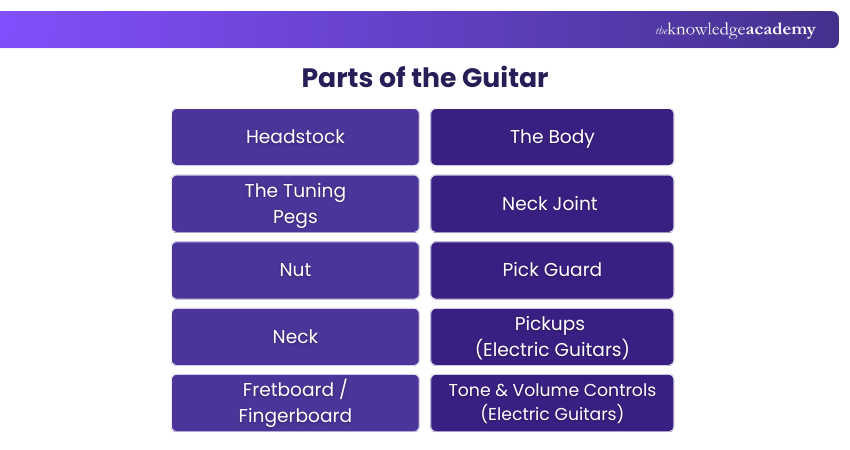
Understanding the main Guitar Parts helps learners connect better with the instrument and improve their playing technique. Each component plays a key role in shaping tone, comfort and overall performance. So, let's dive in and explore the essential parts of a guitar:
1) Headstock
The headstock sits at the very top of the guitar and serves as the anchor point for the tuning pegs. Its design can vary depending on the guitar style, and this variation contributes to the instrument’s overall resonance and sustain. It is a defining visual feature, often carrying the brand logo and shaping the guitar’s identity, making it both a practical and aesthetic component of the instrument.

2) The Tuning Pegs
The tuning pegs are small cylindrical components located on the headstock that allow you to adjust the tension of each string. Turning the pegs clockwise or counterclockwise can raise or lower the pitch to achieve the desired tuning, making them essential for producing accurate and pleasing sounds. Their design and quality impact tuning stability, and well-made tuning pegs ensure that your guitar stays in tune longer, providing both precision and reliability.
3) Nut
The nut might seem small, situated at the junction of the headstock and the neck, but its importance cannot be overstated. The nut is a crucial anchor point for the strings, maintaining their height and spacing as they pass from the headstock to the fretboard. An adequately cut nut ensures accurate intonation and smooth tuning stability, allowing the Guitar to resonate harmoniously across its entire range.
4) Neck
The neck is the long part of the guitar that extends outward from the body. It acts as the pathway for the strings as they travel from the bridge to the headstock. It’s the section you hold with your fretting hand, making it central to how you play and navigate notes. The neck houses the fingerboard and frets, enabling precise pitch control, and its shape, thickness, and material greatly influence playability and tone.
5) Fretboard / Fingerboard
The fretboard, also known as the fingerboard, is where melody meets precision. Mounted on top of the neck, this flat surface contains metal frets embedded at specific intervals, effectively dividing the neck into distinct musical notes. Guitarists press down on the strings against these frets to produce different pitches and execute chords and melodies accurately and clearly.
6) The Body
The body is the central part of the guitar and is the heart of the instrument. This is where sound is produced or amplified, depending on the Guitar Type. In acoustic guitars, the body is hollow and resonant whereas in electric guitars, it features a solid body that houses pickups and electronic components. The shape, size, and material of the body influence the guitar’s sound, making it one of the most defining components of the instrument.
7) Neck Joint
The neck joint, or heel, is the unsung hero of the Guitar's stability and resonance. This is where the neck meets the body of the Guitar, and the design of this junction can significantly impact the instrument's playability and tonal characteristics. Standard neck joint designs include bolt-on, set-neck, and neck-through construction, allowing players to tailor their instruments to their specific preferences and playing styles.
Explore the world behind chart-topping music with our Music Production Course – Join today!
8) Pick Guard
Often overlooked but essential, the pickguard protects the Guitar's body from the inevitable scratches and damage caused by the player's strumming or picking motions. Made of plastic or other materials, this shield is positioned below the strings and above the body, providing an extra layer of defence without compromising the instrument's aesthetics. With various shapes and designs available, pickguards can add visual flair to the Guitar.
9) Pickups (Electric Guitars)
The pickups are electromagnetic devices placed beneath the strings that convert vibrations into electrical signals. Then, they are sent to an amplifier to produce sound. Their type and configuration play a major role in shaping tone and versatility. This makes pickups central to the unique voice of every electric guitar.

10) Tone & Volume Controls (Electric Guitars)
Electric Guitars come equipped with tone and volume controls, allowing players to shape their sound according to their preferences and musical context. The tone control knob adjusts the frequency response of the pickups, allowing for subtle or drastic changes to the Guitar's timbre, from warm and mellow to bright and biting. Meanwhile, the volume control knob regulates the output level, making these controls indispensable tools for sculpting your desired tone.
11) Sound Hole (Acoustic Guitars)
The sound hole is a defining feature of acoustic Guitars, serving as a portal to the instrument's soulful resonance. This opening allows the sound generated by the vibrating strings to resonate within the hollow chamber, producing a rich and vibrant tone that fills the room with warmth and character. The size and shape of the sound hole can influence the Guitar's projection and tonal characteristics, making it a crucial component of its acoustic personality and sonic signature.
Unlock the keys to your musical journey and start playing piano confidently with Piano Course – Sign up now!
12) Electric Guitar Bridge
As the anchor point for the strings, the bridge of an electric Guitar plays a big role in intonation and sustain, ensuring that every note rings accurately and clearly across the instrument's entire range. It not only facilitates the adjustment of the string height and action for optimal playability but also transmits the strings' vibrations to the Guitar's body, contributing to its overall resonance and tonal character.
13) Acoustic Guitar Bridge
Similar to its electric counterpart, the bridge of an acoustic Guitar is essential for supporting the strings and sending their vibrations to the instrument's body, ensuring that every strum and pluck produces a clear and articulate sound. However, acoustic Guitar bridges typically feature a different design, often incorporating bridge pins to secure the strings in place and optimise their tension and intonation.

14) Strings
The strings are the heart and soul of any Guitar, serving as the conduit through which music flows and emotions are expressed. Whether made of metal or nylon, these thin strands are stretched across the fretboard and tuned to specific pitches, producing the sounds that form the foundation of music in any genre or style. With various gauges and materials available, Guitarists can customise their instrument's playability, tone, and responsiveness to suit their preferences and playing style.
15) Whammy Bar (Electric Guitars)
Many electric guitars feature a whammy bar, also called a vibrato or tremolo bar. It's connected to the bridge. Pressing it alters string tension, shifting the pitch and producing interesting sound effects that add character and flair to your playing.
Discover passions that inspire and enrich your life with Hobbies & Interests Courses – Sign up now!
What is the Most Important Part of a Guitar?
Based on context, the most important elements of a guitar consist of its body and neck, as well as its strings, but these components are vital for operational purposes. A guitar functions thanks to the body, which generates sound amplification and enables the neck to fret and produce sound vibrations with the strings.
What is the Part that Holds the Guitar Strap Called?
The parts that hold the guitar strap are called strap pins or strap buttons. These are small, rounded metal posts on the guitar’s body that secure the strap in place. Electric guitars, basses and many acoustics usually feature two pins: one at the bottom and the other either on the upper body shoulder or at the neck joint.
Conclusion
Understanding the different Guitar Parts is about appreciating how each piece contributes to the instrument’s sound, playability, and character. From the headstock and tuning pegs to the neck, body, and pickups, every detail works together to shape your musical expression. Knowing your guitar inside and out deepens your connection to the music you create, elevating both the playing experience and your creative journey.
From muddy mixes to crystal-clear sound, master the art of audio finesse in our Mixing and Mastering Course - Sign up now!
Frequently Asked Questions
Can I Replace the Pickups on My Electric Guitar to Change Its Sound?

Yes, replacing pickups is a common practice among Guitarists looking to customise their instrument's sound. Different types of pickups offer unique tonal characteristics, allowing you to achieve various sounds, from warm and vintage to crisp and modern.
How Often Should I Change My Guitar Strings?
The frequency of string changes depends on important factors such as how often you play, your playing style, and environmental conditions. As a general guideline, it's recommended to change your Guitar strings every one to three months or when they start to sound dull, lose their tuning stability, or show signs of wear and corrosion.

The Knowledge Academy


Global Training Provider
The Knowledge Academy is a world-leading provider of professional training courses, offering globally recognised qualifications across a wide range of subjects. With expert trainers, up-to-date course material, and flexible learning options, we aim to empower professionals and organisations to achieve their goals through continuous learning.


 If you wish to make any changes to your course, please


