




We may not have the course you’re looking for. If you enquire or give us a call on 01344203999 and speak to our training experts, we may still be able to help with your training requirements.
Goals of Artificial Intelligence: The Future Vision
ByVishnu SankarLast updated on: 19 September 2026
Artificial Intelligence (AI) goes beyond being just a trendy term; it's rapidly advancing to transform our lifestyles. AI's possibilities are vast, from improving daily ease to tackling worldwide issues.
Quick Preview
1. AI aims to help systems learn, reason, recognise patterns and support decision-making.2. Different AI systems pursue different goals depending on their purpose and application.3. AI can support automation, planning, communication and creative tasks.4. Artificial General Intelligence (AGI) remains a long-term research aspiration rather than an established capability.5. AI development also needs to consider safety, fairness, privacy and accountability.
In our technology-focused society, Artificial Intelligence (AI) is changing industries like healthcare and artistic expression. Goals of Artificial Intelligence extend beyond automation; they involve developing systems that can learn, adjust, and enhance.
Envision a future where Artificial Intelligence comprehends our feelings, foresees our requirements, and proactively addresses complicated issues. This blog delves into the ambitious goals of Artificial Intelligence, demonstrating how these advancements will revolutionise our everyday lives.
Goals of Artificial Intelligence
AI is developed with a wide range of objectives in mind, from solving specific, narrow problems to exploring increasingly adaptable and general capabilities. Understanding these goals helps explain why AI systems are designed so differently depending on what they're actually built to achieve. Let's discuss the goals of AI in detail:
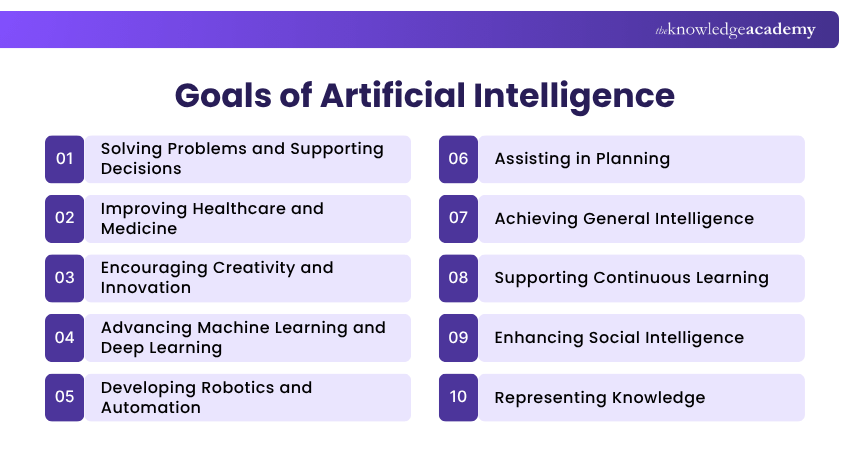
1) Solving Problems and Supporting Decisions
The main objective of AI is to build systems capable of solving complex problems and making independent decisions, drawing on techniques such as Machine Learning, data analysis and pattern recognition to do so.
It can assess massive amounts of information, identify current trends, and make informed decisions. Artificial Intelligence is particularly beneficial in sectors like finance, where it can offer investment and personal finance advice. Additionally, it plays a crucial role in optimising logistics for supply chain management.

2) Improving Healthcare and Medicine
A key goal of AI in healthcare is to support earlier, more accurate diagnosis and reduce the margin for human error in clinical settings. Rather than replacing medical professionals, the aim is to give them better tools, faster analysis of complex data, more consistent detection standards and support for high-stakes decision-making, so that patient outcomes improve across the board.
3) Encouraging Creativity and Innovation
AI can leverage creativity to promote innovations in various industry sectors. Artists and designers can utilise AI to build next-level art and music. Moreover, AI music production tools can help companies create unique music by processing large volumes of data. It has opened doors for new market trends.
4) Advancing Machine Learning and Deep Learning
In the field of AI, two specialised areas stand out: Deep Learning (DL) and Machine Learning (ML). The main goal of both is to construct systems that enhance the efficiency of coding. For example, ML and DL use information from surroundings to assist self-driving cars.
5) Developing Robotics and Automation
When it comes to robotics and automation, AI is the core. It aims to provide machines with the capability to work independently. This includes tasks from intricate industrial operations to household duties. Robots can even function in unsafe conditions like space ventures and deep-sea expeditions, thus improving industry productivity by automating tasks.
6) Assisting in Planning
AI aims to support better decision-making in complex, data-heavy planning problems, whether that's coordinating city infrastructure, managing disaster response or scheduling resources efficiently. The underlying objective is to help organisations and systems anticipate outcomes and allocate resources more effectively than manual planning alone would allow.
Trainer Insight
AI is an umbrella field rather than one single technology. Different AI systems are designed around different capabilities, problems and objectives.
7) Achieving General Intelligence
A significant objective of AI research in the long run is to attain general intelligence, commonly known as Artificial General Intelligence (AGI). In contrast to specialised narrow AI systems, AGI would possess the capacity to comprehend, acquire, and utilise knowledge in various tasks akin to human cognitive capabilities. Although we have yet to reach AGI, the quest for these objectives fuels a significant portion of AI research.
8) Supporting Continuous Learning
AI systems are being developed more and more to facilitate ongoing learning, allowing them to adjust to new data and evolving circumstances. This ability is essential for tasks like cyber security, where AI systems need to learn how to detect and react to new dangers continuously. Ongoing education is vital in customised learning systems, where Artificial Intelligence can customise learning experiences based on each student's needs and progress.
9) Enhancing Social Intelligence
Another key objective of AI is to improve social intelligence, allowing machines to comprehend and engage with humans more organically and intuitively. This involves comprehending feelings, cultural intricacies, and societal environments. The use of social intelligence in AI includes customer service chatbots offering empathetic responses and AI systems aiding in mental health support.
10) Representing Knowledge
Knowledge representation is one part of AI research that concentrates on how information about the world can be presented. The computer system then applies it to address intricate tasks. This implies organising data in a manner that enables AI systems to comprehend, think, and acquire knowledge. Efficient knowledge representation is essential for creating intelligent systems capable of tasks such as language translation, question answering, and meaningful conversations.
Reality Check
Most AI systems are designed or trained to perform particular classes of tasks. AGI represents a broader research ambition and should be distinguished from currently deployed AI.
The AI Agents Foundation and Practitioner (The Builders) Training equips you with the skills to develop and deploy intelligent agents with confidence – Sign up now!
Benefits of Artificial Intelligence
The benefits of AI are vast and varied. It can process and analyse large amounts of data quickly and accurately, leading to more informed decision-making. AI takes over routine and repetitive tasks, allowing human workers to concentrate on more complex and creative initiatives. Here are some key advantages:
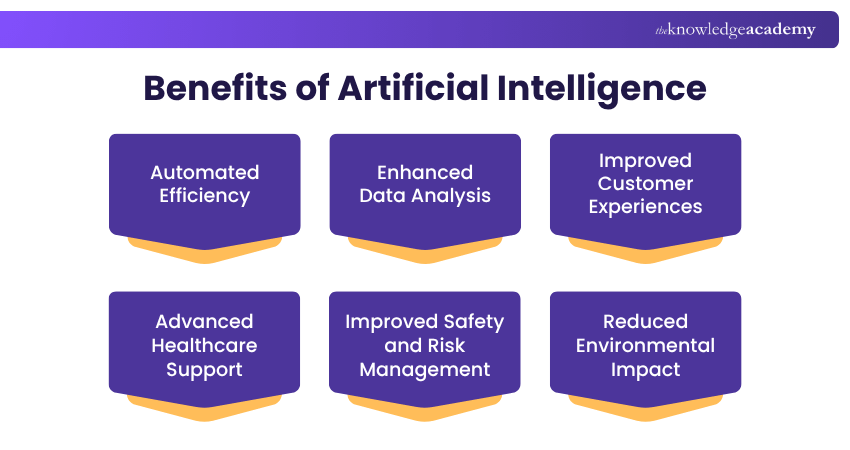
1) Automated Efficiency
AI significantly improves efficiency by automating routine tasks, allowing humans to focus on more complex and creative aspects of their work. This leads to higher productivity and reduced operational costs. For instance, AI-powered automation in manufacturing and logistics optimises production lines and supply chain management, leading to faster and more efficient processes
2) Enhanced Data Analysis
AI systems can process vast amounts of data at incredible speeds, uncovering patterns and insights that humans might miss. This capability is invaluable in fields such as healthcare, finance, and marketing, where data-driven decision-making with AI is crucial. One key example is how AI algorithms can analyse medical images to detect diseases early or examine historical data to predict market trends.
3) Improved Customer Experiences
AI enhances customer service through personalised experiences and 24/7 support. Chatbots and virtual assistants can handle customer inquiries in real-time, providing immediate responses and solutions. Additionally, AI-driven recommendation systems, like those used by Netflix and Amazon, suggest products and content tailored to individual preferences, enhancing user satisfaction.
4) Advanced Healthcare Support
AI contributes significantly to healthcare by enabling early diagnosis, personalised treatment plans, and efficient management of patient records. Machine Learning models can predict disease outbreaks, identify potential health risks, and assist in developing new drugs and therapies. For instance, AI algorithms have been used to analyse genetic information to provide personalised medicine.
5) Improved Safety and Risk Management
AI enhances safety and risk management across various industries. In transportation, AI systems improve road safety through Advanced Driver-Assistance Systems (ADAS) and autonomous vehicles. In finance, AI detects fraudulent activities by analysing transaction patterns. Additionally, AI-driven predictive maintenance in industries prevents equipment failures and accidents by forecasting potential issues before they occur.
6) Reduced Environmental Impact
AI technologies contribute to environmental sustainability by optimising resource use and energy consumption. For example, AI algorithms can improve the efficiency of energy grids, reducing waste and promoting the use of renewable energy sources. AI-driven solutions in agriculture help optimise crop yields and reduce the environmental impact of farming practices by analysing soil conditions and weather patterns.
Drawbacks of Artificial Intelligence
Despite its many benefits, AI also poses several challenges and drawbacks. One of the primary concerns is the potential for job replacement as AI systems take over tasks traditionally performed by humans. This can lead to economic inequality and requires significant workforce retraining and education initiatives.
AI's ethical and privacy implications are another area of concern. AI systems can breach privacy and misuse information by collecting and analysing large amounts of personal data. There are also concerns about bias in AI algorithms, which can lead to unfair or unequal treatment in areas such as employment, law enforcement, and lending.
Furthermore, the development of AI raises significant questions about control and accountability. As AI systems become more autonomous, determining responsibility for their actions becomes more complex. This is particularly concerning in areas like autonomous weapons and other high-stakes applications.
The question 'Will AI take my job?' has sparked debates across industries. By evaluating emerging trends and roles that are most susceptible to automation, businesses can better prepare their workforce for a collaborative future where AI complements human creativity and problem-solving.
AI Responsibility Check
Before implementing an AI application, consider:
□ Is the intended purpose clearly defined?□ Is the available data suitable for that purpose?□ Can the system's performance be measured?□ What happens when the system makes a mistake?□ Could bias affect people or outcomes?□ Is personal or sensitive information involved?□ Is appropriate human oversight required?□ Is responsibility for the system and its outcomes clear?
Take your first step into the technological leap that is Artificial Intelligence with the AI Course for Beginners – Sign up now!

Vishnu Sankar is a Senior Content Writer with 5+ years of experience across content development, software development, web development and system administration. His technical background and professional training support his expertise in IT and Tech, while his extensive research and writing experience covers Project Management and Health and Safety.
View Detail

 If you wish to make any changes to your course, please


