




We may not have the course you’re looking for. If you enquire or give us a call on 01344203999 and speak to our training experts, we may still be able to help with your training requirements.
What is Game Theory in Economics: Explained in Detail
ByThe Knowledge AcademyLast updated on: 18 September 2026
Game theory in economics explains how individuals and firms make strategic decisions by analysing competition, cooperation, pricing, and negotiation outcomes. It is applied in markets, auctions, contract design, policymaking, and more.
In a Nutshell
1. Game theory studies strategic situations where one participant's outcome depends partly on the choices of others.2. Players, strategies and payoffs are fundamental elements used to structure and analyse a game.3. Games can be cooperative or non-cooperative, symmetric or asymmetric, simultaneous or sequential and zero-sum or non-zero-sum.4. Nash equilibrium identifies an outcome where no player can improve their payoff by changing strategy unilaterally.5. Game theory can be applied to market competition, oligopolies, auctions and negotiations, although real-world behaviour may not always match model assumptions.
Imagine two competing businesses deciding their next move. One lowers its prices, but before the other responds, it must consider whether matching the price will protect market share or reduce profits. Neither decision exists in isolation. Each depends on what the other player might do.
This strategic interplay is exactly what game theory in economics helps us understand. It provides a structured way to analyse competition, cooperation, negotiations and other situations where one participant's decision can influence another's outcome. In this blog, we'll explore its types, principles, assumptions, applications, examples, benefits and limitations.
What is Game Theory?
Game theory is a branch of mathematics and economics that studies how individuals or groups make decisions when the outcome of each decision depends partly on the actions of others. It focuses on strategic thinking, where each participant tries to achieve the best possible result while anticipating how others will behave.
It is commonly used in economics, business, politics, and Psychology to understand competition, cooperation, and strategy. For example, companies deciding prices, countries negotiating treaties, or people planning moves in a game can all be examined using game theory.

How Game Theory Works in Economics?
In economics, individuals, firms and governments make decisions based on their objectives and expectations about how others may act. Game theory provides a structured framework for representing these interactions and analysing possible outcomes.
A basic game can be understood through three key components:
1) Players: Players are the decision-makers involved in the strategic situation. Depending on the economic problem, they could be consumers, businesses, governments, bidders or other economic agents.
2) Strategies: Strategies are the actions or plans available to each player. For example, competing firms might choose between setting a high price and setting a low price.
3) Payoffs: Payoffs represent the outcomes associated with different combinations of strategies. They may represent profit, cost, utility or another measure relevant to the players.
The Role of Nash Equilibrium
Nash equilibrium refers to an outcome at which no player can increase their payoff by changing their decisions unilaterally. This describes an outcome in the model, not a process that must unfold over time. Given the other players' strategies, no player has an incentive to change their own strategy alone. Nash Equilibrium is named after American Mathematician John Forbes Nash Jr., who published the idea in the 1950s.
Quick Check
Do people always behave exactly as a rational model predicts?Not necessarily. Real decisions can be influenced by incomplete information, emotions, uncertainty and other factors. This is one reason game theory models should be interpreted according to the assumptions on which they are built.
Types of Game Theory in Economics
Game theory offers frameworks to analyse strategic interactions, where decisions by one player affect others. Here are the main types:
1) Cooperative vs Non-cooperative Games
Cooperative games involve players forming alliances or coalitions to achieve a better outcome together. Cooperative models allow players to form binding agreements, although an agreement need not benefit every player equally. For example, two companies may collaborate on research to share costs and profits.
Non-cooperative games, on the other hand, assume that players act in their own self-interest without relying on binding agreements. Each player tries to maximise their own profit, often leading to more competitive and unpredictable outcomes, such as price wars in competitive markets.
2) Symmetric vs Asymmetric Games
In a symmetric game, players have corresponding strategies and payoffs: swapping their roles does not change the structure of the game. A classic example is the prisoner's dilemma, where both players face the same choices and consequences.
In asymmetric games, on the other hand, the players have different roles, abilities, information, or payoffs. For instance, in a job negotiation, an employer and a candidate operate with different knowledge and power dynamics, creating asymmetry in their strategies and goals.
3) Simultaneous vs Sequential Games
Simultaneous games are games in which players make their decisions without observing one another's current choices. They need not act at the same time. A simplified example is rival firms setting prices without observing each other's current decision.
In contrast, sequential games, however, are played in turns, where one player moves first and others respond based on the initial move. The order of play significantly impacts strategy; think of chess or investment decisions, where the first mover can influence others' future actions.
Pro Tip
Pay attention to the timing of decisions. Ask whether players choose without observing each other's current move or whether one participant acts first and others respond.
4) Zero-sum vs Non-zero-sum Games
A zero-sum game is one in which one player's gain is exactly equal to another player's loss. Across the players in the model, the total payoff is constant. A simplified two-player wager illustrates this clearly.
In contrast, non-zero-sum games allow for outcomes where all players can benefit or lose. This category is especially relevant in economics and real-life business, where cooperation such as joint ventures, can lead to mutual gains beyond individual success.
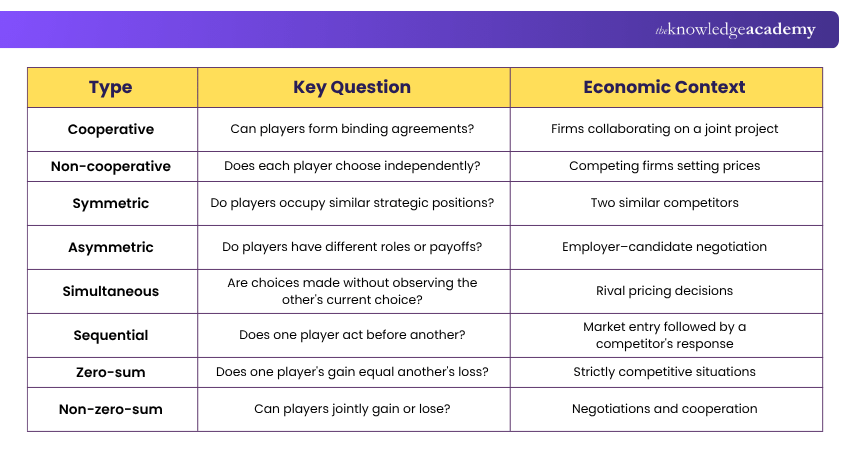
Here's a quick glimpse into the types of game theory in economics:
Applications of Game Theory in Economics
From modelling competing behaviours between economic agents in business to areas such as mergers and acquisitions, capital structure, corporate governance and asset pricing, game theory has tremendous applications in economics. Its applications also include analysing strategic behaviour, formulating optimum responses, and understanding voting paradoxes.
1) Market Competition
Game theory can help model how competing firms respond to one another. Consider two firms deciding whether to compete aggressively or maintain higher prices. Each firm's profits can depend not only on its own decision but also on its competitor's strategy:
a) If one firm lowers its price while another maintains a higher price, the lower-priced firm may attract more customers.
b) If both lower prices, however, both may experience reduced profit margins.
Game theory provides a framework for representing these choices and analysing the incentives facing each competitor.
2) Game Theory in Oligopoly Markets
Let's say that the oligopoly market comprises two rival competitors, Firm A and Firm B. The table below summarises strategies and rewards, depending on the firms' cooperation in price setting. After playing the game simulation, the following outcomes were observed:
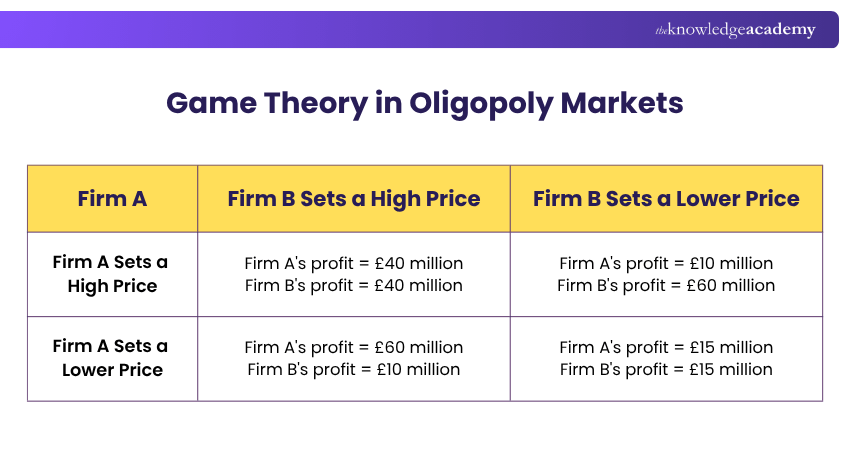
When Firm A sets a high price and Firm B sets a lower price, most consumers will buy Firm B's products, making it more profitable than Firm A. The opposite is true when Firm B sets a high price and Firm A sets a lower price.
If both firms set high prices, neither firm will carry a market share advantage, but the high price will create a moderately high profit for each firm. Meanwhile, if both firms set a low price, neither firm will achieve a market share advantage.
3) Use in Auction Design and Bidding Strategies
Auction design refers to the process of choosing the rules and type of an auction to achieve an objective, such as efficiency or maximising revenue. Game theory can help compare and assess various auction formats based on their incentives and expected outcomes. Factors such as entry fee, reserve price, information disclosure and number of items can all affect the auction design.
Meanwhile, in game theory, a bidding strategy tells a bidder how much to bid based on the item's valuation, as well as the number and type of other bidders. An optimal bidding strategy depends on the auction rules and the bidder's assumptions about other bidders. In a simple case, a winning bidder's payoff is the item's value minus the price paid and any applicable fees; expected payoff also accounts for the chance of winning.
Trainer Insight
Rules shape strategy. Changing an auction's structure can change participants' incentives, which can alter how they bid and the outcomes that emerge.
4) Game Theory in Negotiations and Bargaining
By analysing the interactions between parties, game theory can help examine bargaining strategies and possible negotiation outcomes. By adapting game theory strategies to a specific negotiation context, parties can spotlight opportunities for mutually beneficial agreements rather than engaging in risky win-lose scenarios.
Improve how to analyse historical data for financial information with the Financial Modelling and Forecasting Training - Sign up now!
Examples of Game Theory in Economics
The following widely regarded examples of game theory illustrate the significance of this framework in analysing and predicting human behaviour and strategic outcomes. Here are some popular ones:
1) The Prisoner's Dilemma
In this well-known example of game theory, the prisoner's dilemma involves two arrested criminals. Prosecutors have no concrete evidence to convict them, and to get a confession, officials question the prisoners in separate chambers. The prisoners don't have the means to communicate with each other, and the officials present four deals (often showcased as a 2 x 2 box). The results are summarised in the following table:
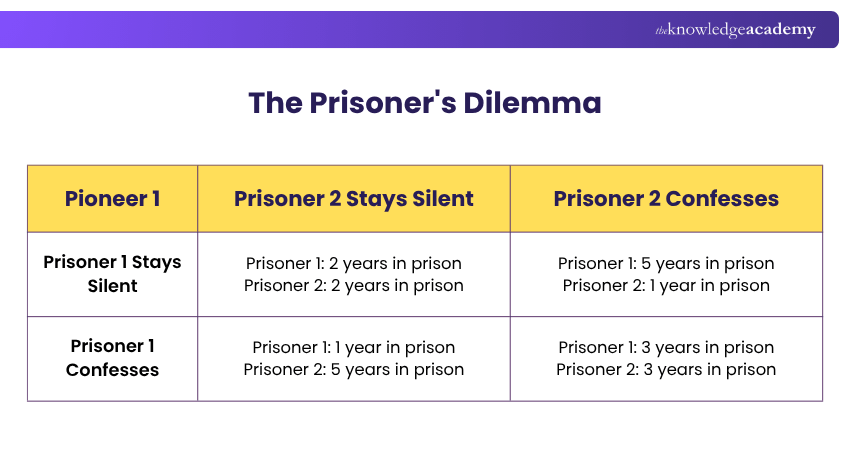
Since neither is aware of the other's strategy (and there's no certainty that one won't confess), both are likely to confess and receive a three-year prison sentence. The Nash equilibrium suggests that in this scenario, both players will make the move that's individually best for them but worse for them collectively.
2) Price War
A price war in game theory occurs when competing firms repeatedly lower prices to gain market share. While reducing prices may attract customers in the short term, sustained cuts can reduce competitors' profit margins. Game theory helps explain why firms may still engage in price wars when each firm fears losing customers if it does not respond.
3) Matching Pennies
Matching Pennies is a simple game that illustrates strategic unpredictability. Two players choose between two options, and one player wins if the choices match while the other wins if they differ. The game demonstrates the importance of mixed strategies, where players randomise their decisions to avoid being predictable.
4) Tariff or Trade War
A tariff or trade war occurs when countries impose trade barriers or tariffs in response to one another. While each country aims to protect its domestic industries, the result can include higher prices, reduced trade and losses for some groups. Game theory helps explain why countries may continue such strategies even when a different choice could benefit both under the assumptions of a particular model.
Gain deeper insight into the diverse procedures of costing and pricing in our detailed Costing and Pricing Training - Sign up now!
Benefits and Limitations of Game Theory in Economics
Game theory is a powerful tool that revolutionised the field of economics, offering several benefits as well as some limitations. Let's explore its benefits and drawbacks in detail:
1) Benefits of Applying Game Theory
Game theory offers several benefits, including the following:
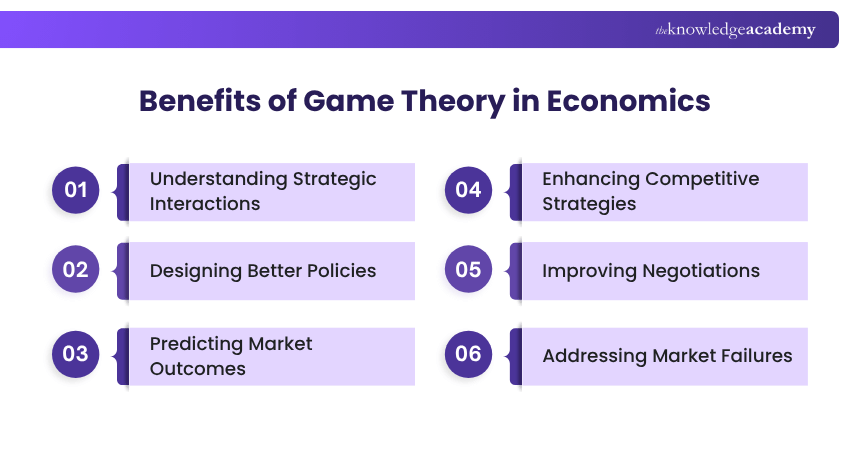
a) Understanding Strategic Interactions: Game theory helps analyse how the decisions of individuals, businesses or governments influence the choices and outcomes of others.
b) Designing Better Policies: Game theory helps policymakers anticipate how different groups may respond to rules, incentives or policy changes.
c) Predicting Market Outcomes: Game theory provides a framework for analysing how strategic behaviour among market participants can influence prices, competition and other outcomes.
d) Enhancing Competitive Strategies: Game theory helps businesses evaluate competitors' possible actions and develop strategies in response to changing market conditions.
e) Improving Negotiations: Game theory helps parties understand competing interests, possible responses and trade-offs when working towards an agreement.
f) Addressing Market Failures: Game theory helps analyse situations where individual incentives may produce inefficient outcomes and supports the evaluation of possible interventions.
2) Criticisms and Limitations in Economic Contexts
Game theory comes with a significant baggage of limitations, including the following:
a) Assumption of Rationality: Game theory often assumes that every player is rational and has complete information, which may not always be true in real-world scenarios.
b) Complexity of Real-world Applications: Real-life situations can display far greater complexity than the models used in game theory, making it a challenge to apply theoretical results directly.
c) Multiple Equilibria: Many games have multiple equilibrium states, making it difficult to predict which one will occur.
d) Limited Predictive Power: While game theory can suggest possible outcomes, its predictions depend on how well the model captures people's incentives, information and behaviour.
The following myths need to be considered related to game theory in economics:
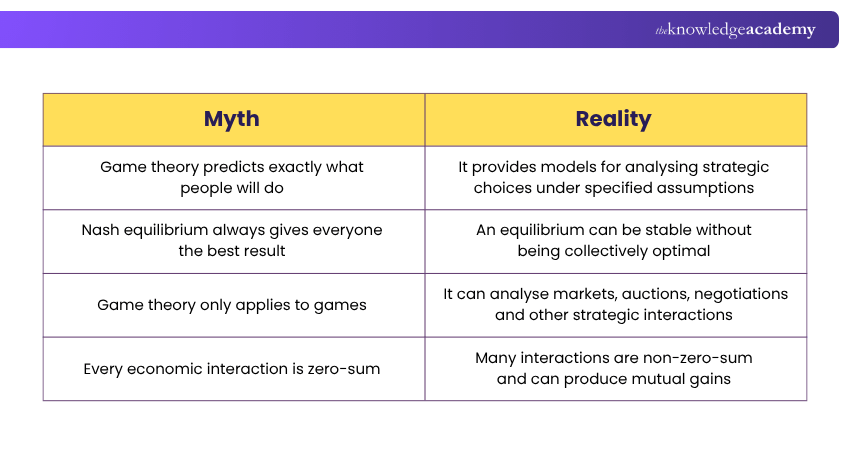
So, treat game theory models as structured representations of strategic situations rather than perfect replicas of reality. Their conclusions should always be interpreted in light of the assumptions used.

The Knowledge Academy develops accessible learning content across Project Management, IT, Cybersecurity, Data Science, Business Analysis, HR, Accounting and Finance, Leadership and Health and Safety. Its resources combine subject research with clear explanations to help professionals build practical knowledge across a wide range of disciplines.
View Detail

 If you wish to make any changes to your course, please


