




We may not have the course you’re looking for. If you enquire or give us a call on 01344203999 and speak to our training experts, we may still be able to help with your training requirements.
Functions of Management Accounting: An Overview
ByNaveena VenkatesanLast updated on: 09 October 2026
Are you curious to know about the functions of management accounting? It plays a vital role in business for decision-making, planning, and performance evaluation. This blog explores key functions like budgeting, cost management, and financial analysis, highlighting their importance in achieving organisational goals.
Quick Look
1. Management accounting turns financial and operational data into information that supports planning, control and decision-making.2. Forecasting, budgeting and cost management help organisations plan ahead and control spending.3. Comparing actual results with budgets and forecasts shows where performance is off track and where action is needed.4. Reporting, advisory work and ad hoc analysis give managers the right information at the right time.5. Taken together, these functions help organisations use resources effectively and work towards their objectives.
Behind every successful business is a steady flow of financial decisions. From budgeting to strategic planning, the tasks can be overwhelming. Without clear, reliable information, even small decisions become harder to get right. This is where the functions of management accounting come in. They aid decision-making and improve business performance.
Effective management accounting transforms raw data into meaningful insights. It helps businesses allocate resources efficiently and monitor progress. Its functions range from forecasting and budgeting to variance analysis and reporting, and each one supports a different part of running a business.
What are the Functions of Management Accounting?
The functions of management accounting are diverse, encompassing a range of activities that support the strategic and operational objectives of an organisation. Here’s an overview of the key functions:
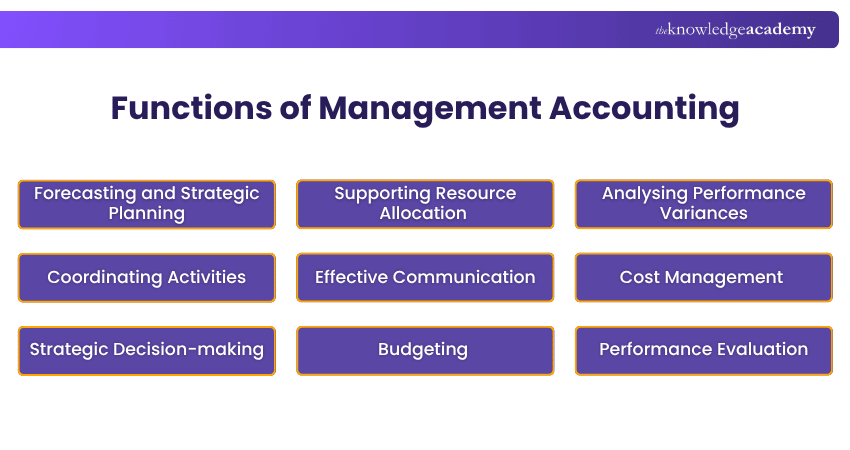
1) Forecasting and Strategic Planning
One of the important functions of management accounting is to assist in forecasting future financial performance and strategic planning. By analysing past trends, market conditions, and economic indicators, Management Accountants can forecast potential future financial outcomes and help the organisation develop long-term strategies.
This forecasting allows businesses to prepare for potential challenges and opportunities, ensuring that they stay competitive and resilient.

2) Supporting Resource Allocation
Management accounting supports resource allocation by providing managers with information about costs, revenues, budgets and performance. This helps decision-makers determine how financial and operational resources can be allocated across departments, projects and activities.
By analysing relevant data, Management Accountants can help identify areas where resources may be used more efficiently and support decisions that improve organisational performance.
3) Analysing Performance Variances
A significant function of management accounting is to analyse performance variances by comparing actual results with budgeted or forecasted figures. This analysis helps identify areas where the organisation is underperforming or exceeding expectations.
By understanding these variances, management can take corrective actions to address inefficiencies or capitalise on strengths, thereby improving overall performance.
4) Coordinating Activities
Management accounting facilitates the coordination of various activities within the organisation. It can help different departments and teams align their activities with the company's broader objectives.
By providing relevant financial information and analysis, Management Accountants help in coordinating efforts across the organisation, ensuring that resources are used effectively and that all sections of the organisation are striving for shared goals.
5) Effective Communication
Efficient communication is essential for the successful operation of any company. Management accounting plays a key role in ensuring that relevant financial information is communicated clearly and accurately to managers and other internal decision-makers.
Whether it’s communicating budgetary constraints, financial performance, or strategic plans, Management Accountants ensure that the right information is delivered to the right people at the right time.
6) Cost Management
Cost management is a key function of management accounting. Management Accountants analyse and monitor costs to help organisations understand how resources are being used and identify opportunities to improve efficiency. Cost information can also support pricing, budgeting, profitability analysis and operational decision-making.
Trainer’s Pro Tip
Do not look at costs in isolation. Compare costs with output, revenue and operational performance to understand whether higher spending represents inefficiency or supports greater business value.
7) Strategic Decision-making
Management accounting provides the financial insights necessary for strategic decision-making. Whether it’s deciding on a new investment, entering a different market or introducing a new product, Management Accountants provide the data and analysis needed to make informed decisions. By evaluating the potential risks and rewards, they help ensure that the organisation’s strategic decisions are financially sound.
8) Budgeting
Budgeting is an important function of management accounting that helps organisations translate plans into financial targets. Management accountants can prepare and analyse budgets covering areas such as revenue, expenditure, resources and operations. Budgets also give managers a benchmark for spending and a basis for approving costs, so each department knows what it is expected to achieve with the resources it has.
Budgeting in Action
Suppose a department expects higher demand in the next quarter. Management Accountants can use historical costs, expected sales and resource requirements to help prepare a budget. Managers can then compare actual results against this budget and adjust spending or resource allocation when needed.
9) Performance Evaluation
Performance evaluation is an ongoing function of management accounting. By assessing the performance of departments, business units, projects and other responsibility areas, management accounting helps managers identify areas for improvement and evaluate progress against organisational objectives. This evaluation process is essential for maintaining high standards of performance and for motivating employees to achieve their best.
10) Providing Advisory Services
Management Accountants often provide advisory services to other departments and senior management. Their expertise in financial analysis and strategy makes them valuable advisors on a range of issues, from cost reduction to investment planning. By offering sound financial advice, they help guide the organisation towards its strategic objectives.
Gain practical knowledge for effective asset management with the Fixed Assets Accounting and Management Course - Join now!
11) Conducting Ad Hoc Financial Analysis
From time to time, Management Accountants conduct ad hoc analyses of specific financial issues or projects. This could involve analysing the financial viability of a new venture, assessing the impact of regulatory changes, or investigating the reasons behind a sudden drop in sales. These analyses help the organisation make informed decisions and respond to specific business challenges.
12) Data Analysis and Management Reporting
Management accountants use financial and operational data to produce analyses and reports that support planning, control and decision-making. They make sure the right information reaches the right people, whether that is a monthly performance report for department heads or a summary for senior management.
Data analytics and digital tools can help them identify trends, monitor performance and provide more timely insights to management.
Keep This in Mind
Management accounting is not simply about producing numbers. Its value comes from turning financial and operational information into insights that support planning, control and decision-making. The most useful analysis connects business data with the organisation’s objectives and helps managers decide what to do next.

Naveena Venkatesan is a Content Editor with 2+ years of experience in content writing, editing and linguistic quality assurance. Her research, fact-checking and editorial experience enable her to develop accurate, accessible resources across Business Skills, Human Resources, and Accounting and Finance.
View Detail

 If you wish to make any changes to your course, please


